Comments
Thanks for writing this, this is super helpful when thinking about policy advocacy
Thanks for writing this, this is super helpful when thinking about policy advocacy
Thanks for your comment, glad some people found it useful!
The rapid deployment of AI may lead to lead to mass unemployment.1
As capabilities continue to advance, whole sectors of the economy may be automated by AI over the next few years.2
To address this, governments will need to support laid-off workers through unemployment compensation, reskilling programs and social security payments.
Once AI becomes so powerful that it can replace almost all human work, many leading experts and EAs advocate for the establishment of a Universal Basic Income (UBI) - an unconditional stipend paid out by the government every month to cover basic needs such as housing, food and healthcare.3
Whilst this may sound compelling - the proposal faces a significant flaw which remains unaddressed: who will pay for it?
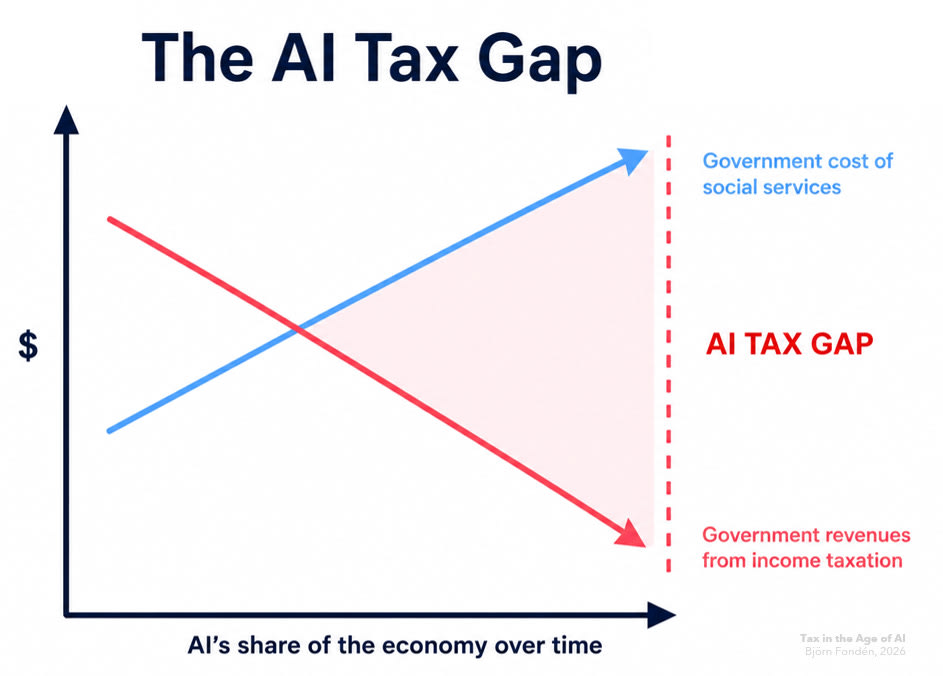
Because, at the same time as AI replaces jobs and social security spending increases - governments’ revenue from income taxation will gradually erode - leaving a gaping tax shortfall.
Today - governments make most of their money from taxing people’s salaries.
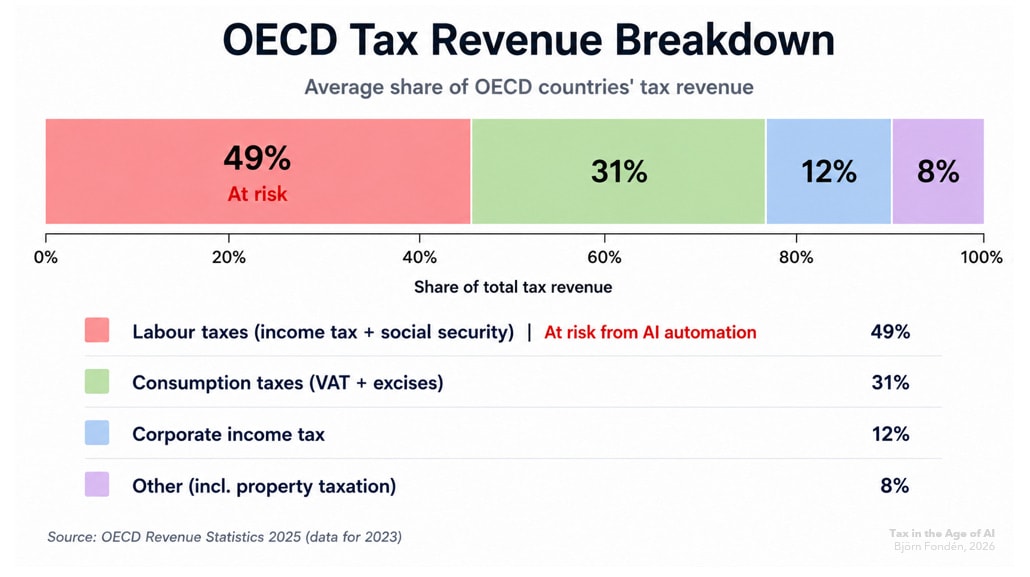
In an average OECD economy, taxes on personal income and social security contributions represent 49.2% of government revenues.4 In the US, the reliance on labor taxation is even higher, up to 75% of federal tax revenue.5
In a future where people’s jobs are rapidly being replaced by AI, this revenue stream is now at risk of being completely diminished.
At the same time, social security spending will surge to support unemployed citizens.
In the US alone, a modest UBI of $1,500 per month would amount to approximately $3.8 trillion in government expenditures every year. If current tax revenues are cut in half due to unemployment, that would leave the government with a $1.35 trillion dollar annual deficit.6
This indicates that governments around the world are staring down a huge fiscal deficit - what I would like to call the “AI Tax Gap” (ATG).
To address this gap - we need to fundamentally rethink taxation for the age of AI.
The key question governments need to address is:
How do we shift tax revenues away from traditional sources (e.g. labor taxes) towards automation or other growing sectors of the economy?
I believe there are three possible answers:
These proposals are briefly described in the following sections.
The idea of introducing a so-called ‘robot tax’ has been floated for more than a decade, with Bill Gates and the European Parliament seriously discussing implementation way back in 2017.7
Conceptually, the idea is simple. Instead of taxing human labor, we start taxing robots, compute and automation instead. This could be done in several ways.
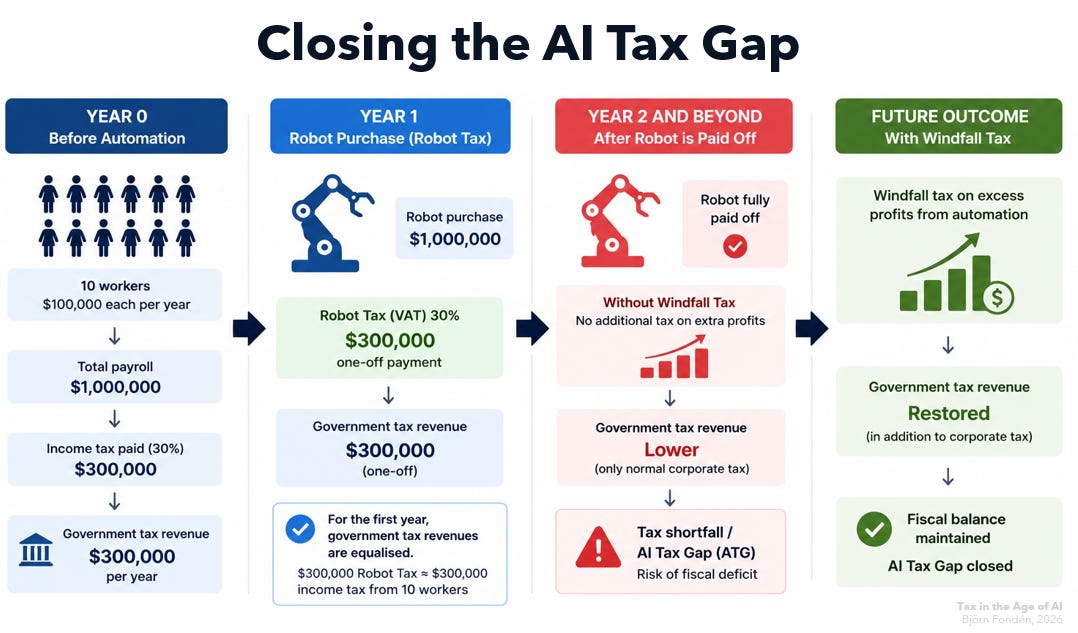
For example, a company deciding to procure a robot for one million dollars to replace the work of 10 people, each being paid 100k per year, could be required to pay a one-off value-added tax (VAT) of e.g. 30% on the purchase. For the first year, government tax revenues would be equalised. Once the robot is paid off, a windfall tax on the profits generated from automation may be introduced to avoid a future fiscal deficit (AI Tax Gap).
For AI systems replacing white-collar workers, governments could introduce a so-called “token tax” on the use of compute.
This idea has been publicly supported by several CEOs of the leading AI labs themselves, as a way to address displacement of jobs from state-of-the-art models. Since Google, Anthropic and OpenAI already meter and bill users based on token consumption, governments could easily leverage existing infrastructure to introduce a progressively increasing VAT on AI token usage.8
Still, a token tax of only 3%, as suggested by Anthropic9, would likely fall far short of what’s necessary to close the ATG. A more effective and meaningful proposal would be to align token tax rates with VAT for other goods and services, in the range of 15-25%.
To avoid these revenues accruing solely to the jurisdictions where AI providers are headquartered (notably, the US), governments may require users to pay the token tax in their country of residence. Administering this may prove challenging, but precedents such as digital service taxes for Netflix and other streaming services are already being implemented successfully in many countries around the world.10
In essence, both the robot and token tax proposals share a common logic as they place the emphasis on the consumption and use of automation and AI.
Those companies who choose to rely more heavily on these systems will have to pay a larger share. By extension, this principle could also be applied to other underlying goods and services that incentivize automation over human labor - e.g. by increasing taxation (mainly through VAT) on the sales of computer chips, such as GPUs, critical minerals, land and energy.
With the rapid build-out of datacenters globally, governments should also consider introducing appropriate taxation and fees on this critical infrastructure.
Rather than continuing to provide implicit subsidies, as is often the case today, governments should ensure that hyperscalers pay the fair share of the negative externalities they impose, from job displacement to rising energy prices, increasing water usage, and climate impacts.
The taxation of corporate income, and in particular windfall profits from automation, offers another vital policy instrument for addressing the AI Tax Gap.
As companies increasingly substitute expensive human labor with cheap AI and robotics, they are likely to capture disproportionate productivity gains and generate significant excess profits. Unless properly taxed, these profits will accrue only to corporate shareholders, whilst the broader population faces job displacement and governments see their tax base eroding.11
To address this imbalance, governments should consider increasing corporate income taxes (CIT) relative to labor tax rates, while introducing targeted windfall profit taxes in sectors where automation is especially high.
Although corporate income taxation is far from being a novel concept, it will require significantly strengthened efforts towards global harmonisation to remain effective in the age of AI. Already today, hundreds of billions of dollars in public revenues are being lost every year due to corporate profit shifting to tax havens.12
To resolve this, stronger international coordination is required, e.g. through the OECD/G20 work on a Global Minimum Corporate Tax Rate (GMCTR). In 2021, a global agreement was reached on moving towards a minimum 15% GMCTR.13 Still, this is unlikely to be enough once automation takes over a majority of jobs.
An international agreement updating the GMCTR to 25% or higher to address the growing ATG in the Age of AI would constitute an important step forward.
Additionally, specific windfall taxation clauses may complement general CIT, whereby a company that generates profits significantly above a defined “normal” level, would be subject to additional tax on those excess returns. This would be particularly important in a situation where a small number of companies capture a majority of automation-driven profits.14
Windfall taxation may be challenging to implement due to corporate profit-shifting strategies, but several successful precedents exist, notably in the oil and gas, banking, and utilities sectors.
While imperfect, taking initial steps towards this direction would send a strong signal to the leading AI labs that governments will seek to maintain fairness in their tax systems and stabilise public revenues for the benefit of their citizens.
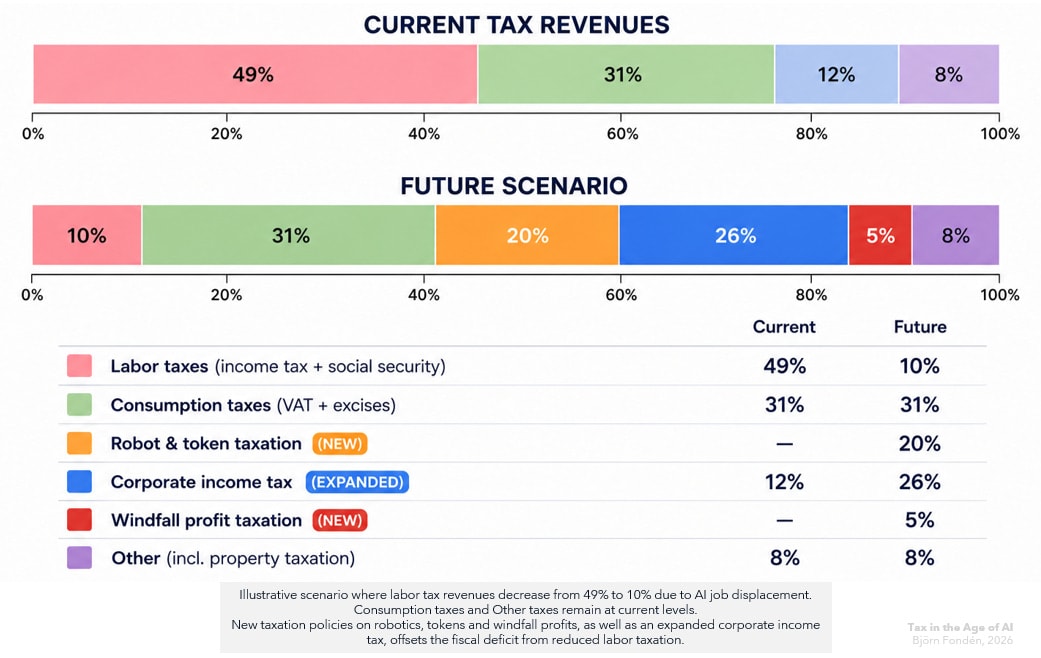
Together with new robot and token taxation policies, these instruments could potentially close the AI Tax Gap arising from reduced labor income, as illustrated in the scenario below.
Finally, a third approach to address government deficits in the Age of AI is to ensure that economic gains from AI and automation are directly socialised through public ownership.
This could be done either ‘softly’ by e.g. sovereign wealth funds or public investment vehicles acquiring stakes in AI companies; or by a more ‘assertive’ approach where governments mandate certain equity-sharing requirements or public co-ownership for market access within the country.
Whilst this may sound controversial, similar models are already common in other sectors, such as oil and gas or mining.
As key examples, both the Norwegian and Saudi governments hold majority stakes in their national oil companies, Equinor and Saudi Aramco, with the success of these businesses making them among the wealthiest governments in the world. Instead of letting a foreign MNC simply export these gains or capture them elsewhere, this regulated approach allows Norway & Saudi Arabia to retain a majority of the benefits on behalf of their citizens and generate public wealth.15
Of course, adopting this approach for AI, robotics and automation today would not be simple.
With leading AI labs already at hundred-billion dollar valuations, acquiring enough equity at market prices would be prohibitively expensive for most governments. Mandating ownership or ‘expropriating’ shares of existing firms is politically sensitive and could have long-lasting negative impacts on investments and market confidence. Meanwhile, government-backed startups may struggle to compete given the fast pace of technological advancements, and the substantial need for capital, IPs, and global technical expertise.
Nevertheless, building domestic capabilities, whilst progressively taking ownership shares in leading firms through public investment vehicles - potentially in exchange for tax rebates or other forms of support - may offer complementary pathways for governments seeking to address the AI Tax Gap and capture public gains from AI-driven automation.
The age of AI is fundamentally reshaping the economic foundations on which modern tax systems were built.
As human labor is increasingly displaced by automation, governments are staring down an ever growing AI Tax Gap (ATG). Left unaddressed, this will erode public revenues, increase economic inequalities and leave workers without social safety nets in a time when they are most needed. The introduction of Universal Basic Income would be a far-fetched dream.
Based on my analysis, I have outlined three complimentary pathways that I believe will be critical to respond to this challenge.
First, we need to tax the use of AI & automation, e.g. through robot or token taxes. Second, we need to strengthen corporate income taxation to ensure productivity gains from AI benefits the wider population - and not just capital owners. Finally, governments should explore public ownership models where dividends from tech companies can accrue to the citizens of the state.
On their own, each approach faces significant challenges. However, taken together, they represent a clear shift away from traditional labor taxation, towards a more balanced system that reflects the realities of a capital- and technology-driven economy in the age of AI.
Whether you agree with these ideas or not, I believe it is absolutely essential that we start thinking about how we resolve these vital questions together as a society.
If you came this far - thank you so much for reading - and I’d love to hear your views in the comments below!
This was originally posted on my Substack on 19 July, 2026.


You may be interested in the Windfall Trust's work - they've published a paper mapping the tax risks from labour-displacing AI and have also floated a proposal to raise the global minimum corporate tax rate.
Prominent economists have also discussed expanding the use of consumption taxes to plug the gap.
I am sceptical of automation/token taxes in general as they are narrow by design. It is hard to predict in advance where in the value chain economic rents will accrue (e.g. what if AI becomes commoditised and the rents accrue to those who hold proprietary data instead?). An automation/token tax implicitly assumes that the value will be captured at the computing layer.