Comments
Interesting study! Could you say more about what the intervention consisted of? Who were the people administering the intervention? What were their instructions/training? What was the structure of the program? Etc.
Interesting study! Could you say more about what the intervention consisted of? Who were the people administering the intervention? What were their instructions/training? What was the structure of the program? Etc.
Hi there, Angel here, John's co-founder who ran the study.
Intervention
The four-week, one-to-one coaching programme combined motivational interviewing and cognitive behavioural therapy techniques, delivered via weekly 60-minute video calls by trained volunteer coaches following a manualised guide.
Session 1 focused on identifying procrastination triggers and building personalised action plans. Sessions 2-3 reviewed progress and addressed unhelpful thoughts and emotions through cognitive restructuring, behavioural activation, and self-monitoring. Session 4 consolidated learning and built a long-term maintenance plan.
Coaches
Outside of this RCT, Overcome runs a three-month internship programme to aspiring mental health professionals to get training and hand-on experience delivering coaching. The first month of this internship is a full-time training programme on techniques from MI, CBT, and acceptance and commitment therapy, including workshops, readings, role-plays, and assessments. In the later two months of the internship, the interns then coach adults across the globe to build healthy habits or manage low mood/worries.
For this RCT, five volunteer coaches from Overcome were trained and delivered the procrastination coaching programme. The selected coaches performed strongly in their initial training and had promising client outcomes.
To prepare the selected coaches, they received two hours of study-specific training, including a workshop on the intervention protocol and a role-play session. They also attended weekly one-hour group supervision with a counselling psychologist to discuss and troubleshoot client cases.
I was a participant and my procrastination is still considerably down on before the course (although the relapse is real). I wouldn't say it "changed my life", but it definitely made a difference. Would recommend.
That seems like a very high rate of remission to me, congratulations! And on the EAIF funding as well.
TL;DR: A recently completed RCT found that a brief, structured procrastination coaching programme produced large reductions in severity and high remission rates. The EA Infrastructure Fund has funded 200 free places on the same programme for EAs. If you want one, take the screening test here.
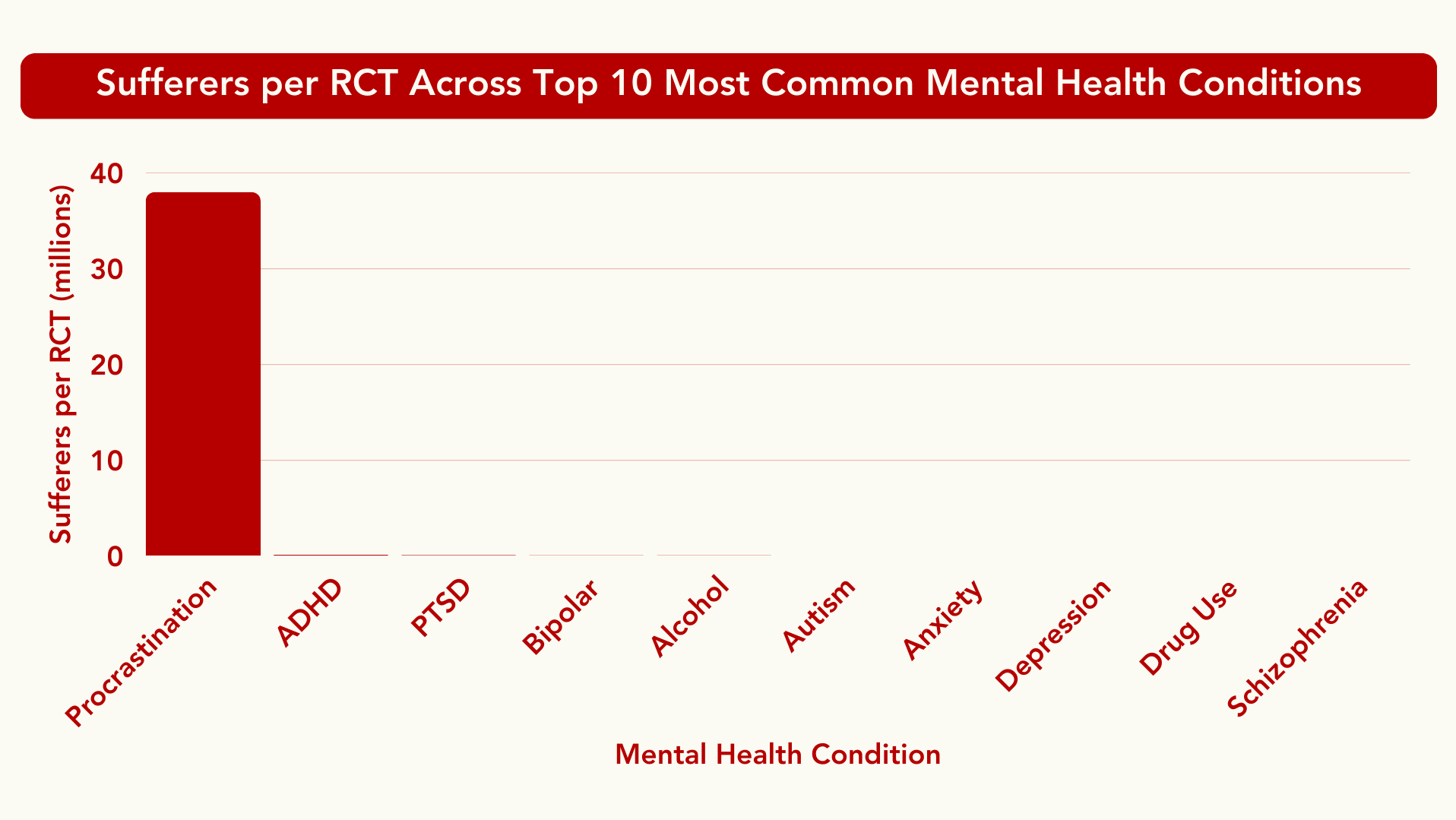
Chronic procrastination affects roughly 20% of adults, costing them both income (tens of thousands per year) and wellbeing (94% report lower happiness), and doubling their odds of unemployment.
Yet it receives almost no clinical attention, research funding, or institutional support relative to its prevalence. No charities are dedicated to it. Health services don't cover treatment. The handful of researchers who study it note that it is among the most neglected problems in applied psychology relative to its scale of harm.
EAs appear disproportionately affected. In a survey where EAs ranked ~50 mental health challenges they personally experience, procrastination ranked third.
Three hours (4 x 45-minute) of specialised one-to-one coaching delivered over four weeks.
117 participants across 25 countries enrolled. 114 included in the analysis (3 withdrew after enrolment). Roughly a third were recruited via the EA Forum, making this one of the more generalisable studies for this community.
Effects continued to strengthen at follow-up rather than fade. A comparable study found no meaningful loss of efficacy at 12 months.
Results are consistent with the prior pilot study that motivated this RCT, and broadly align with the existing literature on structured procrastination interventions.
I'll be direct: this is my organisation's intervention, and I'm the one reporting it. You should weigh that accordingly. That said, the Infrastructure Fund reviewed the evidence independently and considered it sufficient to fund treatment access for 200 EAs at no cost to participants, using the same intervention, organisation, and coach selection and training process as the RCT.
One RCT is not sufficient to be confident. The results are unusually strong, the follow-up data are encouraging, and the EA-skewed participant pool improves generalisability to this community, but independent replication would substantially increase confidence.
The Infrastructure Fund grant covers full programme access for 200 EAs. The RCT recruited from the top quartile of procrastination severity. This round is open to the top 35%, so eligibility is somewhat broader.


Exciting results! Is the RCT written up in more detail anywhere? I'm confused by the current reporting because it seems to compare pre-post intervention results, rather than treatments and controls. Also, how was the control group set up? (Eg, no intervention, active control, waitlist control etc)
Quick answers
Control group was a four-week waitlist. 1-month follow-up was only collected for intervention group as the waitlist group started the intervention as soon as waitlist ended, plus time constraints for the project.
When analysing the results with 20 multiply imputed datasets:
1. Procrastination: Statistically significant pre-post reduction in intervention compared to waitlist (p < .001, Cohen’s d = 1.52). Within intervention group, further small reduction at one-month follow-up compared to post-intervention (n = 47, p < .001, Hedges’ g = 0.36).
2. Life satisfaction: Statistically significant pre-post increase in intervention compared to waitlist (p < .001, Cohen’s d = 0.93). Within intervention group, further small increase at one-month follow-up compared to post-intervention (n = 47, p < .001, Hedges’ g = 0.42).
Detailed version: https://www.canva.com/design/DAGqbQzPKJY/8NkRiubgsgDUpDPIbIkwqg/edit?utm_content=DAGqbQzPKJY&utm_campaign=designshare&utm_medium=link2&utm_source=sharebutton
A couple of further questions that would help me interpret the results:
"with 20 multiply imputed datasets" - What does this mean? What are you imputing and how are you imputing it? What are the results if you don't do any imputation?
How can you say the effect strengthens or is maintained after 1 month if you don't observe the control group outcomes after 1 month? Generally, you see control group outcomes continue to improve over time even if they don't get treated (as you can see by doing control group pre-post comparisons for every outcome), so doesn't seem like you can claim much about whether the effect grows or shrinks over time.
Hi there, Angel here, John's co-founder who ran the study.
1) Question on "20 multiply imputed datasets"
a) What does this mean? What are you imputing and how are you imputing it?
Excluding 3 participants who later withdrew, we had 114 participants in the trial. However, only 94 participants had complete data (pre & post for control; pre, post & follow-up for intervention). This is around 82% of complete cases. One way of handling missing data is multiple imputation, which makes plausible guesses about missing values using the information you do have. I used multiple imputation (via programming in R) to create 20 complete datasets of all 114 participants, with guesses based on each participant's demographics (age, gender, group) and outcome scores (pre, post, and follow-up scores; follow-up for the intervention group only).
b) What are the results if you don't do any imputation?
See the attached graphs for the results of the complete-case analysis of 94 participants. The results are fairly similar:
Procrastination: The four-week intervention led to a statistically significant reduction in procrastination compared to the waitlist (p < .001, Cohen’s d = 1.56). Effect size is comparable to 10-week internet CBT guided by professional therapists (Rozental et al., 2017).
Life satisfaction: The four-week intervention led to a statistically significant increase in life satisfaction compared to the waitlist (p < .001, Cohen’s d = 0.95).
2) Question on 1-month follow-up effects
You raise a fair point. The 1-month follow-up was only collected for the intervention group. The waitlist control group began the intervention immediately after the waitlist period ended, and time constraints meant we couldn't collect follow-up data from them.
Because of this, we didn't compare intervention and control groups at follow-up. Instead, the claim that effects were maintained is based on within-group comparisons for the intervention group only (post-intervention vs. 1-month follow-up), using Hedges' g rather than Cohen's d to reflect this. We should have been clearer about that in the post.
You're right that without a control group follow-up, we can't rule out that scores would have continued to improve naturally over time. We're running a larger RCT with a longer follow-up period in the future and plan to collect follow-up data from the control group too, which will let us make stronger claims about longer-term effects.