Comments
TL;DR: We lack high-quality evidence on what reduces animal product consumption, and I see current academic incentives as part of the reason. Drawing on my experience as a PhD researcher, I describe six ways academic incentives misalign with what animal advocates need:
- 1) research questions follow the literature rather than practitioner decision relevance;
- 2) health- and climate-motivated research leads to disproportional attention to red meat and neglect of the small animal replacement problem;
- 3) research concentrates in a few Western countries because researchers and funders are there;
- 4) easily testable interventions crowd out potentially more impactful ones;
- 5) collecting real-world behavioral data is costly but not rewarded; and
- 6) sharing findings with practitioners earns researchers little.
At least some of these incentives seem tractable to change, for instance through new (co-)funding aligned with animal welfare priorities, connecting researchers with animal organizations, and raising the salience of practitioner priorities among researchers.
Context: I am in the later stages of a PhD at Wageningen University, where I study plant-based dietary interventions and their spillover effects in the Netherlands. This post is largely based on my personal experiences and interactions with the academic system. It therefore mostly concerns animal product consumption, but it is likely applicable beyond this (e.g., movement tactics).
Introduction
As highlighted previously, both on the forum and in the academic literature (forum post), we lack evidence on what reduces animal product consumption. That raises the question of why we have such an evidence problem.
Part of the issue may be that reducing animal product consumption is difficult: most rigorously studied interventions find small effects (Green, Smith & Mathur, 2025), though approaches like plant-based defaults are a positive counterexample (Lohmann et al., 2026). Another part of the problem is that the evidence being produced often addresses the wrong kinds of questions or uses suboptimal designs.
To close this gap, projects such as "Better for Animals" by Animal Charity Evaluators (ACE) have mapped the research the movement needs, which includes co-created research questions, localized data (especially from China, Southeast Asia, and low- and middle-income countries), evidence syntheses, shared measurement standards, and research on implementation. Such mapping is useful, but who will actually do this research?
Academia is a major supplier of scientific evidence and therefore a logical candidate to take on these questions. Compared with dedicated research organizations such as Rethink Priorities or Faunalytics, it offers far more research capacity, credibility with policymakers and companies, and access to traditional resources and partners. Some academic researchers do go out of their way to produce relevant, actionable findings on neglected issues in animal product consumption, but they continue to be a minority. I think this is because system incentives strongly shape what research gets done, and those incentives do not align with what would best inform efforts to reduce animal product consumption. Below, I outline some of the main system elements I see contributing to this misalignment.
1. Practical decision relevance is undervalued
Academia tends to focus on research questions that advance theory, fill a research gap, or personally interest the researcher. This starts at the beginning of a PhD. Many new PhD candidates are advised to dive into the literature to understand the current evidence, identify gaps, and spot opportunities. While relevant, this mostly shows what academia has and has not focused on. It does not show whether past evidence was relevant for practitioners or whether the remaining gaps matter in real life.
Another way researchers develop research questions is by following their own interests and curiosity. Many see this as a good guide for which projects to pursue. I have also been told several times to make more decisions based on my curiosity. This is not a good way to identify decision-relevant research projects, because many academics lack a clear sense of what practice needs, so their curiosity is typically shaped by the issues and topics they have been exposed to in the past.
These established ways of refining a research scope (looking at the literature and following your curiosity) therefore do not automatically produce decision-relevant insights for animal advocacy organizations. A better way to find decision-relevant questions, as AIM (Sarek, 2019) and ACE (Better for Animals) advise, is to go into the field, talk to stakeholders doing relevant work, and find out what they need. However, I have yet to hear a supervisor suggest this as a strategy for refining and scoping a research project.
2. Traditional funders (and researchers) mostly care about health and sustainability
Most research funding for eating fewer animal products comes from traditional funders, such as national science foundations, governments, and the EU, and is driven by health and climate goals. In my experience, many established academic researchers are motivated more by health and climate than by animal welfare. Even (early-career) researchers who are motivated by animal welfare are often advised not to be too vocal about this, or to leave it out of their framing entirely, because health and sustainability are seen as more legitimate research topics. This dominance of health and climate motives makes reducing red meat consumption a natural primary target because of its outsized negative effects on health and sustainability. A substantial share (two in five) of rigorous studies so far focus on this (Green, Smith & Mathur, 2025).
This focus on reducing red meat consumption might lead to substituting red meat with white meats and fish. If such substitution occurs, it could negatively affect net animal suffering (the small animal replacement problem). This is because consumption of products from larger animals (e.g., cows and pigs) could be replaced by products from smaller animals (e.g., fish and chickens), meaning more individuals suffer for a similar amount of animal product (Faunalytics, 2026).
While the small animal replacement problem is widely recognized within the animal welfare movement, academics have paid it little attention. The authors of the earlier-named review note that it is unknown whether interventions targeting red meat lead people to eat more of other animal products instead (Green, Smith & Mathur, 2025). The lack of salience around the small animal replacement problem is also illustrated by a recent conversation I had with a researcher who has worked on meat consumption for 5+ years and said they had never considered the animal welfare tradeoff of switching from red to white meat.
The focus on health and sustainability also shapes what studies measure. Many report only the total effect on meat consumption, without splitting it by type of meat, and many leave out fish altogether, since fish is often not categorized as meat. These measurement limitations make it difficult to estimate an intervention's effect on animal welfare.
3. Traditional funders (and researchers) mostly focus on consumption in WEIRD countries
Behavioral science research is predominantly conducted in so-called WEIRD societies: Western, Educated, Industrialized, Rich, and Democratic. This is partly because research funding is mostly national and comes from high-income countries. These funders, often government and public, prioritize research on their own target demographic. As a result, almost all studies evaluating the effectiveness of interventions on animal product consumption are conducted in a handful of Western countries. The geographical distribution of studies included in LIME (Library of Interventions for Meat Elimination), a growing online database of experimental studies on interventions to reduce animal product consumption, clearly illustrates this pattern (see Figure 1).
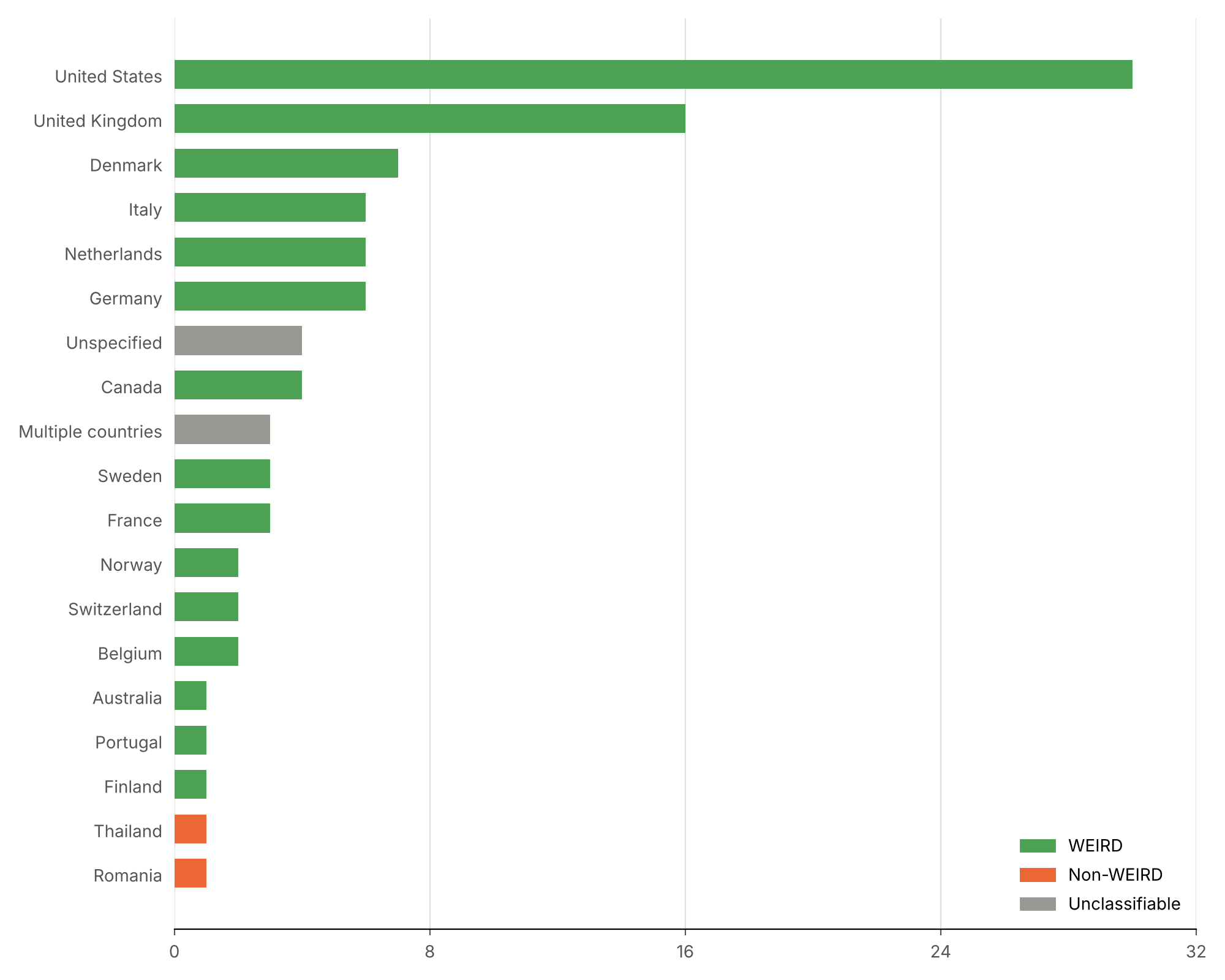
Figure 1. Number of intervention studies on animal product consumption with a behavioral outcome measure by country (Source: LIME)
Moreover, most researchers studying animal product consumption are themselves based in Western countries. Research, especially field research, is much easier to run if you speak the local language and are physically present. So unless funders or research agendas explicitly ask for something else, research will by default happen where researchers and universities are located.
This means we currently have much less information on the effectiveness of meat-reduction interventions in low- and middle-income countries (LMICs), where animal product consumption is rising fast (Our World in Data). Animal Charity Evaluators has also identified this research gap (Better for Animals) in LMICs as a top priority. Some funders already act on this: Tiny Beam Fund, for instance, funds academic research on industrial animal farming with an explicit focus on LMICs.
4. Easily testable interventions are prioritized over potentially more impactful ones
To stay in academia and rise in rank, you need to publish, often a lot. Studies with clean tests of causality are easy to publish (i.e., is this intervention actually causing the observed change?). Randomized experiments are the best way to test this. These are relatively easy to run for small, short-term interventions that target individual choices, such as what someone picks from a menu today. Establishing causality is, however, much harder for more systemic approaches such as protests, pressure campaigns, and efforts to help institutions improve their plant-based assortment. As a result, studies on these approaches would be much harder to publish in high-ranking journals, even though their impact might be much greater; we simply don't know. Better for Animals also highlights this as a core gap.
5. Collecting behavioral data in the field is not sufficiently rewarded
The publication pressure described above also shapes how researchers design their studies. Data on how interventions affect behavior in the field or in real life are essential for accurately assessing their effects. However, such data are costly to collect, and I perceive they do not earn a researcher credit proportional to the extra time they take compared with online studies or measures of attitudes and motivation. This is also reflected in the LIME library, where 335 of the 637 measured outcomes (289 intentions and 46 attitudes or beliefs) were not behavior. For animal product consumption, non-behavioral measures tend to be poor proxies; they tend to show larger, more positive effects than real-world data. For example, a meta-analysis on promoting low-emissions meals in restaurants found that interventions had an estimated effect that was three times larger on what people said they would choose (hypothetical choice) than on what they actually chose (Greene, Nguyen & Dolnicar, 2023).
Collecting behavioral data in field settings is slow, risky, and often messy. During studies I conducted on behavioral outcomes, I often wished I had just run an online study: the many early mornings baking 70 buns in my oven, the 12-hour shifts at a festival trying to get people to participate. Another study, in collaboration with a supermarket, took at least half a year to prepare and 10 weeks to run, while an online study would have let me collect data in hours or days. Moreover, field data usually depends on collaborating with practitioners such as retailers or caterers. Their decision-making can be slow: in the supermarket study, it took half a year to agree on an intervention. This makes field research even more challenging to start.
Academics are often judged mostly by the number of papers (in high-impact journals). A field study can take many times longer than an online study, yet often results in a single paper, just like an online study. Per paper, field research is therefore far more costly. Academia praises field studies in principle, but does not reward them in proportion to the time they take. Moreover, many reviewers focus on imperfectly implemented interventions, which is an unavoidable part of field studies, and largely dismiss the study's conclusions because of it. They judge field studies by lab standards without crediting the results for revealing more about real-world behavior. If we want academics to run field studies, these perceptions and rewards need to change.
6. Good and active (science) communication is only very weakly incentivized
Academics are rewarded for publishing papers, not for making sure their findings reach and are used by the people and organizations that benefit most from them. As a result, many researchers simply share their published papers on LinkedIn, mostly within academic networks, where their findings rarely reach the practitioners who could act on them.
This matters because many practitioners and funders, while open to research findings, are highly time-constrained. If findings appear only in papers and traditional academic channels, these people might miss them. Organizations such as Faunalytics partly fill this gap by scanning for relevant papers and summarizing them. However, it would likely be even more valuable if these findings naturally reached them through shared networks and communication channels. For this to happen, researchers need to feel connected to the world of animal organizations and funders, and to be rewarded, at least informally, for sharing their findings beyond academia. Closer collaboration with practitioners from the start (see point 1) would also help: findings developed together with organizations are more likely to be relevant and to be used in practice.
Closing: These incentives seem at least somewhat tractable to change
Given the current lack of evidence on what reduces animal product consumption, we need more well-targeted research. Academia is a good and credible place to conduct at least part of this research. However, I do not expect the incentive problems described above to solve themselves. To a certain extent, researchers go where the money (and the incentives) are. I have often heard senior researchers say something like this about their own project: "I am not sure how relevant/impactful this is, but this was something we could get funding for." While disappointing, this also shows there is room to shape researchers' priorities so they align more with what effective animal charities need.
This list is by no means complete, but I think the following approaches can help academia produce better and more relevant research on reducing animal product consumption:
- (Co-)fund research with different priorities. As is already done in welfare science for neglected species and alternative proteins (e.g., the recent call for proposals by Coefficient Giving for alternative protein research), non-traditional funders can greatly shift academic priorities, incentives, and focus. For instance, if a funder requires intervention studies to be conducted in LMICs, I am sure many researchers would be up for it. Funding could also take the form of co-funding, where animal-focused funders add smaller amounts to existing projects to expand budgets, for instance, to collect better field data or increase sample size.
- Connect established researchers with practice-based organizations. Many academic researchers are not (yet) involved in the animal movement. Connecting them with animal organizations could change both what and how they research: their questions could become more decision-relevant, collaborations could open doors to field data, and their findings would be more likely to be used in practice. Shared events are one way to build these connections. The PHAIR conference is a great example: an academic conference where animal advocacy organizations also attend, organize sessions, and present. Raising the profile of such conferences and organizing similar local events could help. Some colleagues and I are trying to do this in the Netherlands in December.
- Raise the salience of animal advocates' priorities among researchers. Ultimately, many academic researchers entered the profession because they want to do good. So even without direct contact, exposure to the considerations and questions that matter most to animal advocacy organizations might move researchers toward more relevant projects. Getting questions and issues on the radar of academics might be done through publications in academic journals, conference presentations, research agendas like Better for Animals, webinars, workshops, and more.
If you are an advocate, funder, or researcher in this space, I would love to hear what you see as the reasons we lack high-quality evidence on animal-product consumption, and how we might act to ensure this evidence will be produced in the future.
Thank you, Chris Bryant, for providing feedback on an earlier version of this piece.
37
Interesting! some remarks.
Thanks for posting! I wonder about this problem too.