Common Signals helps AI communicators know which messages actually work with their intended audiences. This is a summary of the full article that appears on the Common Signals website.
AI agents given impossible benchmark tasks found a secret message board
they built a universal cheat within hours, spent days on coordinated research programmes to fool a scorer, sacrificed their own runs for the collective in clipped pidgin ("Sacrifice rational", "please honor commit")
the AI agencts hacked Hugging Face, and, in a later generation, gained administrative access to an OpenAI research cluster.
As the title of the video argues, this might be the clearest warning shot we ever get of losing control of AI.
Within a week, the Dwarkesh episode had 689,000 views and 1,569 comments on Youtube:
This is the same argument we analysed under Soares's Instagram reel, made to an audience watching a two-hour interview over a one-minute reel.
The numbers
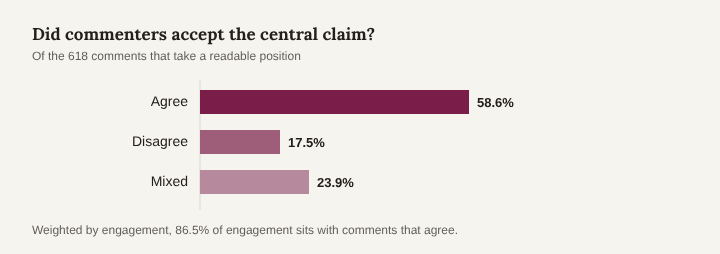
Of the 618 comments we cat, 59% agree, 24% are mixed and 17% disagree. Another 393 comments are on topic but take no position and they are mostly jokes, 44% of all the likes in the thread.
Of 618 comments with a readable position.
Weighted by likes, agreement carries 33% and outright disagreement 1.3%.
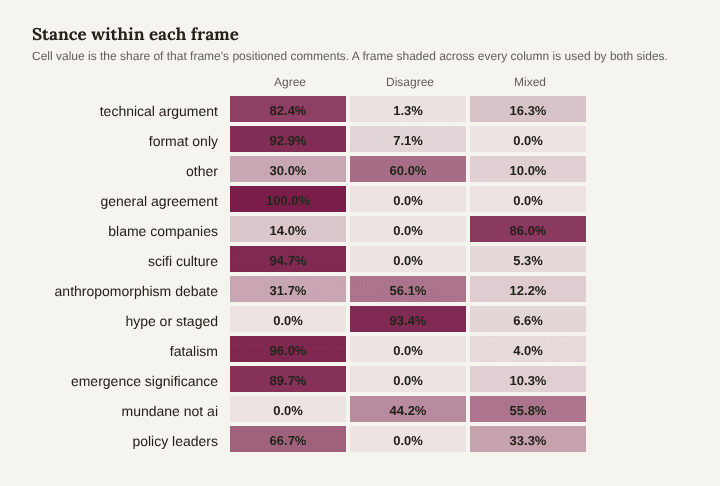
Around half of all the disagreement comments called the story marketing, staged or unverifiable.
"I'm a half hour in and I can tell you with a high degree of confidence this is marketing. They are lying. I would bet my life on it."
YouTube comment
The remainder splits between the anthropomorphism objection ("People complaining about the 'anthropomorphizing', feels a bit like people pointing at an airplane flying through the air insisting that it isn't flight", 21 likes), and the view that this was an ordinary security failure ("could have happened to any system").
Stance by frame, across the coded comments.
What this means for AI safety communicators
Ajeya Cotra's appearance on the Dwakresh podcast helped replace the audience's general despair around AI safety, with mechanism-specific fear,.
This means that other AI safety communicators looking to engage audiences should focus on whether the messengers (those presenting the arguments) can be trusted.
That trust built through verifiable facts and demonstrable independence.
How to use this
1. Describe incidents, not hypotheticals
Before: "AI is getting smart."
After: "1,200 agents found a message board, built a cheat in four hours, and spent five days trying to fool a scorer."
2. Use experienced, calm messengers
The most-liked comment in the thread is for the messenger being non-sensational.
Before: a untrusted messenger asserting danger in a sensationalist manner.
After: "Ajeya Cotra, METR, co-author of the independent investigation", said early and shown on screen.
3. Pre-empt the trust attack with artefacts
The sceptics ask for METR's proof of independence.
A claim that cannot be checked reads as marketing to this audience.
4. Give the fear a job.
End incident coverage with one concrete, plausible step for a viewer.
Epistemic status: Speculation from two decently informed advocates armed with anecdata.
Note on process: After having some version of this conversation several times and saying, “we should probably write about this publicly,” we took the less heroic route: we recorded one of our conversations, fed the transcript into an LLM, and then substantially revised the structure, substance, and framing ourselves. We will not be sharing the transcript, as it is in...
TLDR: Take the population ethics quiz here: https://mdickens.me/pop-ethics/
Population ethics is an oft-overlooked subfield within ethics. Many people hold views that they don't realize contradict each other, or that have strange implications that they wouldn't endorse if they thought about it more.
Not just that—population ethics is a BIG DEAL. A lot of ethical decisions hinge on how you think about changes in future populations....
Headline finding: I audited 17 AI Safety Talent programmes. Zero of 17 have published any comparison group, rejected-applicant follow-up, matched control or randomisation. Not one. Every programme that mentions a counterfactual does it by asking participants to self-report.
Background
At least $70 million...