Comments
“There comes a time in every rightly-constructed boy’s life when he has a raging desire to go somewhere and start a reading group about transformative artificial intelligence.”
— Mark Twain, slightly paraphrased

At 10:24 AM on Monday, 10/19, I started writing a Google Doc about running an “Effective Altruism in the Age of AGI” fellowship at MIT. By 7 PM the next day, the application form for the reading group was sent (or scheduled to be sent) to all the relevant Slack channels, Discord servers, fellowship sessions, and email lists from MAIA and EA@MIT.[1] By the end of the week, the curriculum had been finalized, turned into polished reading packets, and published in several places on the internet for wider use. Four days later, the first session ran, and by that point, Claude had learned enough to automate almost all the logistical grunt work.
This post lays out the methods I use to strategize about medium-sized projects, execute on them quickly, and iterate their design for speed and enjoyability. It also features some of the goofy stumbles and surprising insights I encountered along the way. If you’re a newer organizer and want some tips for how to run things faster, or if you’re just interested in what work as a full-time generalist fieldbuilder looks like, this post is for you! Alternatively, if you’re much better at these things than I am, I’d love to hear your advice.
Phase One: Ideation and Scoping
I’ve wanted to run a Better-Futures-inspired reading group for a while. Over the past few months, I’ve seen a few pieces of evidence that have made me consider this:
- The vast majority of people don’t spend enough time thinking about cause prioritization.[2] In EA university groups, there’s often a sentiment of, “Cause prio is very important, but
because I haven’t done hobby priobecause I’ve been busy lately, I haven’t gotten around to working on it.” - Usually, these people are only thinking about cause prio at the level of “Should I work on animal advocacy or AI safety?” Questions about specific areas in AI safety and Better Futures are often sidelined.
- It seems like EA and AI safety groups have different strengths and weaknesses. EA groups find thoughtful and impact-driven people, but they often struggle to draw a large crowd and, in my opinion, underemphasize transformative AI discussion topics. Meanwhile, AI safety groups can draw a lot more attention by seeming cool and flashy, but the median person they reach is less thoughtful and impact-driven than the median EA.[3] Perhaps a collaboration between these two groups could be valuable.
- Outside of my official fieldbuilding work, as a way to make more friends at MIT, I started a reading group looking at diverse perspectives on AI timelines. I texted the reading list to people I met at MAIA orientation events and asked if anyone wanted to join. In doing so, I accidentally found an extremely thoughtful group of people who were otherwise not engaged with EA.
Despite these thoughts crawling around in the back of my mind, I hadn’t been prompted to start a program until after a conversation[4] at EAG about how EA and AI safety groups could collaborate.[5] I was feeling motivated, though, so when I got into the MAIA office on Monday morning, I took a look at my to-do list and thought, “It’s probably not that hard to write a curriculum. Let me just do this real quick.” This turned out to be wrong; assembling a good reading list is a much larger commitment than I expected.[6]
At this point in time, though, my thoughts about why I was doing this were still pretty scattered. I spent an hour writing a quick introduction to EA and put a bunch of links together in a doc, before realizing I should probably write a 1-pager explaining the theory of change and logistics for this program.
Strategic planning was the first point where the project could have hit delays. Before the group could run, I needed to de-risk[7] the project by sharing the idea with other key stakeholders who would help support it. This included the directors of both MAIA and EA@MIT, a regional organizer whose support I wanted, and a friend at CEA who could give some big-picture strategic advice. Most people are slow to read things and respond to random messages, meaning that projects relying on others can get stuck very easily. If your project can get blocked while waiting for a response, a good rule is to reach out to people AS SOON AS POSSIBLE. You should “put the ball in their court,” as the kids say.
So, I started sprinting on writing my 1-pager to get it done before lunch. Normally, I eat lunch at around 12:15 PM, but I decided to delay it because:
- At 12:15 PM, I still had about 30 minutes of work left on my 1-pager. That’s not THAT much of a delay, and I’m okay with being a little hungry if it means doing things faster.
- Had I eaten lunch, that would have taken ~45 minutes. This would put me in a mild food coma for ~90 minutes, making my writing significantly slower and worse. To accommodate the food coma, I would probably work on a lighter task during that time instead. When I finally got back to work and sent out the 1-pager for feedback, it would already be close to 3:00 PM.
These types of factors make it really easy to accidentally burn a bunch of time. But in exchange for a little discomfort, I got my 1-pager out about ~2 hours faster than I otherwise would have, which can mean the difference between continuing the project one day or the next.
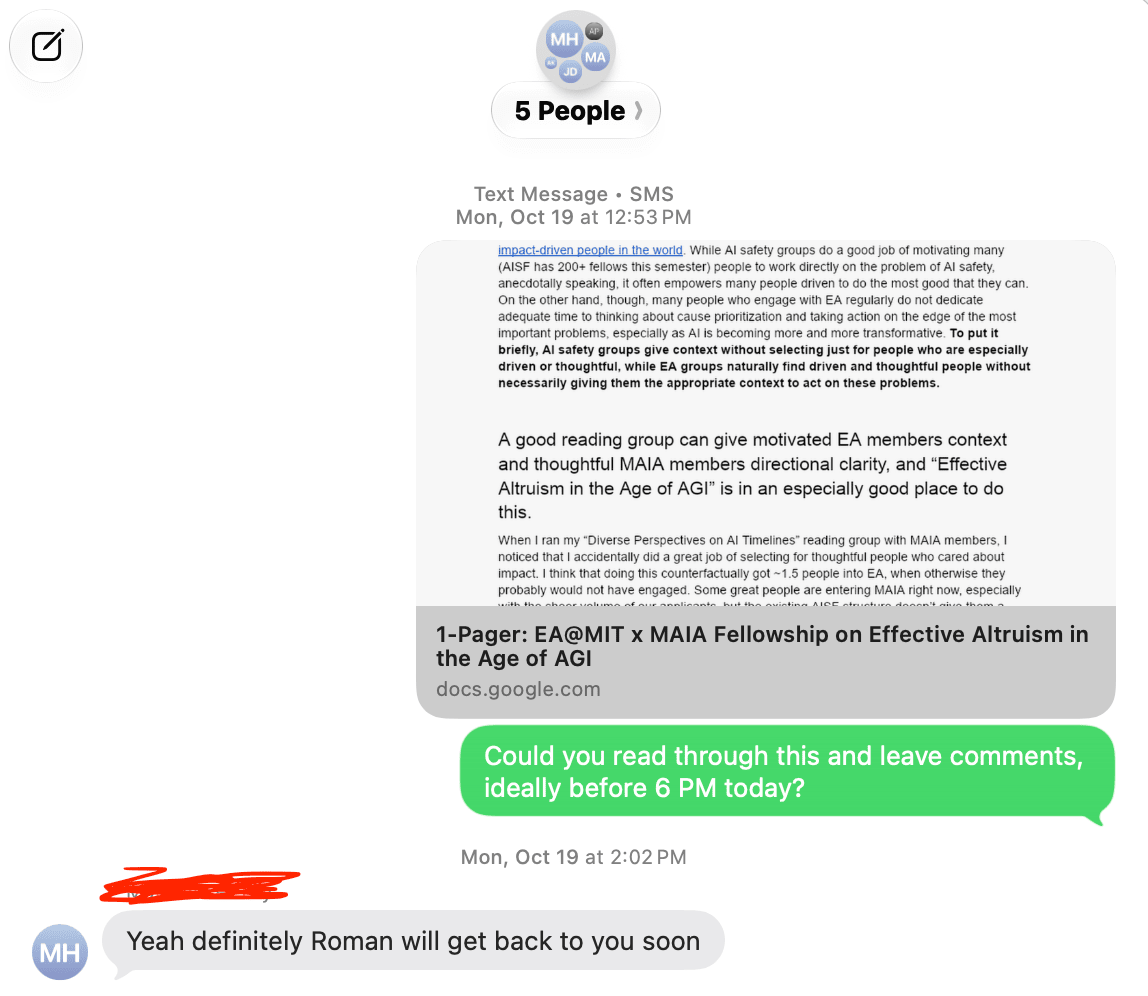
Maybe one day doesn’t seem like a lot, but every small bit of time saved has a chance at being crucial. I wanted to run a six-week program, but over the course of writing the 1-pager, I realized that if the program were that long, it would have to start the very next week for it to finish before final exams. If applications were due on the upcoming Sunday night, there wouldn’t be a lot of time to advertise a program. MAIA’s main intro fellowship, AISF, has 15 weekly cohorts, dispersed across different days of the week. Every day lost could mean missing 15 to 40 of the most promising people in these cohorts.[8]
If you want to read my 1-pager and commentary about how it was written, it’s up for viewing here. I think my 1-pager writing skill is somewhat underdeveloped, though (it came out to 2 pages, but this may be because I like big words), so if you want better advice, try asking someone else.
Phase Two: Advertisement and De-Risking
Many new organizers subconsciously overestimate how much work on a project you need done to advertise an event. To advertise a reading group or fellowship, you need to know everything that an applicant needs to know, anything that would reasonably de-risk the program, and not much else. For my fellowship, this is what I needed to know:
- What is my program?
- Who do I want to advertise to?
- What is my program called?
- When are applications due?
- Is there anything else I can tell people that will make them more likely to show up (i.e. free food)?
- How much commitment should participants have?
- (De-risking) Do I have a general reason to believe I can solve all the logistics problems necessary to run this, and can I commit enough time to make sure it goes well?
- (De-risking) Do I have reason to believe that people will want to join this group, and that running it is worth my time?[9]
Here is a list of things that you don’t really need to know at the time of starting outreach:
- Where will my program be held?
- If you need to make a Partiful, you can write down the general area (i.e. “Midtown Manhattan” or “MIT Stratton Student Center”) and say location/room TBD
- Who are my facilitators for this program?
- If you want to do a logistics check, text a bunch of people your 1-pager and ask if they want to help. Worst-case scenario, you have to accept fewer participants.
- What days of the week will it run on?
- You can do this based on participant availability.
- If I get food, where will I cater from?
- Idk, some place with vegan options, at least? It doesn’t really matter yet.
- What is my curriculum?
- Idk, probably some Forethought stuff, probably some Rethink Priorities stuff, and anything else that gets people to think about cause prio more. Doesn’t matter that much right now.
If you want to move quickly, ignore these things! You don’t need them for outreach, and every second you wait to start could mean another great person never learning about your event! Obviously, you shouldn’t be stupid about this, but you’ll slow yourself down a lot and feel sad if you worry about these too soon.[10]
This is the application form I sent out:
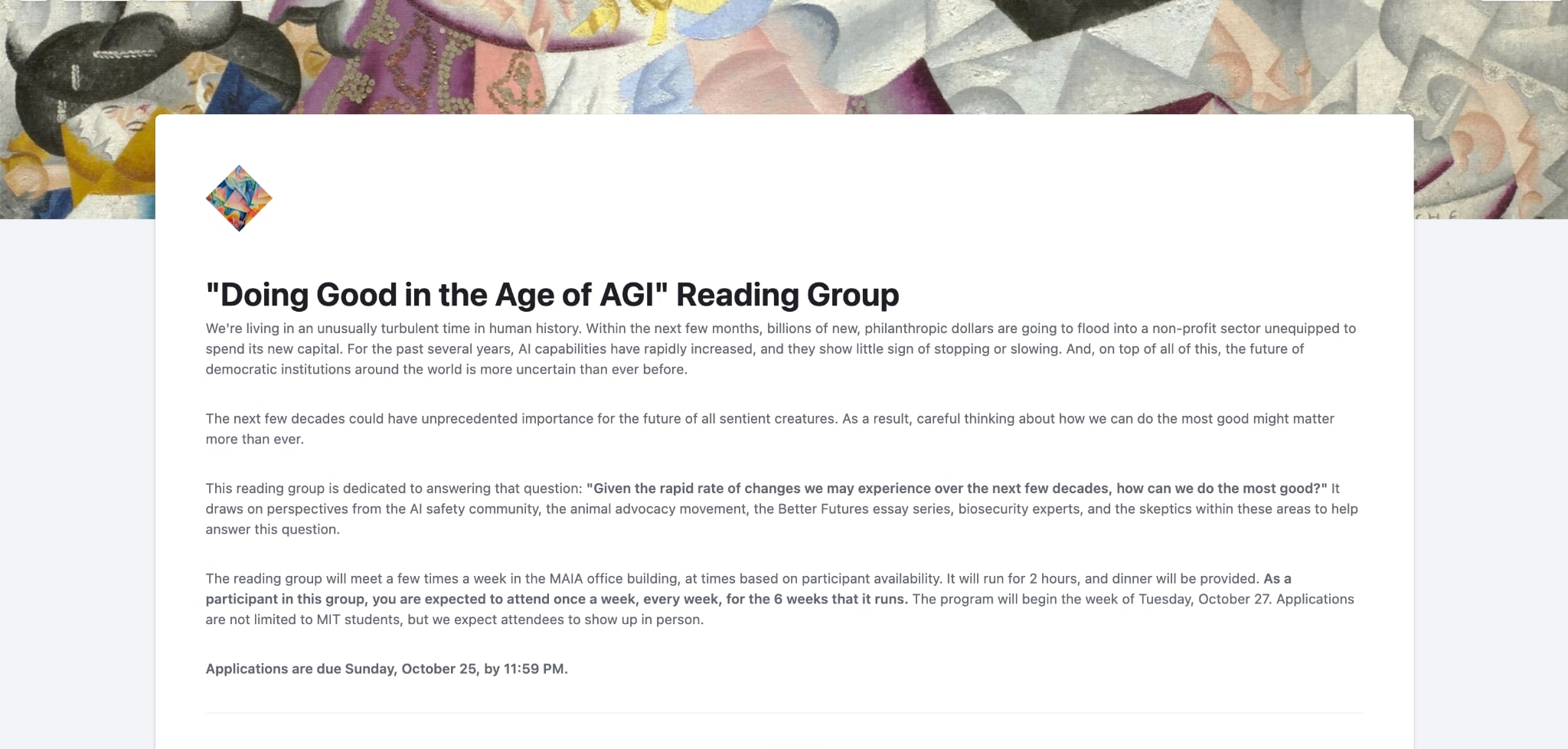
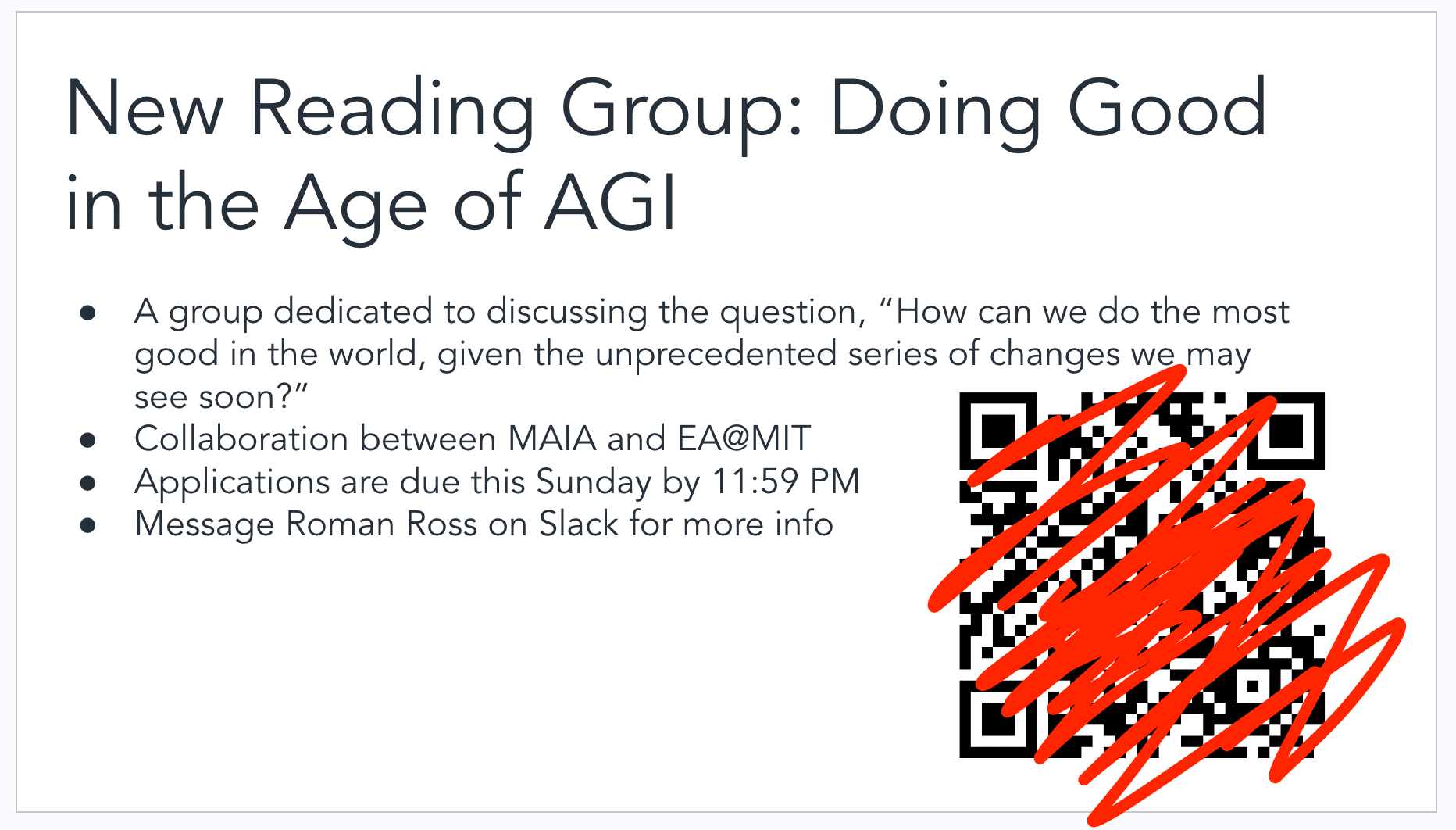
After creating the application form and putting a QR code for the sign-up on the AISF slides, I came up with a snazzy art style to go along with the program and put this on the form as well.
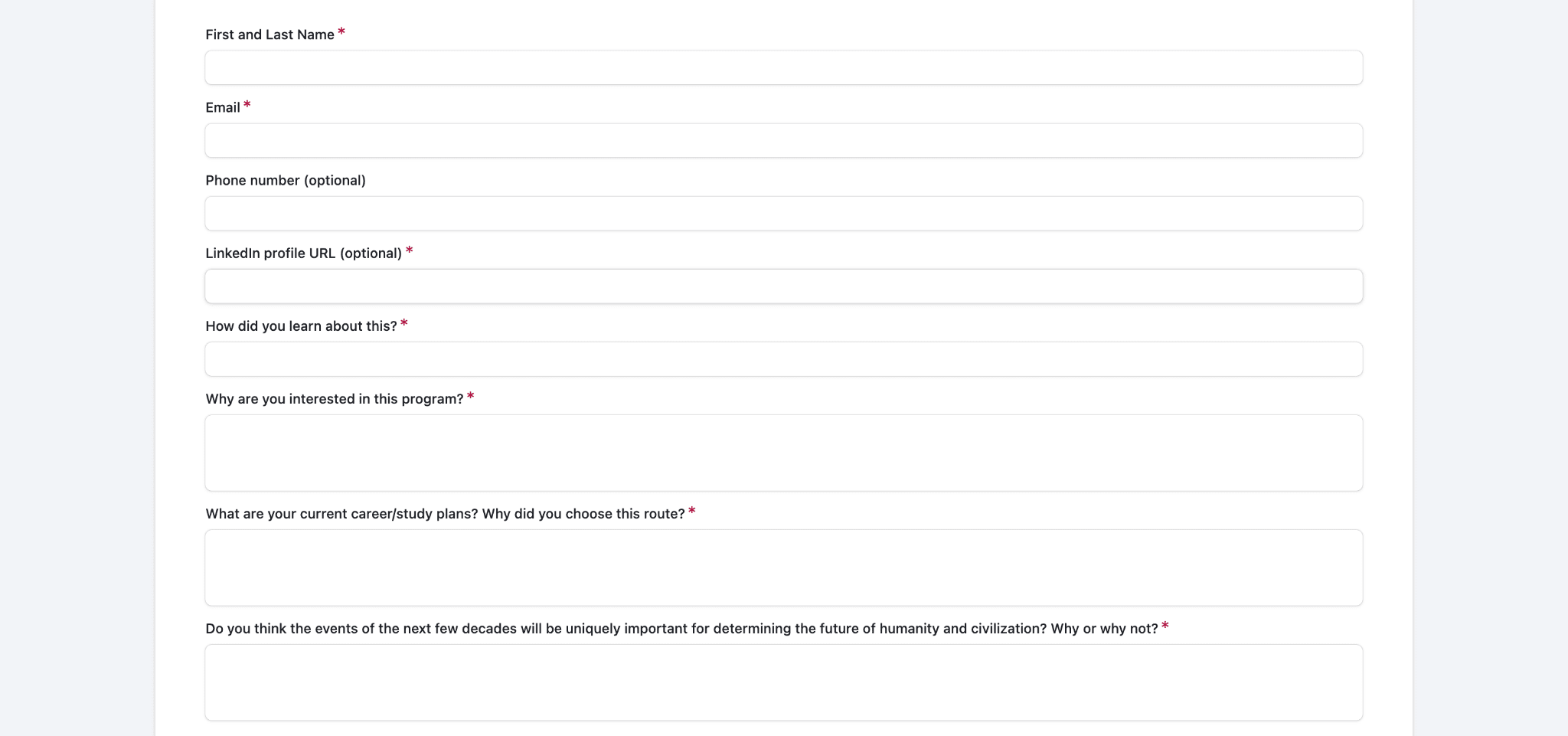
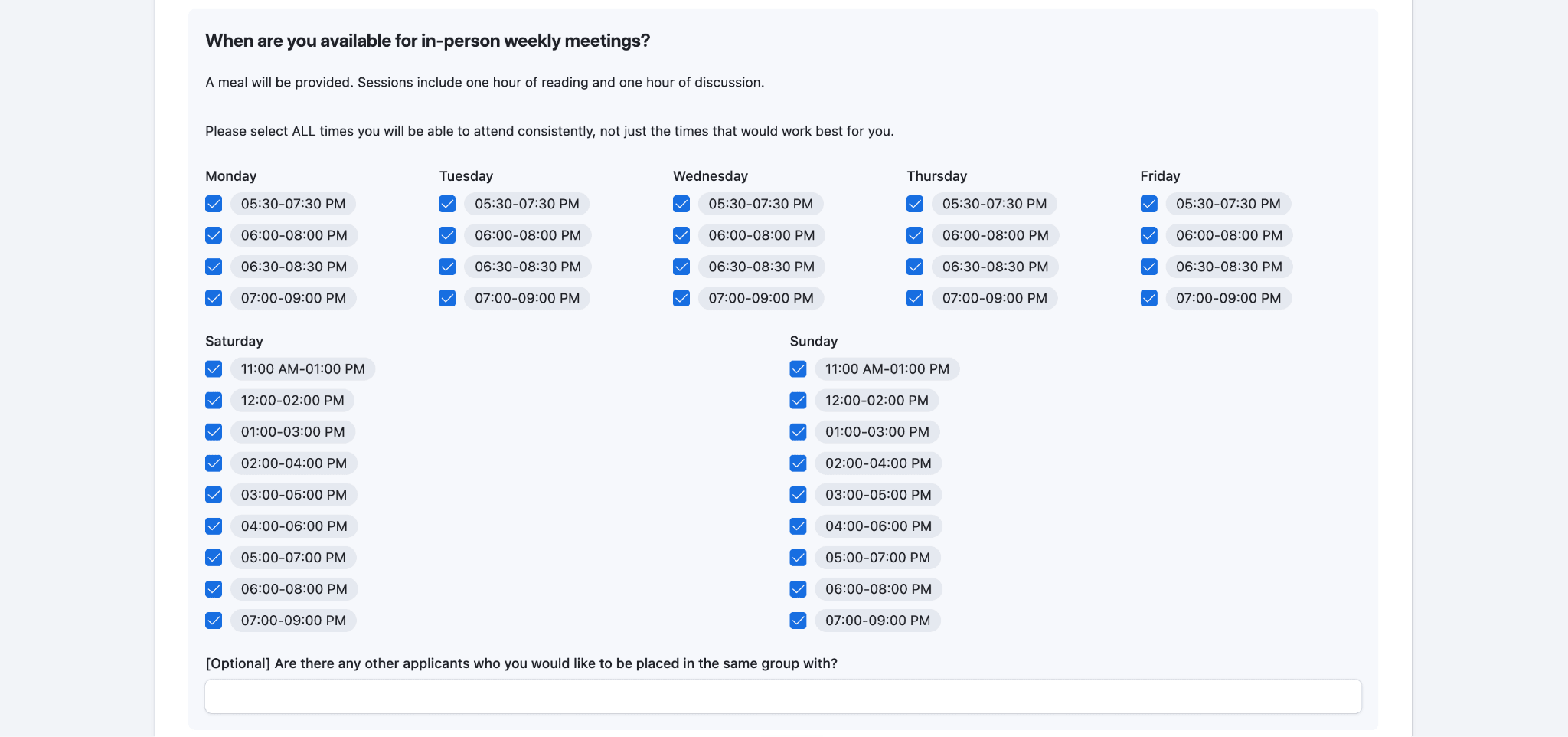
Here are some of my takes about form design and questions:
- Think about what type of answers would make you most want to accept someone, and try to design questions that could elicit those answers from the right people. On this form, the right answers[11] were “I want to think carefully about how to do good in the world, and then do it!” and “I love thinking about cause prioritization!” To get these answers, I asked the questions “Why are you interested in this program?” and “What are your current career/study plans? Why did you choose this route?”
- If you read a lot of applications, you’ll begin to get a really good sense of what qualities you look for in an applicant. I think I’ve reviewed close to 500 applicants across a variety of programs, so I’ve developed a pretty good sense of what type of answers will be meaningful to me.
- If this were a more technically-involved program, making an application would probably be harder, but I didn’t think it needed to be.
- It’s probably important to give people basic logistical information and make this obvious on the form, even if they might see it in other places.
- Everything should be designed to select for your ideal participants. In this case, I wanted to find thoughtful people who could have good discussions and might be motivated to think more about cause prio in their own time. I called this a “reading group” because I wanted to find applicants who enjoyed reading. Also, as a disciple of Brian Foerster, I dislike the word “fellowship” and try to avoid using it when I name my programs.[12]
- The point of the group should be heavily emphasized, so that the type of person who would be interested in it can easily find it.
- In general, I think that tricking people who won’t engage with the topic into joining you will only lead to lukewarm discussions.
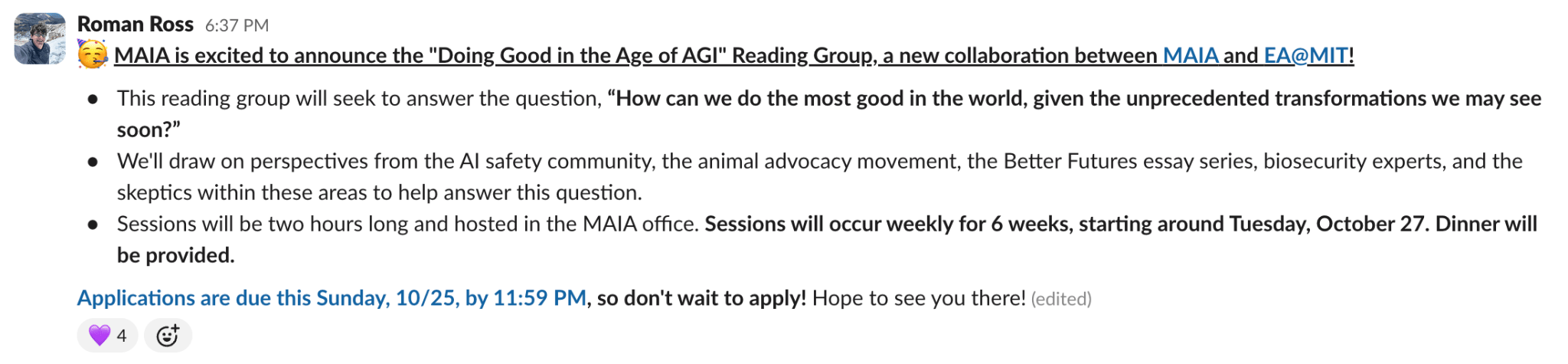
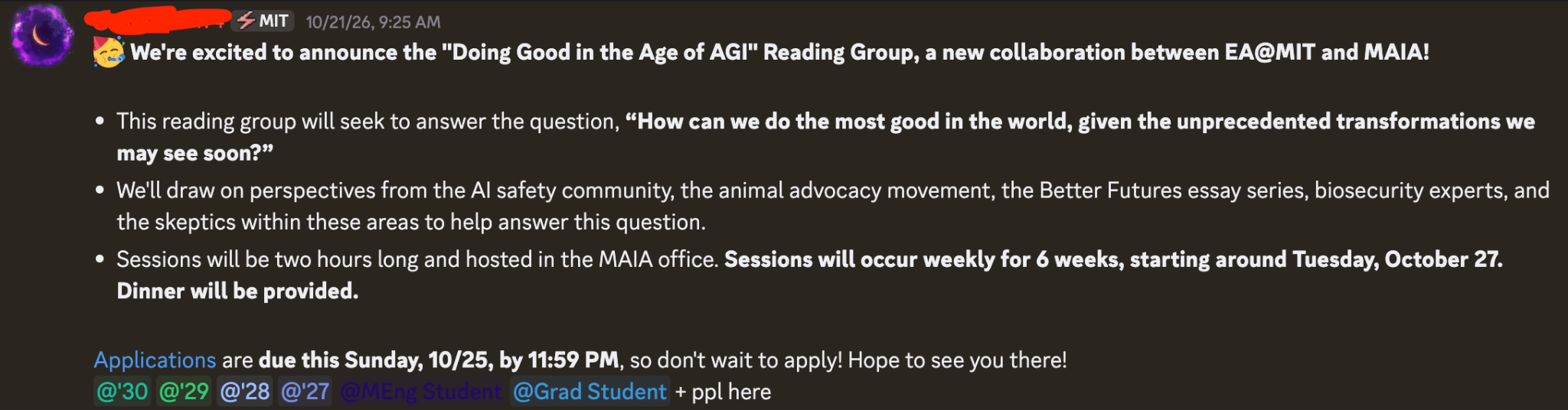
Here’s where/how I advertised the program:
- Slack channels: MAIA and AIST (Harvard’s AI safety group)
- Discord: EA@MIT (sent to the club director so he could send it through his account)
- AISF ending slides, right before the attendance form, and the EA@MIT social:
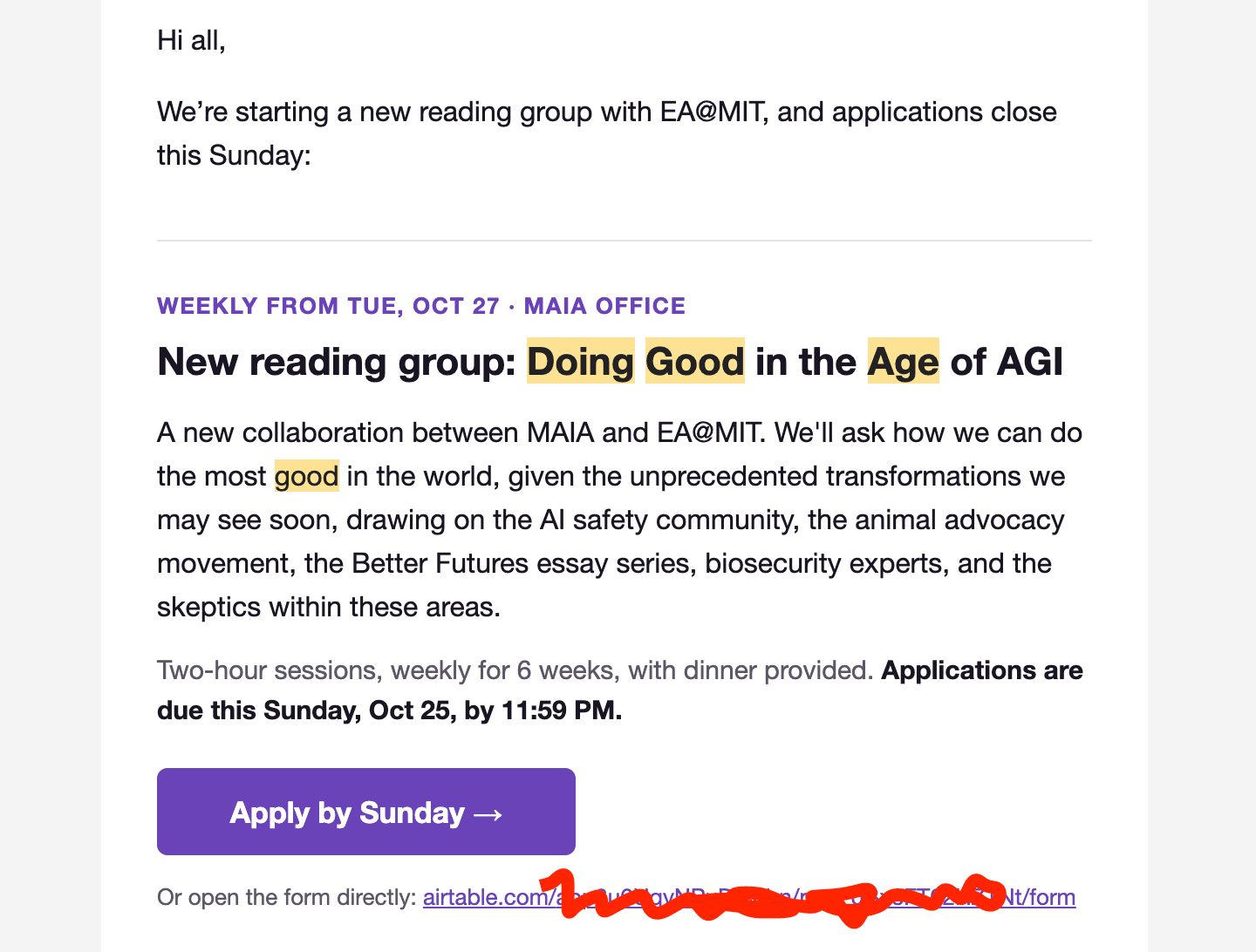
- Mailing lists (MAIA, EA@MIT, and MIT’s “dormspam” system)
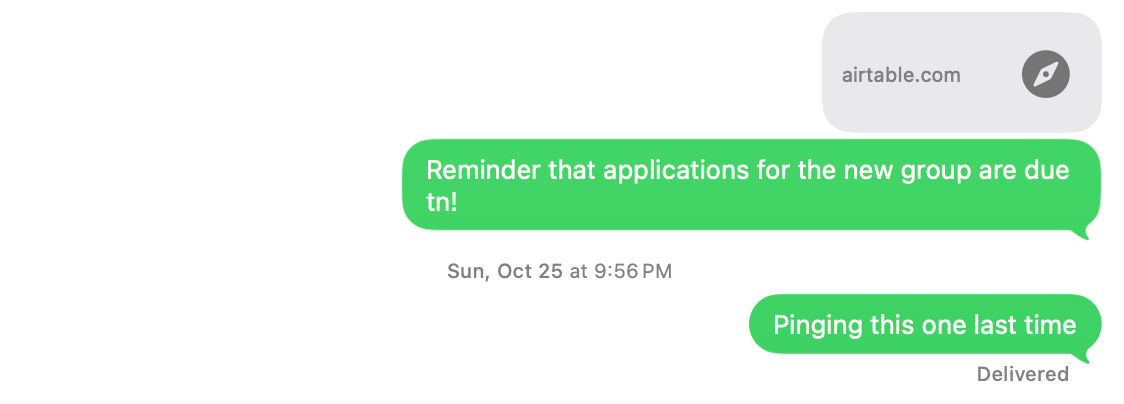
- Direct text messages to a bunch of people:[13]
Here are some places that I forgot to advertise to and would have attempted if I was trying harder:
- The Deep Learning class at MIT
- EA@MIT’s intro fellowship[14]
- DMing every MAIA organizer over Slack
- Probably some other places; there are always more ways to be ruthless.
I regret missing these, but in my defense, I was also busy with protest organizing and other MAIA stuff, which I thought was more important at the time.
Interlude: Naming
Originally, I was going to name the program “Effective Altruism in the Age of AGI.” Then, I was like, “maybe we don’t need to explicitly call it ‘Effective Altruism,’ because that signals in-groupy-ness in a way I don’t really intend.” So, I changed the name to the “future-focused action reading group.” But I thought this sounded too much like EA@MIT’s Future Fellowship, so I changed it to something my friend recommended: “Doing Good in the Age of AGI.”
“Doing Good in the Age of AGI” is kind of a mouthful, though. How do you shorten that? DGAA? DGITAA? DGITAAGI?
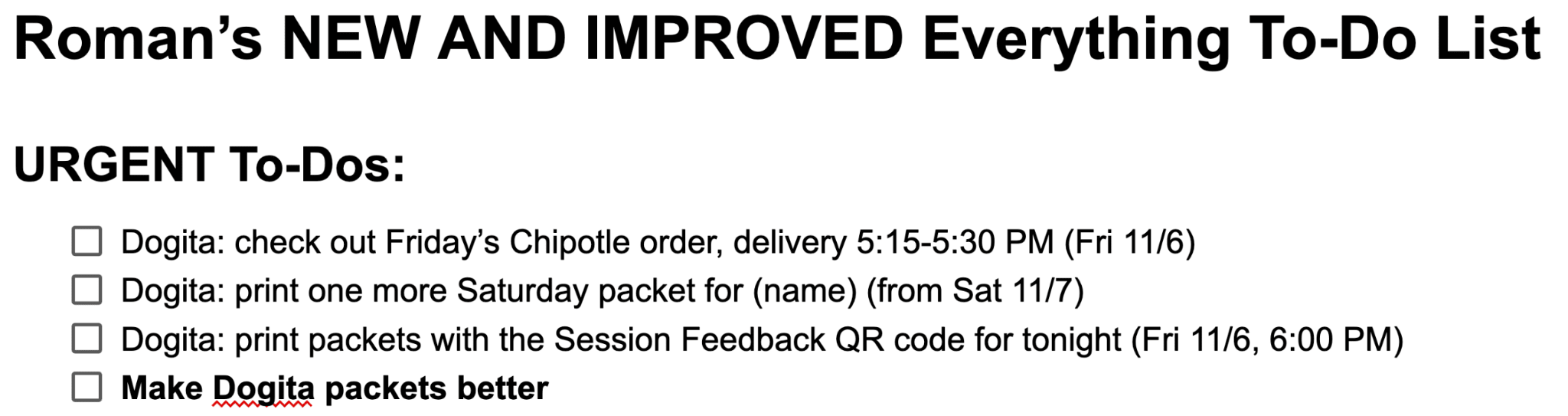
Internally, MAIA execs now call the program “Dogita,” because it a) somewhat fits, and b) sounds really stupid. My Claude agent has picked this up and has begun writing it all over my to-do list when it writes daily reminders.
Phase Three: Curriculum and Writing
My process for assembling the curriculum looked something like this:
- Paste a bunch of relevant-seeming links into a Google Doc into a big list.
- Try to split the links across each of the weeks of the curriculum with some sort of coherent structure.
- Spend a bunch of time reading the articles I had not yet read.
- Reflect on what I’m trying to achieve with this reading group, realize that my current direction is suboptimal, and make a plan to adjust directions.
- Repeat the cycle again, this time with a more refined approach.
For me, Step 4 means writing another strategy doc.[15] The main takeaways were that my ideal reading group graduate is:
- Serious and truth-seeking when thinking about the possibility of transformative AI.
- Tasteful when they evaluate potential projects to pursue.
- High-context enough to understand current EA/AIS community dynamics and navigate them properly.[16]
To reach this goal, I wanted my readings to be:
- Enjoyable enough to keep participants engaged and attending meetings regularly.
- Information-dense enough to not waste their time, while still being understandable.
- Discussable enough that participants would have fun talking with each other during sessions.
In retrospect, I don’t think the first version of the program met these as much as I would have liked it to. Since the initial draft, I’ve rewritten a bunch of it to be shorter and more enjoyable.
One thing that I didn’t anticipate about making a good curriculum, though, is that it takes a LONG time. Many things can be 80/20’d.[17] A good reading list is not one of those things.[18] It’s so easy to come up with a bunch of slop recommendations that are either inefficient, redundant, or uninteresting. If a lot of people are going to use your resources, you should think carefully, maybe even re-read/skim the content, choose the best bits, and avoid wasting their time!
I also realized that there were very particular things that I wanted to tell each participant about the program, but none of the readings shared the message in a way that was satisfying to me. So, I decided to write a blog post as the introduction to the series. I’d be a little surprised if writing this was the most impactful use of my time,[19] but it was also working toward my end-of-the-school-year goal to write an EA Forum post that receives 100+ upvotes. The thesis of the post is, “We should try our hardest to think carefully about how we can do good for the future, as we could be living at an enormously important moment in history. Still, we should be very uncertain about any specific argument, as the group of people thinking about this seriously is pretty small.” I think this did a good job of setting up a program about cause prioritization, but the feedback was somewhat mixed:
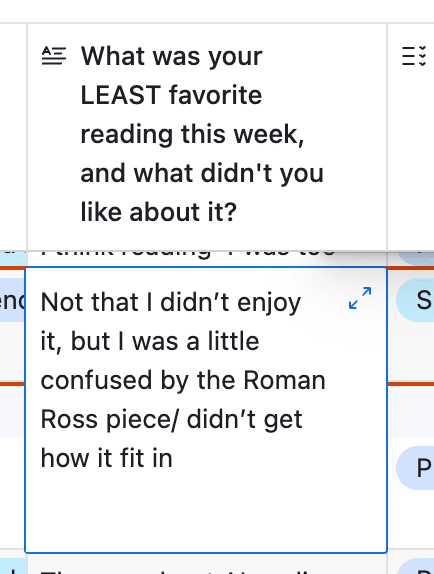
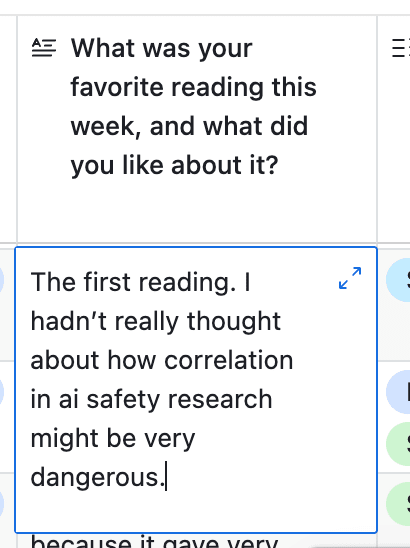
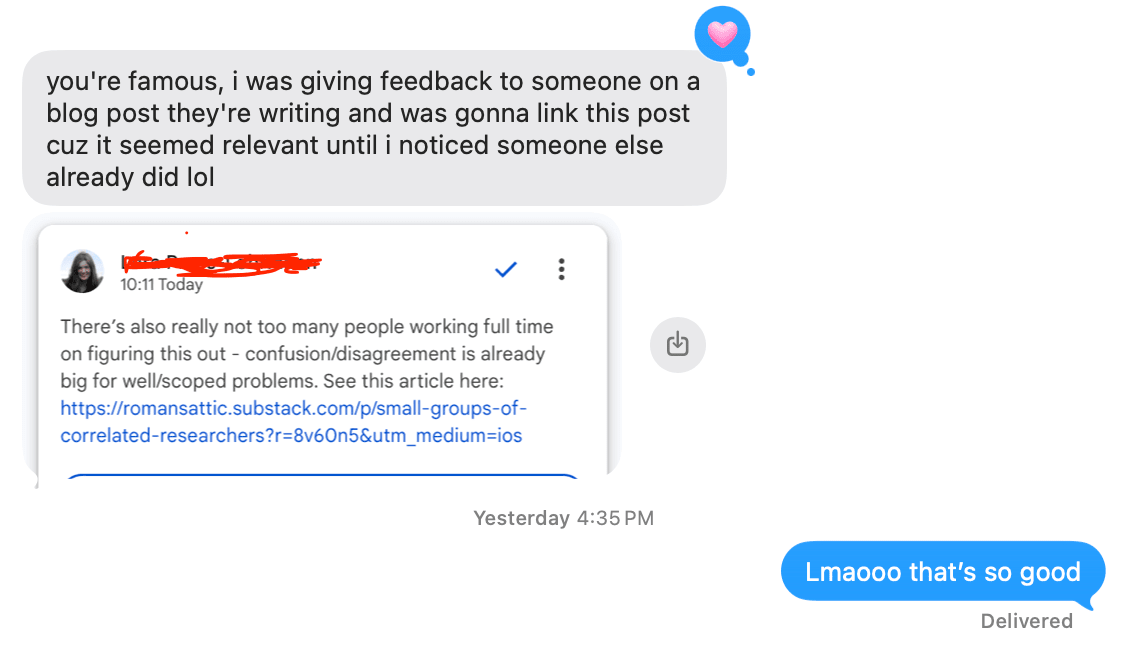
Overall, though, I’m glad I wrote my essay. Ever since publishing, it has shown up in unexpected places:
Phase Four: Logistics and Uplift
After sprinting to review applications, set up an attendance confirmation form, and determine session pairings, I sent out all acceptances on Monday night at 7:10 PM. That’s 1 week, 8 hours, and 46 minutes after I made my first Google Doc for this project, which I think is pretty good!
From this point forward, about 70% of the remaining work was logistics: booking rooms, telling people where to go and when, tracking facilitator participation, sending group DoorDash links for session meals, getting feedback, reminding participants about sessions, telling participants AGAIN that they need to fill out the DoorDash, managing participants who need to switch sessions, and so on. These are all well-specified, time-consuming, repetitive tasks that could be done over the internet, meaning that it was time to gradually disempower myself responsibly hand off my tasks to the AIs.
Recent Claude models are really good.[20] Claude in Chrome will reliably complete pretty much any decently-specified task on the first try, and Claude Code doesn’t even need to activate Chrome if it has MCP access to various systems on your computer. You can set this up by opening Claude Code, saying “Claude, give yourself access to (whatever things you want to give it access to),” and it will find some way to do that. Is this safe? Not sure. But it’s pretty fast and easy.
To get Claude running, I started by writing a doc outlining everything that needed to happen for the program to run and when. I listed each day of the week, wrote out the types of messages that would need to be sent, and specified when any other tasks would need to be completed. I gave it to Claude and said something like, “find some way to autonomously do all this at the specified times each week.” It told me why some of it was difficult, and I found a way to make it easier. It told me that some of the stuff needed my laptop to be open to run, which I thought would be fine, until it led me to sprint out of the gym one morning so I could connect to the internet and run it. Oops! I then told it to rewrite the instructions to retry the program every few minutes if it fails, which has allowed all of my current weightlifting sessions to continue in peace. After some additional tests and debugging,[21] Claude reliably does all my digital logistics other than confirming the DoorDash orders.[22]
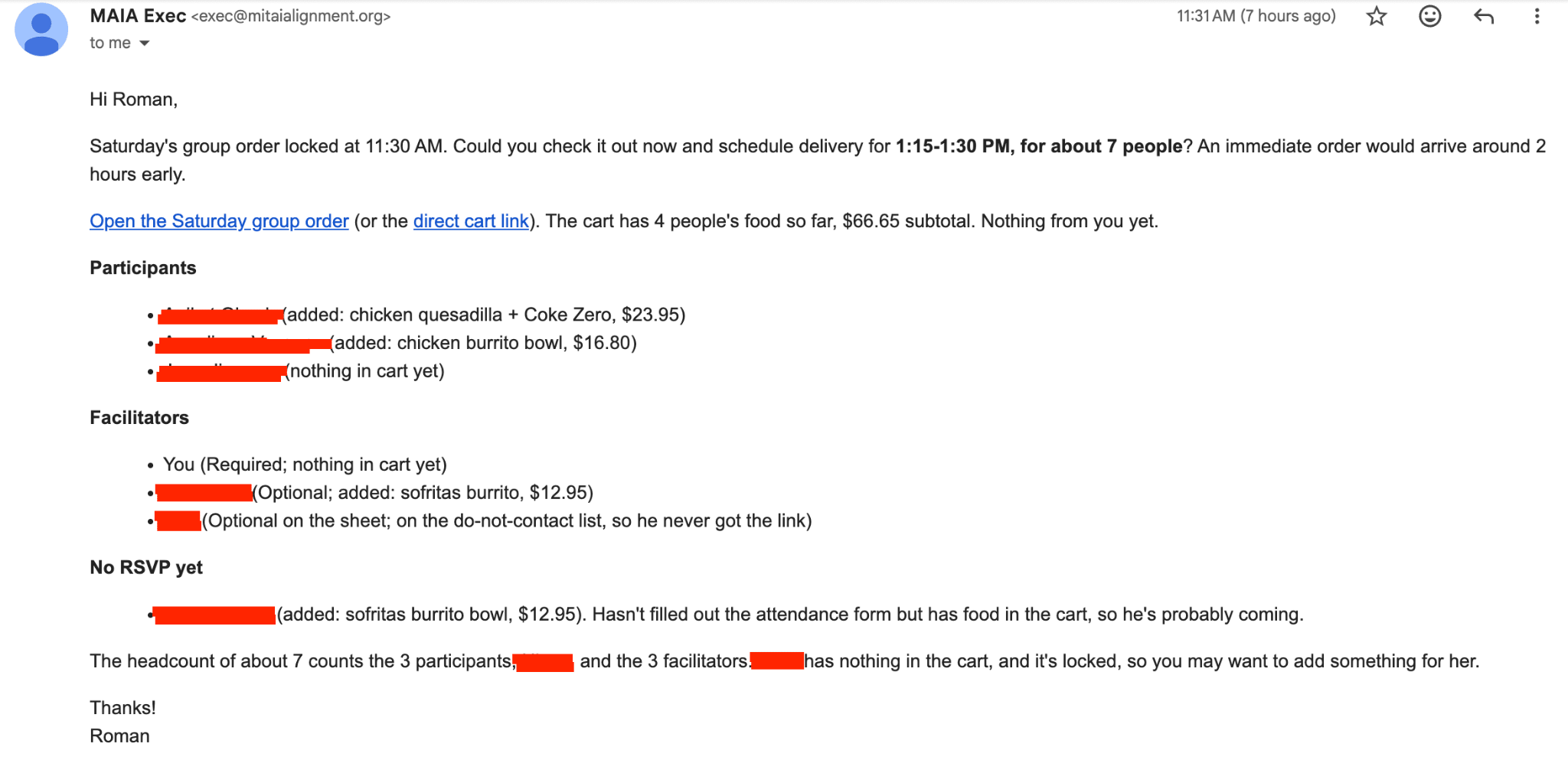
Aside from doing the logistics, here are some ways that I used AI to do things faster:
- Claude made the application form in the relevant Airtable. I just told it what information I wanted from the forms, what questions I wanted the form to ask, and how it should format the availability section. Instead of describing the formatting in words, though, I linked it to a few previous Airtable forms that I think did a good job and told it to replicate the good things.
- I wrote the intro text myself, though.
- Claude generated the code to make the outreach email look nice and pretty.
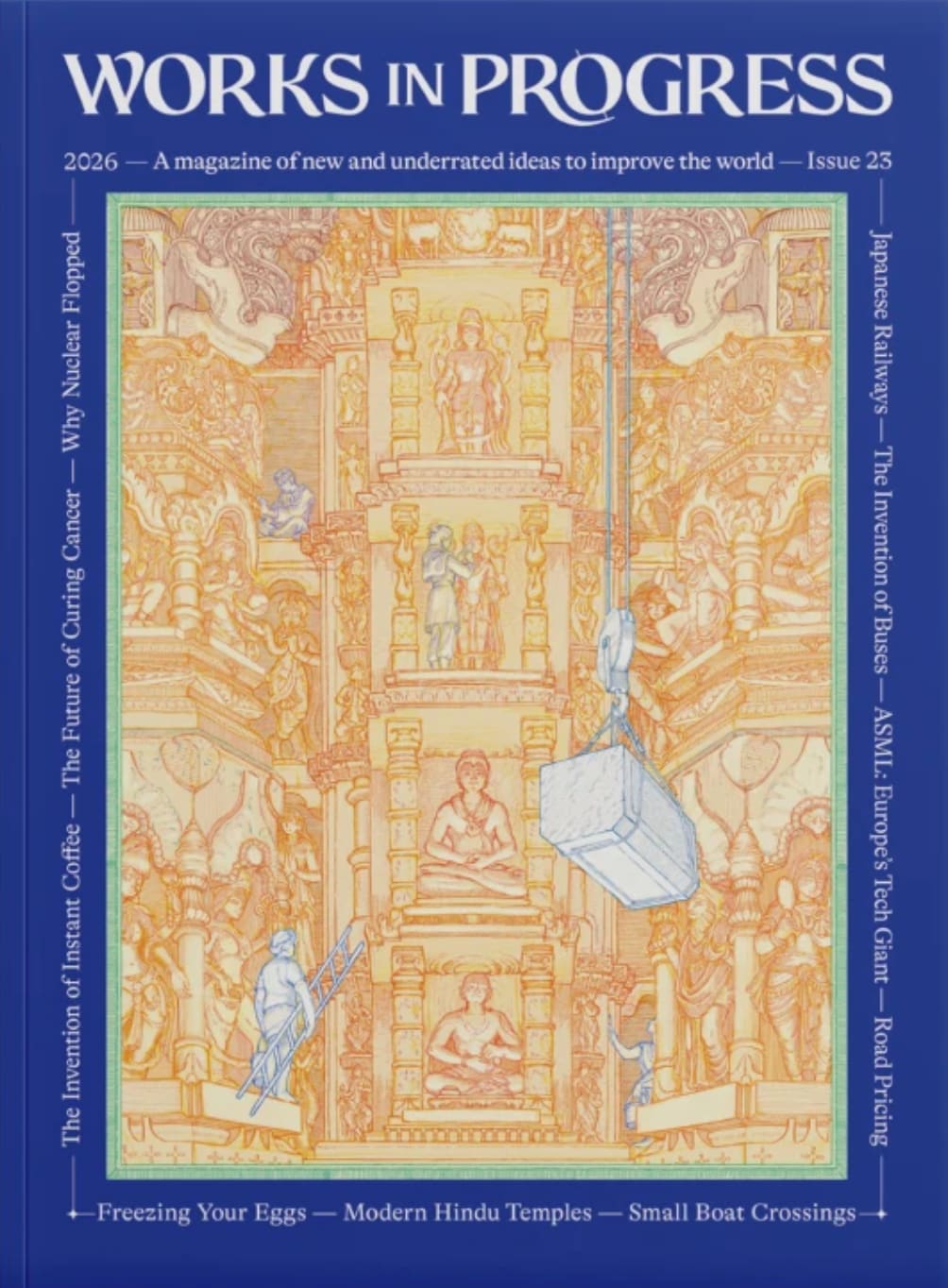
- Claude did most of the formatting work for the final reading guide, as well as the sub-packets for each week. To choose a style that wasn’t too Claude-like, I told it to get inspiration from a Works in Progress magazine cover that I liked.
- Claude figured out how long each reading is and put this into the curriculum doc next to the link, helping me choose 1 hour of readings more easily.
- Claude generated the QR codes for each week’s attendance forms. It also created the attendance forms (based on some other forms for inspiration) and the Airtable database that they live in. It did all this in about a single prompt.
- Claude built an interface for me to view all of the Airtable applications I received and easily accept/reject them.
- Claude looked at the application submissions and designed the optimal session timings based on participant availability and a series of other constraints I gave it.
- Claude is very good at mail merges: I can write an acceptance email prompt for it, write in blanks for names, emails, and relevant dates, and Claude will uniquely specify this for each person.
- It also made it so that participant attendance confirmation forms were prefilled with each person’s name and session automatically! What a nice guy!
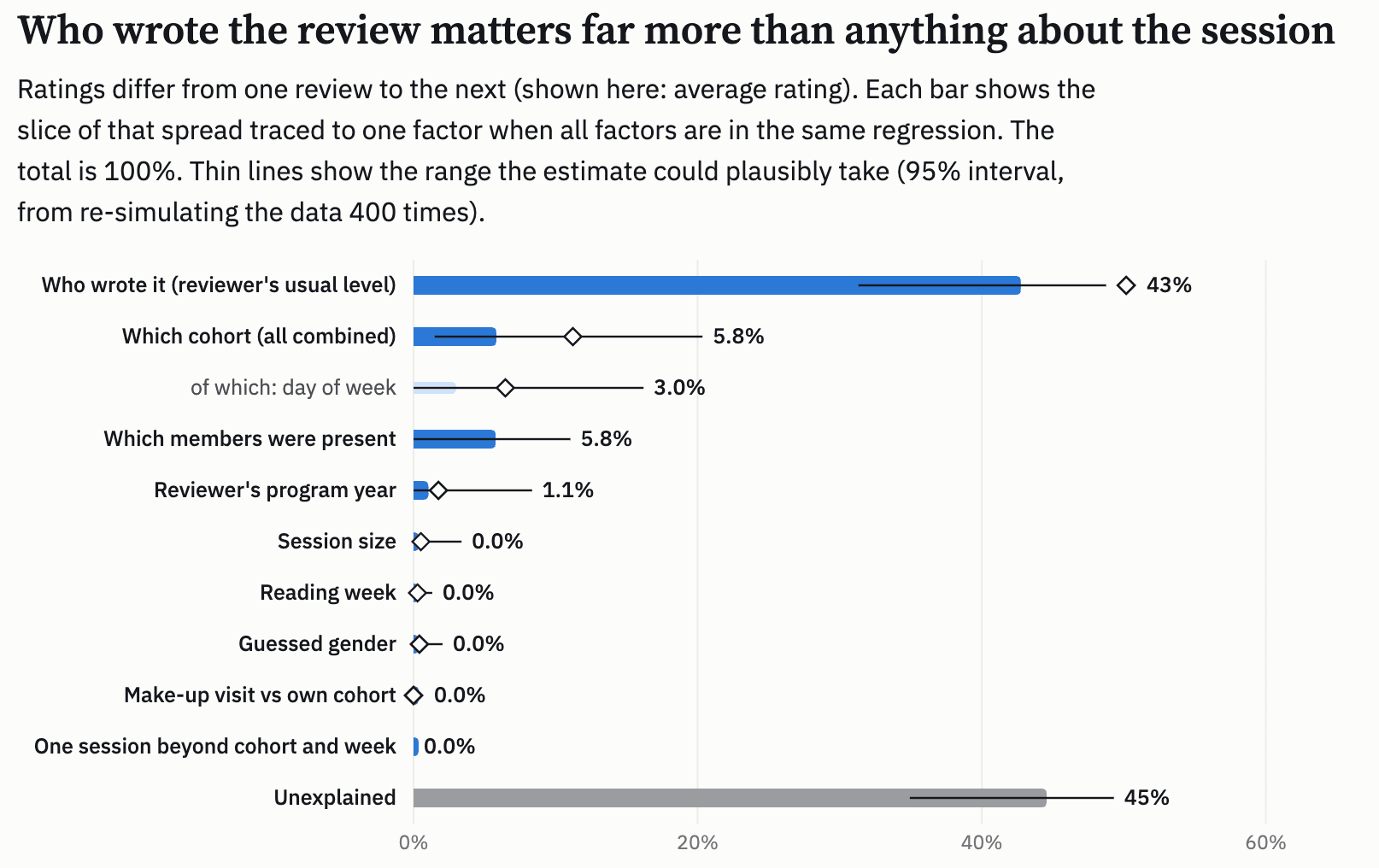
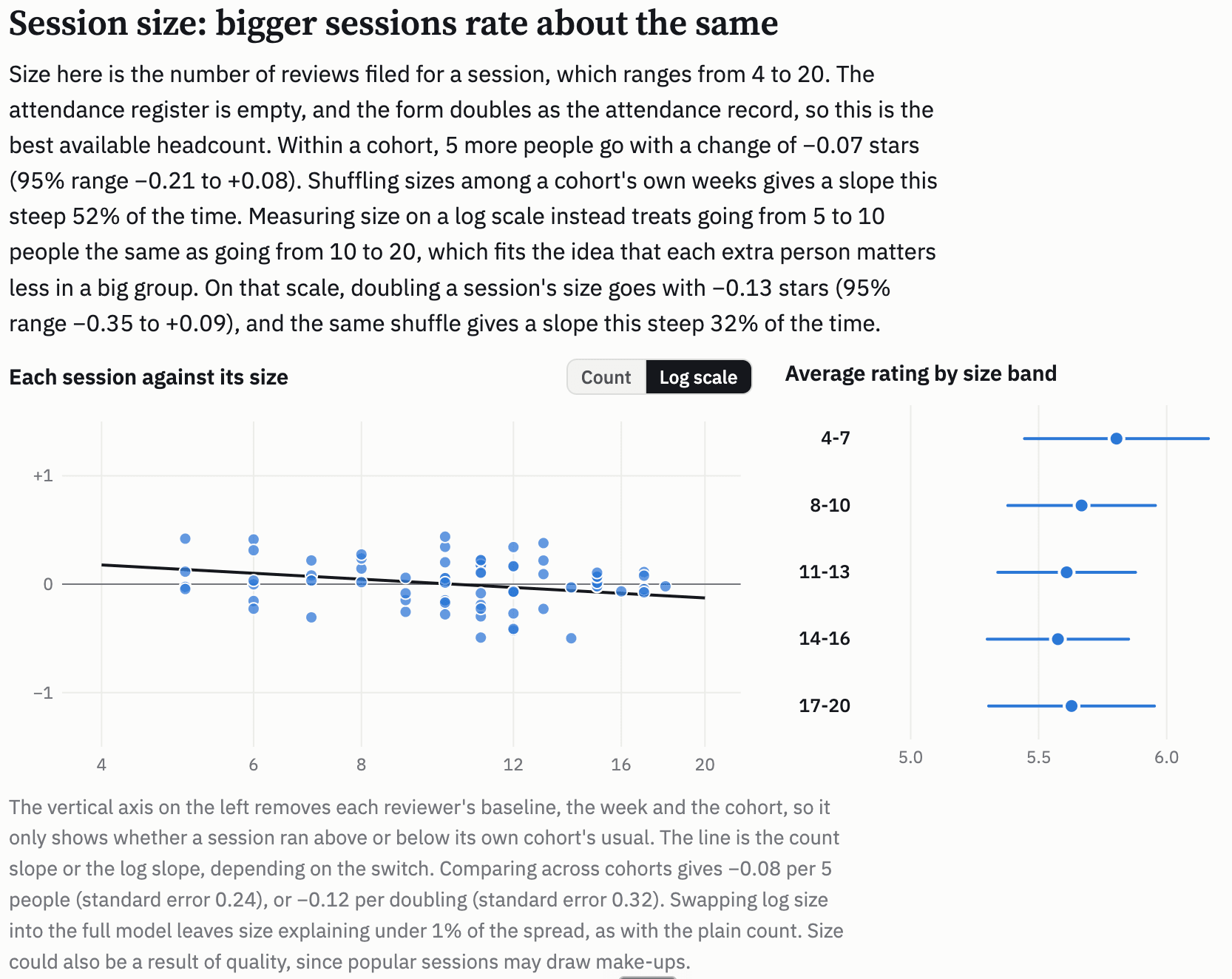
- Claude ran regressions on the AISF and Doing Good feedback data for me and displayed the results in a nice artifact
Here are some things I didn’t delegate to AI, or that it failed at doing:
- Claude failed to choose a good design palette for the program. All the paintings that have been inserted throughout the curriculum were my choices alone.
- Claude did tell me that a few of my choices were actually fascist propaganda, and that I should probably choose different paintings instead. Thanks, Claude!
- Claude didn’t do any substantive, public-facing writing. The descriptions on the main reading guide and application form were almost all written by me. The advertisement messages were written by me. Almost all of my general communication Claude sends to people has been drafted by me, with Claude filling in a few relevant blanks in ways that I instructed it to.
- Claude didn’t write my 1-pager. A large goal of writing a 1-pager is to make sure the theory of change is good and spot any overlooked considerations. Delegating this stops you from thinking things through.
If you’re not automating some of your workflow, you’re really missing out. I save so much time and stress each week because I don’t need to worry about sending specific messages at the right time or checking to see if everyone’s chosen their food. If the work you’re doing is sufficiently important, you’re losing out on important work by missing this! My friend Hazem has written some additional advice about this for university group organizers, and the comments are helpful for making sure you’re doing it safely.
Interlude: Facilitator Tips
In addition to everything that Chris says on the BlueDot blog, I like to flag anything that seems jargon-y and explain it to the group. I might say something like, “if the AI is acting paperclip-y… (catching myself) uhhh, raise your hand if you don’t know what I mean by ‘paperclip-y,’” and this does a pretty good job of keeping everyone in the group up to speed. I also might say, “raise your hand if you want a summary of the paper we just read,” after each reading. These summaries are popular.
I think telling people to raise their hands is a good way to let people communicate that they don’t know something. In larger sessions, I might have shy participants who don’t want to speak out to the group about their lack of context. Being proactive about asking this question is good.
When I scheduled this reading group, I chose to run it as a bunch of small sessions for a few reasons:
- Participants who are busy on one day can find another to join, which can help reduce attrition.
- I get to talk to more people directly when the groups are smaller.
- When I was setting up groups, I thought smaller groups would be more popular because they give each person more depth of discussion. Since then, I have discovered that this is not obviously reflected in MAIA’s AISF data, so maybe this reason wasn’t as important as I thought.[23]
Overall, I think our conversations are pretty good! About half of our sessions have had people stay afterward to keep talking.
Phase Five: Feedback and Iteration
Despite running an AI safety club, I am first and foremost an EA. As an EA, it is of utmost importance to me that participants in my philosophy reading group receive multiple messages a week asking them to fill out a feedback form.[24] So, I have good comments to draw from about what’s working and what’s not.
As I write this, the program has just finished its second week, meaning that I don’t have much long-term data about attrition or overall reviews. However, I do have an anonymized Claude artifact summarizing the feedback from the first two weeks, and it has some interesting stuff.
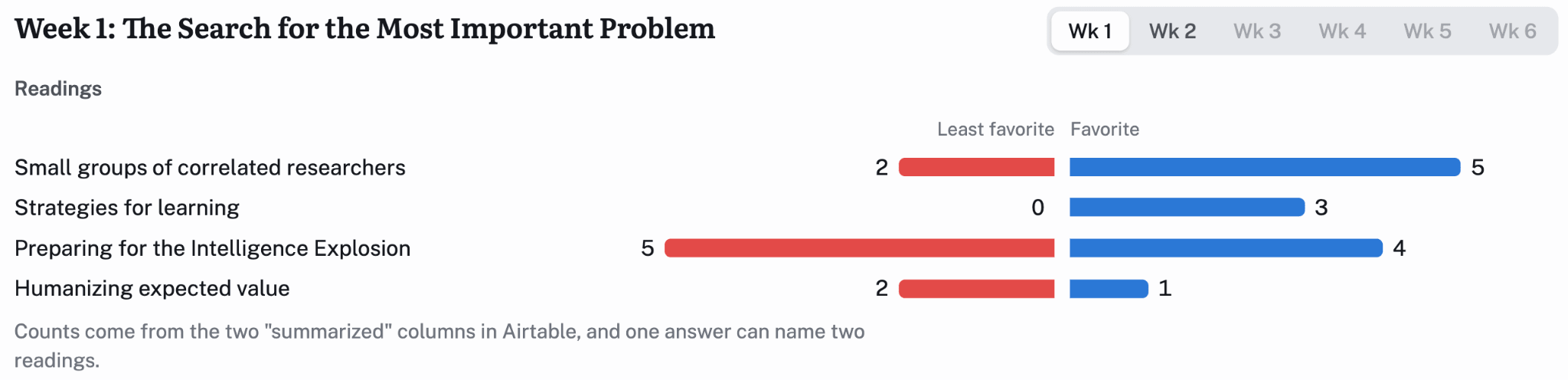
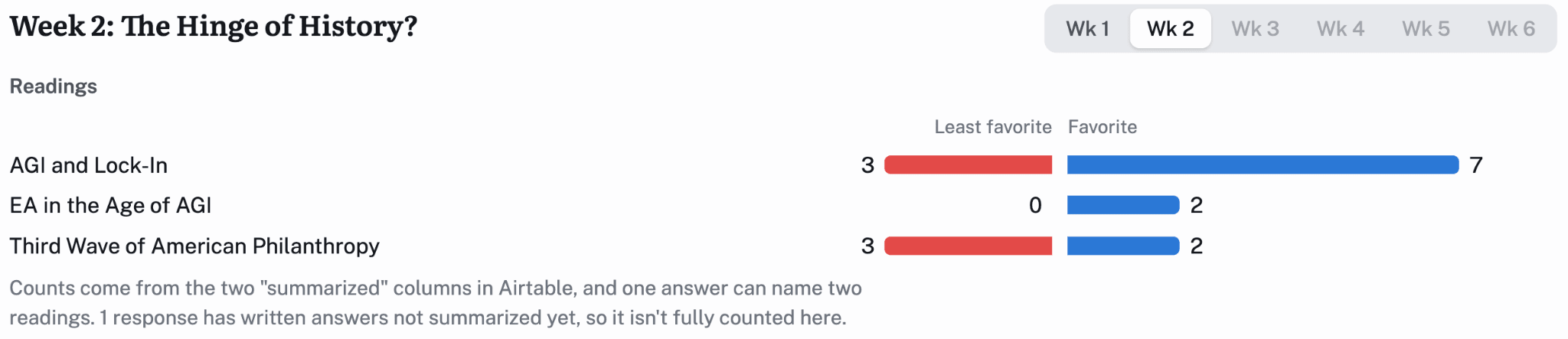
Favorite and least favorite readings for each week:
It’s possible that I have sycophantic participants who like telling me that my writing is the best, but I was out of town during the session that gave it the most positive reviews. The negative reviews gave helpful writing feedback, though! The most common critique of various readings was that they were too long and too technical. My original reading packets were already pretty curated, but between the Thursday and Friday sessions of Week 2, I cut down the length of all the readings (but especially AGI and Lock-In) much more. I think this was a great decision. - Most of the “least favorite” reviews weren’t all that negative; they mostly expressed small confusions or distaste towards the length.
- Highlights from “the thing I changed the mind most on”:
- “I'm a bit more open to the idea EA is still useful in a post/on-the-way-to AGI world.”
- “I learned how to learn better.”
- “I am unsure what this question is asking me, sorry.”[25]
- “I need to start writing. I've known this for a while, but this might be the last snowflake needed to break the branch! I started writing last night.”[26]
- “This was my first time engaging with EA. The stickiest idea was strong bias towards neglected areas.”
- “Updated upwards on the utility of speculative research agendas -- for 2 reasons. Firstly, probability of them having a high impact. And secondly, on the low-costliness of pursuing them: due to the influx of money.”
Background: In a Position to Succeed
A lot of things needed to go well for me to start a program like this. Some of these came as the result of broader preparation that happened to pay off here, but a lot of it was good circumstances.
The lucky things
To start, MAIA is a functional organization situated within one of the most talent-dense cities on the planet. All of our execs[27] and top organizers are amazing people who run our programming consistently well, meaning that if one of us suddenly proposes a promising project, the group usually has bandwidth to take it on. If our workshops and speaker events were constantly falling to pieces, I wouldn’t have had as much room to do this. However, our organizers are great, and I’m really grateful to work with them. Also, our past outreach efforts make it pretty easy to start a new program filled with cool and interesting applicants.
Not just luck
When I was still taking classes at Purdue, I frequently bumped into a 2.5-hour limit on my ability to focus deeply on specific tasks. Ever since coming to MAIA, this has expanded to… I’m not quite sure how long, but definitely much longer. I can’t exactly tell where this came from, but one hypothesis is that my schedule here is extremely stable. Following Dewi Erwan’s sleep advice, ever since coming to Boston, I’ve woken up at 7:45 AM almost every day, usually preceded by getting 7.5+ hours of sleep. This includes weekends and nights when I stay out late with friends. As a result, I build some sort of “productivity momentum” that lets me feel great on most days and do what I want to do most.[28] I also eat healthy (avoiding simple sugars entirely when I know I’m going to work) and lift weights 3-4 days a week, usually right after waking up.
Aside from keeping my physical health in check, a lot of my hobbies predispose themselves to helping me with my work. I go out of my way to read blog posts that might be important, attend a variety of EA-related events, and stay in direct contact with the most thoughtful people around me. I mostly do these things because they’re intrinsically enjoyable, but setting myself up for future opportunities is what pushes me to read a Forethought blog post instead of rereading old Slate Star Codex.
Conclusion
Overall, I’m pretty satisfied with my work on this reading group. I suspect that Better Futures fieldbuilding for university students is especially important as timelines get shorter, so I think betting on this project and starting it quickly might turn out to be especially important.
Thank you to the CEA Groups Team for inspiring this project, the MAIA exec for being awesome, the other reading group facilitators for leading discussions and covering sessions I missed, the BlueDot blog for making me more productive, and Jason Chin for telling me to write this post.
If this post is popular enough (50+ EA Forum upvotes), I’ll also write similar posts about organizing for political events in the Massachusetts area and hosting a 123-attendee student social in a city that I was only visiting for three days.
- ^
Not to mention all the people I personally DM’d and told to apply to the program
- ^
By “cause prioritization,” I mean “thinking about what the most important problem in the world to work on is.”
At the level of depth reading group participants are at, most thinking about cause prioritization is also cross-cause prioritization, as the curriculum is largely introductory for a broad range of topics. - ^
This disparity is especially visible at MIT, where MAIA has over 200 fellows in our introductory AI Safety Fundamentals (AISF) program, while EA@MIT’s intro fellowship is close to an OOM smaller. Still, I enjoy my conversations at the EA meetings much more than my conversations at most MAIA socials.
- ^
Thank you to the highly counterfactual Kennan McClung and James Lester for getting me to do this!
- ^
I had Claude look through my Google Docs to figure out the history of creating this program. It tells me, “‘AGIxEA fellowship’ went onto your to-do list 11 minutes after a CEA networking session at EAG NYC ended.” For some reason, this is really funny to me.
- ^
This is especially ironic because creating a curriculum for a class is the primary example that Kahneman uses to explain the planning fallacy in Thinking, Fast and Slow.
- ^
By “de-risk,” I mean “think about things that could cause your program to fail, and quickly figure out whether or not this is actually likely.”
- ^
Of course, they would have had other opportunities to learn about the reading group, like through the MAIA Slack and email lists. But I think that in-person advertisement is especially valuable, as people are bad at checking their inboxes.
- ^
For this fellowship, I texted everyone from my Diverse Perspectives on AI Timelines reading group and asked if this is something they would be interested in. I only got about 3 responses, but the answers were pretty overwhelmingly “yes!”, which was a good sign (I haven’t read The Mom Test yet. Sorry, Carolanne!).
- ^
There’s a little strawman party-planner in my head saying there’s a bunch of elusive shadow benefits that come with being the type of person who has decided on a specific curriculum ahead of time. I think this is WRONG and you should just go faster.
- ^
I recognize writing this on a public blog post on the internet might harm my ability to screen applicants using the same method in the future. I feel okay with writing this because I think the expected downside of publicly explaining how to write a good application for this program is low, and I don’t think these answers will transfer to other applications much. If I were writing about a program like SPAR, I would not have included these details.
- ^
It's helpful for communicating to the EA Forum, though.
- ^
In retrospect, I could have done more to sell it to each individual person better, but my street cred was enough for this.
- ^
This is probably the place I missed out on the most.
- ^
When I write for myself, I have a habit of saying things in a way where I know exactly what they mean. However, a lot of my cached context sometimes fails to translate well to wider audiences.
- ^
My ideal graduate is also highly agentic, but I don’t think that influencing this was within the scope of the fellowship.
- ^
Get 80% of the value with 20% of the total effort.
- ^
I’m not incredibly confident in this claim. In the context of this reading group, I think most of the value comes from giving people as many good and interesting ideas to think about as I can. However, someone can reasonably claim that the value comes from getting people to a 2-hour weekly discussion group where they can think about these problems to begin with. Also, reading choice doesn’t show up as a significant factor explaining the variations in AISF reviews, which has received ~1000 form submissions so far (although it’s hard for statistical measures to actually isolate this specifically)
It may be worth cleaning the AISF data more and writing a full post about it. - ^
I’m a little confused about the impact case for writing. I’ve received some positive reviews on some of my previous work, but I struggle to imagine a coherent theory explaining why most individual essays will be highly impactful.
I think a lot of the value of trying to write something really good comes from improving my writing skills. - ^
I don’t use ChatGPT because I’m not a heathen, but if you are of the kind who indulges in that sort of behavior, frontier OpenAI models are also quite good. /j
- ^
A list of failures would include sending emails with weird and broken spacing, sending Slack messages without reading the previous messages first, and shadow-banning a facilitator due to my miscommunication.
- ^
I want to make sure spending aligns with any additional in-person communication I’ve received.
- ^
One explanation for this is that perhaps talkative people will be talkative no matter where they go, while quiet people will be quiet no matter where they go. All types of people are similarly content across group sizes.
- ^
The CEA Groups Team didn’t even tell me to do this!
- ^
The feedback form used to say “biggest update” before I received this response
- ^
As far as I am aware, this person has not continued writing. However, I expect him to read this essay, so he can leave a comment if he has.
- ^
current execs, at least
- ^
Brief argument against staying up late: Losing an hour of sleep probably cuts down on my ability to do things well during the subsequent day by about 10-20%, while staying up an hour later is rarely above an 8/10 experience. I enjoy doing things well, and I feel pretty dissatisfied when I’m operating below my peak. Based on the sheer duration of the subsequent day compared to the amount of extra time I stay awake, breaking my sleep schedule seems like a net negative, unless I’ve got something really great going on.