Comments
Two ways not to handle uncertainty in cause prioritization

10 min readNov 6
28
This post is part of the Rethink Priorities Cross-Cause Fund (CCF) series on how to allocate funding across causes when it is uncertain what matters most.
TL;DR:
By a worldview, I mean a set of beliefs about the parameters relevant to cause prioritization (risk profiles, moral weights, degree of cluelessness about long-term effects, etc.).[1]
What are our core values, how do we approach risk, what spectrum of consequences do we consider? These factors often implicitly drive what we do. They often exist “at the back of our heads”, we don’t systematically write them down or analyze them, while they create heuristics that help us function efficiently in the world. However, when it comes to making decisions of significant importance, we should look at our beliefs more closely, with the scrutiny these decisions deserve. In this post, I want to focus on a specific type of decision: allocating charitable resources across causes, analyze the impact one’s worldview(s) can have on our decision-making in this setting, and what can go wrong.
Most of us prioritize (explicitly or implicitly) what to support by applying our best guesses regarding how to deal with risk, moral weights, and other key considerations, even though those best guesses may be fragile or arbitrary.[2] In a specific case I want to look at, which is allocating resources, this amounts to evaluating causes and interventions through a single (contentious) worldview. Take a donor deciding how to split their giving across global health, animal welfare, and reducing risks from AI. They are already relying on assumptions about how much chicken suffering counts relative to human suffering, how much confidence to place in estimates of far-future effects, and how much risk to accept, without having explicitly considered any of them. Consider, for instance, the following set of beliefs one can hold when approaching this decision.
| Parameters considered | Sample worldview (set of beliefs) |
| Moral weight/importance of chickens (compared to humans or other animals) | A year of chicken suffering averted counts about a third as much as a year of human disability averted |
| Far-future effects (what do we make of estimated consequences 50, 500, trillions of years from now?) | Moderately distrusted/discounted due to arguments for cluelessness, but still large enough that most of the expected value lies in longtermist interventions |
| Attitude to risk (do we value a 100% chance of helping 1 person the same as 1% to help 100 people?) | Risk-neutral: maximizes expected utility |
This fits a standard utilitarian-ish longtermist worldview that is popular in the Effective Altruism movement.[3] You and I may very well find this worldview reasonable.
However, there are many ways in which it could be seriously mistaken, e.g.:
You may think that this worldview acknowledges some of these uncertainties by avoiding “extreme takes” in either direction (e.g., chicken weight <0.1 or >0.9), but this is nowhere near sufficient. The whole point is that these extreme values, on both sides, are actually plausible. We do not do justice to this by precisely assuming some middle ground, as if we knew this middle ground was true. No matter how carefully reasoned and moderate your worldview may seem, optimizing according to it means optimizing according to a single, fragile best guess for each crucial parameter. This makes sense only if you are nearly 100% confident in all these best guesses, or highly sympathetic to the “My Favorite Theory” approach to worldview uncertainty—neither of which you should be.
Alternatively, you may think that the problem comes from trying to explicitly model one’s worldview in the first place. Maybe your (implicit) all-things-considered worldview, based on heuristics, fares better. We do not think so. The implicit best guesses hidden behind this kind of informal approach are just as fragile and arbitrary, if not more.
You might fully agree with the previous section but believe that one of your favorite worldviews is “higher stakes”, in a way that justifies acting as if it were the correct one. Here are two examples.
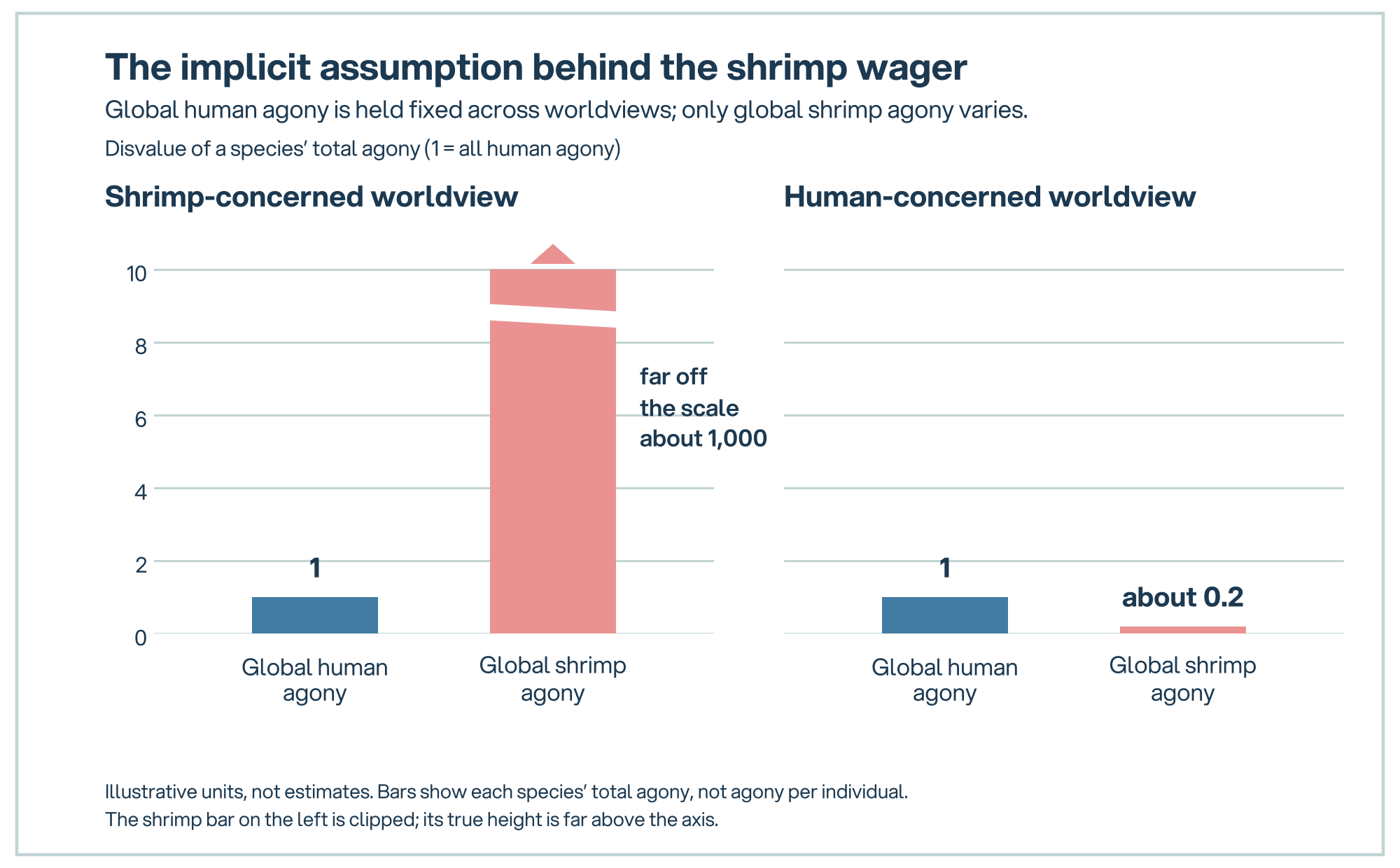
The shrimp welfare bet: Sure, it is a serious possibility that no realistic amount of shrimp suffering (assuming they do suffer) can outweigh the agony of even one single human. But since there are far fewer agonizing humans than (plausibly) agonizing shrimp, the possible worlds in which this is true are “lower stakes”.[4] The safe bet, and the bet with the highest expected value, is to act upon the shrimp-concerned worldview.
The longtermist bet: Sure, the potential long-term effects of our actions may be too uncertain or speculative to be worth acting on. But since there are far fewer beings to help in the near-term than in the long run, the possible worlds in which near-term effects should guide our actions are “lower stakes”. The safe bet, and the bet with the highest expected value, is to act upon the longtermist worldview.
This kind of philosophical move aligns, in spirit, with a version of MacAskill et al.’s MEC (Maximize Expected Choiceworthiness) approach, applied to worldview uncertainty, that takes stakes comparisons between worldviews at face value (i.e., without normalizing them). Under MEC, you take the action with the highest expected moral value across all the worldviews you give some credence to, where each worldview’s verdict is weighted by your credence in it. For a given credence, the worldviews with the largest stakes therefore have the most influence on this weighted average. As a result, the action MEC recommends tends to agree with the highest-stakes worldview, even if your credence in that worldview is very far from 100%. The two bets above are informal applications of this reasoning. They can be criticized for the following important reasons.[5]
First, such an approach is fanatical. This method takes a claim of each worldview at face value, which means that a worldview with extreme stakes can dominate the decision, even if you are almost certain it is incorrect (as the bet above illustrates).
Second, the approach is uncompromising (its rationalized formal MEC version, at least), even between worldviews with comparable stakes. In Lloyd’s Ninety-Nine Charities example (dissertation, §2.3, p. 37), a philanthropist has 1% credence in each of 98 moral theories and 2% credence in a 99th. Each theory says that only its own charity is worth donating to, and that choiceworthiness rises in proportion to the amount donated to it. MEC then recommends giving her entire fortune to the charity favored by the 2% theory, although she is 98% confident that theory is false. Instead of finding a solution that reasonably satisfies several plausible worldviews, MEC hands everything to whichever worldview comes out even slightly ahead once credence and stakes are combined. This approach may appear as failing to “respect” one’s worldview uncertainty. This is arguably because MEC treats uncertainty about the normative components of our worldviews as if it were ordinary empirical uncertainty, where betting everything on the best gamble can make sense. Kaczmarek et al. argue that a procedure designed to select optimal gambles is much less appealing under normative uncertainty, and that moral choice should look more like finding a fair compromise between the views we find plausible.
Third, it is not even clear that the worldviews portrayed as “higher stakes” actually are, to begin with. Take the shrimp welfare bet, for instance. It implicitly assumes that the absolute disvalue of global human agony is fixed across worldviews and that only that of global (potential) shrimp agony varies. Concretely, both worldviews are measured in units of human agony: a human’s agony counts the same in each, while a shrimp’s agony counts for very little in one and a lot in the other. Since only the shrimp side moves, the shrimp-concerned worldview looks like the one with much higher stakes.[6]
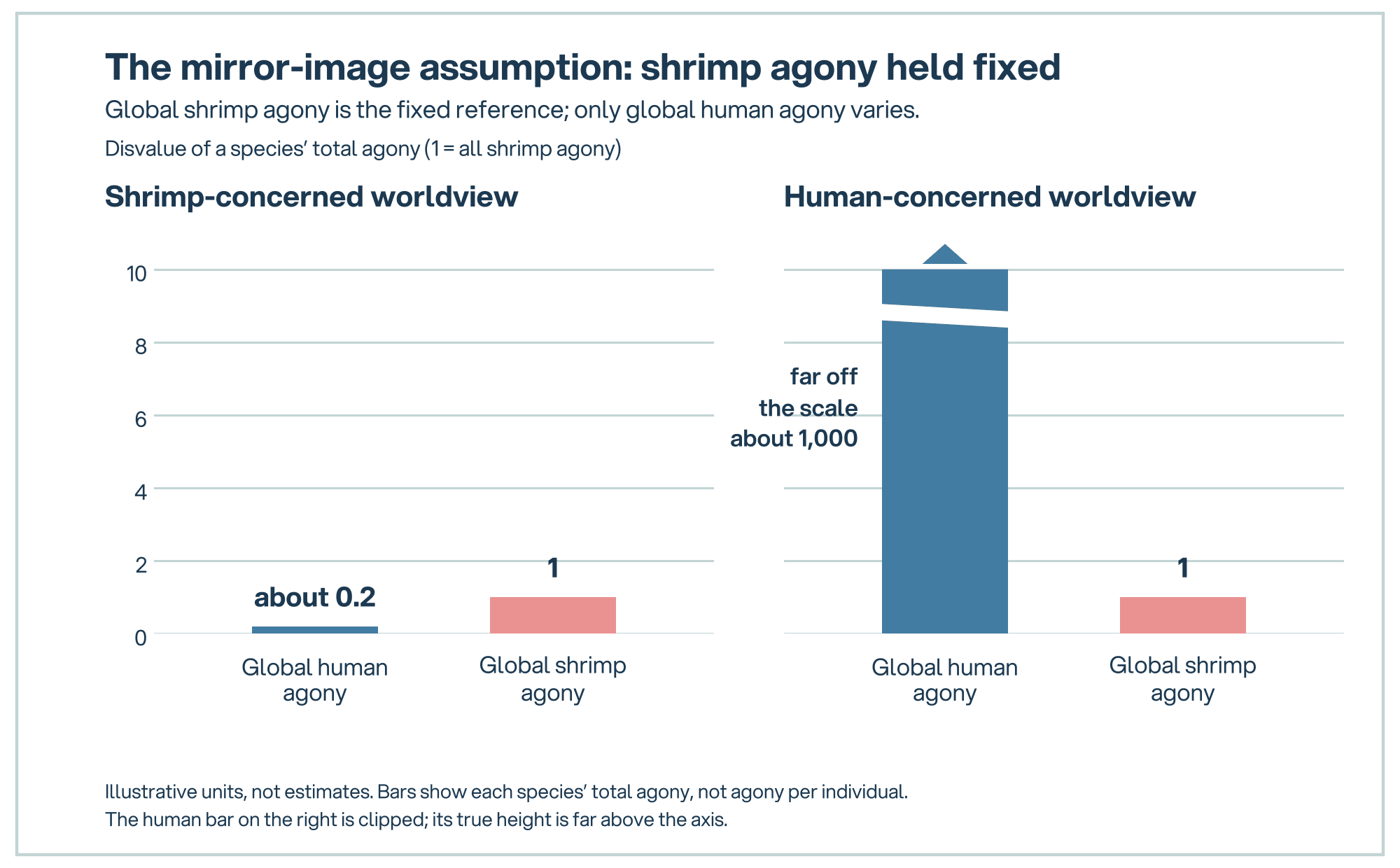
But why should the global human agony weight be the fixed one? We might answer that we know what human agony feels like, and that this is why only the uncertain shrimp agony weight should move. But a hypothetical sentient talking shrimp[7] could say the reverse: we know what shrimp suffering is like, and do not know exactly how much worse human agony is (see this related comment). This would lead this shrimp to believe that the human-concerned worldview is the one that is “higher-stakes”!
The shrimp welfare bet relies on picking the first framing over the second one. Yet, this choice may not seem any less arbitrary than the opposite one. Knowing how bad human agony feels does not tell us how much it matters according to each worldview, and that is precisely what the worldviews disagree about. See these related discussions of the moral two envelopes problem. See also this discussion of DiGiovanni (Appendix A) for an explanation as to why a similar problem arises with the longtermist wager.
This is all related to the problem of intertheoretic comparisons. It may be hard, if not impossible, to make such comparisons non-arbitrarily (see, e.g., Kaczmarek et al., Lloyd, Davis, Tarsney, and MacAskill et al.).[8]
Fourth, many other methods to deal with worldview uncertainty (leading to very different results) are on the table, and the field is still in its infancy. For instance, take Nash Bargaining, a (tentatively) plausible alternative. In our implementation of the method in the model behind the Cross-Cause Fund, each worldview starts with a share of the budget proportional to its credence,[9] and money moves only if every worldview gains from the move. In the example above, the shrimp-concerned worldview can’t claim the whole budget, just because its stakes look higher. The human-concerned worldview won’t give up its share for nothing, so the allocation moves away from a credence-only split through trades both sides accept. The results also don't change if we re-scale the utilities of one worldview, so being “higher stakes” doesn't matter. The same logic follows in the longtermist bet.[10]
A fifth and final point worth raising is that, even if MEC was the one correct approach, applying it correctly would require precision about the judgments of each worldview and your credences in them. If you're doing this process informally (e.g., by following your intuition in favor of the longtermist wager), it's quite possible that you are implementing it poorly and misapproximating its results.
I do not claim to have anything near a fully satisfying answer to this question. However, here are some steps RP's CCF team has taken in its approach to allocating funding across causes, which I think go in a good direction:
Consider multiple worldviews when prioritizing between causes (instead of trying to average them into a single one).[11]
If you would like to explore how your own beliefs affect cause prioritization, you can try RP’s Donor Compass tool (the quiz or the advanced version), which draws on a similar modeling approach to the one used for the CCF. To be clear, we do not believe this model deals with uncertainty perfectly. Besides the limitations that we have already raised, the following imperfections are worth acknowledging in the context of the current piece:
However, we must trade off between accuracy and simplicity/legibility. Also, as suggested earlier in this concluding section, we believe making steps in the right direction is better than refusing to move until a perfect solution is provided. And we continue to dedicate resources to refining its approach and addressing these limitations.
This post was written by Jim Buhler, building upon internal Rethink Priorities work from Marcus A. Davis and David Moss. Thank you to Hayley Clatterbuck, Laura Muresianu, Stan Pinsent, David Moss, Marcus A. Davis for feedback, and Urszula Zarosa and Jonathan Nelson for feedback and editing.
Parts of this content were prepared (not written) with the assistance of AI tools (such as Claude and Gemini), which I used to improve research efficiency. The header graphic and two graphs were generated by Claude.
This builds upon Clatterbuck’s previous definition (see also DiGiovanni’s characterization of a normative view), by not limiting what worldviews are made of to normative inputs only. Worldviews can be a mix of normative and empirical inputs, here.
This can include imprecise best guesses (rather than precise estimates). These may remain fragile and arbitrary, although arguably less so— hence the “(precise)” in the section title. More on this in footnote #11.
For a more specified version of this worldview, see this “Default Total Utilitarian” worldview built by RP for our Cross-Cause Fund (CCF).
Stakes here means how much a worldview says the options differ in value, which often, though not always, scales with the number of beings affected.
Detailed critiques of the premises behind MEC have been given by Gustafsson and Torpman, Hedden, Tarsney, and Lloyd. I will primarily focus on the informal wager version I have just described, which does not necessarily always align with MEC, recommendation-wise.
MacAskill et al. propose normalizing worldviews’ stakes to get around this; see footnote #8 for why this doesn’t rescue the wagers.
Or an alien that has somehow experienced what it feels like to be a shrimp, but not what it feels like to be a human.
MacAskill et al. are aware of this problem: when worldviews can’t straightforwardly be compared, they propose normalizing each one’s verdicts (e.g., to the same variance) before applying MEC. But this leaves the wagers above facing a dilemma. Either you keep the stakes comparisons, which may be arbitrary, or you normalize, in which case no worldview counts as “higher stakes” by fiat (under the narrower version, at least), and the wagers lose their motivation. Normalization also relocates the arbitrariness rather than removing it: the result depends on which normalization method you pick and which options you normalize over. And normalization has problems—relatedly, see Lloyd.
This is our choice of disagreement point. Greaves and Cotton-Barratt consider other options (e.g., “random dictator”).
Nash bargaining has its own problems, however. The result depends on the disagreement point (what each worldview gets if no agreement is reached), and there is no clear fact of the matter about it, since bargaining between worldviews is only a metaphor. It can also give different verdicts depending on whether decisions are modelled one at a time or as a single combined problem. Greaves and Cotton-Barratt, who develop the approach, tentatively conclude that MEC is superior. As suggested by my earlier claim that the field remains in its infancy, we think that there is no obviously correct solution to worldview uncertainty, which speaks against putting a very high precise credence in aggregation methods like MEC or Nash bargaining.
An alternative I at least personally happen to believe has merit is building an imprecise worldview (an extreme and normative-focused example of which would be what DiGiovanni calls a “clueless view”). However, even then, it seems reasonable not to have 100% credence in an adequately imprecise worldview (DiGiovanni agrees), and may be unavoidable if we want action-guidance.
One could also get around these potential problems by rejecting, e.g., risk-neutral expected value maximization and/or precise Bayesianism, and coming up with appropriate decision rules to derive action-guidance from a single appropriate worldview. However, the “multiple worldviews” framing may seem more natural and hence preferable, if only for practical reasons.
For instance, suppose two crucial parameters are the risk of an AI catastrophe and how clueless we are about long-term effects. They are not independent. If AI risks are high because AI will transform the world in unpredictable ways, we may be more clueless about the long-term impact of our actions. So the sensible worldview may be a neartermist one (which does not exclude valuing some neartermist AI safety interventions). If AI risks are low, the long term effects of our actions are more predictable, all else equal, and the sensible worldview may be a longtermist one that is more worried about biorisks than about AI. If we seperately average each parameter, the result is a moderate chance of AI catastrophe and a moderate confidence that we can shape the long-term future. In this scenario, the longterm-focused work on AI risk may look very promising, despite the fact that none of the worldviews you actually find plausible is recommending it (in one, cluelessness undermines the work on long-term risks and in the other there isn’t much AI risk to address). When you keep each worldview intact, it preserve these dependencies.