Comments
I also wonder about this. I'm excited to see where research in the field leads.
I also wonder about this. I'm excited to see where research in the field leads.
Thank you for writing! I believe this is a core issue in mental health. As we measure today, mental health and wellbeing is almost entirely subjective and therefore we can’t truly understand the spectrum of human emotion and wellbeing! It is a fascinating issue.
Hi Jim. Great post. I share your concerns.
Granularization was impossible at first, since there was no sentience, so expansion was of course necessary.
Unless any operationalisation of sentience is arbitrary?
In what sense? That there is no such thing as a first-ever sentient being, such that expansion might never have happened?
In the sense that talking about the 1st ever sentient being is to some extent like talking about the 1st ever planet. There is a fact of the matter about which was the 1st planet, and when it formed for a given definition of planet, but there is nothing very special about any particular definition. I think the same applies to falsifiable definitions of sentience.
Interesting. Yeah so my post implicitly assumes that what sentience is is more objective than what a planet is, but that's a good pushback, I think. I defo did not think about this and this might be a whole other problem with moral weight research.

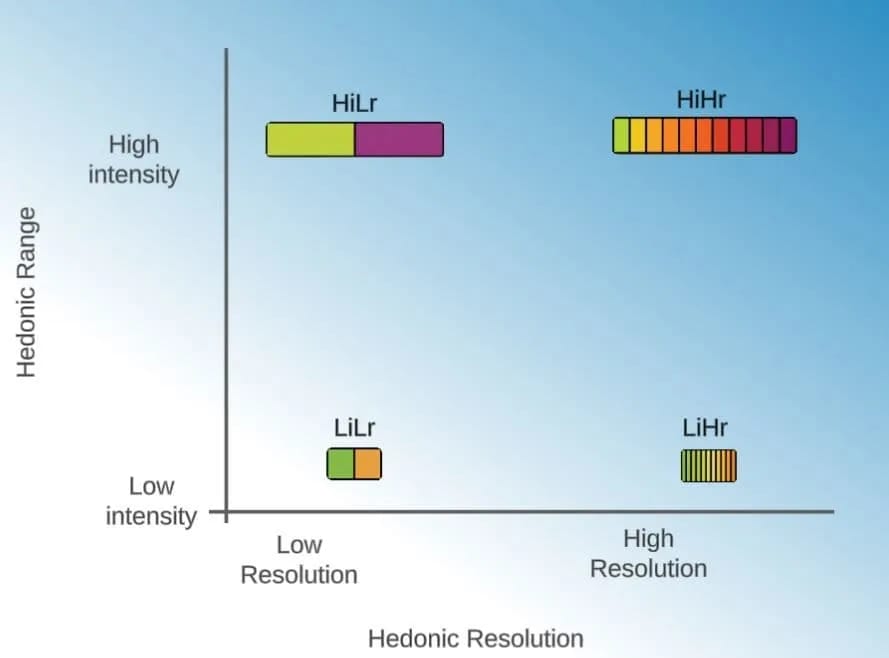
Consider Loïc, a man with an unbelievable condition. Like pretty much every human, Loïc can feel the slight unpleasantness of entering a room just a bit too warm, and the excruciating agony that makes one unable to think anything other than “make it stop”. But what makes him peculiar is that he cannot feel anything in between. Loïc’s condition makes it easy to differentiate what Birch et al. (2020) and Shriver et al. (2024, §3.2.6) call evaluative acuity from a hedonistic definition[1] of welfare range (see Fischer and Timmerman 2024):
Acuity: the number of dissociable levels of negative and positive affects.[2]
Range: the absolute intensity at the end of the affective spectrum, from none to extremely painful.[3]
Figure 1: A helpful visualization, with different terms, from Alonso and Schuck-Paim’s (2025a)
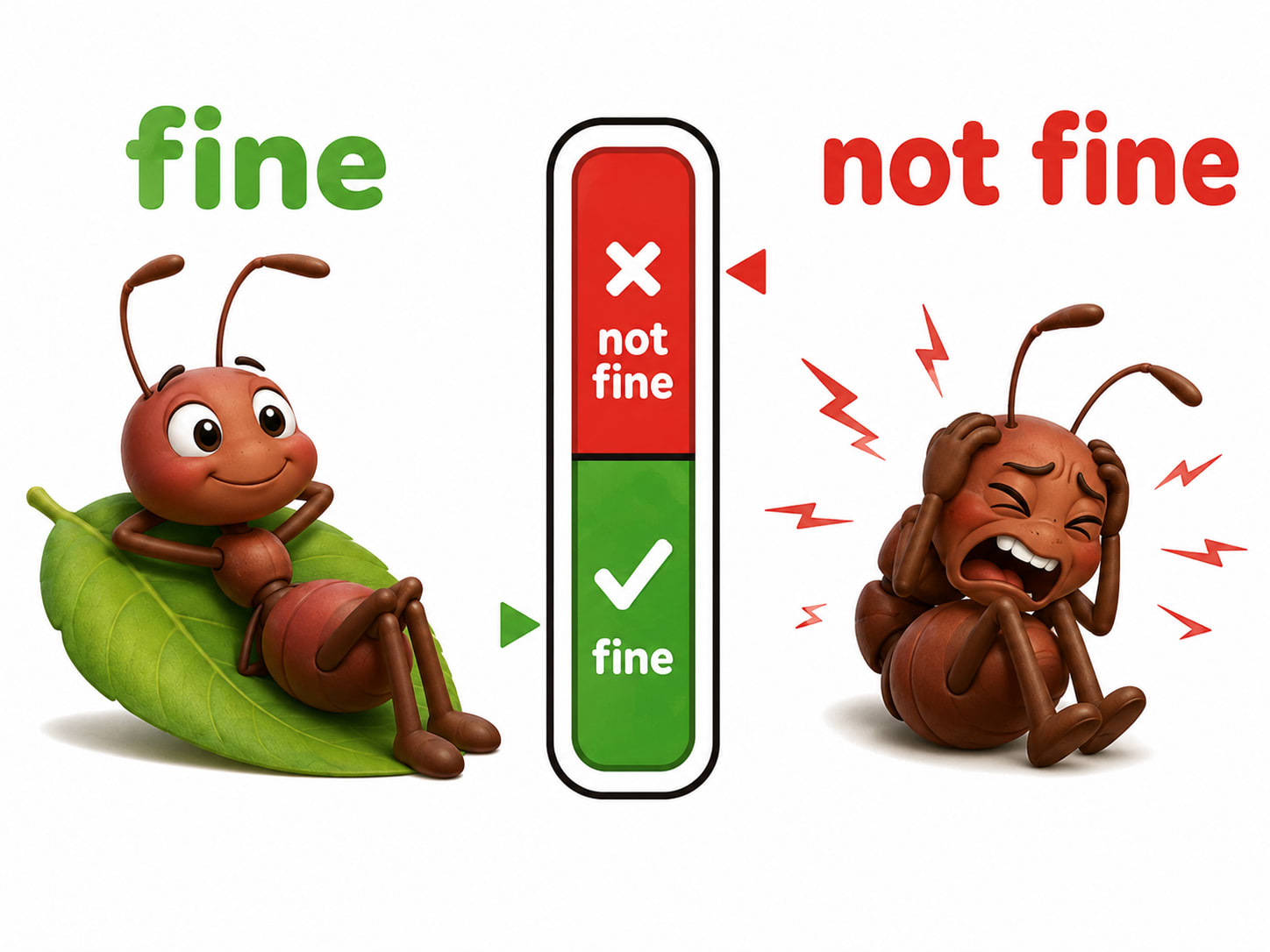
While a representative human is usually considered to have both a wide range and high acuity (top right of Fig. 1), Loïc has a wide range but low acuity (top left). While a regular ant is usually considered to have a narrow range and low acuity (bottom left), one could imagine a “sophisticated ant” that feels many mid-spectrum valenced states at different intensity levels (bottom right), or a Loïc-like ant that has low acuity but feels extreme things (top left, again, and Image 1 below).
Image 1: A Loïc-like ant, by Dall-E.
Presumably, valenced states come in different intensities in many different creatures because they need to be able to prioritize between different problems they face (Cabanac 1992; Veit 2023; Schukraft et al. 2024, §4.2). A broken leg is far worse for fitness than having a slightly too high body temperature. So it will feel far worse. A cognitively simpler being that does not face complex tradeoffs has fewer reasons to feel at different intensities. This led Schukraft et al. (2024, §4.2) to make the following assumption, which is key to the vast majority of the existing literature on cross-species welfare comparisons[4]:
[W]e should expect intensity to scale with something like the complexity of valence-informing choices that organisms face.
However, it is not (at least not directly) intensity but acuity that we should expect to scale with such complexity.[5]
Recall the regular ant with a narrow range and low acuity from the previous section. Say, for simplicity, that it feels only two different levels of negative states (or “pain”, for simplicity, even though that may not be aligned with how the term is used in welfare sciences). An example of level-1 pain is being mildly hungry. An example of level-2 pain is starving. One day, as it is mildly hungry, it sees a delicious-looking leaf floating on a puddle, near its edge. The fear of drowning is only level-1 pain, just like mild hunger. Hence, there’s a very decent chance it decides to take the risk of drowning to get the leaf, which is evolutionarily suboptimal. There are two different ways evolution could “solve this problem”:[6]
In both cases, increased acuity is required. However, range (indirectly) scales with complexity only in the case of evaluative expansion. A widened range is evolutionarily advantageous only in that it increases acuity, and acuity could be increased through granularization instead. Hence, while evidence of “something like the complexity of valence-informing choices that organisms face” is evidence of higher acuity, it is not automatically evidence of a wider range. Call this the acuity-range independence problem, or simply the acuity problem.[7]
Nonetheless, there might be reasons to believe granularization is not systematically favored over expansion, such that we should maybe not expect total independence between acuity and range.[8] I assess these reasons in §3.
I see three reasons to expect some dependence, all of which have serious limitations.
A) Just-bad-enough pain is more adaptive for beings with low acuity, which makes expansion more plausible than granularization.
The first part actually does not seem obvious under scrutiny. Say that sentience first appeared in two different simple creatures, independently, at the same time:[9]
Dolores: She's just like her non-sentient siblings, except that she feels unnecessarily severe pain if she's about to die of starvation, though not so severe that it would impair her ability to do what is necessary not to starve (otherwise, she would die, and it's her non-sentient siblings who would spread their genes).[10]
Here are two different arguments for why Dolores would have lower fitness than Mildred (and pushbacks):
B) We at least need expansion from nothing to sentience, so we should expect some expansion after that, too.
Why should we? Granularization was impossible at first, since there was no sentience, so expansion was of course necessary. But once granularization is possible, it might be favored, for all we know.
C) If we have no clue how much granularization vs expansion there was, we should apply some principle of indifference (POI) and assume it was 50-50.
We are in a situation of complex cluelessness where the reasons to believe evolution favors granularization over expansion, and reasons to believe the reverse, are asymmetric. The use of POI in such contexts has been widely rejected in the literature (see, e.g., this, that, and refs therein). There is a very meaningful difference between “I have no idea whether X is true” and “I have a 0.5 credence in X”.
Now, let us grant that there is something to at least one of the above three arguments, despite my critics, such that we should assume some dependence. How much exactly? And what is the exact dependence relationship (e.g., proportional vs logarithmic vs exponential)? The difference matters immensely. If we derive something like welfare range estimates from evidence of differences in terms of acuity, we implicitly answer these questions. And the more precise our estimates are, the more arbitrarily specific our answers to these questions must be.
To the extent that welfare ranges are a crux for moral weights, the above implies that the moral weights we should assign to different species must be much less determinate than many discussions implicitly assume. If much of the evidence commonly used in cross-species comparisons bears more directly on evaluative acuity than on welfare range, and if the relationship between the two remains poorly understood or otherwise undetermined, then our confidence in many precise interspecies tradeoffs should drop accordingly. Notably, this point bites even if we assume all animals are sentient. For example, according to Clatterbuck’s (2025) assumptions about welfare ranges and the cost-effectiveness of helping different types of farmed animals, an expected value maximizer should prioritize insects over chickens if chickens’ welfare ranges are less than ~8.5 times as wide as insects’. Otherwise, chickens should be prioritized. But the case I have made in this post gives us a reason for deep uncertainty about which side of this threshold we are on.[11]
Moreover, the acuity problem is only one of the drivers of moral weight indeterminacy. Others include uncertainty about:
This indeterminacy is problematic to the extent that moral weights are an unavoidable crux for cause prioritization (Fischer 2024b;[12] Browning 2023; 2022; Gaffney et al. 2022; Budolfson and Spears 2020), and not only for animal-focused or neartermist causes. Supporting any given project always involves some cross-species welfare comparison and interspecies tradeoffs, even if only implicitly.
Hence, we must research how to respond to this deep uncertainty about moral weights. Should we endorse and stick to a prior that posits no substantial differences in welfare ranges across species (see Shepherd et al. 2023; Dickens; Shiller)? Should we ignore the indeterminacy and optimize according to best guesses anyway? Should we prioritize further moral weight research to try to reduce the indeterminacy? Should we bracket out the considerations that are paralyzing? Should we accept some partiality? Should we look for projects that seem robustly good across various species, such that there are fewer tradeoffs to make? While discussing these options is beyond the scope of this post, each of these responses comes with serious challenges (Buhler 2026, slides). Hopefully, they can be overcome by research on decision-making under the kind of deep uncertainty we face here.
For valuable comments on a related draft, I thank Ben Stevenson, Vasco Grilo, and David Moss.
For helpful comments on an earlier version of the present piece, I thank Jeremy Andréoletti and Sébastien Moro.
I am also grateful to Wladimir J. Alonso for helpful discussions in different comment sections of the forum, which I link to in the piece.
Fischer and Timmerman (2024) also give a wider definition of welfare range that is compatible with non-hedonistic theories of welfare. But, for a case in favor of taking hedonism as a working assumption in our present context, see Fischer (2024a, §4.2) and Browning (2020). Though, the answers we would find under this assumption may, in fact, not be too dependent on it (Fischer 2024b, §5; Fisher 2022; St.Jules 2024).
Defined as such, evaluative acuity seems to correspond to resolution in Alonso and Schuck-Paim’s (2025a) alternative terminology, and to “number of intensity levels” in Schukraft’s in this 2020 comment.
This differs from what Birch et al. (2020) call evaluative bandwidth, which is about the number of inputs taken at once for affect-based decision.
Note that Schukraft et al. indirectly acknowledge this (see the next section). For reasons to doubt a strong correlation even between acuity and “the complexity of valence-informing choices that organisms face”, see the first bullet point in the second paragraph of §4.
This dichotomy was first drawn by Shevlin in an unpublished draft cited by Shriver et al. (2024, §3.2.6), although he uses the term contraction, rather than granularization, which I find misleading.
This acuity problem has been explicitly, although only briefly, acknowledged by Shriver et al. (2024, §3.2.6): “[I]t’s not immediately obvious that simply having a more discerning ability to evaluate will also entail having the capacity for more intense experiences [...] [There is] no particular reason to assume that the expansion rather than the compression account is correct”. More implicitly, Alonso & Schuck-Paim’s (2025) and Schukraft et al. (2024, §4.2) allude to it in their arguments for why we should expect acuity and range to correlate (see the next section).
We might need to assume that the animals we are comparing, welfare-wise, do not lack common sentient ancestors (i.e., do not result from independent evolutions of sentience) for this to follow. Or to make specific biological assumptions such that this still holds despite this.
This toy example is directly taken from this comment of mine.
Dolores is just like the hypothetical “Loïc-like ant" described earlier.
And that is leaving aside uncertainty about i) the cost-effectiveness of helping different types of farmed animals, independently of their welfare ranges, and ii) expected value maximization vs alternatives. The situation is even worse once we factor these in.
More specifically, see Fischer 2024a, §1; Fischer & Timmerman 2024, §3.4; Fischer et al. 2024.

Would you be willing to elaborate on this point?
How are the reasons asymmetric?
Sure, here are examples (and I'll take reasons not explicitly mentioned in the post, so this hopefully adds some value):
- Reason to think expansion (such that Loic-the-ant/Dolores should not exist): that's what smart moral weight researchers have assumed so far.
- Asymmetric reason to think granularization (such that Loic-the-ant/Dolores could very well exist): some subtle weak localized pains might require a complex brain architecture.
Here are symmetric reasons to contrast:
- We might be in a simulation where the simulators are observing what sentience evolution through expansion looks like.
- We might be in a simulation where the simulators are observing what sentience evolution through granularization looks like.
It seems legit to assume these symmetric reasons cancel out (that's "simple cluelessness"). Not so for the assymetric ones.