Comments
How the alternative protein ecosystem in Europe has evolved, and where barriers remain

4 min readMar 31
15
I wanted to share an update from GFI Europe, written by my colleague Seren Kell (with her permission), that we recently sent to a small group of donors. Seren leads our science and technology work in Europe, and this post shares her perspective on how the alternative protein research ecosystem has evolved over the past five years and where bottlenecks remain.
We thought it would be useful to share more broadly here, and hope it’s of interest.
I’m Seren, and I lead GFI Europe’s science and technology work. I’ve been at GFI for almost 5 years now, which means I’ve been lucky enough to see the alternative protein research ecosystem in Europe really start to take shape and grow.
I want to share my first-hand perspective on the impact this community's support has helped create: the progress we’ve made, what still needs to happen, and the role GFI is playing in advancing the field.
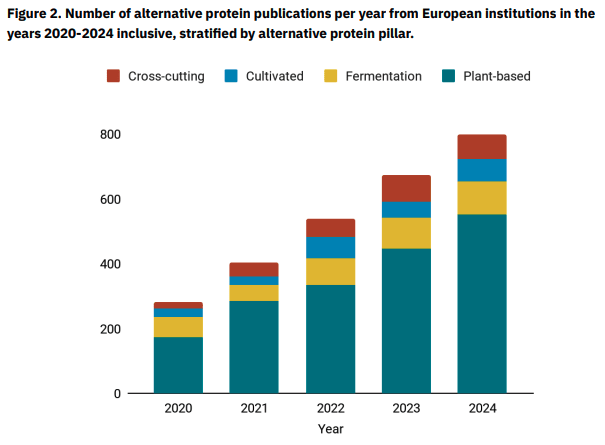
When I joined GFI Europe, a fair bit was happening in alternative protein research, particularly in Europe. But we were really looking at small, siloed pockets of activity rather than a coordinated field. Since then, the ecosystem has come of age. With increased research funding, we’ve seen the emergence of research centres, conferences, and networks specifically dedicated to supporting alternative protein science, including the launch of four such centres in the UK.
Now, thanks to our detailed analysis, we have a clear understanding of what research is underway and the topics researchers are focusing on. And while there’s been a significant increase in activity, much of it isn’t yet focused on the challenges that matter most – taste, texture and price parity with conventional animal protein. Knowing this has been hugely helpful in guiding future research and funding towards the areas that will make the biggest difference.
In cultivated meat, one of the biggest barriers has always been cost. In 2013, the first cultivated meat burger cost around $300k to produce. Early on, GFI identified animal-free cell culture media (the liquid used to grow cells) as a key cost driver and directed research efforts on tackling this challenge. Today, these costs are significantly lower, with many companies showcasing low-cost and animal-free formulations.
More recently, our analysis has shown that much of the applied work on cultivated meat is happening within industry, with limited involvement from academia. Looking ahead, we’d like to encourage more collaboration between companies and academic researchers to more effectively unlock breakthroughs and ensure that research benefits the entire field rather than individual companies.
In fermentation, we’re seeing a similar pattern. Costs are coming down, but further reductions are still needed before these products can genuinely compete in price with animal-derived equivalents. Feedstocks are a major cost and environmental driver, so the SciTech team in Europe is mapping realistic pathways for fermentation feedstocks to scale in Europe. This regional focus is one of the strengths of GFI’s global affiliate model, allowing us to tailor guidance to Europe’s local agricultural and food systems, rather than relying on global assumptions.
Plant-based foods present a different kind of opportunity. This is the most established ecosystem of the three, and yet in many parts of Europe, we’re seeing sales plateau or decline. This likely reflects the fact that only a relatively small proportion of research is focused on developing products that meet consumer expectations for taste and price, which we believe is critical for increasing uptake. This is a clear opportunity for GFI to steer efforts towards more targeted research to help close that gap.
One way we’re already doing this is through our Research Grants Program. These grants support work in underfunded, high-potential areas and help researchers generate the proof-of-concept data needed to unlock much larger pots of public funding. A great example of this is Professor Marianne Ellis in the UK, who received a grant from GFI and went on to lead the Cellular Agriculture Manufacturing Hub (CARMA), which has received £12 million in funding to investigate how cellular agriculture products, including cultivated meat and ingredients from precision fermentation, can be manufactured at scale.
We’ve also learned that having team members on the ground makes a real difference. Building trust and connecting researchers allows us to shape research priorities over time. In the Nordics, for example, our Scientific Community Coordinator, Ismaël Bawah, mentored students from the DTU Alt Protein Project in organising a national conference that brought together over 150 researchers across Denmark and the Nordics. The event strengthened collaboration and accelerated alternative protein research in a region that is likely to be a major force in advancing global alternative protein research.
As we build on progress from the last few years, we hope to expand our on-the-ground presence. Take Southern Europe, where there is growing research activity in alternative protein science, but for the most part, we have barely scratched the surface of the latent potential in agricultural and food sciences that this region is so strong for. With a team member based in Italy, for example, we could tap into this potential and make real progress.
Scientific progress is often gradual, but I hope this gives you a sense of how change is steadily happening and of what’s possible as the field continues to move forward. Getting taste and price right is essential if alternative proteins are to bring real benefits to the climate, animals, and people.
I’d welcome any reflections or questions you may have, so please do feel free to leave a comment.


Thanks Alex,
This is a nice update.
I would really be wonderful if we could see the urgency the world needs applied to this topic. GFI is doing amazing work, but how can we turn this from what appears still to be a niche area, into what it should be: a massive international effort to solve one of the greatest challenges of our time.
As EA's we're very aware of the multiple challenges the world faces. Alternative protein is unique in that it can bring huge improvements in at least three areas:
What should EA's be doing to push for more political support, more funding, more investment? Imagine what the industry could achieve with 1% of the crazy investments going into AI ...
Keep up the great work!
Hi Denis,
Thanks for your comment, and I completely agree with your framing of the opportunity here. Alternative proteins really do sit at the intersection of animal welfare, climate, and global health in a way that’s quite unique.
One of the biggest barriers to impact right now is funding. Public R&D funding for alternative proteins is increasing, which is really encouraging, but it still represents only a small share of overall food and agriculture funding and is far below what’s needed. Shifting that is one of the highest-leverage opportunities, and a key focus for GFI Europe.
Last year, GFI Europe directly influenced more than $55 million in R&D funding for the alternative protein ecosystem (excluding new government commitments that haven’t yet been spent). And globally, every $1 donated to GFI catalyses roughly $25–30 in follow-on public R&D funding. This multiplier effect is one of the reasons many in the EA community see this as a particularly high-impact area.
For EAs looking to help, one of the most impactful routes is supporting early-stage research and field-building, where philanthropic funding can unlock much larger pools of public funding as the field becomes more established and investment is seen as less risky.
Another way to help is by strengthening talent pathways. Building a pipeline of scientists, entrepreneurs, and policymakers is crucial to scaling the field. Individuals can have a direct impact here, either by pursuing careers in alternative proteins themselves or supporting others to do so. At GFI Europe, for example, we support student-led groups at universities to become hubs for alternative protein research and innovation through our Alt Protein Project, helping to inspire the next generation of leaders shaping the future of food.
Your comparison to AI is really interesting. It shows how quickly a field can scale once it’s treated as a strategic priority. We’re definitely starting to see a shift in the right direction, but accelerating it is the big challenge.
Really appreciate you raising this – it’s exactly the kind of conversation that helps move the field forward.
Alex