Comments

Cross-posted from Substack.
TL;DR
I share a list of rules I try to follow to be a lowercase-g “good person” in everyday life. The list is guided by three principles: be less selfish, take responsibility, and think in probabilities and counterfactuals. It includes things like avoiding chicken and eggs, donating effectively, checking on depressed friends, and cleaning up after others.
I give three reasons to follow these kinds of rules if you only care about uppercase-G Good: habits shape your moral thinking, everyday goodness may be important under moral uncertainty, and being visibly committed to doing good makes others more receptive to your moral views.
I personally (try hard to) follow a long list of rules in an attempt to be good. When I say “good,” I mean in the everyday / colloquial sense, not “philosophically” — because I don’t know how to be (uppercase-G) Good. This post is more pseudo-philosophy than actual philosophy, and has more persuasive power than it would if I were aiming for perfect epistemic humility. Put simply, I am Substack-tagging this post as “lifestyle” instead of “philosophy.”
I hope this post increases discourse on what standards we should be following in our day-to-day lives, particularly from EAs and EA-adjacent people. I want to expand and improve my list!
Do I follow everything on this list? No, but I do 85% of the time (I estimated what % of the time I follow each item and averaged them). Also, the list is not comprehensive (I probably forgot 5–10 other niche/untraditional rules that I have for myself; might add more here later).
The principles driving this list are:
- Be less selfish.
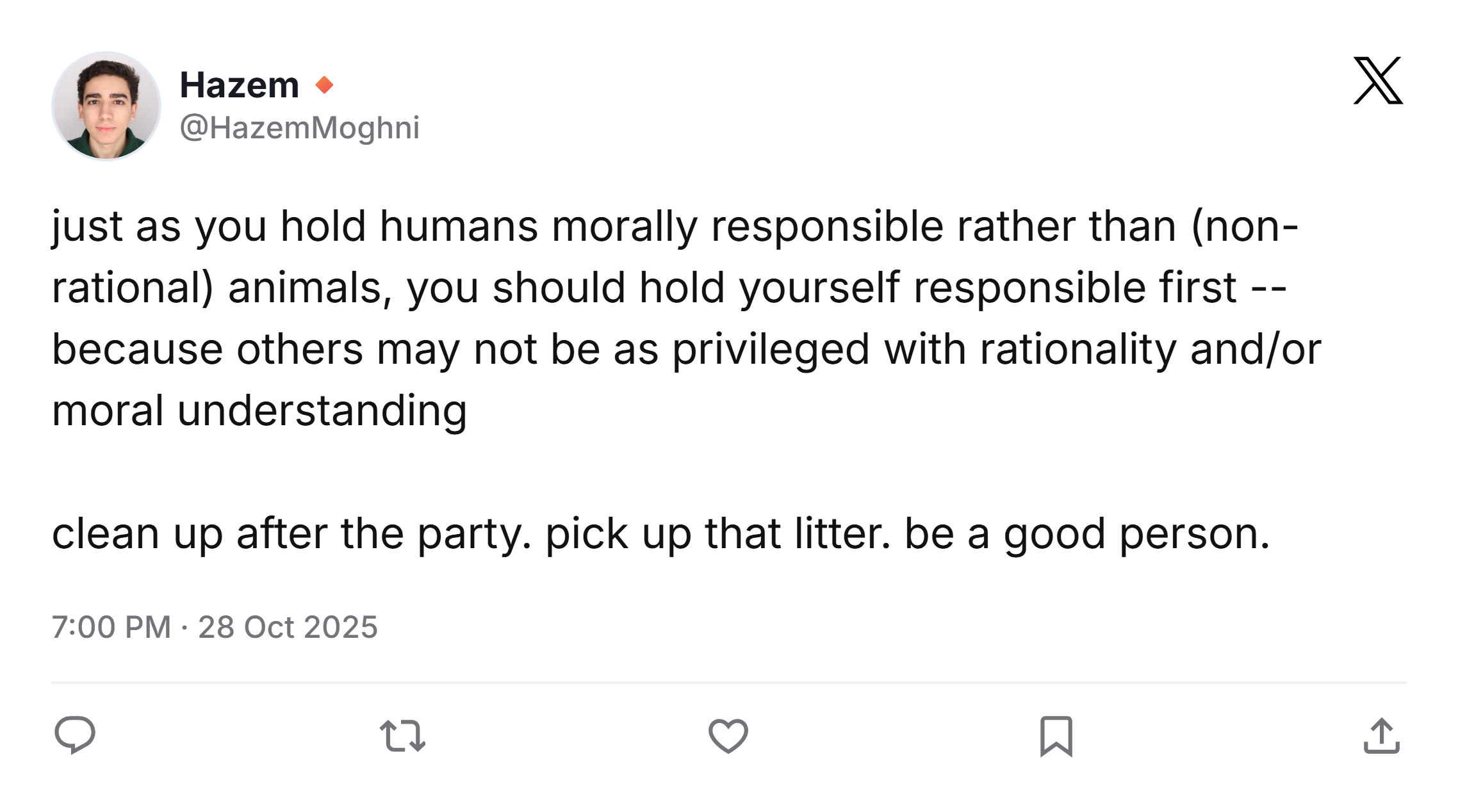
Take responsibility. Here is a way to rationalize this without feeling “taken advantage of”: We don’t hold animals morally culpable because they can’t do moral reasoning. Using the same logic, you should consider most others less culpable because they have less moral reasoning under their belt.
https://x.com/HazemMoghni/status/1983247481224749452 - Think in probabilities and counterfactuals[1]. Stop thinking in absolutes! Please!
Why do this if you only care about the (uppercase-G) Good?
Three reasons:
- Commitments and habits affect our thoughts and actions — I imagine I’d think less about, say, veganism if I always left shopping carts in the parking lot. I find this intuitive and expect most to accept it. Feel free to disprove it, though.
- “Being an everyday-good person” seems nearer to many moral theories than “being an everyday-bad person.” I haven’t tested this, but I think judging both on the expert-share-weighted, confidence-weighted belief in moral theories would show this. This point stands cause I think the list below is easy (if it were hard, then maybe it wouldn’t be worth it: doing a hard thing to be “slightly nearer the Good” might take away from actually thinking, reading, writing, pursuing the Good, whatever better alternative there is). Be a good person to be nearer to the Good.
- It makes others take your strong and actually important (socially expensive to hold) beliefs on morality more seriously, and even ask you for advice on their real-life moral dilemmas (at least that’s my experience). People listen more to you when you’re talking about how, say, they should donate their kidney if they know you are committed to donating 1% of your income. Be a good person to spread better beliefs in the Good.
Why do this if you only care about yourself?
I don’t know. Maybe it makes you feel better or something. I won’t make a counterintuitive argument for how being good makes you happier, partly cause we all know that to some extent, but mostly because a lot of the things I recommend are socially expensive.
When I say a lowercase-g good person, I don’t mean “society will like you” — they probably will if you follow this list, but it’s not optimized for their liking. It’s optimized for (I think) the result of (1) simple intuitions, (2) a few minutes of serious thinking/questioning per issue, and (3) better-than-average epistemics. I like to imagine a far future where society continues its gradual moral progress. What habits would they disapprove/approve of?
Honestly, just consult the graph:
(Before I get to the list, I want to clarify: I largely lean utilitarian, but use a lot of virtue-ethics/deontology-based words cause they deliver the ideas faster.)
To pick the items, I asked: (a) what would I want everyone to do, and (b) what can I convince a lot of people to do without much arguing? (That second restriction is why veganism is not on the list, and why some do’s and don’ts are only marginally beyond the status quo good persona.)
Without further ado, here is my list, in descending order of neglect (how few people already do it[2]):
The Don’ts
1. Don’t eat eggs or chicken.
99% of US farmed animals are “factory-farmed,” meaning they’re born, raised, and slaughtered in painful, disease-filled spaces that cramp their bodies. That makes 10 billion animals, every single year. Eggs and chicken in particular cause the most suffering per unit weight (excluding farmed fish), mainly because a chicken gives ~100x less meat than a cow but is probably <2x less conscious, so avoiding them solves most of the problem.
I recommend you read Andy Masley’s Animal suffering isn’t pretend — here is my favorite snippet:
Imagine that you found out that a doctor were going to cut you open and disfigure you without pain medication or anesthetic. You learned that this doctor did not behave as if they thought humans were really conscious or that their pain was worth considering. A lot of people who came to them died during the procedure. When you were cut open, you would feel the searing pain of the knife. You would live with your disfigurement after.
Really try to spend a minute thinking about what that would be like. Not in an abstract thought experiment “adding up happiness and suffering points” way. What would you feel in your bones? Try to think “I’ve found out this is going to happen to me in a week. There’s no way I can avoid it. I’m stuck in this timeline where I’m about to feel really horrible pain.” What would you feel as the minutes and hours passed? What would the experience of the pain itself be like?
Before you say it won’t make a difference cause it’s a drop in the ocean, see principle 3. In short, for every 1 kilo of chicken you don’t buy, the economy may produce 0.76 fewer kilos, on average (instead of 1, cause others capitalize on the drop in demand).
2. Don’t pedestalize people for traits they did not earn.
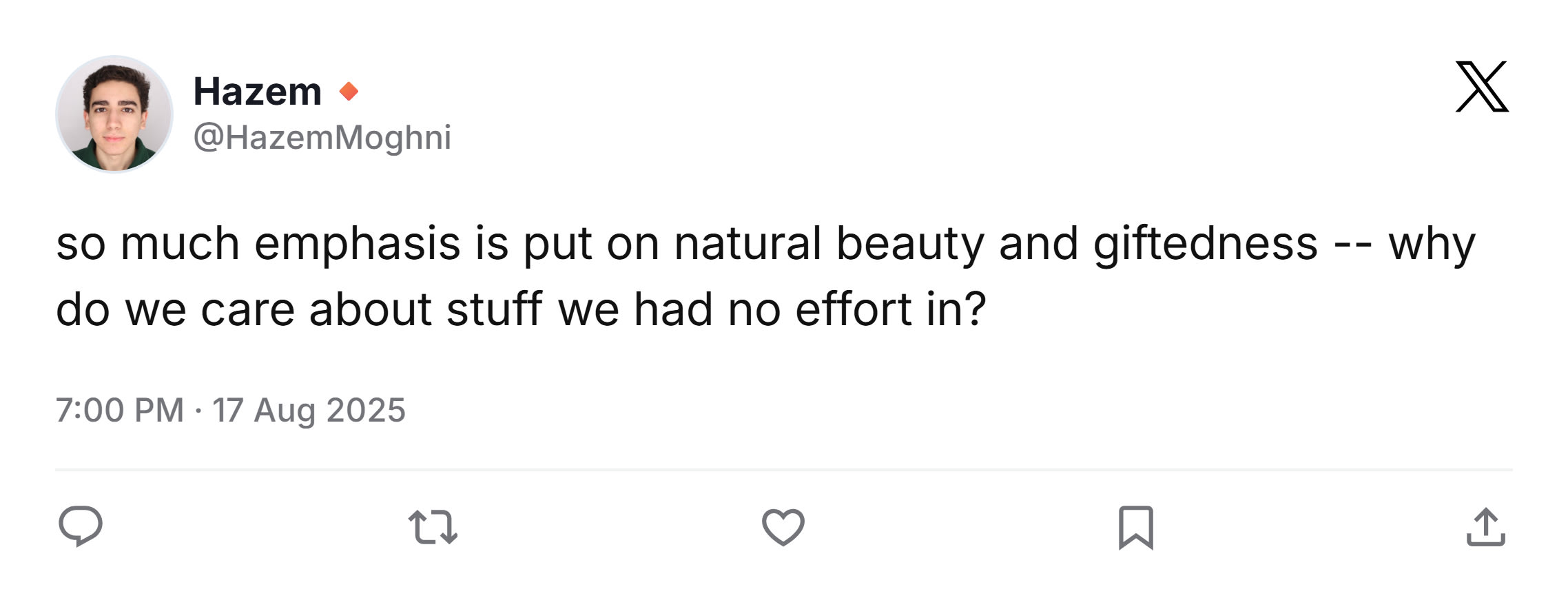
People base their worth on things out of their hands (mainly beauty and intelligence). I think it’d be better if we derived our value from our actions and morals, and better yet if we realized every one of us is inherently valuable.
Yes, even your children. Kids praised for being smart choose easier tasks and do worse after failing, compared to kids praised for their effort. Sadly, all of society is defecting here; even if you are a perfect parent, your kids will still be conditioned to have this self-worth that’s outside their control. So when your kid comes back from kindergarten and asks, “Am I ugly? :(”, you should be able to comfort them, telling them they’re not ugly or dumb, but only if you believe it (Don’t #9), which feeds into Do #5.
More generally: reward traits that, if rewarded, make the world better. This leads to rewarding (colloquial) “earned” and “good” traits, like being kind and hard-working.
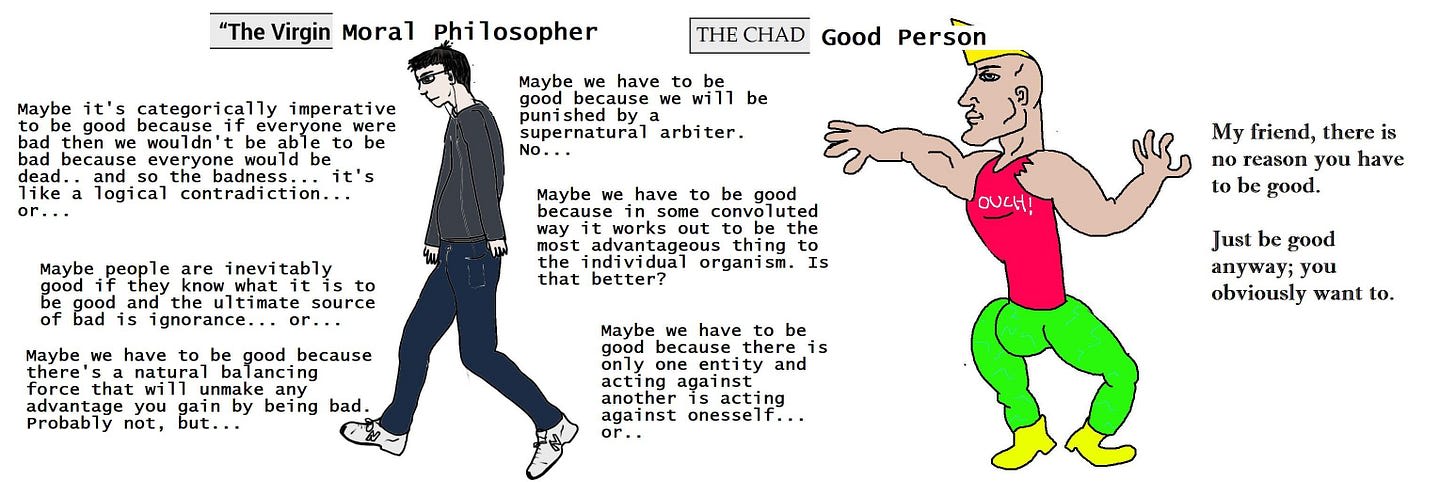
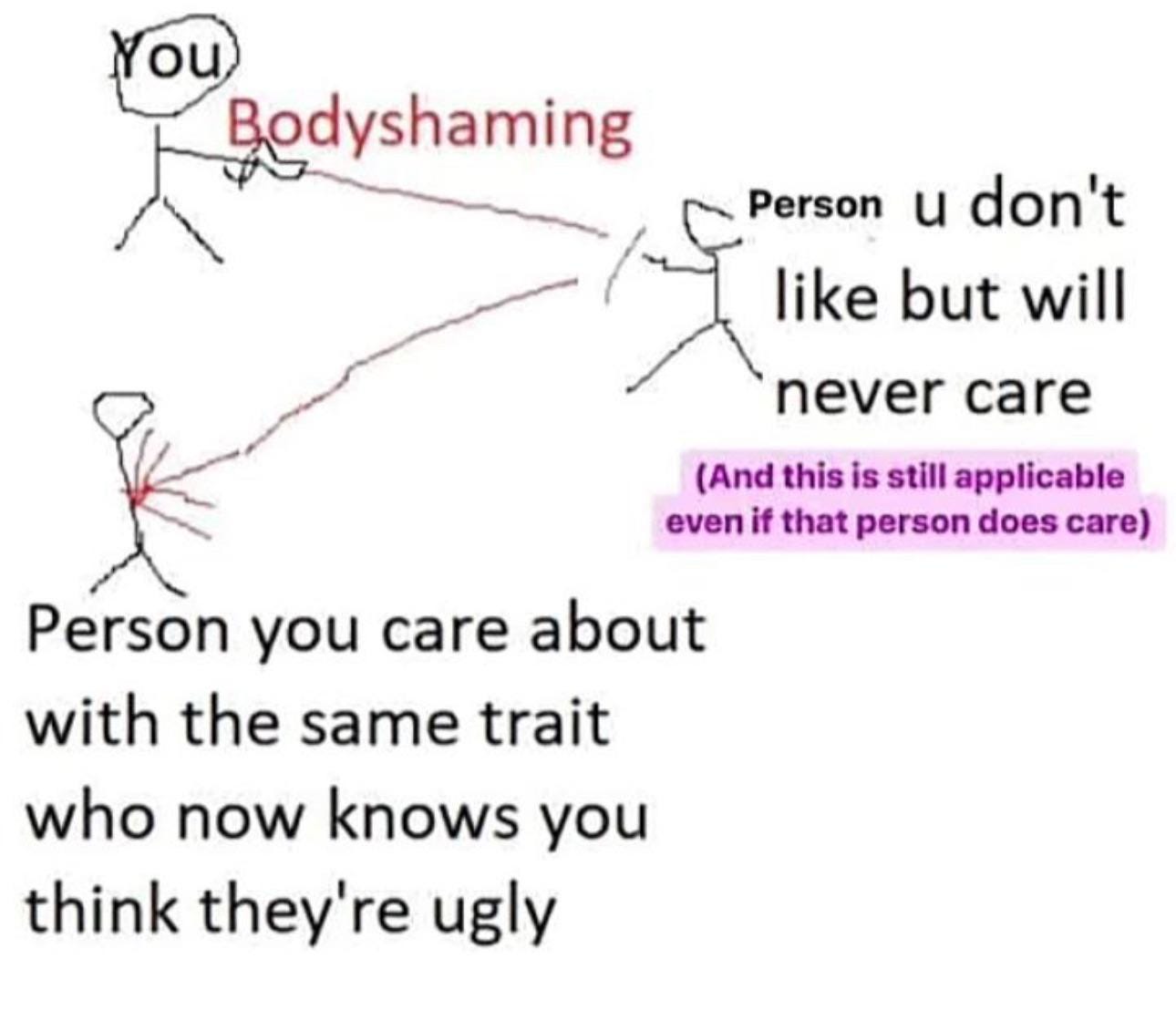
3. Don’t make fun of others’ appearance.
Even if they’re morally bad! [Insert morally bad person] isn’t bad because they are [insert non-beautiful physical trait]. I like to show people this pic:
4. Don’t consume pornography.
The industry is very underregulated and evil (low pay, weak worker protections, abusive content). Many (<80%?) videos have instances of abuse, yet over 80% of men consume them every year. Don’t.
Think: if x% of views go to videos that include abuse, then consuming videos will be (x% of the time) supporting/enabling an abusive creator and also (100% of the time) supporting/enabling the overall vehicle powering those x% of videos.
I had a friend once argue that the pleasure they get from consuming pornographic videos exceeds the probability-weighted harm they’re causing; even if that’s true, you still shouldn’t do it, as the counterfactual of not consuming involves a similar amount of pleasure[3] AND removes the harm. Besides, see principle 1!
5. Don’t curse at others.
Not for purity reasons. Make it less of a habit; resist it. Most of the time, you’d be acting out of anger. Nearly every time you want to call a friend something bad, it’s because you’re in your feels, not because they actually did something that warrants shaming.
Example (Newark airport)
Example: I’m in Newark airport. Train coming soon. I’m sweaty. Tired. Phone will die, but it has the ticket. I search for an outlet, but all of them are glued up? WTF? Do people not pay taxes in NJ? Whatever.
I ask a shop to charge my phone for 1–2 minutes; they say “sorry, no.” I ask another, same thing. I ask some policeman. He tells me, “Ask customer service,” and so I do. She says, “I’ll tell you where you can charge it if you ask nicely.”
I am now confused; I said please, spoke slowly and, as far as I can tell, very politely, too. I ask, “Sorry, was I being disrespectful? I didn’t mean to.” She says, “No, you weren’t,” then repeats that I should ask nicely.
I pause and think, “Hmm, is this a request for some feel-goody words in exchange for charging it at her office?” I ask, “Umm, is there a place to charge?”
She reiterates her point, with tone. At this point, I’m very irritated. “Ask again…” she says. I feel like she’s humiliating me. I repeat my first ask: “Hi, can you please tell me where I can charge my phone?” She says, “That’s it, no.”
I then feel a strong urge to curse at her, but then I realize I’m just tired and mad; she’s probably the same. So I don’t.
6. Don’t cheat on things if consequences follow.
Example where consequences follow: in high school in Egypt, I was part of a national system of 20-something gifted schools. In our final year, we all took exams and were ranked, then matched (using our preferences) with colleges/unis. Cheating on, say, the biology exam (or even helping or allowing others to, without cheating yourself) counterfactually makes a deserving, amazing-at-bio person go from being a doctor to becoming, say, a teacher. You cause them harm and make society worse.
7. Don’t drink alcohol.
Read Andy Masley’s article. Here is my favorite snippet:
1 person dies from alcohol each year for every 1900 people who drink. This means that throughout a lifetime of drinking (let’s say from 20 to 70) 1 person dies from alcohol for every 38 people who regularly drink. We can think of the 38 people as each casting a vote to normalize alcohol and fund the alcohol industry. Because it takes so few votes for an additional person to die, I do not want to be part of that 38.
A strong counter is: people are lonely and depressed. They’re also conditioned to not lower their guard and to keep to themselves. Drinking alcohol allows people to open up, creating friendships and possibly mitigating this problem.
(I personally find the counter strong to the point that I stopped telling my friends to stop drinking; I am mentioning the argument because I expect some to take it seriously and want them to form their own take.)
8. Don’t use hateful slurs.
Yes, even if the target people are not in the room. The less you say slurs, and the more you tell others not to, the less likely they are to be said when the target is in the room.
And yes, even if you are the target person. The analysis still holds, though the probabilistic effect is weaker, so I don’t really tell target-people to avoid saying slurs that target them. Still, I believe that if many of us avoided hateful slurs, we’d be collectively working toward a society where “specific hateful slurs that hold power” practically no longer exist. Obviously, bigots will always exist, but I think there would be fewer of them, and with no specific words for them to concentrate the hate in.
9. Don’t lie.
Obviously (or maybe not obviously), lie when it leads to good outcomes. You should lie to the axeman.
Be trustworthy. Keep secrets, esp. when you promise to do so. Don’t exaggerate others’ bad-moment stories. Don’t lie about your feelings to others; lying hurts them less now but more in the long term. Not lying is hard, because the opportunity to lie arises all the time, but you must try!
10. Don’t cheat on your partner, or make someone cheat.
Cheating on your partner is clear; the second isn’t. One can say, “If I hooked up with a monogamously-dating person named Bob, it’s on him for cheating.” See principle 2. And no, Bob wasn’t “going to cheat anyway” — he was going to cheat at some probability (principle 3), so that probability increase (times the pain of getting cheated on) is the harm you caused.
11. Don’t litter.
Even better: if something falls, come back and pick it up. Yes, even if you’re late to something. Best: pick up litter you find, which is surprisingly easy once you start doing it.
The Do’s
So far, this has been quite negative. Don’t. Don’t. Don’t. How annoying, am I right? But it’s necessary for being a good person. A lying, cheating, littering, frequently-hatefully-cursing person is not a good person. But I think that’s enough on not doing bad. Instead, let’s focus on the — more creative and less boring! — easy habits to do good in the world.
1. Donate 1%.
The average adult in the US donates 1%. You, too, can donate 1%, but a little differently: choose the most impactful charities. You could save 6–7 lives in your lifetime on a simple $65,000 salary.[4]
For context, if you chose randomly like the average person, you’d save <0.1 lives via donations. The reason behind this disparity is charities lacking good feedback mechanisms.
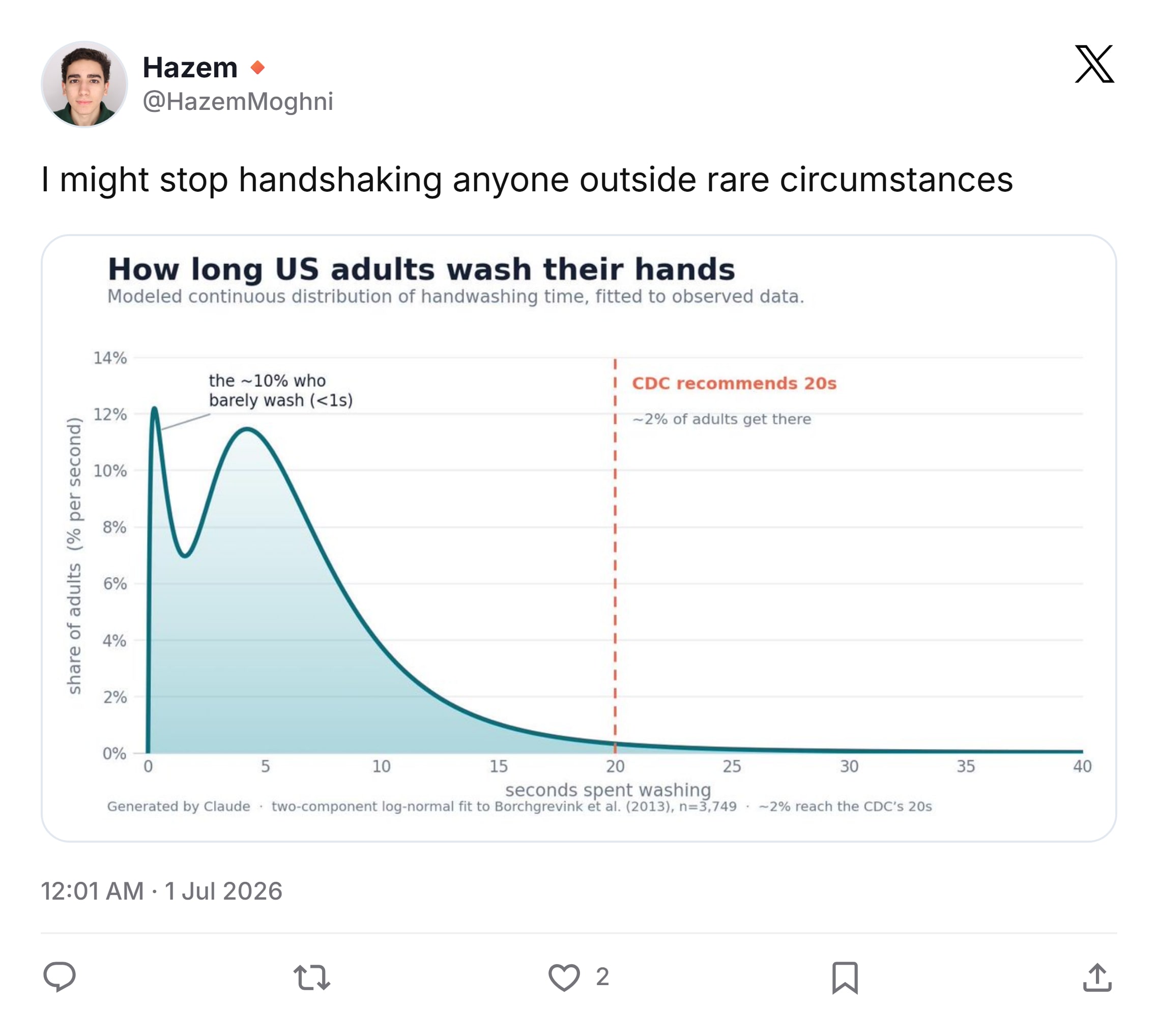
2. Wash your hands thoroughly for 5+ seconds.
Don’t spread disease. Contribute to a better society.
On the number of seconds, the CDC recommends 20 seconds. But that’s probably (in my opinion) overcautious; 5+ seconds of thorough washing may be good enough[5]. I personally always do at least 10 seconds (to be safe); 20 if I’m not in a rush.
3. Check on your depressed friends.
In Egypt, I had weekly reminders to check on three friends who I knew were suicidal. Caring texts reduce suicide attempts. Yours can, too.
You also can (should?) take this a step further. One friend was often not very responsive, so I frequently Uber-motorcycled over to his place.[6]
4. Be warm toward weird people.
Don’t just be tolerant of people who are different; be supportive! More generally, you’ll often be in circles where someone is extra awkward, left out (intentionally or not), made fun of, getting weird looks, avoided, etc. — steer away from those bad habits and talk to the weird people.
Think of the veil of ignorance: choose society’s rules without knowing who you’ll be in it. Remember the weirdest thing about you, and how their thing could’ve been yours. Imagine being them. Love them like others, but esp. more, cause they’re neglected by society.
5. See the beauty in people.
This one builds on Don’t #2. I think humans are beautiful in many ways. We compare other humans so much that many of us have forgotten how beautiful the human face is.
I want you to look at human faces (online, or wherever[7]) and try to see the beauty in them, the same way you do as you walk by museum paintings because you paid for a ticket and want your money’s worth. Really try, hard. I do this and find 80–90% of faces pretty/beautiful. My friends say their beauty standards for dating filter out 80–90% of people; my ratios are flipped.
And I don’t just mean beauty; humor, too (and remember to entertain humor at the object level instead of thinking “is this considered good humor?”).
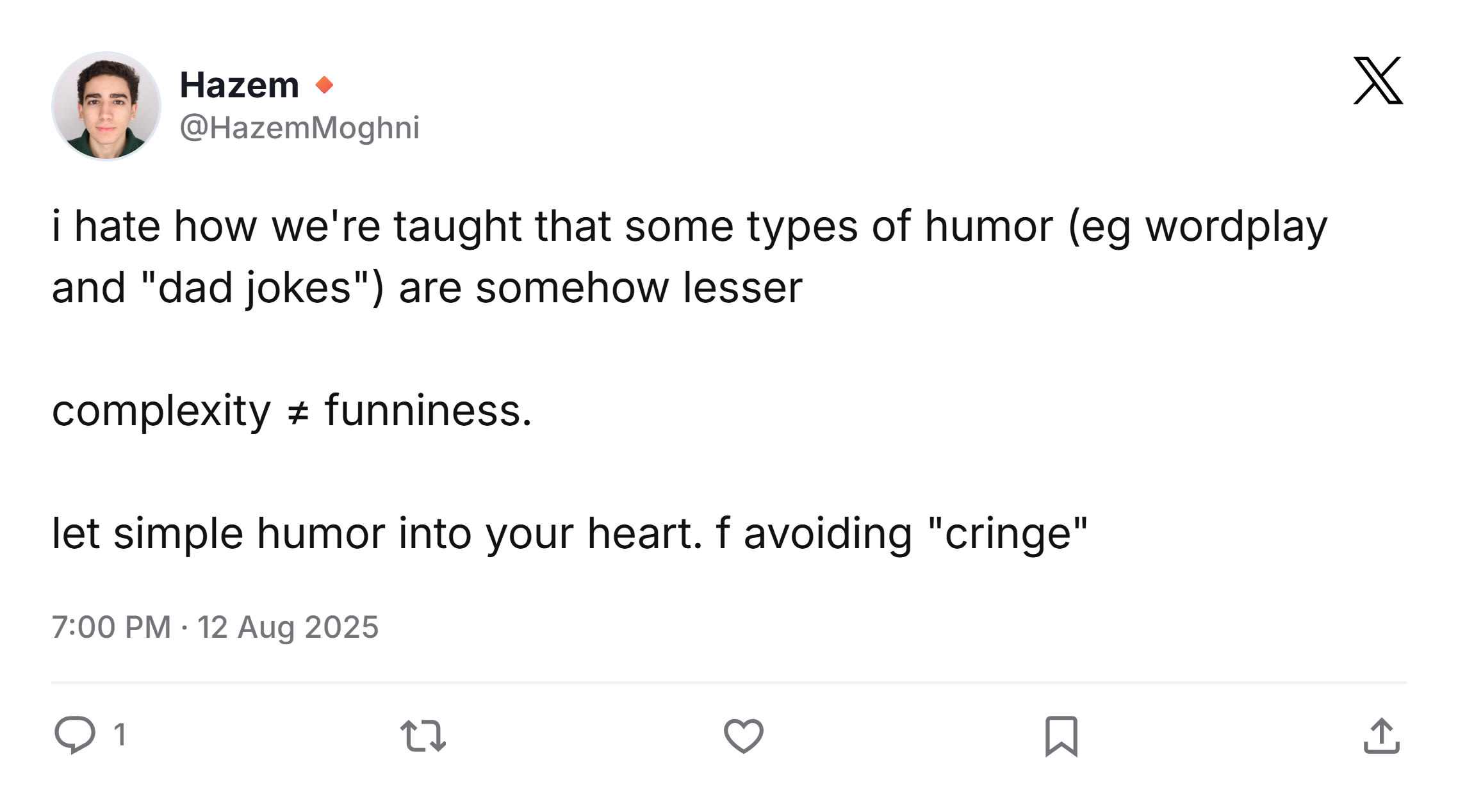
Generally, see (abstract) beauty in people. And let them know!
6. Sit down while peeing.
Much-needed advice for guys. It’s simply cleaner. For my physics nerds: less potential energy leads to less kinetic energy. The person using the toilet after you will really appreciate not sitting on invisible piss. Only 23% of US men do this; join us!
(Obviously don’t do this in public bathrooms; the defection of the rest forces you to join them and stay standing.)
7. Clean up after others.
Do wipe down the apartment, yes, even if your roommate has been a bum lately. Help with the after-party cleaning. Remember principle 2.
8. Thank, apologize, and love (explicitly! say words!).
Even for the smallest things. People love receiving a thank-you for a good deed they didn’t expect thanks for. Same goes for apologies — that kid you bullied in elementary is now a man who might (see principle 3) still be traumatized by your actions, and your sincere apology might make their day/week/month. On “I love you,” not saying it enough (or, more broadly, not expressing your feelings) is dying people’s #3 regret, and saying it makes people happier and feel, well, loved. If love doesn’t follow from being a good person, I don’t know what does.
Schedule messages to the people you care about during times you expect them to be lonely and yourself to possibly be very occupied. Pro tip: people are loneliest in December / around the holidays.
9. Return what you borrow.
Takes a second to put it on your calendar or tell your AI to remind you.
10. Vote.
It makes a difference. Before you say it won’t make a difference cause it’s a drop in the ocean, see principle 3. In short, you have a chance of flipping the election toward the better outcome. It takes a few hours and could benefit millions, so do it.
Have standards
Use this list of habits as standards for who you befriend, date and grow in proximity with. Maybe not all the rules, and maybe give weight to some more than others. But you’ll find that your commitment (real and verbal), along with expressed standards, will allow you and other wanna-be-good-ers to grow together. I think this last step makes society better, in a locally radiating way.
- ^
i.e. what changes because of your actions compared to what would’ve happened anyway. An easy way of operationalizing this is thinking: by how much do my actions change the probabilities of certain things? (the key word is change, as anything you “cause” or “prevent” had some prior probability of happening or not happening already; the change in probability multiplied by the impact is your difference).
- ^
based on numbers and my rough personal estimates.
- ^
self-explanatory I think
- ^
1% × $65,000 × 40 years ÷ $4,000/life = 6.5 lives. The most impactful charities save a life with every $4,000 donated.
- ^
Sorry, I am the man of one study.
- ^
Yes, there are Uber motorcycles in Egypt. You get on the back, experience the speed, feel the air. It’s really fun… dangerous but fun.
- ^
Don’t stare at people, though!