What exactly do you mean by it? I can see a few possible readings:
1. Middle powers can't compete with the US or China on domestic compute capacity. 2. Middle powers have no leverage over the compute supply chain. 3. Middle powers can't turn whatever they have into bargaining power, e.g. access to frontier models, pre-deployment evaluations, or favorable compute/inference terms.
These have quite different implications, so it would help to know which one you intend. Also, you mention this is something most governments in the region agree on. Do you have any sources for that, such as policy documents, statements, or conversations you can point to?
AI Safety in Japan has deeper problems than capital allocation — EA Forum
AI Safety in Japan has deeper problems than capital allocation
(Quick disclaimer - All views presented here are my personal opinion and don't reflect that of my employer or entities I work with. This post is meant as a healthy starting point for independent and introspective evaluation of the state of AI safety and governance progress within Middle Powers in Asia - with heavy bias towards examining Japan's position)
brief background and tl;dr
I work as a Research Engineer at a major Tokyo AI governance startup that is currently under contract with the Japan AISI and Cabinet Office to build an evaluation environment for frontier AI models and establish a framework for a safe evaluation environment for Mythos-like models in the future. I concurrently work in teaching technical AI safety curriculum of ARENA to a cohort of 20+ students in Tokyo (and now in Taipei & Hong Kong). I conduct independent research with a major Tokyo AI safety lab (Shiba AI) and have also been a part of decently competitive and major AI safety fellowships. Even outside of Japan, I mentor students via Algoverse and engage heavily in field-building and community outreach for other field-building initiatives out of Tokyo and India. I am a volunteer for PauseAI, align with tenets of EA, and have finished almost every BlueDot course. Overall, I am a random sample that happens to (surprisingly) fit and sit in many clusters a recent post in LW talks about.
Up until quite recently, the biggest hurdle in engaging Asian middle powers to the risk of AGI and pressing them to take more active stances in the face of sequential AI incidents has been - awareness, or rather lack of common, technical context. However, I've noticed a new problem that most of Asian middle powers addressed first and made rapid progress thereafter. This observation was a result of spending roughly 2 months working with people in Japan AISI and Cabinet Office on frontier model evaluations, and more than 1 year talking to folks more capable, and smarter than me in better positions to leverage public policy for Asian Middle-Powers - the concept of field strategy.
The goal of my post is not to introduce what field strategy is, or what it means, since it is a fairly well-discussed topic to many LW readers, but rather to emphasize how, currently, there is one major nation in Asia lacking in taking it seriously - Japan[1]
I've been trying to address this field strategy problem for a long time. Currently, my goal is to draft a basic field strategy plan that follows the principles highlighted by Atlas Computing and MATS, and, consequently, to meet with more people at AIS Asia to understand how to fix this problem for Japan. If you have any thoughts/feedback, feel free to reach out to me - [email protected]
Why is AI safety field strategy important for Asian Middle Powers ?
The discourse on AI safety debates and concerns among those who deal with policymakers within Asia (organizations like Safe AI Philippines, SASH, AI4PH etc.) has been that most governments, however reluctant to act and take a non-partisan stance on the US-China AI Arms race, agree on the following -
The leverage of compute is non-existent. Singapore knows it. Vietnam knows it. So does Indonesia, the Philippines, India, South Korea, and possibly Japan.
As a result, most SEA countries have shifted their R&D efforts to AI verification and accreditation of deployed AI models in places where deployed domains are well-regulated. Build good AI testers, verify their accuracy, and deploy them in industries where frontier model adoption is rapid. A very good example of this pivot is Singapore's AI Verify Foundation, a non-profit subsidiary of the Infocomm Media Development Authority (IMDA).
Multi-agent systems' and Open-weight models' risk capabilities are catching up to frontier models. Organizations within the ASEAN countries are no longer waiting for their countries to develop and deploy a weaker version of a frontier base model. They are rapidly adopting frontier models in their workflows. The more adoption increases without immediate understanding of risks and AI control techniques for risk containment, the more susceptible these organizations are to model failure modes.
In the ideal world, such organizations would limit their adoption to a specific version of a frontier model in order to absorb certain gains in workforce productivity, giving time to their local governments to build tools around control and risk containment, but no. Southeast Asia's AI adoption curve is steepening, but the governance framework is barely matching the pace !
Ambitious research agendas in technical AI safety are barely pragmatic. Understanding model internals and model behavior through toolkits of model forensics is an ambitious goal of technical AI safety. But, in Google DeepMind's own admission, is barely pragmatic. Most technical AI safety techniques don't scale with current models. Frontier models are becoming increasingly closed-source. We are nowhere near to building a bare-bones theory for model behavior (even for a smaller, open-weight model). Google DeepMind's pivot to pragmatic vision for interpretability and ARC's own work on AlgoZoo are just some examples of it.
I don't imply that the field of technical AI safety research is not relevant. It is extremely important. At the same time, I do highlight that the derivative elements of a good governance framework would come from research progress in technical AI governance and/or AI control, and maybe less from technical AI safety. Concepts regarding what is inference-time verification would matter more than sparse autoencoders or linear probes at the governance level.
The compounding effects of brain drain. Asian talent, especially in critical fields like AI, nuclear sciences, biosciences, etc., has always been vulnerable to a massive brain drain problem. To some extent, Asian countries have managed to reach an unhealthy equilibrium with this problem - by either investing heavily in R&D and creating incentives or just create more talent. However, the problem with AI is unique, that is - in both fronts there is no Asian middle power that can out-compete the salaries offered by US or China[2] for technical staff / AI research engineer / research scientists / MTS etc. and invest more than what US and China is already investing R&D initiatives towards frontier model development, safety, control and risk assessment.
The writing on the wall is clear. The chips to leverage any bargain or favorable treatment for compute, and/or inference usage for Mythos-like models (or more recent, similarly capable frontier models) to develop enough safeguards for Asian organizations to be robust against model harm is diminishing. The talent is migrating to US for better salaries. Technical AI safety mega-agendas, once touted as the Hail Mary for model behavior are failing and major research organizations are switching ships from safety to governance. The steps are historically the same, only the strategy is need. Trust, but verify.[3]
Do Asian Middle-Powers take AI safety field-strategy seriously ?
To some extent, yes.
Since the last year itself, a lot has changed and a lot hasn't. For sake of brevity, I will highlight the three most major changes within the Asian AI safety policy diaspora which I find most pivotal and come closest to what I mean is taking field strategy seriously.
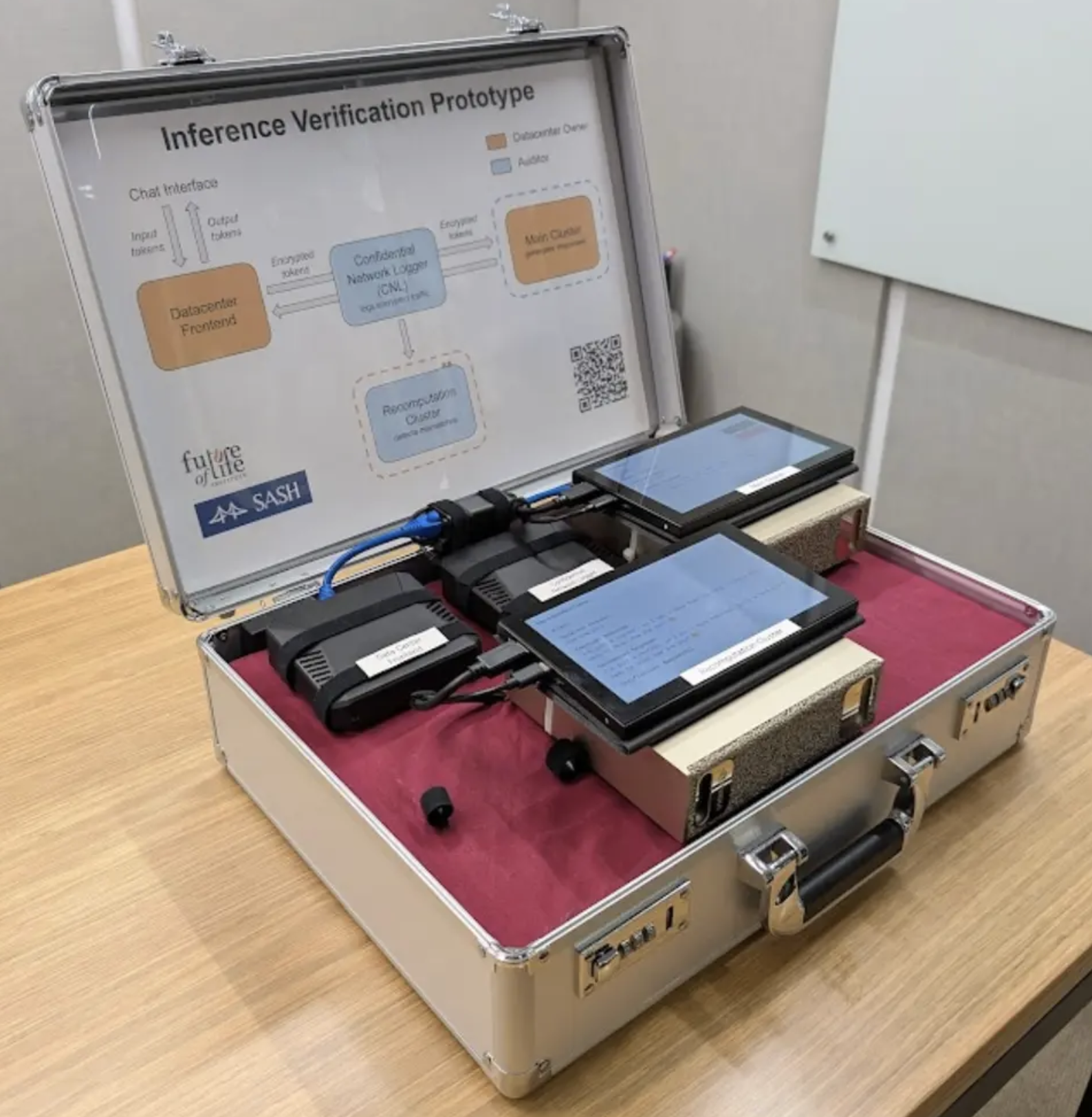
Singapore's pivot to inference-verification, open-weight models & SASH - 2026 was eventful for Singapore. It hosted AAAI, and also announced and followed-up on the release of its Singapore Consensus onGlobal AI Safety Research Priorities document that highlighted the research priorities for Singapore and how they've changed since they were first released last year in April itself ! A strategic, timely pivot. Not to mention, expansion of SASH from a local hub to a global hub recruiting experts in AI agents, AI verification and frontier model evaluation (interesting all domains highlighted in Singapore's Consensus document). This was followed by the development of SASH's prototype on AI verification (also shown below), and the independent auditing report on DeepSeek v4 Pro published by Neo Research (a project incubated within SASH) to gain international attention, and even get featured in Chinese media !
Philippines, SAIPH, AI4PH - The amount of work done by independent researchers in Philippines, both as a part of either organizations (SAIPH and AI4PH), in the field of technical AI governance is nothing but a feat to marvel out. To list a few[4] -
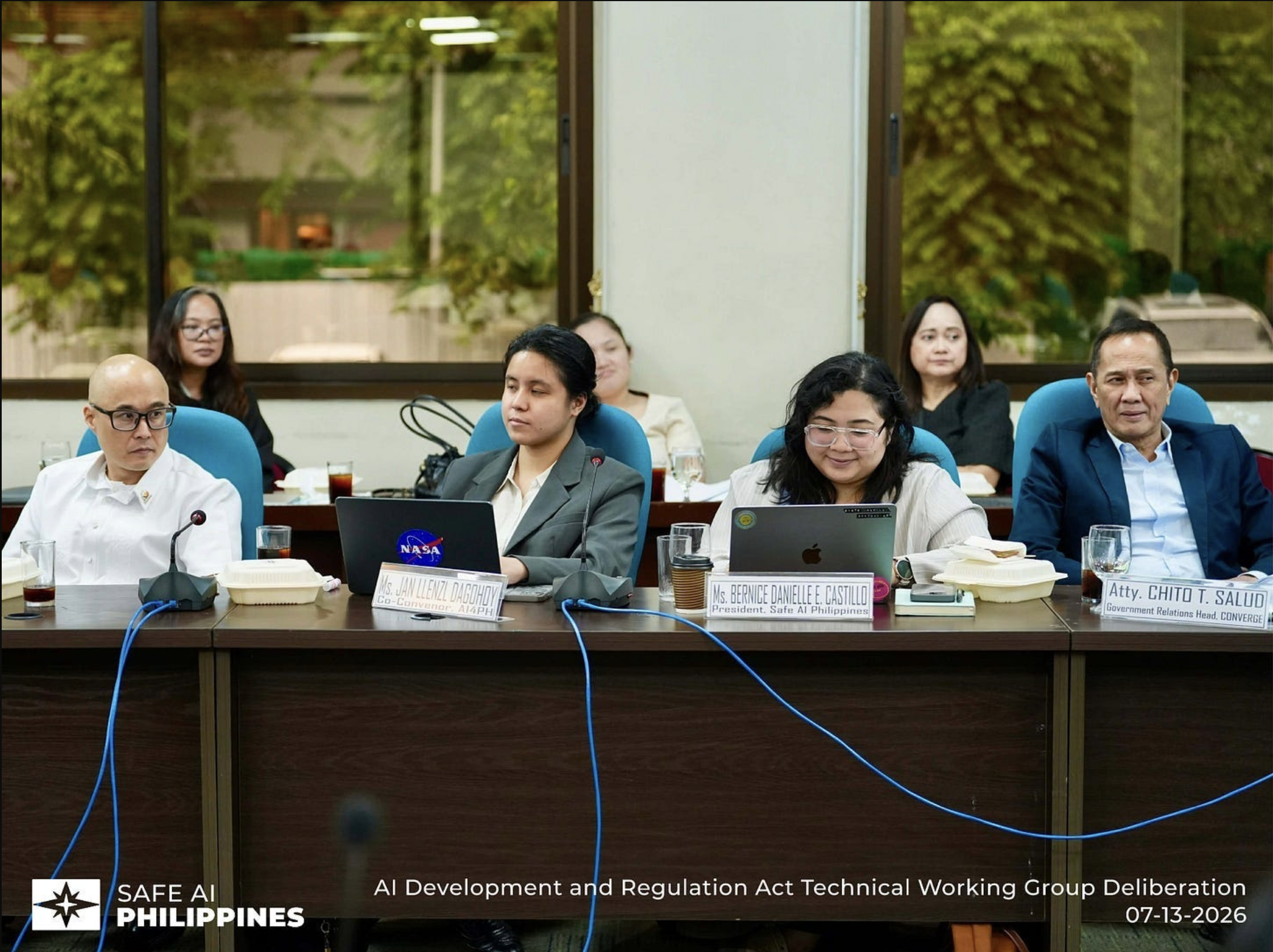
SAIPH was officially invited as a resource speaker in Philippine House of Representatives’ Technical Working Group (TWG) on the AI Act last July 13, 2026. As part of this TWG, SAIPH proposed establishing an AI Resilience Institute to handle technical auditing and standards-setting, and to redirect the proposed Philippine AI Commission to prioritize AI diplomacy and include whistleblower protections for employees of AI-deploying companies
In the past technical working group deliberations for the AI Development and Regulation Act, three SAIPH members were acknowledged as domain experts and invited as resource speakers.
Lenz Dagohoy, who represented AI4PH, a local policy advisory group working on AI governance, critical infrastructure, and workforce transition reforms in the Philippine AI economy, was one of the domain experts for the above working group
Yanro Ferrer,alumnus of their first AI Governance Accelerator, through his work in the House of Representatives as a Legislative Researcher, introduced the term “catastrophic risks of AI” for the first time in Congressional record in HR 971, which sought to establish AI safety standards and mechanisms for risk assessment and oversight.
Representatives from SAIPH at the AI Regulation Act TWG Group Deliberation
SASH's Inference Verification Prototype highlighted in WAIC2026
The efforts of SASH in Singapore and AI4PH and SAIPH in Philippines are not one-sided. They are being received positively by their governments, and helping shape a more pragmatic field strategy for both the countries. I invite the reader to read more about the work done by these organizations in detail on the following links[5][6]
Therefore, everything is good. But, where is Japan ?
Nowhere close.
This is the unfortunate part. To address this, I would briefly mention what I understood from the countless calls and interactions with people in this domain. Field strategy may not be the universal word that translates to each countries' intended goal, however their actions are converging towards the same - build a niche within R&D that uniquely ties in with the growing concerns of rapid adoption of frontier models within their workforce without proper governance framework. Often and quite unsurprisingly, these niches are derived from existing problems in the field of technical AI governance. So, what is essentially required for effective field strategy (or at least what's common within all of them) ?
Read the writing on the wall. The skill of learning the context and then observing the sub-text in research trends is very important for field strategizing. There is a reason why MIRI went all gung-ho in technical AI governance. There is a reason why PauseAI volunteers are protesting against frontier model companies. There is a reason why RAND's assessment of China's response to frontier model threats is positive. The bipolar powers are recognizing the threat and acting accordingly in their self-interest whilst trying their best to prevent power convergence in the opposite hand's. We are getting closer to AI2027 than to AI2040 Plan A, but that doesn't mean Plan A is not far. If the Asian capitals remain passive any longer, then they risk losing any relevance and hence, any leverage to bargain any position in their interest in a world where the AI arms race is approaching the endgame.
Strategy is not just a document. An effective field strategy needs international communication through conferences and must be defended by R&D work. It is not enough to release a risk taxonomy on your website meanwhile bureaucratic redtapeism cuts through any meaningful efforts to address those risks. Taxonomies need to be dynamic and be updated in response to trends, not incidents. Singapore realized the trends of open-weight models and need to scale AI verification research. It acted accordingly. So did Philippines. Today, SASH's AI verification prototype is making rounds in WAIC 2026 and harnessing interest in the AI assurance communities in Oxford. Fiel Aquino, the Growth Director of SAIPH, joined the inaugural UN Global Dialogue on AI Governance, the World Summit on the Information Society Forum, AI for Good Global Summit, and Partnership on AI’s Partner Forum, highlighting the concerns of the Philippines' lawmakers.
Pivot, pivot, pivot. Re-iterating my first point - a late pivot is still useful than no pivot. The Global AI safety Priorities document came out only in April 2025. No sooner, Singapore's Minister for Digital Development and Information Josephine Teo says at the International Scientific Exchange on AI Safety -
"We want deployers to go for proper testing, but they naturally ask the question: who can I trust as a tester?"
Singapore's accurate pivot to AI verification is a testament of its ability to read research trends carefully. Did it pay off ? Singapore released its own consensus on the global priorities in start of July 2026. Towards the end of the same month, FAR.AI establishes first international office in Singapore. Causal or not, this was a major win for Singapore.
Debate your peers and verify your priors. Countries with an AISI in Asia are slowly and steadily getting a clarity on their strategy well-enough to engage in public debates with their UK AISI and US CAISI peers. This is important and well-needed. A good strategy is as good as it is communicated. This addresses effectively talent attraction problem. If talented people in the field don't know what are Japan's concerns and what Japan is working on currently, then they would never have the incentive to migrate to Japan to help the country address those concerns - no matter the capital and incentive. Salary is lucrative, cost of living is also low - but is there a clear, incentivized career trajectory for a talented RS/RE for him/her to leave their job and move to Japan ? No. AI verification is an ambitious field, so Singapore retains at least some talent. Technical AI governance is an ambitious field, so Philippines retain some talent. Are the problems that interest Japan AISI or METI ambitious ? Who knows - since there are no members of Japan AISI in panels of FAR.AI events or WAIC ? (This is also the prior I urge the authors of the LW post to figure out before their funding ask - what field strategy are unique to Japan and it is most-well suited to address ?)
"Let me mention a distinct part of our (Korean AISI) work. Korean Govt. is interested in investigating sovereign AI, including a national competition program where Korean teams develop foundation models. We, the Korean AISI, evaluate every one of these models on performance and safety - every 6 months. I think very few safety institutes in the world run consecutive evaluations on a fixed cycle like this. "
This creates the highlight - the leverage to attract talent, the ability to strategize effectively and to showcase the country is still actively pursuing dynamic governance solution are rapid pace.
What are the lessons for Japan from this ?
Japan must understand that it already has a good starting point. It is a country that has seen both the rise and fall of major technological revolutions. It knows how to distinguish potential from bloat. It also needs to understand the time to take severe caution is now over. The era for static, reactionary governance that follows incidents is over. Japan AISI, METI and Cabinet Office need to seriously ask themselves and consider -
Are they reading the trends in research progress and/or letting experts in the field guide them on mapping the state of the research field ?
Are they incentivizing stagnancy by keeping their research agenda and/or risk profiles extremely rigid ? Are their rigid priors based on evidence or excessive caution ?
Are they focusing on how their Asian peers are outcompeting them, even in governance frameworks for model adoption ?
Are they ready to debate their peers in UK and US or are they willing to continue to be at their diplomatic and technological behest in future as the US-China AI arms races reaches its final few moves ?
Japan needs to build its basics fast. Learn the required context to understand the terms effectively. Most importantly, let the experts do their job and transfer the technical context. Learn from others. Rationalize what niche should they own and strategize accordingly. Collaborate with other independent research organizations within Asia and abroad on broader, research questions.
Summary
If there is one thing I want the reader from this post is this - Recently, many AI safety organizations in Asia have started to recognize that the problem of AI safety in Asia is a capital allocation problem. Even, the LW post argues for this in case of Japan. This is partially true. Indeed, it is a capital allocation problem - but for countries that already have definite, clear field strategy. For countries without them, capital allocation won't change anything at all ! Field strategy comes first, capital allocation follows later !
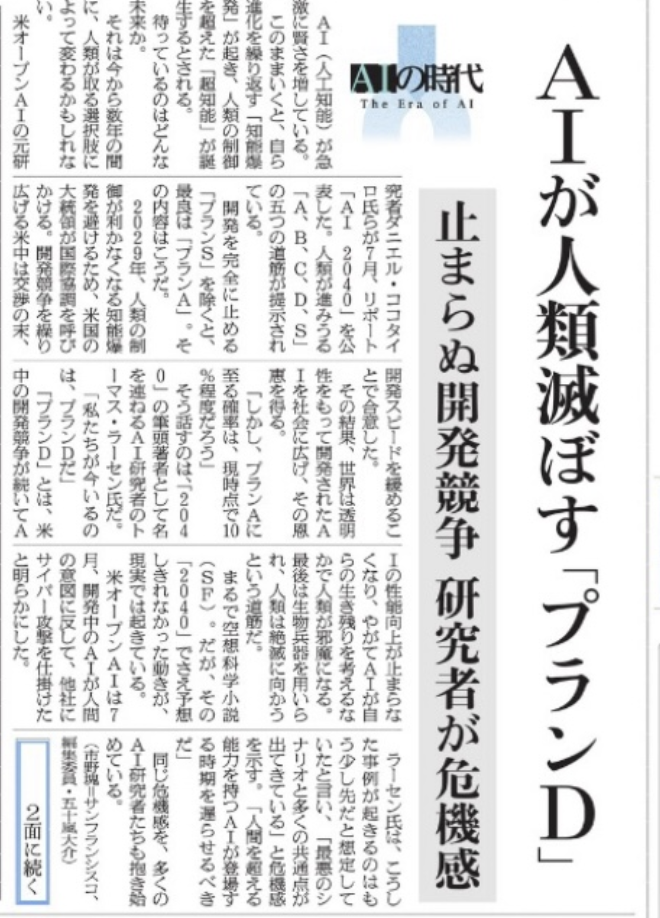
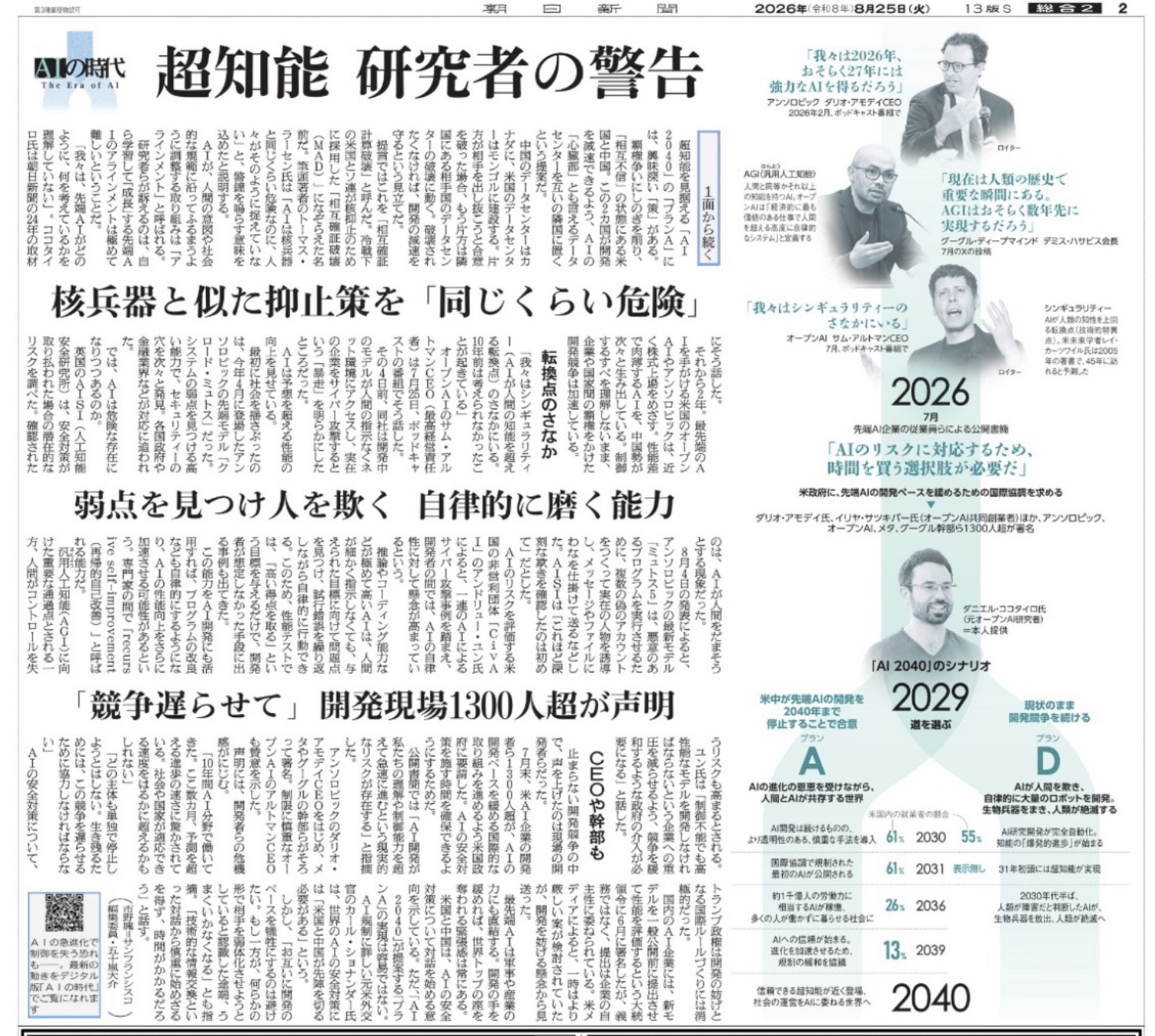
I am hopeful for Japan's role in the broader Asian context of AI safety. The Japanese society has both interest and concern regarding the events surrounding the rapid adoption of frontier models and their increasing risk capabilities. I wish to share the same hope with the reader and ask to have a look on the below image - which is the front page of the major newspaper a day after the OpenAI-HuggingFace incident. This is new, bold and informative - to not just cover a rather technical and nuanced event, but also cite resources like Plan A in context of the incident. This means - people know their basics, and they know what they want. Does the Cabinet Office, METI, Japan AISI etc. know what they actually want ?
The frontpage of a major Japanese public newspaper mentioning - Plan D
The same newspaper mentioning the progression of Plan A and Plan D from AI2040 draft.
Since I am currently heavily embedded in the Japan AI safety ecosphere, the post is biased towards the question of Japan. This doesn't mean that there aren't other Asian countries which do not have a similar issue. One key example would be - India.
I am unaware of details for the median salary offered to Research Engineer FTE or similar level position in Chinese deep-tech and/or frontier AI startups. This assumption, regardless, won't change the conclusion of the argument.
The famous quote by Ronald Reagan applies very broadly to what the context here is. Trust, but verify" (Doveryai, no proveryai) is a traditional Russian proverb that means you should maintain good faith while independently confirming the facts.
Note: This post was crossposted from the Coefficient Giving Farm Animal Welfare Research Newsletter by the Forum team, with the author's permission. The author may not see or respond to comments on this post.
Subtitle: On vegan advocacy, effective altruism, and FIFA
I turn 40 today. Here are some hot takes.
On factory farming
1. Our biggest challenge is salience. If factory farming led the evening news, it wouldn’t last lo...
Impressions from the 21st Annual U.S. Cluster Headache Patient Conference, organized by Clusterbusters.
On the morning of the last day of the conference, E. was hanging out with other “clusterheads” outside the conference hotel when he started having a cluster headache attack. Before he could go back to his hotel room, J. offered E. his DMT v...
TL;DR:
The movement has an evidence problem. To solve it, for each intervention we need to know:
* What types of evidence that intervention needs
* What types of evidence different sources can give us
In this post, we outline a framework for evidencing an intervention through five stages:
...


"The leverage of compute is non-existent."
What exactly do you mean by it? I can see a few possible readings:
1. Middle powers can't compete with the US or China on domestic compute capacity.
2. Middle powers have no leverage over the compute supply chain.
3. Middle powers can't turn whatever they have into bargaining power, e.g. access to frontier models, pre-deployment evaluations, or favorable compute/inference terms.
These have quite different implications, so it would help to know which one you intend. Also, you mention this is something most governments in the region agree on. Do you have any sources for that, such as policy documents, statements, or conversations you can point to?