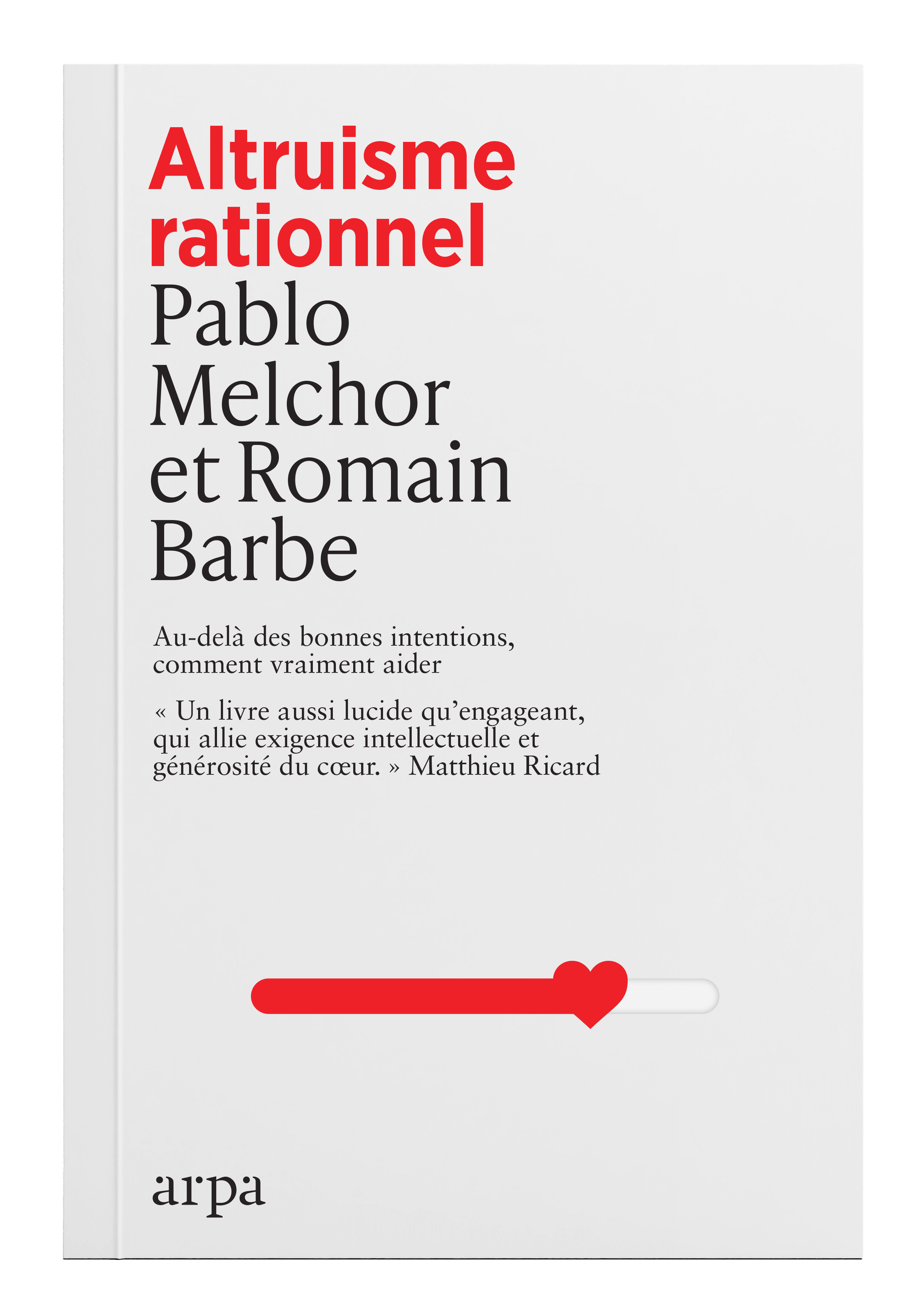
Altruisme rationnel comes out in France on November 5. It is a French edition of Pablo’s Altruismo racional, co-authored with Romain, with content rewritten or newly written for French readers.
Pablo and Romain founded and run the Spanish and French effective-giving orgs: Ayuda Efectiva and Mieux Donner.
The new book makes the case for “classical EA” to a general French audience: the world’s poorest people are largely invisible to us, ordinary people can do far more good than they think, and some ways of helping do vastly more than others.
All author royalties go to highly effective charities.
If you want to help: share it with French speakers, suggest French media we could reach out to, or get in touch if you are considering something similar in your own language.
The previous experience in Spain
Altruismo racional came out in September 2025. It sold decently, even well compared to the Spanish market, opened (or reopened) doors to media and podcasts, and fueled the growth of Ayuda Efectiva. It also became an outreach tool: Ayuda Efectiva and others bought copies in bulk to hand out at conferences and to potential donors. A year on, Pablo still thinks writing it was the best use of his time.
How Altruisme rationnel happened
The initiative came from Pablo. His Spanish book was doing well, and the publisher was opening a French branch. He could have simply had it translated with them, keeping the content as it was. Instead, he proposed that Romain become a co-author so that the book could become a valuable asset for Mieux Donner in France. That meant giving up part of the ownership and spending time rewriting.
Romain’s first question was whether the Spanish sales came from Pablo’s own reach in Spain or from the book finding readers on its own. If it was the former, a French edition would need a French author with an audience of his own, which argued for co-authorship.
Time was the only real obstacle. We went through the main cruxes, concluded that the expected value was clearly positive since most of the book already existed, and got started.
Was co-writing hard?
Writing a book takes a lot of time. The co-writing part was easy.
Everything lived in a Google Doc. We split sections, left comments and resolved each other’s open threads. Decisions were fast because we had agreed on the book’s goals. It had two jobs: convince someone who has never encountered these ideas, and give the existing community something they would want to pass on. Every proposed addition or cut faced the same question: does this serve one of those two jobs? That settled most disagreements before they even became disagreements, including painful ones about cutting good material to stay under 270 pages.
What changed from the Spanish edition
Most of the new material exists to make the book work in France:
Impact measurement in France. Romain has spent a lot of time studying this sector. There is a French story to tell about how often impact is claimed and how rarely it is demonstrated.
Climate. A lot of our French donors, and many people who start out wanting to do good, are worried about climate and focus on it first, so leaving it out would have been odd. The section stays short: one example, and an explanation of how the same principles apply.
Animal welfare. Pablo had deliberately kept it out of the Spanish edition to focus on one single message. We added it for two French reasons:
The EA community in France is close to animal advocacy, so a book that ignored it would be harder for that community to champion.
We had a strong example: a French charity that found its vegetarian-menu campaign risked increasing caged-hen suffering, changed course, and now works to get hens out of cages.
Title and subtitle. The title is a literal translation. The subtitle went from “why we can help more and how to do it better” to “beyond good intentions, how to really help”, chosen as the framing most likely to make someone open the book (a literal French translation of the original would also have been too heavy).
What makes this book different
Three things, beyond the French context.
It is written from Europe. The existing books on effective giving in French are translations of Singer and MacAskill, with English-speaking examples and charities.
It reads as a conversation. We are both in the text, with our own paths and our own mistakes. An early reader, a former deputy editor at a French national newspaper, said it felt like sitting across from us, raising objections that we answered as they came.
It takes the bad reasons seriously. “NGOs are corrupt”, “I already pay taxes”, “it should be the state’s job”, “the rich should give more”, “it is a drop in the ocean”: these are the objections we have heard in two years of conversations about giving. We devote a third of the book to them, working through them one by one.
Expected impact, and what we can actually measure
We are treating this as hits-based outreach. The book creates the opportunities for impactful things to happen, most of which we won’t be able to trace.
Our targets for the first twelve months (minimum success / best guess / excellent):
Copies sold: 1,000 / 2,000 / 3,000
Media coverage generated by the book, scored on a weighted points system where a national outlet like Le Monde counts 10: 15 / 30 / 50, with the top end requiring five major national placements
Podcast and YouTube views attributable to the book: 30,000 / 60,000 / 200,000
Directly identifiable money moved through the book, book-related podcasts and press: €5,000 / €10,000 / €50,000
The last figure needs a caveat. Attribution is poor here, and it errs in the direction of making our number look too low. The book feeds into year-end giving decisions that have many inputs. Some podcasts will invite us because of the book; others would have invited us anyway. For larger donors, what matters is a change in giving trajectory over years, which no attribution model we have will capture.
Where it stands
Four people read the manuscript and endorsed it: Peter Singer, Matthieu Ricard, Franck Ramus and Éric Antoine (entertainer and TV presenter).
Coverage mentioning the book so far: a profile of Romain in Les Echos in July, an interview on Le Futurologue in September, a feature in Bold Media and a radio interview (AirZen) in October.
How you can help
If you read French: preorder or buy it, for yourself or as a gift. Early sales decide whether bookshops stock it, and stocking decides most of what follows. Reviews on Amazon, Babelio or your bookshop’s site help more than they should.
Most of you will not read the book, and that’s fine. Passing it to a French friend, relative or colleague who has never come across these ideas is the reason it exists.
If you know relevant French media: suggest podcasts, YouTube channels or journalists we should contact.
If your group or organisation wants copies in bulk: write to info@mieuxdonner.org.
If the book could be useful to you but you don’t read French: we can send you an AI-translated English version of the manuscript.
Launch event
Monday, November 9, 18:30, at the Club de l’Étoile cinema in Paris. Romain in conversation with Éric Antoine, then two testimonials, drinks and a buffet. Free, registration required:luma.com/k9o70hk5
Acknowledgements
Thanks to Éditions Arpa, the Mieux Donner and Ayuda Efectiva teams, our early readers, and everyone in the effective giving ecosystem who gave their time to this.
With the AI windfall, mental health may be taken increasingly seriously by mainstream EA. There’s increasingly room to explore the cause area and answer some of the biggest uncertainties; at the same time, costs of the most effective interventions are continuing to fall. StrongMinds is now treating for ~$35, about a third of GiveWell’s best guess from a few years ago, and is expected to...
Summary: The actions taken this decade may be exceptionally important for the future of civilization, but we should be unusually hesitant to proclaim that any course of action is “best.” Still, we should try to think carefully about how we'll influence the future.
This post was written as part of an introduction to a new reading group I’m starting called “Doing Good in the Age of AGI.” If you want to follow along, the full curriculum can be found ...