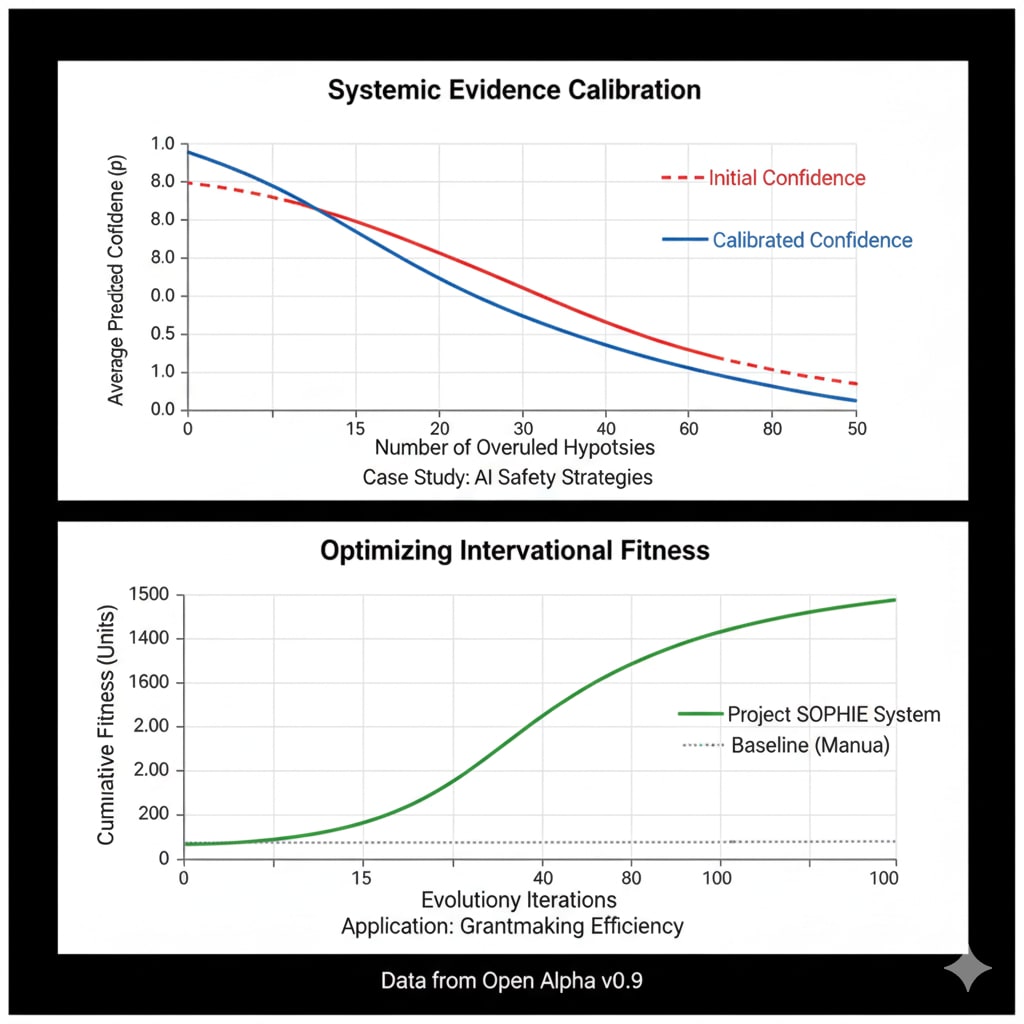
This document describes a conceptual framework for improving institutional epistemology and optimizing strategic decision-making at scale—"Project 'Sophie'." The core objective is to develop methods to make decisions on complex problems with high uncertainty, such as those typical in Effective Altruism (EA) (e.g., grantmaking, AI safety), more robust and less susceptible to cognitive biases.
We outline a multi-agent architecture based on four core principles:
Evolutionary Strategy Generation: An optimization core that generates and iteratively refines pools of solution strategies.
Consequentialist Evaluation: A feedback module that evaluates strategies based on simulated or real-world outcomes.
Epistemic Calibration: A service that uses Bayesian inference to adjust the system's confidence levels based on past performance.
Institutional Memory: A learning module that extracts successful patterns from past decisions and applies them to new problems.
We present this methodology for discussion to gather feedback from subject-matter experts and to assess its applicability and potential weaknesses.
1. Introduction: The Problem of Institutional Epistemology
Institutions dealing with complex global problems face a fundamental challenge: How can decisions be made that are impartial, optimally calibrated, and capable of learning over time? Human decision-makers are subject to known cognitive biases (e.g., scope insensitivity, confirmation bias), and valuable institutional knowledge is often lost through staff turnover or a lack of systemic documentation.
"Project 'Sophie'" is an attempt to address this problem with a dynamic architectural concept. Instead of relying on a single static model, we propose a system that simulates, tests, and refines strategies through a continuous process of evolutionary optimization, calibrated by consequentialist feedback.
2. Conceptual Architecture
The proposed architecture is designed as a recursive feedback loop in which multiple specialized agents or modules collaborate.
The main conceptual components are:
An Evolutionary Core: This module generates populations of potential strategies. It uses established evolutionary operators (e.g., mutation, crossover, targeted reinforcement) to refine solutions over generations, rather than relying on a single, human-designed solution.
A Consequentialist Evaluation Module: This module acts as the "fitness function" for the generated strategies. It evaluates the variants based on a multi-criteria vector that simulates or measures real-world outcomes. The criteria typically include feasibility ("Tractability"), target audience resonance, and alignment with the overarching mission goal.
A System for Institutional Memory: To learn from successes and failures, a service extracts patterns from completed decision cycles. This allows for the identification of causal relationships and the transfer of successful strategies from one context (e.g., a past mission) to new, similar problems.
A Predictive Component: Learned patterns are used to predict the likely effectiveness of new strategies. This helps the Evolutionary Core to intelligently narrow the search space for new variants and accelerate the optimization process.
3. Methodological Foundations
The system is based on established mathematical and conceptual approaches.
3.1. Bayesian Inference for Calibration
To combat systematic over- or under-confidence, we propose the strict application of Bayes' Theorem.
The basic formula is:
P(H|E)=P(E|H)⋅P(H)P(E)
In our context:
$P(H)$ (Prior): The system's original confidence in an assumption (e.g., "We believe with 70% certainty that this grantmaking strategy will be successful").
$E$ (Evidence): The actual outcome from the evaluation module (e.g., the strategy only achieved 40% of its goal).
$P(E|H)$ (Likelihood): The probability of observing this outcome $E$, given that the assumption $H$ is true (estimated from historical data).
$P(H|E)$ (Posterior): The calibrated confidence. The system adjusts its original 70% certainty based on the 40% outcome.
This process ensures that the system's confidence levels are rigorously adjusted to reality, rather than relying on intuition.
3.2. Evolutionary Algorithms as an Optimization Tool
The system uses evolutionary algorithms as a powerful tool for optimization within the solution space. Strategies are treated as "individuals" subjected to "selection" (based on their fitness score) and "mutation" (to generate new, improved variants). This approach is particularly well-suited for finding robust solutions to complex problems where local optima are a challenge.
3.3. Recursive Self-Improvement
A core principle of the architecture is recursive self-improvement. The system applies its own reflection and learning processes to itself. Based on performance analysis (e.g., if the evaluation module consistently favors variants that later fail in reality), the system can modify its own internal instructions and evaluation heuristics. This enables a meta-learning capability, where the system learns not only what to decide but also how to decide.
(AI generated Infographic to follow the Rules in the Forum of Using Ai Images or Open Source Photos)
4. Discussion Basis: Potential Use Cases in the EA Context
We believe this methodological framework could be useful in addressing some of the EA community's core problems:
Grantmaking (Assessing "Tractability"): Instead of just estimating the tractability of an intervention, the system could launch a mission to perform $N$ evolutionary rounds to optimize a strategy for that problem. The rate of improvement over the rounds (i.e., how quickly the system finds better solutions) could serve as a quantitative proxy for the tractability of the problem itself.
AI Safety (Cooperation Scenarios): The system could model complex cooperation and negotiation scenarios (e.g., between multiple agents). The pattern-recognition module could help identify subtle causal patterns that lead to stable (cooperative) or unstable (defective) outcomes.
Forum Improvement (Epistemic Quality): The evaluation module could be trained to score arguments based on derived metrics for epistemic quality (e.g., logical consistency, presence of calibrated probabilities, acknowledgment of uncertainty) rather than popularity (karma).
5. Current Status: Open Alpha & Invitation to Test
The system described here is not purely theoretical. A core implementation of "Project 'Sophie'" is currently in an Open Alpha phase and is already being used in real-world scenarios.
To move the discussion from theory to practice and to directly demonstrate the "Tractability" of our approach, we are offering members of the EA community free test access upon request.
We believe the "Scout Mindset" requires practical testing. A conceptual framework is valuable, but an applicable tool is a direct intervention to improve our collective epistemology.
6. Conclusion and Invitation for Discussion
We believe the approach outlined here, combining evolutionary optimization with Bayesian calibration and an institutional memory—has significant potential to improve the quality of long-term institutional decision-making.
We are posting this conceptual whitepaper to the EA Forum for discussion to gather feedback from subject-matter experts—ideally based on a direct examination of the system. We are particularly interested in answers to the following questions:
What potential pitfalls, systemic risks, or "Goodhart's Law" effects do you see in this approach, (potentially) after having tested it?
For which other EA problem areas (beyond those mentioned) might this methodological framework be useful?
What existing fields of research or tools (e.g., from game theory, causal inference, or AI safety) could be integrated to improve the robustness of the "fitness function" (the evaluation module)?
We look forward to a critical and constructive discussion.
I was born at the end of the cold war, unaware of the danger we were emerging from. Duck and cover drills (as if those could protect schoolchildren from a nuclear blast) were a curiosity of the past.
The farmer-poet Wendell Berry, who wrote about the dread of nuclear war, died recently. From his 1968 “The peace of wild things”:
When despair for the world grows in me
and I wake in the night at the least...
Summary
Over the course of a year, the Fieldshaper program develops you into a field-leading grantmaker. You’ll steward $1,000,000 in grant capital, receive a $125,000 annual stipend, and deploy that capital within a sub-field of one of three key areas (farmed animals, global health, or philanthropic infrastructure); building the track record to become a grantmaker who can shape a field.
Role Details
* Title: Grantmak...