Comments
Thank you, Matt, for giving us the chance to discuss your critique before taking this live. We appreciate the opportunity for a productive exchange, including a comprehensive feedback document and a direct conversation, and we're grateful for the care you put into this analysis.
Before this report circulates widely, we want to offer context and explain where we substantively disagree.
We agree with Matt on more than the report suggests
In line with Giving Green’s core value of collaboration, we want to start by highlighting common ground, because there is more of it than the critique suggests.
We share Matt's view that variable renewable energy (wind and solar) will do the heavy lifting in the energy transition. No serious analyst believes otherwise, and neither do we. We also agree that other tools can be used in addition to clean firm power, such as energy efficiency or demand response, to meet growing demand and help modernize the U.S. electricity grid.
Beyond electricity, we agree that transportation, food systems, and heavy industry are lagging sectors that deserve sustained philanthropic attention. Our portfolio reflects these priorities. The Giving Green Fund is broad: the majority of our planned 2025-2026 allocation supports high-impact nonprofit work on a global scale within food systems, heavy industry, and aviation and shipping. We expect to allocate about an additional quarter of our grantmaking to industry, energy, and possibly land use initiatives that are specifically in low- and middle-income countries. Likewise, our Unleashing Clean Energy—the strategy that encompasses all clean firm technologies—accounts for about a quarter of our portfolio, with nuclear-specific grants representing 1-2%.
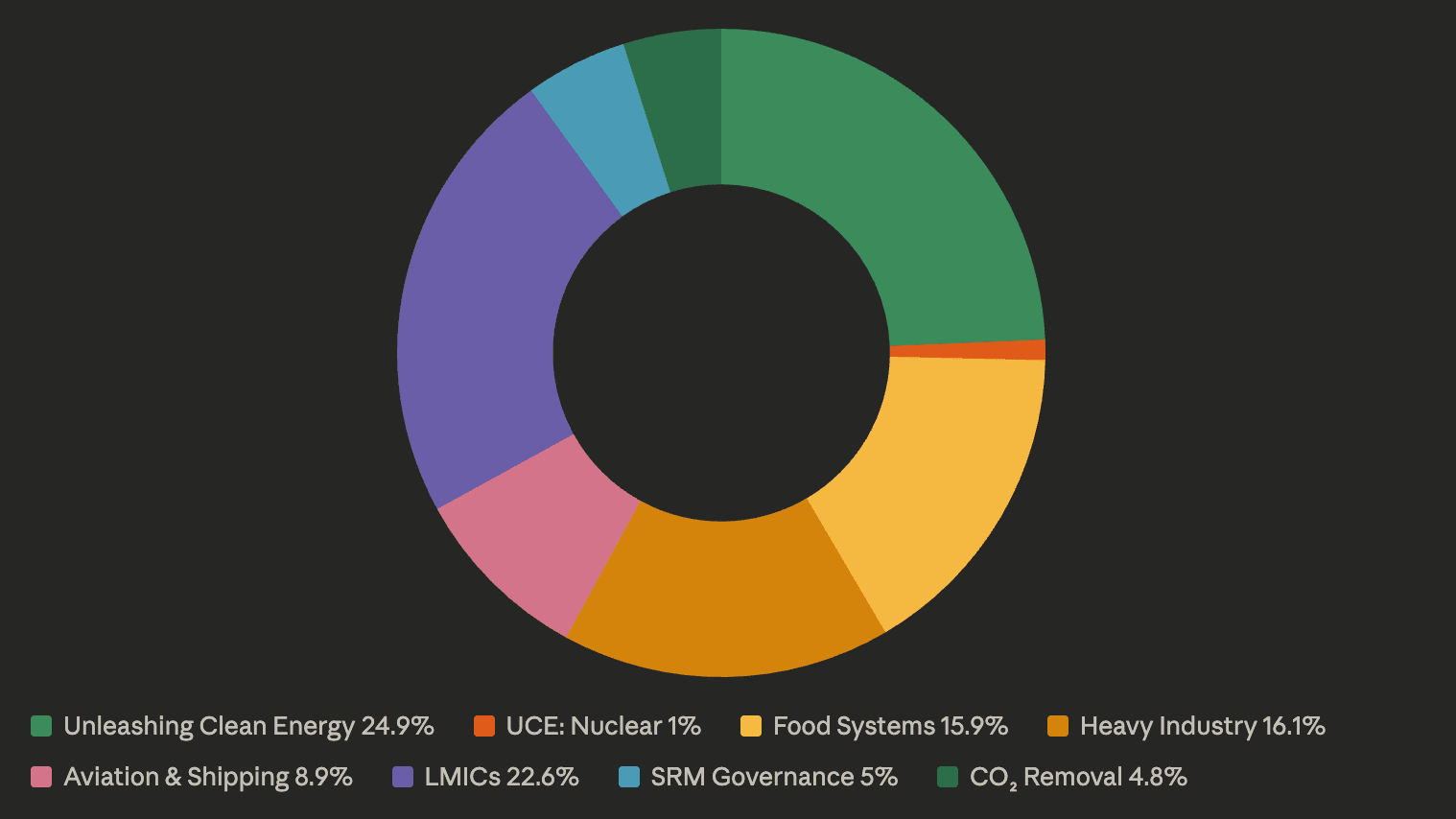
Figure 1: Expected 2025-26 Giving Green Fund grants by strategy
We also agree that the energy transition involves deep uncertainty. We do not think any single technology is the definitive answer, and when we do make grants supporting particular technologies, we likely have a good argument for doing so (for instance, capitalizing on a policy window of opportunity). Our Unleashing Clean Energy framework supports the policy and market conditions that allow the best solutions to emerge—whether that turns out to be long-duration energy storage (LDES), enhanced geothermal systems (EGS), carbon capture and storage (CCS), nuclear, or some combination. A portfolio approach is both more resilient and more honest about what we don't know.
Between 2023 and 2025, Giving Green’s nuclear-specific grants fell from 17.5% of a small $570K portfolio to 1.7% of $18.15M (as of early 2026), a sharp and deliberate shift that captures our evolution in supporting a wide portfolio of promising clean firm power technologies.
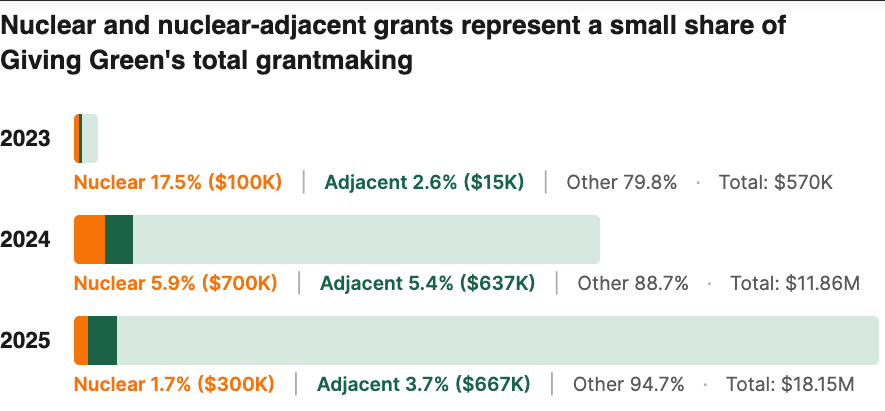
Figure 2: Giving Green Fund nuclear and nuclear-adjacent grants as share of total grantmaking, 2023-2025
How much clean firm power do we need?
The report argues that excluding efficiency as a capacity resource makes the implications of the models in support of clean firm power weaker.
We continue to trust the three grid modeling studies we rely on—Baik et al. (2021), Cole et al. (2021), and Denholm et al. (2022)—which collectively suggest 700–900 GW of new clean firm capacity will likely be needed, representing roughly 20–40% of grid capacity on a net-zero grid. We acknowledge that these models use older cost assumptions and could benefit from more nuanced consideration of efficiency, and we welcome updated modeling. But the broader picture is more mixed than falling solar and battery costs alone suggest. There is a surge in AI data center buildout, growing civic opposition to large-scale renewable land use, and increased party-level polarization around renewables in the U.S. These forces increase the relative value of firm, dispatchable power.
The demand signal from major technology companies makes this growing value concrete. Hyperscalers like Microsoft, Google, and Amazon are not simply buying renewables plus batteries. They are signing long-term nuclear power contracts, investing in geothermal, and explicitly seeking around-the-clock firm power for data centers that cannot tolerate intermittency.
The underlying dynamic is as follows: at low to moderate penetration, adding renewables is cheap and displaces fossil fuels straightforwardly. But as renewable penetration rises, costs become increasingly asymptotic. The last 10–20% of decarbonization—filling seasonal gaps, providing grid reliability services, meeting firm 24/7 demand—is precisely where variable renewable energy (VRE) and short-duration batteries hit their limits, and where clean firm becomes essential. Reaching 100% clean energy is a hard constraint on which we simply cannot compromise. Where the cost curve bends depends on local factors such as land availability, transmission, and battery costs. But the logic of needing some firm capacity at high penetration is robust across most U.S. grid contexts.
Which clean firm technologies should we support?
We don't know which clean firm technologies will ultimately prove most viable, and we think that uncertainty is actually an argument for continued investment, not for withdrawal.
Every clean firm option has fundamental challenges. Long-duration energy storage still faces cost challenges and indirectly faces land use and social opposition challenges associated with VRE. Enhanced geothermal systems are promising but remain largely unproven at the commercial scale. CCS is still in early-stage demonstration and similarly faces cost challenges. Nuclear is a proven, widely deployed technology, but its primary challenge is cost, which is real and not fully resolved.
We find the asymmetry in the report's recommendations puzzling. If uncertain economics and unresolved challenges provide sufficient reason to deprioritize nuclear, the same logic would seem to apply to EGS and CCS, which are less proven. The report does not explain why nuclear should be singled out rather than all unproven or expensive clean firm options. Our view is that the uncertainty cuts the other way: because no single technology is a sure bet, eliminating any from the portfolio increases the risk that we reach high renewable penetration without the firm power needed to complete decarbonization.
Clean firm innovation to improve costs, prove technologies at scale, and build supply chains requires sustained investment now, not after the uncertainty resolves. Delayed action risks missing the window to build the knowledge base and industrial capacity that a net-zero grid will require.
Where should philanthropy focus?
Given these dynamics, we think the distinctive role of philanthropy is to fund the long-term, high-risk work that private capital and government programs underinvest in.
Private actors have strong incentives to develop and deploy technologies once they are commercially viable. They have weaker incentives to build public trust, integrate equity and environmental justice, conduct independent policy research that may complicate deployment, or engage in the kind of long-term systems thinking that doesn't generate short-term revenue. Nonprofits fill that gap. Some of the organizations we support have pushed back against industry-favored policies, such as cost-overrun insurance for nuclear, precisely because independent analysis is what they are there to provide.
The report suggests that philanthropic support for nuclear duplicates existing private and government promotion. We disagree. The functions are genuinely different, and the counterfactual—a clean firm landscape shaped entirely by private and government actors without independent nonprofit input—is not one we think leads to better outcomes.
We also think the current policy environment creates a strategic opportunity. The Trump administration has been more favorable to nuclear and geothermal than to variable renewables, and a similar dynamic is playing out internationally following Russia's invasion of Ukraine. Working on clean firm policy during a window of political receptivity, even under an administration otherwise hostile to climate action, can advance long-term decarbonization goals in ways that would be harder to achieve later.
Planned updates and corrections
The critique prompted several updates to our published materials that we think are warranted. We plan to: (1) add nuclear cost as a counterargument in our UCE report alongside our best case for why the overall thesis holds; (2) clarify the provenance and limitations of the Bank of America/Idel (2022) figure; and (3) re-incorporate a balanced treatment of nuclear's co-benefits and risks that was inadvertently omitted when we archived our previous nuclear strategy report. We will note that omission on our mistakes page.
Since receiving our feedback document, Matt has corrected several errors about Giving Green and our history. We have agreed to disagree about a few remaining areas, which you can read more about in the feedback document linked at the top of this post. Some key examples:
- We think the report sometimes oversimplifies or, at times, mischaracterizes grid markets and required services.
- We interpret Cole et al. (2021) differently and don't believe their findings point to nuclear deployment increasing emissions.
- We are at odds with the assumption that countries near the tropics will not need clean firm power solely because solar radiation is more stable throughout the year.
- We find the analysis behind nuclear power increasing electricity rates misleading, as this is a challenge with electricity market policies and is not specific to nuclear power, especially in the case of Meta’s investment in Ohio.
We hope this response provides useful context for the report's publication and look forward to continuing to engage with experts and our followers to identify the most promising climate opportunities, especially as they relate to clean firm power.
— The Giving Green Team
Please note that it is unlikely we will respond to comments on this post, given capacity constraints.


Matthew, thank you for engaging critically with our work. We weren't contacted for comment before publication, which led to some mischaracterizations of our strategy as well as the case for nuclear-oriented climate philanthropy. The TLDR for everyone who stops reading here is that I think – while it cites a long of specific things I agree with – Matthew’s post:
(a) misunderstands the actual foci of our work,
(b) makes a set of claims against nuclear that are much weaker than they seem and, crucially,
(c) does not address and thus does not refute the positive case for nuclear-focused climate philanthropy – nothing Matthew observes refutes the case for nuclear-oriented climate philanthropy.
(a) Misunderstanding of the actual foci of our work
Reading the statistics one could get the sense that almost half of our work is nuclear-specific (17-46%).
The high share here largely comes from an expansive definition of “nuclear-adjacent” and treating “nuclear-adjacent” grants as fully counting towards nuclear.
Indeed, when I replicate and expand the analysis, I actually get a higher share of “nuclear + nuclear-adjacent” grants: 50%. However, I also get 49% for advanced geothermal and I even get ~15% for technologies we never made a specific grant in (LDES).
The point is that “adjacency” is not a good metric to think about our grantmaking at this point given that most of what we have been doing over the past several years have been technology-agnostic or multi-technology bets. Over the last two years (2024 and 2025) we made one grant only focused on nuclear (WePlanet), everything else we did that was nuclear-inclusive was equally geothermal-inclusive (e.g. coal repowering). What is more, most of our focus has been on defending and improving the effectiveness of the climate policy architectures under attack; benefitting all technologies in need of climate policy support (crucially, inclusive of many renewables).
The analysis only uses grant data through May 2025. Our full 2025 grantmaking, which is not yet reflected, shows the full picture even more clearly. The vast majority of our grantmaking are efforts to improve the resilience and efficiency of climate policy architectures that are under attack everywhere and that negatively affect many technologies, including renewables.
As I am writing this, I am finishing a set of grants on defending European climate policy – if technology-specific at all, then mostly benefiting geothermal (a specific grant) and industrial decarbonization (green steel, green hydrogen, etc.) – as well as a grant on US innovation policy that will be adjacent to nuclear, but also all other technologies this and the next Administration are interested in pursuing with the DOE.
In short: yes, we support nuclear but we also support other philanthropically neglected technologies (geothermal, industrial decarbonization) and also – more crucially – most of what we fund these days does not map onto single technologies to begin with.
(b) The linked essay contains a lot of specific claims, even many I agree with, but overall reads more like a collection of anti-nuclear arguments than an engagement with our philanthropic strategy.
In particular:
1. Nuclear v renewables
The essay starts with making the point that in a marginal least-cost electricity market in the US nuclear will, under most assumptions, not win against renewables.
This is probably true, but it is somewhat irrelevant to the question of whether nuclear-oriented philanthropy is high-impact because most of the world does not make energy policy decisions in this market structure, and indeed the countries we should care about most from a global emissions standpoint – China and India – are both either actively building more nuclear (China) or are actively preparing for it (India). These are the countries that matter most for cumulative emissions, and the economics, politics, and policy are very different than in the US.
Bottom line: US market dynamics are essentially irrelevant in evaluating global decarbonization bets.
2. The value of clean firm power
The essay then goes on to argue that the value of clean firm power – the broader category to which nuclear belongs to – is very limited because most increase in population and energy demand will come from near-equatorial regions which can do great with renewables + storage.
Last I checked, China alone was 35% of future emissions, Europe and the US would be another 10-15% and these would not be the only regions with strong seasonality. So even if one fully bought “clean firm power doesn’t matter outside regions with strong seasonality”, this would be at most a 2x discount on nuclear. Even with generous assumptions, 50%+ of future emissions will still come from regions with high seasonality.
Bottom line: Unless you believe decarbonization in the US, EU, China and other regions with high seasonality is automatic, clean firm power matters.
3. The unexplained costliness of nuclear power
One of the key disagreements with the essay is the unexplained nature of cost increases, this is one of the two most relevant cruxes.
The essay cites a study that identifies low labor productivity as the main driver of expensive nuclear power in the West, but fails to ask where this low labor productivity comes from.
It seems clear to us that the poor economics of nuclear power in most Western countries are not independent of societal factors, i.e. low labor productivity is the result of the nuclear supply chain having atrophied/collapsed. This is widely acknowledged in the literature, including by the National Academies and DOE reports that Matthew himself cites. No one claims that the West right now is set up to build cost-efficient large reactors at scale.
The real question is whether the conditions that made nuclear power expensive are fixed features of the technology or contingent outcomes of policy choices. Historical examples from the West and current examples from China point strongly toward the latter–that societal conditions, rather than techno-economics alone, are the decisive influences on the economic viability of nuclear power.
This makes it especially strange to argue that philanthropy and civil society can play no role; after all, we know that factors such as public support, market structures, regulation, and similar factors could make a large difference and that they have been different in the past.
What is more, we should not lose the eyes on the ball here – whether or not the West gets its act together on building nuclear power is not the decisive question to evaluate nuclear philanthropy, especially not globally focused nuclear philanthropy of the type we are doing.
4. The assumed but unjustified low tractability of nuclear power
Matthew writes on tractability:
“Assuming that eventually new nuclear generation can be built and displace gas, advocacy work still needs to be effective to be justified. Advocacy work could fail to cause additional government support, or the government support could fail to lead to more development. As we saw in part 2, the main challenge for nuclear power is cost. The cost problem is largely due to nuclear power’s nature as a massive infrastructure project with long construction times. Efforts that seek to gain public support are useless, because they have little bearing on project costs. Efforts for regulatory reform and easing licensing have limited impact, because regulatory burden accounts for a small component of the total project cost. Further R&D is unlikely to be effective at reducing costs. The U.S. DOE has been funding basic nuclear R&D since the 1950s and has little to show beyond the large light water reactors of the existing fleet. The plethora of new designs, including SMRs (although most aren’t small), haven’t been able to find a design with better economics. The range of effective advocacy is likely limited to streamlining acceptance and financing support for one large, replicable design, as done in China and South Korea.”
(The focus on gas shows the US bias of much of the analysis, in many parts of the world it would be coal that would be replaced)
Together with stating the unaffectability of the economics of nuclear power, if one buys this then – yes, indeed! – one can only conclude that nuclear-oriented climate philanthropy is not worth doing.
But this section – which would need to be at the heart of a critique of nuclear-oriented philanthropy – makes very strong claims of intractability on essentially no evidence.
I think one would need much stronger evidence to believe that the situation of nuclear energy in the West is (i) inherently unaffectable and, more importantly, (ii) that this unaffectability translates to those regions most decisive for future decarbonization.
Essentially, we are to believe that nuclear-oriented philanthropy is fundamentally less tractable than many other things we – as a community – are happy to fund. And we are to believe that in a situation where nuclear has more momentum than it has had for 20 years, a very small philanthropic effort – $10-20M/year – can have no significant impact on how well this effort translates into outcomes.
Concretely, over the past decade and a half we've seen a small civil society effort contribute to meaningful shifts in the political economy of nuclear — from the bipartisan ADVANCE Act streamlining NRC licensing, to the COP28 declaration to triple nuclear capacity signed by over 20 countries, to shifting public opinion.
Obviously, these aren’t fully caused by civil society – many other factors contributed – and obviously these aren't sufficient to solve the cost problem alone, but they put strong doubts on the claim that the trajectory of nuclear energy is unaffectable by advocacy.
I think the baseline view on the tractability of nuclear-oriented work should be that it is, indeed, somewhat more challenging than working on more popular technologies, but it is strange to think that there is anything close to prohibitive evidence against the tractability of nuclear-focused work, a list as the above one could be written for many technologies.
(c) The positive case for nuclear-oriented philanthropy does not rest on any claim Matthew refutes.
Despite being German, my mantra is not “nuclear uber alles”.
I agree with Matthew that nuclear power is not a least-cost marginal option in the US right now and also that nuclear power has a lot of challenges I am not sure it will overcome. Like Matthew, I also believe that renewables will play a large role in future power decarbonization and I also believe that nuclear is just one bet – among many – that are worth supporting. Indeed, at FP we support geothermal as much as nuclear.
For this reason, nuclear is far from the only thing we fund and even the ~17% estimate is vastly overestimating our current share of nuclear-funding given what I discussed above.
All that said, there is a positive case for nuclear-oriented philanthropy and I think it’s important to state it as it is somewhat unrelated to Matthew’s arguments.
The core of our case is this:
Overall, these are the qualitative arguments that compel me to see nuclear-oriented grants as one component of a grantmaking strategy aimed at minimizing expected climate damage.
In a situation such as nuclear – where many inside-view arguments are heavily contested – one should not believe that chaining a set of anti-nuclear arguments together makes a compelling case against nuclear, just like the opposite affirmative case shouldn’t just be based on a set of pro-nuclear arguments.
One needs to look at the expert views in aggregate, understand where they come from, and try to identify what the most robust stylized facts are. When it comes to nuclear, there is a wide distribution of views on the role of nuclear power in global decarbonization – from Matthew's position that nuclear has minimal value to considerably more bullish assessments from bodies like the IEA, IPCC, and multiple national academies. Climate philanthropy as a whole, however, puts almost no weight on the more bullish end of that distribution.
And we know that this is not random. The environmental philanthropic sector has well-documented institutional roots in the anti-nuclear movement, and there are strong conformity pressures in philanthropic communities — as this very debate illustrates, supporting nuclear is reputationally costly in ways that supporting solar or efficiency simply isn't. These are exactly the conditions under which EA reasoning suggests a cause area is likely underfunded relative to its merits: a wide range of expert views and strong neglectedness driven by sociological factors rather than a considered analysis of relative impact.
This is, after all, the same logic that led effective altruists to take seriously neglected tropical diseases (overlooked for reasons of geographical neglect), farmed animal welfare (speciesism), and catastrophic risks (small probabilities) that fell outside mainstream philanthropic discourse and where the strongest case for outsized marginal impact comes from a consideration of moral and cognitive biases shaping philanthropy at large.
I encourage readers to read the post in full, as I anticipated and covered many of these objections, and reading will give you a full perspective on what claims Johannes is responding to. I reached out to GG but not FP for feedback before publication for reasons I do not think are appropriate to discuss in this public forum.
Some specific asks to Johannes in the post where I think a response would benefit forum readers:
Specific responses:
a) I first drafted this post 2-3 years ago when nuclear power was a clearer target of EA climate philanthropy, but didn't get to publishing it until now, and now nuclear is less of a priority for both FP and GG. The lower threshold (17%) is for nuclear-specific grants. The adjacency includes work for clean firm power generally, which for the typical funded non-profits in the space is for nuclear and geothermal only, or with CSS too. In the post, I discuss several other technologies for resource adequacy that are not covered or included by organizations that FP and GG give to for their clean firm power work. FP and GG could choose to fund other strategies for resource adequacy, but they largely do not.
Regardless, the main contention is that nuclear power advocacy has historically been the most or one of the most funded interventions in the EA climate space. GG does not contest this, and I think the evidence is clear on this point.
b1) Cost is a primary driver of technology selection in all countries. Solar and wind are cheaper than nuclear in the U.S., and the relative difference is similar in other countries. In 2020, China set a goal of 1.2 TW of renewables by 2030. It met that target in 2024, 6 years ahead of schedule Source. Last year it added over 430 GW of renewables, including 300 GW of solar PV [Source](https://en.wikipedia.org/wiki/Renewable_energy_in_China. For comparison, China had set a goal for nuclear power of 58 GW by 2020 and 70 GW by 2025. It met the 2020 target in 2024 and will meet the 2025 target several years late. It has a goal of 110 GW by 2030, and 335 GW by 2050. Source. Last year, China added 2 GW of new nuclear capacity, though typically adds 3 GW per year (Source, Source). 430 GW/yr vs. 3 GW/yr.
b2) I don't contest the need for clean firm power, I question the size of the need for new clean firm power resources, especially in the form of baseload resources given other technology solutions for resource adequacy. I covered this in a section in my post discussing the U.S. case and the European case Source. The grid needs resource adequacy. Nuclear is a baseload source. Baseload sources are a subset of clean firm resources. Clean firm resources are a subset of resource adequacy. Conflating these as one thing is source of great confusion and misdirection. Dispatchable, low CAPEX clean firm resources are the ideal fit for firming a largely VRE fit; nuclear power is not that.
b3) I cover the economics of nuclear power extensively in the piece and discuss the pathways to cost reduction in the U.S. nuclear industry. Labor costs are largely set by what other work opportunities are available; engineers and construction workers can get high pay in many industries, which sets the high labor price for nuclear plants.
b4) The responsibility is on funders to make a positive case for how their specific grants can reduce costs enough to make nuclear viable as a clean firm power option, and furthermore why such an intervention is among the best options for climate philanthropy in an ITN framework. It is not possible to prove a negative. The highlighted philanthropic contributions, including "bipartisan ADVANCE Act streamlining NRC licensing, to the COP28 declaration to triple nuclear capacity signed by over 20 countries, to shifting public opinion", have done little to address the economic challenge. I do think the nuclear advocacy work done by EA philanthropy has and will do little to change the economics.
c) If the core case is nuclear could be cheap, philanthropy needs to make an affirmative, specific case for how they think that can happen. The most optimistic cases from National Academies and DOE reports set targets of around $5-8/W and $80/MWh that are above the cost for other firm resources, including geothermal and especially fossil gas, and above many other resource adequacy options. For new nuclear power to compete and displace other sources, there ultimately will need to be some carbon cost through regulation or clean requirements. Otherwise, there is no market incentive to build nuclear power vs. other fossil-based dispatchable options. And even if there is a carbon requirement, nuclear power must compete against other resource adequacy options that are either demonstrated, established tech, or are seeing much faster cost declines and market uptake.
Hi Matthew, I run the research team at FP.
Thanks for engaging with this. Obviously, we still disagree and don't really feel your responses address the heart of our disagreement or the misrepresentations we think your piece contains. I'm not sure why you didn't feel that it was fruitful to reach out to discuss beforehand, but for the sake of our team's time I've asked Johannes not to engage further.