Comments
Thanks for writing this up, amazing work!!
Thanks for writing this up, amazing work!!
Thanks Gergo. I've enjoyed discussing marketing, comms and EA with you!
Wow these are amazing results! I'm also waiting for more EA orgs to invest heavier in marketing :)))
Agreed Anna! How do you think we can get EA orgs to realize the importance of marketing and advertising?
Executive summary: A digital marketing campaign run by Consultants for Impact achieved substantially stronger results than expected—generating over 11,000 newsletter subscribers, 44 million impressions, and 212+ career advising applications—suggesting that targeted paid social media can be effective for EA-adjacent orgs with defined audiences and clear offerings, though results may not generalize broadly.
Key points:
This comment was auto-generated by the EA Forum Team. Feel free to point out issues with this summary by replying to the comment, and contact us if you have feedback.
Curious - how much time did you spend testing each channel to decide which one was best for this project? I think about this and budgeting for ad spend. And furthermore, can you tell us a little bit more about any work you did beyond social media? For example, did you work with @Consultants For Impact on their funnel to improve relationship building and points of contact beyond initial outreach?
Hi Rebecca,
On channels, we were pretty clear for the onset that Meta (Facebook and Instagram) as well as LinkedIn were going to be our winners. They allowed us to target employees at the major consulting firms. We were able to confirm this with about a month of ads testing. We also tried Reddit, but that didn't pan out.
Beyond social media, we had a few important impacts. One was creative strategy. Getting the right creative in front of folks was essential to success. Another was email optimization. We helped them with their nurturing, ensuring that people who signed up for their newsletter were getting follow up emails about the org, and that the open rates and content of those emails was engaging. CFI was already quite good on the email front.
I love this.
Sometimes it feels like we in EA are "too honest" to market ourselves. The reality is that so many people haven't heard of EA, haven't heard of impactful careers or effective giving or whatever. And when we don't reach them, we are depriving them of the chance to improve their own and other people's lives.
I may contact you to find out some more details to help with the (smaller) campaign we're planning to run with Effective Giving Ireland.
Keep up the amazing work! I've been on the receiving end of some material from Consultants for Impact (and I am in your target audience), and it has been really engaging.
That's awesome, Denis. Glad you are liking the content from Consultants for Impact.
Would love to talk about Effective Giving Ireland. Feel free to message me, and we can find a time. We did a successful campaign for EA Germany last year.
I agree with you. EA needs to market itself better. Why are there more people into many niche hobbies than their are EA? I believe the answer is marketing and advertising. EA and EA orgs need to get itself out there in a meaningful way. The ability to do so has never been more accessible.
As a marketer, I have to say you hit the nail on the head about what makes someone great to partner with. Folks at EA orgs often have so many traits and habits that can set them worlds apart from your average brand in terms of getting the most out of marketing.
All of these come to mind:
I think orgs that know they exemplify the above could stand to get a lot more confident about what marketing can achieve for them.
I also really appreciate the level of detail you shared and your point about good paid marketing being a multiplier of what your brand is set up to achieve. If your website, reputation, lower-funnel engagement opportunities, etc. aren't in good shape, your multiplier can't do anything with a zero by its side. Kudos to CFI for setting themselves up for success.
I'd love to hear how you approached measuring and factoring in applicant quality into your results. What signals did you look at as you optimized to make sure the people you were pulling in at the top of the funnel were people that would be a good fit for CFI?
Thanks for sharing, Molly Jo!'
CFI actually did all of the applicant scoring at the bottom of the funnel. At the top of the funnel we just made sure our targeting was directed towards people who worked at consulting firms. That was the main criteria.


This post reflects one campaign run in close collaboration between a digital marketing agency and an EA-adjacent org. Results exceeded expectations, but may not generalize. We aim to share lessons, not promote a particular approach or provider.
Epistemic status: Practitioner sharing one campaign’s results. Reasonably confident in the numbers; less certain about generalizability to other orgs or cause areas. I run the agency that ran this campaign, so take the framing with appropriate skepticism.
In late 2024, Consultants for Impact, an EA-adjacent org that helps management consultants transition into high-impact careers, partnered with our agency, Effct.org, to run a digital marketing campaign on Facebook, Instagram, and LinkedIn. The goal was straightforward: reach working consultants who might want to do more good with their careers, but don't know where to start.
Our goals were initially reach more consultants, build their newsletter, and see if paid media could move the needle for the org. What we got was much more than we planned for.
By the end of 2025 we had generated:
That last number surprised us as much as anyone. We built a funnel aimed at the top, and people kept walking all the way through it.
CFI’s team (Sarah, Emily, and Cindy) didn’t say “let’s raise awareness.” Together, we set roughly five SMART goals and tracked them throughout the campaign. Because the target was specific, everything else snapped into focus: the audience, the channels, the content, the metrics. Vague goals produce vague campaigns. A clear north star made the work simpler. We guided them on what numbers felt realistic. I tended towards conservatism with the estimates. In the end we ended up crushing the goals by about 900%.
Midstream goal changes are one of the fastest ways to sink a campaign. Once you commit to a direction, protect it. Revisit it at a planned checkpoint (at least a couple of months away), not at week three.
Consultants are busy. They scroll LinkedIn between meetings and Instagram during commutes. They don’t want whitepapers in their feed; they want something worth a second of their attention. So we went to them. Facebook, Instagram, LinkedIn: wherever working consultants already spent time.
Match your content and platform to your audience. And regardless you are going to need a way to hook and entice your audience into whatever you are doing. For example, a one-sentence summary of a white paper sent to LLM researchers around the country via e-mail with a call-to-action to receive the entire document may be an ideal path for your organization. Or maybe it's a graphic of that paper's key finding posted to LinkedIn, and amplified with targeted ads at people that work at OpenAI, Anthropic, and other companies.
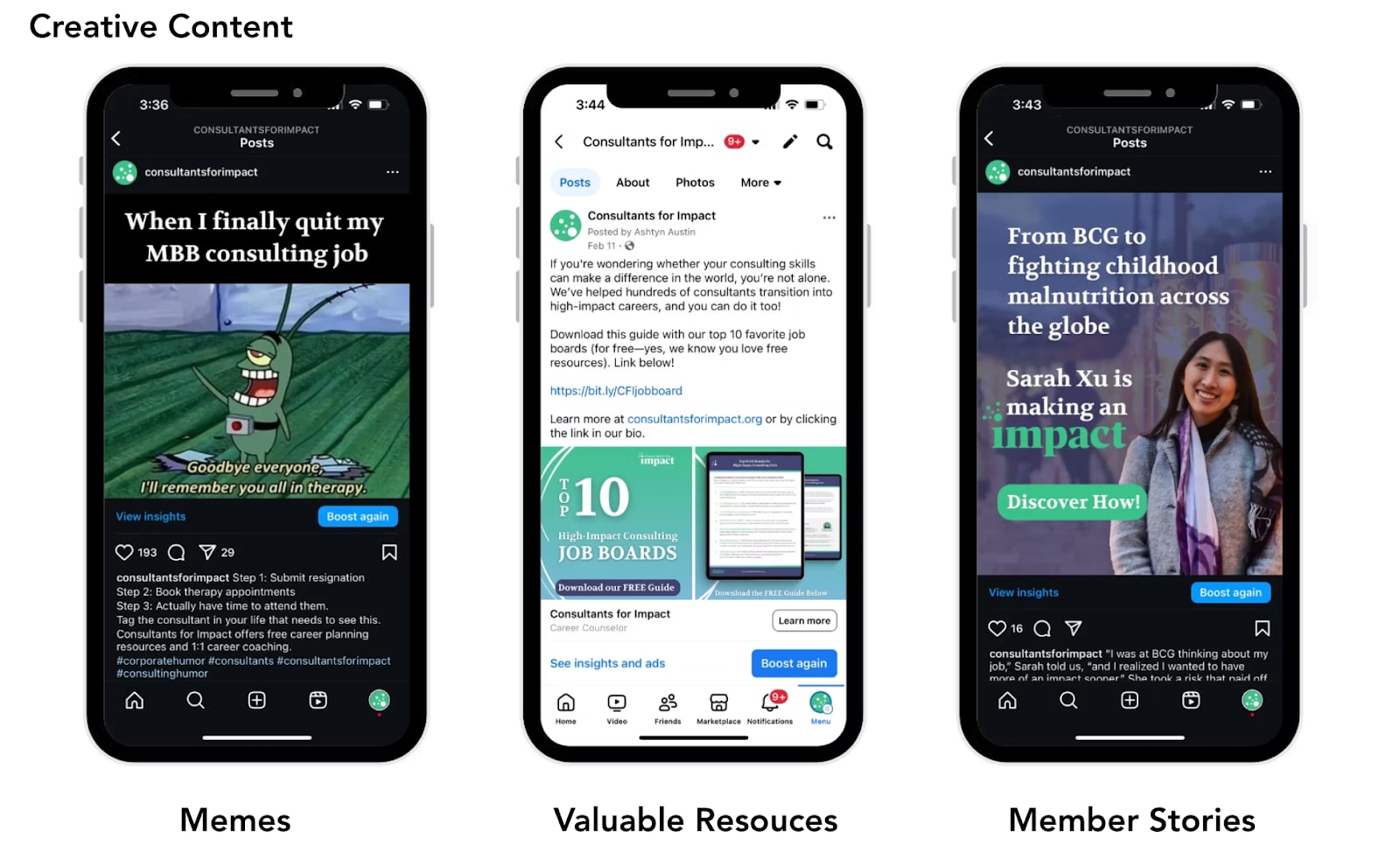
CFI had a strong brand but needed to grab attention. Sarah and Emily pointed us to the @consultinghumor Instagram account, a page with a massive following built entirely on relatable consulting memes. We knew immediately we had a model. But we tweaked it to fit CFI's brand, and also effectively tell the organization's story and impact. Our content mixed three things:
The memes were entry points. The resources built trust. The stories made it clear how the organization could help consultants transition into higher impact careers.
We started with a three-month window. A few ads and posts we were confident in underperformed. We adapted. That mindset of test, learn, repeat is as native to good marketing as it is to EA. You don’t need to commit to a year upfront. Try one channel. Try a few thousand dollars. See what you learn. Once you find what works, do more of it. We ended up working together for over a year.
One caveat: a three-month window is a minimum, not a maximum. I would recommend six month time intervals if you're working with an agency. Give yourself (and your partner agency if you have one) enough time to build, execute, measure and iterate. Ending a campaign before you have enough data doesn’t tell you the experiment failed. It tells you nothing at all.
Consultants for Impact's team trusted our expertise and stayed closely involved. That combination of trust and engagement made the work both better and faster. If you go the agency route, find someone who understands your norms. EA-adjacent orgs have a specific tone: epistemic humility, transparency, no hype. Get aligned on that upfront, keep communication open, and then let your partner do what they’re good at. A good agency will also work with you to develop a scope of work to achieve the goals. Sticking to that scope is critical. The cleaner the brief, the better the results.
CFI had a few things working in its favor: a clearly defined target audience (management consultants), a great website, strong programming to point people toward, and a team willing to collaborate closely. Those conditions made the campaign easier to run and the results easier to achieve.
Orgs without a defined audience, or without downstream offerings to convert interest into action, will likely see weaker results. Marketing amplifies what’s already there; it doesn’t create mission or credibility from scratch.
That said: if you have a specific population you’re trying to reach, a clear message, and something real to offer them, paid social is more accessible than most EA orgs assume.
In 2016, I was between careers when I came across a Facebook ad from 80,000 Hours. I took their quiz. It pointed me toward entrepreneurship, impact, and marketing. What struck me about 80,000 Hours wasn’t just the content. It was how rare that ad was. EA had strong ideas and almost no megaphone.
So in 2017 I started Effct.org, a digital marketing agency, with the hope of eventually helping EA orgs get their message out. The appetite wasn’t there yet, so we spent years working with governments, nonprofits, political campaigns and private companies. In 2024, I went back to EA Global Boston and met Sarah Pomeranz. This campaign is what happened next.
For some EA-adjacent orgs, reaching more people isn't a nice-to-have. It's the bottleneck. The programs exist. The mission is clear. The only thing missing is an audience. If that describes your org, marketing isn't a peripheral experiment; it's core to your theory of change. The cost of a test is marginal. The opportunity cost of never finding out is massive.
For CFI, the conversation started with a funny meme about being a consultant. From there, some very real things happened: tens of thousands of people signed up to learn about impactful careers, 212+ applied for 1:1 advising, and some have now changed their careers entirely to work at impactful organizations.
That’s impact. And it started with a meme.
If you’re thinking about trying something like this, happy to chat or answer questions in the comments. And if you’re skeptical, that’s fair. I’d just encourage you to test your skepticism.
Thanks to Sarah Pomeranz, Emily Dardaman, Cindy Lin, and the entire Consultants for Impact team. Thank you, Emily, for helping with this post. This campaign was successful because of the hard work and leadership of Ashtyn Austin at Effct.org. Thanks to the donors who funded this impactful experiment. And thanks to the EA Community for being open to big ideas even if at first glance they look like memes.
Great post, thanks for sharing! We’ve also had promising results when we’ve invested in marketing. Could you say approximately how much was spent? Or Sarah, if you’re reading this and you’d rather chat privately about spending, could you ping me an email?
Hey James, I will send you a message. I want to be respectful of confidentiality, and allow Sarah to post publicly if she wants.
What I can say is that it was much less than what a full time digital marketing hire would have cost for the services and labor. We also invested enough in ads to get us around 300,000 impressions monthly. We ended up blowing that number out of the water because people resonated with the content, and we advertised globally.
Thanks! And were your goals mostly about getting sign ups to the advising service? Or getting newsletter subscribers? Or raising brand awareness? Or a mixture of these things?
Last year we ran performance ads for our intro course and EAGxAmsterdam, and then did a bunch of brand awareness content production on LinkedIn.