Comments
58
...


By E. G. Mead
Futurekind Spring Fellowship 2026
Animal advocacy has focused on persuasion, corporate reform, policy, and technological innovation. This essay proposes the possibility that a neglected strategic opportunity lies further upstream: investing in cultural production. As artificial intelligence (AI) dramatically lowers the cost of cultural creation (books, films, music, educational materials, advertising, and other cultural artifacts) animal welfare activists have a historic opportunity to effect change at the culture level rather than merely by advocating within a culture largely shaped by others.
People do decide how to eat within a cultural milieu. Long before encountering arguments about animal ethics, they inherit a social world in which eating animals is assumed to be normal, desirable, and morally unremarkable. Those assumptions are transmitted through our institutions and daily social practices—schools, books, films, advertising, governments, traditions, family life, and social conventions. Consequently, our individual dietary choices are made within a cultural architecture that individuals have not constructed for themselves.
Drawing on Virginia Woolf's A Room of One's Own, the essay discusses that history is shaped not only by ideas but by who possesses the means of cultural production. Woolf's deeper insight was that societies lose entire bodies of unwritten literature when groups lack the resources necessary to create. My essay extends this insight to animal advocacy by asking:
As with women’s inability to participate in cultural production illustrated by Woolf in her essay, perhaps animal advocacy’s cultural works have been rarely created because the movement lacked the conditions necessary for sustained cultural production.
Producing high-quality cultural works has historically required large organizations, significant budgets, and specialized teams. AI has now substantially lowered those barriers. Individuals and small organizations can increasingly create work that once required professional studios, publishers, advertising agencies, and media companies. AI therefore changes not simply how advocates communicate, but who is capable of participating in shaping culture itself.
The essay proposes creating a modern patronage system for vegan creators, arguing that sustained creation of cultural works has historically emerged from patronage systems.
Rather than funding advocacy campaigns alone, the fund would support writers, filmmakers, musicians, artists, educators, festival producers, and other creators whose works contribute to a richer cultural landscape. The purpose would not be to dictate subject matter or produce propaganda, as was often the case in historical patronages, but to expand the number of respected creators publicly identified as vegan, allowing veganism to become increasingly familiar through admiration, visibility, and cultural participation rather than argument alone.
The proposal suggests with AI capabilities we can reframe animal advocacy from primarily asking:
How can we persuade people?
to asking:
How can we help create the culture within which different moral conversations become easier?
This essay proposes that culture itself should become a primary domain of intervention, rather than viewing culture merely as the environment in which advocacy occurs.
If culture largely determines what people experience as normal, then changing culture could have unusually durable effects. Every story, film, song, children’s book, festival, and positive representation of plant-based living becomes part of the cultural inheritance transmitted to future generations. AI, combined with the internet and social media, make the opportunity for intentional cultural cultivation accessible to small groups and individuals for the first time in history.
The essay does not argue that AI itself could solve animal suffering. Instead, it urges animal advocates to consider how AI changes the economics of cultural production, creating a strategic opportunity that animal advocacy should not overlook. The central claim is that future progress may depend more on investing in the cultural conditions that make moral arguments increasingly imaginable, familiar, and ultimately ordinary.
I'd like to thank Stacy Neilson, co-founder of Positively Vegan, for encouraging me to apply for a Futurekind AI fellowship for which this essay was written.
I am also most grateful to Danielle Hanosh, co-founder/Executive Director of Leaders for Ethics, Animals, & the Planet (LEAP), for reading an early draft of this essay and offering thoughtful comments and suggestions.
I am deeply grateful to my wife, Teresa Waterland, author of fairy tales, whose patience in reading multiple drafts, thoughtful questions, and careful comments substantially improved the work.
All ideas, arguments, conclusions, and any errors or omissions are entirely my own.
Animal welfare activists may be missing an historic opportunity only made possible by artificial intelligence (AI).
I spent my career in the technical writing field doing both writing and editing work. The hardest edits I ever had to make were in looking for what was missing. Faced with evidence of what software engineers and other writers were trying to say in their drafts, it took effort for me to look for what was missing, what they had left out. I had to consciously direct my attention toward looking for what was missing. Whenever I dropped my vigilance and forgot to look, I overlooked the missing instructions and stories. The gaps would then remain, voids unfilled. In this essay we look for what may be missing in animal welfare activism.
Animal welfare activists take several approaches toward reducing the suffering of animals in factory farming, among those include corporate campaigns, state-level legislative work, and animal-welfare messaging aimed at reducing meat consumption. Yet by exposing the stories of suffering, which currently hide within the larger culture’s normalized animal consumption way of life, animal welfare activists take on the essentially locked-in cultural traditions that we have collectively inherited—traditions that typically keep us in a state of cognitive dissonance. Seeing and learning about harm to animals occurring in factory farming can shock people into becoming vegan. At a recent plant-based gathering, I overheard someone say they had never met a vegan who did not become vegan as a result of learning about this harm. From this perspective, animal advocates can be seen as putting their attention on what’s missing in our modern society: the visibility of stories and images depicting the harm done to animals in factory farming.
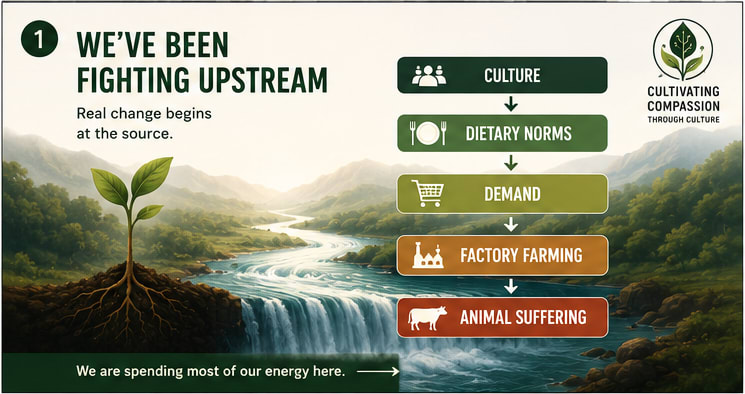
Some animal welfare activists are doing important and timely work toward ensuring data reflecting equal consideration for animals[1] are not missing from the large language models (LLMs), so animal welfare interests are not locked out of future AI trained on those LLMs. Yet, the greatest obstacle to changing how societies treat animals may not be a lack of information or exposure to moral arguments, but the cultural inheritance through which people learn what is normal, desirable, and possible in the first place. Like it or not most affluent cultures today center their cultural mores around consuming animals as food and using animals to create products. What if focused resources and effort—that before AI had been too expensive to attain—could now begin to change the culture itself? What if with AI we can now begin shaping the generations to come to be more and more compassionate to animals. We could shift the world from animal consumption to plant-based by starting at the level of culture, as animal suffering is downstream of culture. We could cultivate culture itself rather than relying only on downstream efforts at alleviating animal suffering in specific scenarios.
Is it possible animal welfare activists might be overlooking a new strategic opportunity made available by AI to address cultural inheritance itself? What if our movement were to turn its attention to using AI to alter the balance of cultural creation? Think of any of the more successful culture-influencing mass-media campaigns, such as anti-drunk-driving and anti-smoking campaigns.[2] These were among the long-lasting, far-reaching campaigns typically funded by national public-private partnerships between public interest agencies and non-profits. With today’s availability of AI facilitating a significant drop in the costs of mass-media production becoming more and more widely available, marketing campaigns that previously had been possible only by multi-million-dollar backers are now within the reach of small groups and even individuals.
This essay argues that AI has fundamentally lowered the cost of cultural production, making it practical for the animal welfare movement to create a new form of patronage[3] devoted not primarily to persuasion but to building the culture within which future persuasion becomes easier.
With dedicated resources, animal advocates could capitalize on the strategic opportunity AI brings to become authors of the cultural conditions within which their moral arguments can be heard, rather than remaining confined to attempts at persuasion within a culture largely authored and continually defined by others.
If culture shapes what people find normal, who gets to create culture? Although culture is created by everyone to some degree, history shows that those with sustained control over the powerful levers of attention and repetition have had disproportionate influence, namely religious institutions, governments, schools, publishers, broadcasters, and major media companies. In recent decades, this dynamic has changed. As Lawrence Lessig writes in his book Free Culture - How Big Media Uses Technology and the Law to Lock Down Culture and Control Creativity, “the Internet has unleashed an extraordinary possibility for many to participate in the process of building and cultivating a culture that reaches far beyond local boundaries.”[4] Adding AI into the toolset can now level the attention-repetition playing field for animal welfare, as well as for others.
In her 1929 essay A Room of One’s Own, Virginia Woolf masterfully illustrates that women not only need the freedoms afforded to men to write and create, but that civilization loses vast and unmeasurable possibilities when whole groups have been denied a voice in cultural creation.[5] Unlike men whose privilege by default gave them all of the things needed by creatives throughout history, women had been denied patronage, education, travel, the ability to earn money and own property. They did not even have a room of their own within which they could write. The century of history since Woolf’s essay shows the great cultural shift burgeoning since the doors to women’s creativity had been opened. Toni Morrison[6] winning the 1993 Nobel Prize in Literature, Katherine Johnson[7] calculating the Apollo 11 flight path for the first moon landing, and Yayoi Kusama[8] connecting mental health, obsession, and beauty through contemporary art are examples of women who have authored world culture, created women’s literature, expanded scientific and intellectual thought, and created stunning art—such examples of which had previously been missing from human history.
What if animal advocates dedicated resources toward using AI for cultural co-creation[9] in addition to their current efforts at persuasion? If the world population were to become vegan, animal agriculture and factory farming—the greatest source of animal suffering—would collapse. Culture influences norms, which influence behavior; behaviors influence markets, which influence production.
In most affluent locales vegan people number less than 1% of the population[10], and many vegans at some point revert. What if they could be inspired to keep on track by positive cultural depictions of vegans? Such as heroes they see as main characters in movies and TV shows? What if being vegan were actually visible in culture? Something like the TV show Will & Grace did for gay marriage,[11] not as the brunt of jokes, but as sometimes flawed, sometimes heroic characters we could connect with, laugh with, and admire.
The significance of the changes AI brings lie not merely in who can produce books, films, and media, but in who can help shape what philosopher Charles Taylor calls the social imaginary—the shared background understanding through which societies come to experience certain ways of living as normal, desirable, and legitimate.[12]
With adequate resources and with AI, animal advocates could mount relatively inexpensive major media campaigns to effect cultural change.
Anti-drunk-driving campaigns are a model for how long-term cultural change can occur. The movement started at a time when Americans routinely treated drunk driving as poor judgment and an unfortunate accident. Now it is a serious moral and criminal offense. In 1980, with the founding of Mothers Against Drunk Driving (MADD)[13] the conversation changed by putting victims and their families at the center of the issue, framing drunk driving as a preventable crime rather than an accident. MADD led to campaigns such as “Friends Don’t Let Friends Drive Drunk” that shifted responsibility from the individual driver to everyone around them. Preventing drunk driving became a shared social responsibility by the 2000s; drunk driving became increasingly stigmatized. Societal norms now include designated drivers, bars promoting safe rides home, willingness of friends to take away car keys, and media portraying drunk driving as reckless rather than humorous.
The cultural norm around drinking and driving has changed in only a few decades. Rather than relying on a single factor, the culture changed as a result of combined education, storytelling, policy, enforcement, repeated over and over, eventually changing social expectations over a few decades.
Until now, animal advocates have largely made their efforts at persuading people to eat plants for the sake of animals within the existing culture. Animal advocates who look for what’s missing in their approach may find that we can now contemplate co-creating culture as a new and exciting capability, uniquely brought to us by AI and internet-related tools that have put the powerful levers of attention and repetition within reach of small groups and individuals. AI has brought field-levelling capabilities that could be used to go much further than previously contemplated, and instead of merely working to change dietary habits within the culture they can now begin to shape the culture.
A compelling example of AI being able to drastically reduce the cost of marketing campaigns can be seen in this essay itself. All of its illustrations were generated by ChatGPT in a couple of minutes after receiving an early draft of this essay to read along with a well-crafted prompt. In a large corporation, producing a single polished illustration would typically involve an entire creative pipeline rather than one person. A typical workflow might look like this:
What AI has changed is that many of these steps can now be compressed into the work of a single individual or a very small team. This dramatically lowers coordination costs across an entire creative ecosystem. As demonstrated in this essay, in just a few minutes one person can:
That dramatically reduces the cost and complexity of cultural production. AI is lowering barriers that once required specialized departments and significant budgets. Instead of needing a corporate creative team, an individual advocate can increasingly produce high-quality cultural materials that previously would have required an entire organization.
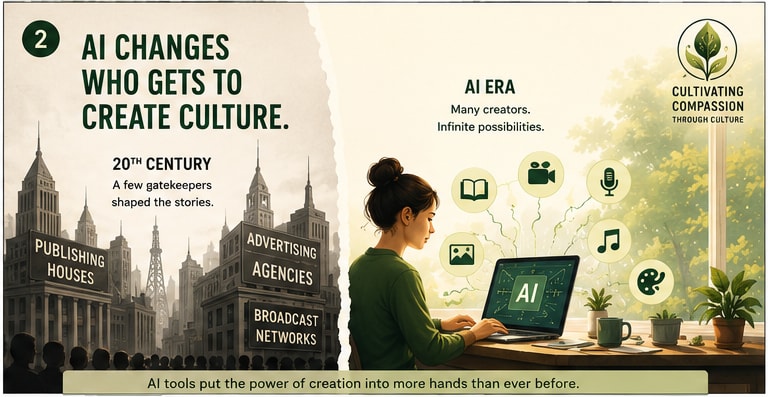
The whole notion that we can now contemplate co-creating future culture is a new and exciting capability, uniquely brought to us by AI and internet-related tools that are now available to small groups and individuals.
Culture is transmitted through schools via both curriculum and everyday practice, through books shaping not only knowledge but imagination, through films often making values feel emotionally natural, and through advertising selling not only products but also identities and lifestyles. It is also transmitted in more oblique ways through relationships, families, religious practices, traditions, and memories. Sometimes the people who orchestrate the creation of culture understand this more clearly than those playing their individual roles.
Charles Taylor asserts that societies operate within social imaginaries, the shared understandings, stories, expectations, and images that shape what people experience as normal, legitimate, and imaginable. Unlike explicit political or ethical theories, social imaginaries are embedded in everyday life—in family traditions, entertainment, education, rituals, advertising, and ordinary conversation. We inherit them long before we consciously evaluate them.
“The social imaginary is that common understanding that makes possible common practices and a widely shared sense of legitimacy.”—Charles Taylor[14]
In the early ‘70s at the age of 14, I had a mind-opening cultural, youth summer-camp experience. I was selected to spend nine days at NCCJ’s Brotherhood Camp.[15] Two students from each of nearly 200 Los Angeles County Unified School District’s public Junior High schools were chosen to attend the camp. The setting for this widely diverse collection of young teens was Idyllwild, California, whose woods and hilly terrain deeply called to this city girl’s heart and soul. We had scavenger hunts, hikes in the fresh mountain air, and sang along together at fireside circles. We did all those things, but in addition, interspersed among the typical camp activities, we spent a few hours each day gathered into groups of like identities, discussing loaded questions of the era:
What does it mean to be white?
How does it feel to be female in the existing white male power structure?
Which group does one belong to when of mixed parentage?
Each evening, our camp community would gather for what was called townhall, meeting in the main lodge’s great room to discuss what we had learned in our assigned breakout groups during the day. Often through tears we would share the deep insights we gained, sometimes of disturbing truths, not only about our families of origin, but about how others outside our groups view us. Wow! Today's youth encounter ideas about multiculturalism, power structures, and gender at much younger ages than my generation did. Concepts that once required specialized camps and consciousness-raising groups now circulate widely through schools, media, and online communities. Today children at quite young ages can sensitively defend the rights of diverse communities when challenged by the remnants of those in our culture who are still-entrenched in racism and other ‘-isms’.
My generation grew up in the ‘70s in the wake of the Civil Rights movement, when Americans were just beginning to openly grapple with questions of identity and cultural perceptions, each week gathering with their families in front of the TV to belly-laugh as Archie Bunker displayed his prejudices.
Twenty years later, yearning to share my profound camp experience with my niece and nephew, I telephoned the Brotherhood Camp head office and left voice mail messages requesting invitations for my niece and nephew to attend that summer’s upcoming camp; my calls went unreturned. After a couple of years of trying, with the kids growing up fast and time running out, I finally reached someone who explained why Brotherhood Camp would not be extending them invitations to attend. The legacy admission I had been asking for them was moot. The simple fact was that it was not needed—my niece and nephew would receive the consciousness-raising ideas through me.
The camp administrators understood something I had not—Brotherhood Camp was not merely educating campers. They were participating in cultural transmission. Their goal was not to change a child for nine days but to create adults who would carry those ideas into families, workplaces, and future generations. When they declined to admit my niece and nephew, they revealed something I had not considered.
The cultural transmission had already occurred.
What Brotherhood Camp understood about race, class, and power structure may also apply to attitudes toward animals. What if animal advocacy began thinking less like a persuasive marketing campaign and more like Brotherhood Camp? What if its greatest ambition were not simply to persuade people to change their next meal, but to cultivate generations capable of transmitting different assumptions about animals, food, and compassion? What if vegan artists, writers, poets, sculptors, singers, dancers, filmmakers, camp administrators—every manner of vegan culture-makers—were given the means and mission to simply go out and cultivate vegan culture. What would that look like?
In A Room of One’s Own, Virginia Woolf in her landmark, culture-changing essay, makes palpable the gaping void of women’s literature in history by looking and looking for the missing books. Eventually, she creates a fictionalized sister to Elizabethan England’s William Shakespeare—Judith Shakespeare, making her equally genius to him. Then Woolf achingly draws the picture of Judith’s cultural lock-out with the stark words: “But she was not sent to school.”[16] We cannot know what Judith Shakespeare might have written. That is precisely Woolf’s point. The tragedy is not simply that one gifted woman was silenced—it is that a vast portion of humanity’s cultural inheritance was never created.
Animal advocates likewise leave behind works that never come into existence. Just as women once lived within societies where they were effectively barred from literary achievement, most vegans today live within a food culture that barely sees them—making the eating of animals the norm and our refusal to eat them a joke. The repeated message that it is natural, necessary, and even virtuous to eat meat and productize animals forms our culture. From childhood, we live amongst family traditions, advertising, school meals, school fund raisers, media portrayals, restaurant menus, government policies, and social expectations that all reinforce consuming and exploiting animals. From this perspective, the issue is not merely individual moral failure; the issue is the cultural architecture surrounding us all. Individual choices matter, but those choices are made inside a cultural architecture that most people have not constructed themselves. Questions to consider include:
The answer has historically been the institutions whose economic interests align with the dominant paradigms of the day and whose resources enable them to craft culture (rinse and repeat ad infinitum).
In today’s world, the availability of AI with social media gives animal welfare activists a unique opportunity to begin to change the social imaginary. The social imaginary is not simply a collection of ideas. It is the shared background understanding of what feels normal, desirable, possible, and morally appropriate. People inherit it long before they encounter formal arguments. Animal advocacy therefore confronts not only individual beliefs but an inherited social imaginary in which eating animals has been woven into family traditions, celebrations, advertising, identity, hospitality, children’s stories, television families, admired heroes, holiday rituals, and everyday life. AI can alter the balance of cultural power and the means of cultural production; it can also democratize the capacity to contribute to the social imaginary. Stories, films, children’s books, music, advertisements, festivals, and everyday cultural artifacts do more than entertain; they help define the world people imagine themselves living in. Changing the social imaginary means changing the boundaries of what future generations experience as ordinary.
We know vegetarian cultures exist. We can look at the largely vegetarian menu at McDonalds India (https://mcdindia.com/) to remind us that what counts as “normal” food is culturally contingent rather than biologically fixed. The same corporation adapts to different inherited food cultures. This is how we know big food will respond to cultural pressure—because it already does. Now let us deliberately build a richer cultural architecture—one filled with vegan heroes, joyful vegan stories, memorable animal welfare songs, compelling plant-based films, beautiful art and celebrations of plant-centered living. Let’s fund all vegan creatives and give them a mission to cultivate vegan culture. In the end, every positive representation of vegan lifestyle that gets out there will have a cascading effect into future generations (“the transmission will have already occurred”).
Brotherhood Camp understood that ideas become durable not when they are merely taught, but when they are lived and passed forward. Animal advocacy faces the same opportunity today with the convergence of AI, the internet, and social media. Every repetition of every vegan story told, film produced, child’s book written, song composed, joyful image of plant-based living becomes part of the cultural inheritance available to future generations. That is how cultural architectures change—not all at once, but one transmission at a time.
My niece and nephew never attended Brotherhood Camp. Yet in an important sense, Brotherhood Camp helped shape them anyway. Its ideas had already found another route of transmission—me.
At a time when the evidence shows vegans have made some inroads into culture—with vegan options appearing on restaurant menus and plant-based food sections growing in supermarkets—now may be the perfect time to leverage the attention of the masses by using AI to cultivate vegan culture and mount mass media campaigns from every source possible.
A new room of our own from patronage for animal welfare activists would provide the missing opportunities for vegans to cultivate vegan culture.
At 29 years old, a decade after graduating from high school, I was privileged enough to be accepted into Reed College, an elite institution in Portland, Oregon.[17] There I learned that patronage shaped the classical canon. First year students were required to study the humanities, and I soon became dismayed upon learning that only one writer of the ancient/classical period was a woman, Sappho, and that all the ancient writers were either wealthy aristocrats in their own right, as Sappho was, or depended upon royal patronage to support their writing. I wondered why women had not been given patronage during those centuries, why only men had. If women had enjoyed similar access to patronage, along with other conditions necessary for sustained creative work, the literary canon and culture itself would contain far more women’s voices than the solitary Sappho representing the ancient world.
It should be emphasized that Virginia Woolf had not simply been explaining the absence of women from literary history in her essay. She was identifying one of the great drivers of cultural history: those who possess the means of cultural production shape the stories, symbols, and assumptions that we all inherit and typically transmit as reality. What voids have animal welfare activists been forced to leave?
What if for the sake of reducing animal suffering worldwide we encouraged vegan artists and writers to cultivate vegan culture through their works by giving them the resources. Being given basic income, medical care, and education (including resources for travel), would enable vegan creatives enough leisure time to be able to create whatever works they may be inspired to create, whether the subject is vegan or not. The purpose would not be to dictate subject matter or produce propaganda. The only string attached would be identification that the creative work has been produced by a vegan creator.[18] Identifying creators as vegan would allow audiences to encounter veganism not as an argument but as an ordinary characteristic of respected producers, writers, filmmakers, musicians, and artists. Just as readers today may discover that a beloved celebrity creative or artisan happens to be vegan, the normalization of veganism could occur through admiration alone. Eligibility for support would require only one thing: whenever the work is promoted, the creator is identified as vegan. Pointedly, no restrictions would be placed on the subject matter or artistic style whatsoever.
Can we extend Virginia Woolf’s insight to animal advocates to similarly provide them patronage for dedicated resources to produce works that do not exist? Those works that are missing because the movement has historically either lacked the means of cultural production or chosen to prioritize immediate persuasion over long-term cultural architecture. Woolf asked what would have become of Shakespeare’s gifted sister. Different but analogous questions are:
Where are animal advocacy’s celebrity writers?
Where are its music, myths, and cultural touchstones?[19]
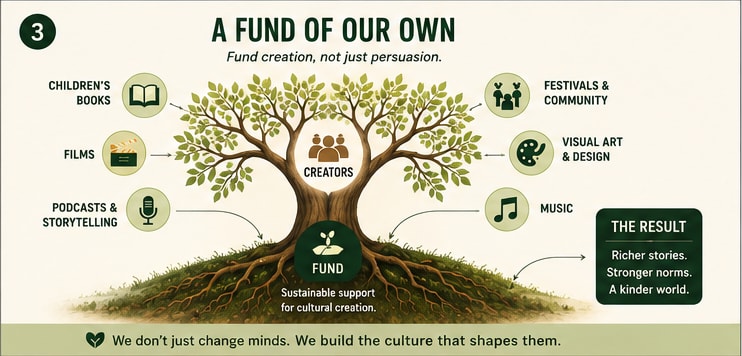
Perhaps many of them were never created—not because no one possessed the imagination, but because the confluence of conditions that allow great cultural work to flourish had rarely existed for them. Well they could exist now, with A Fund of Our Own in the form of a well-crafted patronage for vegans in the AI age. Patronage would therefore support more than individual creators; it would enable them to contribute to the social imaginary inherited by future generations.
From ancient temples, to princes, to publishers, to governments, to social media platforms—every era has had a patron. There has rarely been a sustained cultural output that arose purely from the free market without some form of intentional support for creators. A Fund of Our Own for vegans would not be unprecedented—it would be the latest chapter in a very long history of cultural patronage. If previous eras found new ways to support cultural co-creation, our own era must ask an additional question. As AI dramatically lowers the cost of writing, filmmaking, production, illustration, translation, music, publishing, and more, what new forms of patronage might make animal advocacy’s unwritten books possible?
A Fund of Our Own for animal welfare must not only be designated for vegan creators but must also be structured to protect their creative energies.
How could a cultural fund for animal welfare activists be used? Could the fund’s product be not merely media campaigns themselves, but campaign capacity? In other words, could the fund enable industrializing support for widespread, grassroots cultural production itself? The answers are unlimited, but let’s look at some possibilities.
The fund could award support to individual vegan artists, writers, filmmakers, festival directors, and so on, simply to create their works. What amazing works could they bring to the world on the behalf of compassion for animals when free from worrying about earning a living for ideally several years (and from re-applying during that time)? With the proper resources we could flood the culture with works done by vegan creators, regardless of the subject matter of the work itself.
The fund could make resources available to vegan activists in every locale to pursue the activism they desire for their communities. Even better than simply funding these groups and enabling them with AI and media tools, the fund could enable creation of activist toolkits that systematize and templatize media campaigns that a small group could use. This would start them off further ahead than they would if they started from zero trying to figure out how to craft it all themselves. None of these resources are valuable merely because they produce more content. Their significance lies in making it easier for thousands of communities to contribute repeatedly to the shared cultural world through which later generations would come to imagine ordinary life. In Charles Taylor’s language, they would become distributed tools for cultivating the social imaginary.
One of the reasons MADD spread so rapidly is that local chapters didn’t have to invent everything themselves. The national organization provided branding, educational materials, legislative guidance, campaign ideas, media training, and fundraising support. A local chapter could spend its energy building relationships rather than reinventing brochures or slogans.
A Fund of Our Own could play a similar role for animal advocacy in the AI era. Instead of simply awarding grants, it could create a Cultural Campaign Starter Kit that dramatically lowers the cost and effort of launching a local culture-change campaign. Imagine a community group deciding they want to normalize plant-based living in their city. Rather than beginning with a blank page, they download a professionally developed package containing:
The fund could also maintain a living library rather than a static toolkit. Whenever one community discovers a particularly successful campaign—a recipe challenge, a restaurant passport, a family cooking night, a school project—it is documented, improved with AI assistance, and added to the shared collection for everyone else to adapt. Over time, this becomes something like an open-source ecosystem for cultural change. One group in Vancouver develops an excellent children’s reading program. Another in Austin develops a successful plant-powered high school sports campaign. A third in Manchester creates a compelling short-video series. The fund curates these, develops AI prompts and templates around them, and redistributes them to every participating community.
AI changes what can be shared. Historically, organizations shared finished brochures and posters. Today they can share the means of producing those materials. For example, instead of providing a single poster, the toolkit provides: paste your city’s name, choose your target audience (parents, college students, seniors, athletes), and the AI will generate a locally tailored campaign in your community’s style.
That is a much more powerful form of infrastructure. Virginia Woolf argued that women needed more than encouragement; they needed the conditions that made creation possible. A Fund of Our Own would not simply finance individual projects. It could create the conditions under which thousands of independent animal welfare advocates can become creators.
The purpose of A Fund of Our Own would not merely be to finance cultural production. It could support ordinary advocates with the tools, templates, training, and shared infrastructure to create high-quality campaigns that would otherwise be beyond their reach.
A Fund of Our Own would not be another grant program but would build an enduring movement that spans multiple years for individual creators and small groups, providing infrastructure that targets change from upstream. Instead of funding one documentary or one festival, it funds a reusable system that enables untold numbers of communities and individuals to create art and culturally relevant campaigns of their own, adapted to local circumstances but supported by a shared foundation of AI-enabled tools, knowledge, and creative resources.
Not long ago I found myself learning an entirely new profession. I had volunteered to write grants for Positively Vegan, a small nonprofit that organizes annual vegan festivals in three British Columbia communities. I had never imagined that preparing people to enjoy an afternoon of music, good food, cooking demos, plant-based speakers, and family entertainment would require me to become conversant in grant terminology, logic models, SMART objectives, budgets, evaluation metrics, organizational governance, and funding priorities. Yet there I was, spending my time learning the language of fundraising rather than the language of culture.
At first, I accepted this as simply the cost of doing good work. Every worthwhile organization needs funding, nonprofits must demonstrate accountability, grant makers have limited resources and difficult decisions to make. But the longer I worked on those applications, the more another thought began to trouble me. Why are so many of the movement’s most creative people spending so much of their limited time becoming amateur accountants, evaluators, and grant writers?
The people behind Positively Vegan did not create the organization because they loved filling out funding applications. They created it because they wanted to build welcoming spaces where curious people could discover that vegans were ordinary people enjoying ordinary pleasures—sharing meals, listening to music, laughing with friends, introducing children to new foods, and creating community. They were producing culture in the most practical sense: creating experiences that gently expanded what people imagined a vegan community could look like.
Yet before any of that could happen, an extraordinary amount of energy had to be diverted elsewhere. The festival first had to survive the funding obstacle course. Funding applications had to be researched. Eligibility requirements had to be interpreted. Budgets had to be assembled. Outcomes had to be predicted. Reports had to be promised before the work itself had even begun. Each application demanded a different format, different priorities, different language, and different assumptions about what success should look like. All the while planning remains theoretical until actually winning a grant and knowing how much money will be available for this year’s projects (and only this year’s).
None of this is malicious. Most grant makers are trying to be heartfelt stewards of limited resources. But viewed from the perspective of a small organization, the cumulative effect is striking. A movement that already lacks resources asks its volunteers to spend untold hours acquiring skills that have little to do with its actual mission. Virginia Woolf argued that generations of women were denied not simply the opportunity to write but were denied the conditions that made writing possible. Time, financial security, privacy, and intellectual freedom were not luxuries. They were productive conditions. Without them, countless books remained unwritten.
I began to wonder whether something similar was happening across today’s moral movements. How many festivals are never held because the organizers cannot navigate the funding process? How many documentaries are never filmed because the filmmaker spends months chasing grants? How many children’s books are never written because their authors are occupied with writing proposals instead? How many artists, educators, event planners, musicians, and storytellers possess precisely the imagination our movements need but never receive the conditions necessary to exercise it?
The tragedy may not be simply that organizations remain underfunded. The greater tragedy is the missing culture that never comes into existence. This is why I have come to think differently about what I have been calling A Fund of Our Own. Originally, I imagined it primarily as a source of money. Now I think of it as something more fundamental: a way of purchasing time, attention, and creative freedom. Its purpose would not be merely to finance projects. It would be to reduce the friction and energy drain that prevents good ideas from becoming cultural realities.
Imagine a local organization receiving the support needed to spend less time proving its worth and more time welcoming families into a joyful festival. Imagine an independent filmmaker spending six months making a film instead of six months assembling funding applications. Imagine a children's author writing stories rather than proposals. Imagine a musician composing songs rather than budgets.
In each case, the resource being purchased is not merely money. It is productive capacity. AI makes this possibility especially intriguing. It can increasingly help organizations draft grant applications, prepare budgets, translate documents, and complete many of the administrative tasks that once consumed weeks of volunteer effort. That alone is valuable. But perhaps the larger opportunity lies elsewhere. If AI reduces the administrative burden of creating culture, and if dedicated funding reduces the financial burden, then small organizations and independent creators gain something far more important than efficiency. They gain the freedom to spend more of their lives creating the very culture they dream to create. Perhaps that is what A Fund of Our Own should ultimately provide. Not simply grants, but the conditions under which more people can become authors of vegan culture.
Our institutions make small moral movements—like animal welfare activism—spend an extraordinary amount of energy proving they deserve the opportunity to create culture. Can we create vegan culture with A Fund of Our Own that genuinely enables vegan creatives and small organizations to do what they dream to do in the support of animal welfare? Without having to devote all the hours and energy up front on tasks of no interest to them but currently required by the existing system.
The objective is not merely more vegan media. The objective is a richer social imaginary in which compassion toward animals increasingly becomes one of the ordinary assumptions inherited by future generations.
A reader might wonder why existing philanthropies have not already built such an institution as this essay proposes with A Fund of Our Own for animal welfare. Part of the answer is historical: animal advocacy organizations understandably evolved to address immediate suffering through corporate campaigns, investigations, legislation, research, public education, and more recently alternative proteins. Those remain indispensable. And philanthropy often funds discrete interventions rather than the long-term cultural infrastructure from which new stories, symbols, traditions, and identities emerge. Until recently, creating culture at scale also required budgets available only to governments and major media companies. AI changes that landscape. By dramatically lowering the cost of writing, illustration, filmmaking, translation, music, design, and coordination, it makes a dedicated patronage system for cultural creation newly practical. What was once economically unrealistic has become strategically imaginable. So the question is no longer: “Which projects should we fund this year?” But with A Fund of Our Own becomes: “How do we create the conditions under which entire generations of creators can flourish?”
Perhaps animal advocates have been missing a strategic vantage point—not because persuasion, policy, welfare reforms, or technological innovation are unimportant, but because they all operate within what Charles Taylor calls a social imaginary: the inherited background understanding that quietly teaches people what is normal long before they encounter a moral question. Brotherhood Camp administrators understood something I did not when I called asking whether my niece and nephew could attend. They knew that the real work had not been the nine days at camp. The real work occurred later via cultural transmission. Once ideas become woven into the lives of those who carry them forward, “the transmission has already occurred.” That realization has stayed with me because it suggests a different way of thinking about social change. The most enduring victories may not be won when a moral discussion prevails, but when a different way of seeing the world quietly becomes ordinary. Virginia Woolf mourned the books that were never written because generations of women lacked the conditions necessary to write them. I cannot help wondering what culture animal advocates have never created for similar reasons—the films never made, songs never composed, stories never written. Which festivals, works of art, television series, classrooms, traditions, and celebrations never came into being because those who imagined them lacked the time, resources, or institutional support to bring them to life? AI does not guarantee moral progress. Like the printing press, the internet, and every great communications technology before it, AI changes conditions. It lowers barriers between imagination and expression; it enables smaller budgets to make far greater advances than ever before possible. Whether those new possibilities become cultural realities depends, as they always have, on people.
That is why I urge creation of A Fund Of Our Own for animal welfare. Not merely to finance projects, but to purchase something rarer: the conditions under which vegan creators can create. As Virginia Woolf so brilliantly illustrated those are time, freedom, education, travel, experimentation, and supportive community. AI brings us a new opportunity to make animal welfare’s missing works—the unwritten books, the unseen films, the unheard songs, and the uncelebrated joyful traditions that future generations could inherit without ever realizing they’d had to be imagined first. Each generation inherits a cultural landscape it did not fully create. Ours may become one of the first in which ordinary people and small movements possess powerful technological tools, once found only in the domain of the largest institutions, allowing access to powerful levers of attention and repetition such that we can intentionally shape culture. The question before animal advocates is therefore larger than diet, larger than AI, and even larger than animal welfare itself. It is whether we will remain critics of a culture authored by others, or become conscious participants in co-creating a different one.
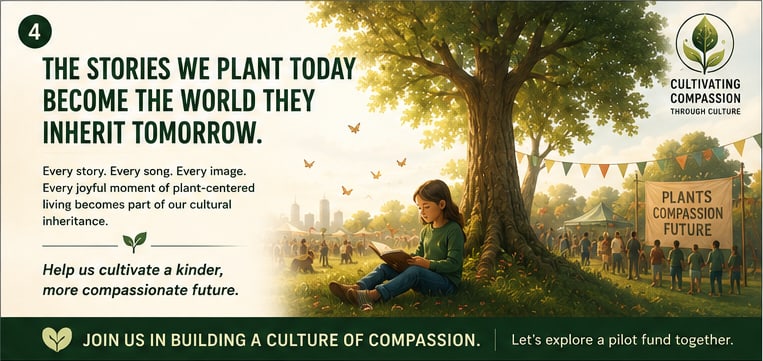
If we succeed, perhaps one day a child will grow up in a world where compassion toward animals feels as natural as many other moral assumptions that earlier generations struggled to establish. The child may never know where those stories, celebrations, heroes, and traditions came from. They will simply inherit them.
In its technical sense, equal consideration of animals means the like interests of animals deserve the same moral consideration as the like interests of humans, regardless of species. For the genesis of this concept, see Peter Singer, “All Animals Are Equal,” Philosophical Exchange 1, no. 5 (1974): 103–116. As Singer notes, Jeremy Bentham argued that the morally relevant question is not whether animals can reason or talk, but whether they can suffer (Singer 1974, 108).
As returned by Elicit query: “most successful culture-influencing campaigns,” accessed July 13, 2026.
Patronage in the sense of the historical financial or institutional support provided to artists, writers, scholars, or other creators that had enabled them to produce work they might not otherwise have been able to create.
Lawrence Lessig, Free Culture: How Big Media Uses Technology and the Law to Lock Down Culture and Control Creativity (New York: Penguin Press, 2004), 13, https://web.archive.org/web/20151013234548/http://www.jus.uio.no/sisu/free_culture.lawrence_lessig/portrait.letter.pdf
Virginia Woolf, A Room of One's Own (London: Hogarth Press, 1929; repr., Global Grey eBooks, n.d.), https://www.globalgreyebooks.com/ebooks/virginia-woolf_room-of-ones-own.pdf
Toni Morrison 1931-2019, USA. Novelist and essayist. (Beloved, Song of Solomon.) Reshaped American literature by centering Black history, memory, and language.
Katherine Johnson 1918-2020, USA. NASA mathematician. Proved that human computers were essential to the space race and opened STEM to Black women.
Yayoi Kusama 1929-, Japan. Contemporary artist. Infinity mirror rooms, polka dots, and immersive installations.
Co-creation in the sense that we all participate in creating culture, as well as in the sense of co-creating with AI.
As returned by Elicit query: “current estimate for the percentage of vegans in affluent countries,” accessed July 16, 2026. Numbers rise when surveys bundle vegans with vegetarians or broader plant-based categories; one German representative survey reported 5.4% for the combined vegetarian-or-vegan group.
The successful 1998 TV series brought gay principal characters into homes for over 8 years. Gay marriage was legalized in Canada in 2005 while Will & Grace was still in production, and was legalized in 2015 in the USA.
Charles Taylor, Modern Social Imaginaries (Durham, NC: Duke University Press, 2004).
The organization was started after a California mother, Candace Lightner, lost her 13-year-old daughter to a repeat drunk driver.
Taylor, Modern Social Imaginaries, 23.
The National Conference of Christians and Jews (NCCJ) Brotherhood Camp, 1974, or “Anytown.” The organization was renamed the National Conference for Community and Justice in 1998.
Woolf, A Room of One’s Own, 21.
At the time in the late ‘80s Reed College appeared consistently in the U.S. News & World Report top 10 rankings.
Visibility matters. Throughout history, admired artists have helped normalize ways of living simply by being known for them. Think of Steve Jobs’ black turtleneck and minimalist aesthetic becoming iconic, Ellen DeGeneres helping make same-sex relationships seem familiar and ordinary, and John Lennon’s Imagine helping normalize ideals of peace and internationalism.
The point is to achieve cultural visibility of “vegan creatives” who proudly announce their veganism while promoting their creative works (vegan or not). The assumption is many of those works will be vegan-forward having been influenced by the creative’s own veganism. The writer of this essay also highly celebrates those who already create amazing, animal-kind works as well as promote their own visibility within the vegan sub-culture.
