Comments
People can build their capacity for work

9 min readNov 26
Cross-posted from Same Page.
This is one of two posts in which I make the case that many people should try to build their capacity to do more stuff. This post is about how to build that capacity. The second is about why putting some of that capacity into work pays off more than you’d expect.
I wrote these posts before the AI timeline updates of the past month. I think that their #vibe is much less urgent than is now appropriate. I’m hopeful that you will ‘hear’ urgency from other messages, like Run, don’t walk, to a short-timelines-responsive AI safety role and Orienting to 1 year AGI timelines, and hopefully the messages here about sustainably being able to produce more are still helpful adjuncts.
I think that people can build the capacity to work more.
They can build it through managing their energy, intentionally increasing their sense of excitement about their work, and making the demands on their life outside work easier.
It’s basically the process of learning to achieve more: whether that’s at work or in the rest of your life. You can put the resulting surplus into work, or into other things you value, as it pleases you. Importantly, I’m not arguing that you should aim to miserably grind out an extra ten hours a week. Instead, I’m arguing that by trying the techniques below, many people will be able to increase the amount that they can sustainably and happily work over time.
To some people, this sounds trivially obvious, and many people are already acting on it.
It’s totally plausible that you’re already doing this close enough to ideally.
If you’ve spent years being thoughtful and systematic about your productivity, then I don’t have an opinion on whether it’s worth you putting more into it. I suspect that you’ve already seen large gains, and that you’re the one who is best positioned to judge whether you should do more.
But I think that many people, including many readers of the EA Forum, haven’t done those motions. Concretely, I think that there are people who have never tried the ‘Capture’ habit from Getting Things Done, who haven’t highly prioritised a short commute to work, or who have never optimised their Slack notifications to reduce distractions.
I think that most people contributing to the EA ecosystem should be quite thoughtful about increasing their output, such that the suggestions above and all of the suggestions below are ones which they’ve either a) implemented, b) tried and ruled out, or c) are on track to try out.
I’m not aware of any trials or whatever, but I’ve seen it happen, and it seems generally true to me.
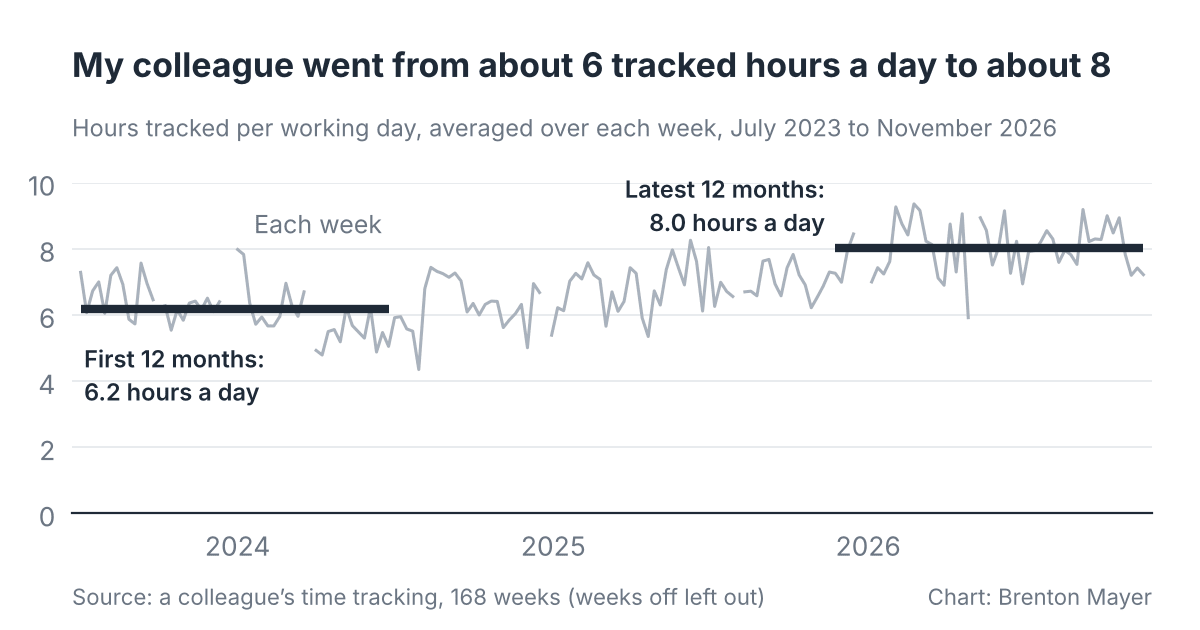
When I started weekly reviews and debugging sessions with a friend in 2014, I experienced a step change in my rate of improvement. I got into a regime where I iteratively learned what worked, and over time I spent much less time procrastinating or working ineffectively. It was not only good for my output, but for my experience: I didn’t enjoy the sense that I wasn’t working effectively.
My colleague has a similar story — this is a chart of her tracked hours:
No.
Sorry, that was nonsense from me: I can’t possibly give a firm ‘no’ to that question. This isn’t an area I can be confident about: there are too many complicated interacting pieces about your own psychology, how you’ll hear my advice (vs. what I mean), the fact that the clinical model of burnout seems more confused than the typical psychological diagnosis, and so on.
But I do kinda want to vibe ‘no’.
Burnout isn’t caused by working above some pre-ordained number of hours.
Instead, burnout is about:
At some point, your brain learns that the push that you’re asking from it doesn’t result in a reward. Your system 1 no longer ‘expects’ a reward for the effort you put in. The idea of chasing a win is no longer appealing.[1]
The above assertion is too basic to be the full story. But I assert that the mechanism here is a large part of my motivation system — and many people around me report that it rings true for them as well. You could see if it seems true for your psychology too.
The suggestions below either heighten your perception of getting ‘wins’, make chasing wins more enjoyable (working when you’re not sleep deprived is usually more pleasant), are orthogonal to the ‘wins:getting wins’ axis (e.g. getting a cleaner), or are directly about figuring out what is motivating for you.
Honestly, I think it’s an ‘antiburnout’ package!
To be clear, I think that there are valuable tools to increase output which do increase the risk of burnout. For example, practices to improve output like deadlines and commitment mechanisms have their place. Most organisations run on deadlines.
But I feel less good about recommending them in a series aimed at people who are trying to unlock more work capacity, many of whom are guilt-prone. And by skipping them, I’ve written a set of tips which will help you build the capacity to work more while reducing the likelihood of burnout.
I won’t attempt to summarise the entire literature on productivity-related self-help. Instead, I’ll point at some interventions which I think people trying to improve the world should usually try (or consider, and then rule out for some reason). If you think that you can work a fixed amount and you haven’t tried these, I’d guess that you’re making a mistake.
Different things work for different people. If you’re turned off by the more tech bro-ish of these ideas, maybe ask your LLM what it thinks would appeal to you more.
The aim here is to set up some system or set of systems which will let you improve over time.
The strongest single tool I’m aware of here is focused problem-solving with a peer or coach. This is what gave me the step change I described above. I found it super powerful to have a compassionate, non-judgemental person look at my habits with me and figure out systems to get ‘in the moment’ Brenton to behave as I want him to.
You will probably also want to have some system of reviewing your week and your quarter, and some way of getting data to supplement your memory on what happened.
The short commute and the cleaner are the huge ones.
In general, it’s often a good idea to spend money to buy yourself more time and attention: more so than feels intuitively comfortable to those who are accustomed to being frugal. I’ve traditionally been willing to spend money relatively lavishly to preserve my work time, despite having a modest lifestyle otherwise (for example, I might buy the more expensive direct flight so I can use the extra time to work).
I used to think of this as an altruistic use of money – I was essentially donating some of my money to buy impact through my own work. But given that salaries in the AI safety ecosystem are high nowadays, I think that buying time will make sense even from a self-interested perspective for many of my readers. If you spend money to save time, and then use that time to work and develop yourself more, you’re more likely to land better-paid roles in future, so you’ll make back the money you spend now in expected future earnings.
I’ve made a tool where you can play with the figures here, based on AI safety and catastrophic risk salaries from the 80,000 Hours job board. Tl;dr: based on a simple model, if you expect your average income to be $150,000/year over the next ten years, I think you can boost your income by about $150 for each extra hour you work, or about $90 after tax (in expectation).
In short: do it iteratively and with focused effort.
I’d use the standard toolkit I’d use for any complex set of behaviours which I wanted to change: set aside time to work on it, analyse how I could become better, run experiments, track the experiments, review what’s worked, hold onto what works and throw out what doesn’t, and iterate again and again.
I’d lean against setting a target of tracked time. It’s ok to track your time, and indeed I’ve manually tracked all my work time for literally 8 years now (!!). But I’m not targeting pushing the number up. It’d be pretty lame if you Goodharted hours of input. The aim is absolutely not to induce burnout by forcing yourself to spend time at the office when you aren’t motivated to be there.
Instead, I’m:
I then pair that data with other information about how I felt, whether I was achieving what I tried to, and so on, to inform my model of what work I thrive at, under which circumstances, and so on.
That informs what work I should gravitate to next, and what should be in my next round of experiments in being more productive.
Hank Green’s video The Productivity Lie is good on this idea.
I claim that if you try the strategies above, your effective work hours are likely to increase.
I recommend that you treat building your ability to do valuable activities as a long-term project. Within that project, improve your energy levels; cut energy-sapping, low-value activities from the rest of your life; and cultivate feeling motivated by what you’re doing, and the hours will follow.
Unlike other perspectives you might have heard, I claim that those extra hours are a substantive factor in the impact you can have with your career, because the returns to those extra hours are superlinear. I’ll make the case for that in the next post.
This is a particular risk in AI safety, which is, um, quite a hard problem. If you feel like you’re getting ‘defeated’, you’re more vulnerable to burning out. In that case, it’s especially important to do the stuff under ‘Get more motivated’ in the starter pack, like getting good at appreciating your work and getting hyped about it.