Comments
Research Report: A genetic basis for potential nociception in lac bugs (Kerria lacca; Hemiptera: Kerriidae)

12 min read
Prepared by: Claudinéia Pereira Costa, PhD; Meghan Barrett, PhD
Note: This report has not been peer-reviewed and has only been generated for the Forum. Results should be interpreted with caution, though we do follow peer-reviewed methodologies.
Lac bugs (Kerria lacca; Hemiptera: Kerriidae) are harvested and killed as part of the production of shellac, a resin used in pharmaceuticals, food products, wood finish, cosmetics, and crafts. A report by Rethink Priorities estimates 1 to 100 trillion lac bug deaths annually, with low subjective confidence in the accuracy of these estimates (Rowe 2020). This low confidence largely relates to poor reporting of the number of animals used and significant uncertainties about how many animals die as nymphs (juveniles).
Lac bugs belong to the Hemiptera - the order of ‘true bugs’ that contains cicadas, aphids, stink bugs, assassin bugs, water striders, bed bugs, whiteflies (not true flies), plant lice (not true lice), scale insects (like the cochineal, used in making carmine dye) and leaf hoppers. The diversity of the order is, as that list suggests, astounding. There are more than 80,000 species of Hemiptera described to date and estimates suggest there may be 120,000 - 150,000 total species in the order.
Despite the importance of this group, they have been so poorly studied for nociception, neurobiology, and cognition that they were not included among the major orders reviewed in the Gibbons et al. (2022) paper on pain in insects. (As an author on that review, I, Barrett, can confirm that our decision was guided in large part by lack of any available evidence in the order one way or the other.) In general, evaluating evidence for a trait at the level of ‘order’ is arbitrary - as I argue with Fischer and others here, we should seek more sophisticated and evolutionarily-informed trait analysis methods.
The strong evidence for nociception in many other insects might lead us to suspect we can justify a background assumption that it is also present in lac bugs. However, there are some reasons to suspect lac bugs may not share some key characteristics with other, better-studied insects from the review, such that greater empirical attention to their plausible nociception (and, at some point, sentience) may be warranted. These features include:
One of the easiest and fastest sentience candidate markers to assess in the Birch framework (though also of the lowest value in providing evidence for sentience) is Criterion 1: Presence of nociceptors. Data to support this criterion may take the form of:
The present report aims to assess only evidence piece 1 by searching a publicly-available genome for late-stage adult female K. lacca for the presence or absence of nine receptor genes known to be linked to nociception in other insects/arthropods, repeating the process performed in Goldberg et al. (2024) for other farmed arthropods[1]. These genes include (text quoted from the methods of Goldberg):
This is the first, simplest check for evidence of nociception. Below, we present our findings; methods are briefly provided for those interested at the end. Importantly, finding evidence of any of these gene families does not prove nociception is present (much less sentience!) in K. lacca, as genes may have evolved to serve different functions, these genes may not be expressed in nociceptors, or nociceptive neurons may be absent. Further, finding evidence that all of these gene families are absent does not prove nociception is absent (much less sentience!) in K lacca, as different insect taxa have evolved novel genes that have nociceptive functionality (e.g., HsTRPA in Hymenoptera, to replace the lost ancient TRPA1 channel; Matsuura et al. 2009, Kohno et al. 2010, Wang et al. 2018).
Note: This analysis was an initial in silico screening step, and results presented here should thus be considered provisional. Targeted sequencing and functional assays are recommended to confirm the gene presence and genomic structure as well as functional roles.
Candidate genes were identified across six of the seven target gene families (using the criteria described in our methodology section at the end) in the original search. There was strong support for a single copy of pain (XKL66442.1), NompC (XKL61404.1), TRPA1 (XKL60332.1), and trpm (XKL64618.1), as well as two copies of Piezo (strong canonical channel [XKL69283.1] and a divergent, second Piezo-family member with less support [XKL69451.1]), and two copies of DEG/ENaC channels in the ppk/rpk/ppk26 gene family (XKL60324.1, XKL60325.1). This suggests the genetic architecture that supports heat, chemical, and mechanical nociception in other insect species has strong support in K. lacca.
Update (8/27/2026): There was strong support for 1 copy of Straightjacket in the K. lacca genome. TRPA5 and Pyrexia were not detected.
When comparing the number of gene copies - and gene families present - between multiple Hemiptera, we obtained the results shown in Figure 1. Both Acyrthosiphon pisum (Hemiptera: Aphididae), the pea aphid, and Rhodnius prolixus (Hemiptera: Reduviidae), the kissing bug, have all seven target gene families according to the analysis in Goldberg et al. (2024). K. lacca has six of those seven gene families. Copy numbers do not suggest significant expansions or reductions among these hemipteran species as copy numbers are roughly similar.
Update (8/27/2026): TRPA5 is found in R. prolixus kissing bugs but was not detected in K. lacca; no searches have been done for TRPA5 in aphids. There is support for Pyrexia-like channels in the pea aphid from prior studies (Paschapur et al. 2025), but it is absent in both R. prolixus (Liénard et al. 2024) and K. lacca. Straightjacket presence has only been assessed in K. lacca (in this report) but support for its presence was found.
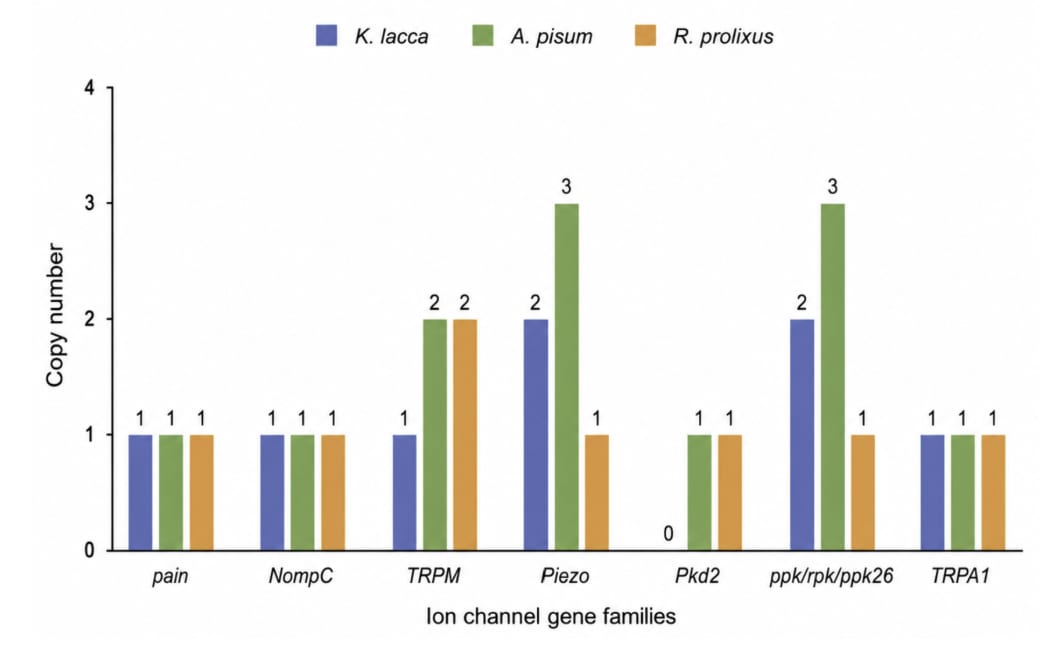
Figure 1. Gene copy numbers among the seven orthologous gene families searched in three hemipterans.
Pkd2 was the only channel not detected in the search of the K. lacca genome. Pkd2 is used in fruit fly larval class III multidendritic neurons (which respond to both gentle touch and noxious cold) to directly sense noxious cold temperatures (Turner et al. 2017). NompC and trpm are also used for modulating responses (perhaps, calcium homeostasis) to noxious cold in CIII neurons in fruit flies (Turner et al. 2017).
Our prior search of these same seven gene families in Goldberg et al. (2024) showed that Pkd2 was the ‘most absent’ gene family in the arthropods - when searching 40 total species, we found that Pkd2 was not detected in 50% of the genomes, including all Hymenoptera (bees, wasps, ants), all Lepidoptera, the single mantodean (mantises), and all mosquitoes searched (though most other Diptera had Pkd2). All other gene families were present in ≥70% of genomes searched. Despite the regular absence of Pkd2, other channels that had a role in cold nociception [NompC and trpm] were almost always (97.5%, NompC) - or literally always (100%, trpm) - present in the 40 analyzed genomes. However, NompC also has roles in noxious touch sensitization.
Given that the noxious cold-sensing function of Pkd2 has only been characterized in fruit flies, it is difficult to infer with confidence from its absence in so many genomes that the arthropods without Pkd2 lack cold nociception. A plausible alternate explanation is that arthropods without Pkd2 have evolved other noxious cold-sensing mechanisms that have yet to be elucidated, as cold nociception is especially poorly studied in arthropods. We do know that this evolution of novel proteins for noxious sensing in different insect orders has happened in the past with noxious heat: the loss of TRPA1 in Hymenoptera was followed by a duplication and neofunctionalization of waterwitch into HsTRPA, which performs a similar, noxious-heat-sensing function in the clade (Kohno et al. 2010). As we have only one datapoint for noxious cold sensing in insects (fruit flies; Turner et al. 2017), it may even be that the use of Pkd2 in fruit flies is itself the lineage-specific adaptation and not the ancestral state for noxious cold-sensing.
Further, there is often more than one receptor for assessing potentially noxious thermal information (e.g., the heat sensitivity of pyrexia, painless, and TRPA1; Tracey et al. 2003; Lee et al. 2005). This suggests that, while Pkd2 may be the essential receptor elucidated to date in fruit flies, multiple other channels that also engage in noxious cold sensing could be waiting for discovery. Ultimately, significantly greater interspecific research on mechanisms of noxious cold sensing is warranted in insects and other arthropods.
Thus, at this time, we can infer with reasonably high confidence that K. lacca does not use the Pkd2 mechanism for noxious cold sensing - but we cannot infer that cold nociception is thereby necessarily absent in the species.
Genetic architecture alone does not provide robust evidence of nociception: genes that are present in the genome may not be expressed in peripheral neurons used for noxious sensation or they may have functional plasticity (of both nociceptive and non-nociceptive varieties). As Goldberg et al. (2024) write, even a single “amino acid substitution can also lead to variation in channel sensitivity to noxious stimuli, even for orthologous channels (e.g., loss of chemical sensitivity in SiHsTRPA v. AmHsTRPA; Wang et al. 2018).” As a further example, mosquitoes have additional ion channel gene copies that play a role in non-nociceptive sensory processes, like heat perception involved with prey location (Wang et al. 2009).
Therefore, follow-up studies would be required to conclusively demonstrate nociception in the species. These studies should demonstrate nociceptive neurons in the periphery of the K. lacca sensory system for both sexes across multiple life stages (and particularly for late-stage sessile females), produce gene expression data that demonstrate the presence of the proteins encoded by these genes in those neurons, and secure functional data that demonstrate these proteins have noxious stimuli-sensing roles.
We obtained the genome of K. lacca from this preprint which, to our knowledge, has never been formally published and is by a different research group. The authors claim the genome was taken from late-stage, and thus sessile, adult females.
The annotated proteome from the K. lacca genome assembly GCA_045014175.1, containing 10,696 predicted proteins, was used to identify nociception-related ion channel gene families. We followed the comparative approach described by Goldberg et al. (2024). Protein sequences were analyzed with eggNOG-mapper v2.1.15 and eggNOG v5.0.2 database (Huerta-Cepas et al., 2019; Cantalapiedra et al., 2021). This approach groups evolutionarily-related proteins into orthologous gene families and provides functional annotations. Seven gene families previously associated with nociception were examined: pain, NompC, TRPM, Piezo, Pkd2, ppk/rpk/ppk26, and TRPA1, using the same eggNOG orthogroups reported by Goldberg et al. (2024). Update (8/27/2026): An additional three gene families associated with nociception were examined: TRPA5, Pyrexia, and Straightjacket.
Candidate proteins were evaluated using multiple criteria: their gene family assignment, protein length, predicted function, and conserved Pfam domains (Mistry et al., 2021). These additional checks were used to confirm that the predicted proteins had structural traits of each ion channel type. For uncertain annotations, candidate sequences were compared with known insect proteins using DIAMOND and BLAST similarity searches (Altschul et al., 1990; Buchfink et al., 2021). We did not use a fixed percentage identity cutoff; instead, we interpreted sequence identity together with alignment length, coverage, E-value, and conserved domain presence/absent. Low-identity matches were retained only when these additional criteria had strong support for homology. For genes not detected in the predicted protein set, TBLASTN searches were also performed directly against the K. lacca genome. This allowed us to test whether a gene might be present in the genomic sequence but missing or incomplete in the current annotation. Genes for which no clear evidence was found in either the proteome or the genome-level annotation were reported as not detected.
The ppk/rpk/ppk26 family required additional analysis because these related genes belong to the same eggNOG orthogroup. Protein sequences were aligned with MAFFT (Katoh and Standley, 2013), and their evolutionary relationships were analyzed using maximum-likelihood phylogenetics with IQ-TREE (Minh et al., 2020). Reference proteins from different Diptera species, including one of the best-studied model species, the fruit [or vinegar] fly Drosophila melanogaster (Diptera: Drosophilidae), and the hemipteran pea aphid, A. pisum, were included for comparison. Because the available data did not allow the individual K. lacca sequences to be confidently classified as ppk, rpk, or ppk26, the copy number for the ppk/rpk/ppk26 was conservatively reported as family. Update (8/27/2026): A similar process was needed for TRPA5 and Pyrexia. For Pyrexia, phylogenetic comparisons included 15 Pyrexia and 15 Waterwitch reference protein sequences from Liénard et al. 2024, which allowed for a more conservative distinction of closely related TRPA family candidates.
Code has been made available here on the Barrett lab’s GitHub. To reduce errors in software implementation and improve code quality, we used a LLM only for code review and debugging. All code logic was written by humans, with AI suggestions manually checked and tested to ensure accuracy and reproducibility. All text in this document, and the interpretation of findings from the in silico screen, were written entirely by humans.
Thank you to Macroscopic Ventures and The Navigation Fund. Their funding made Dr. Costa’s position in the Barrett lab possible and thus supported the research that generated this post. The funders had no control over experimental design, methodology, interpretation of results, or decision to publish this work. This post should not be taken to reflect the opinions, values, or beliefs of the funders. Thank you to Bob Fischer for reviewing a draft of this post before release.
You can review the post on what we found for the first 7 gene families in Goldberg et al. (2024) here. A brief summary of other farmed species we reviewed in that paper (Table 2), follows:
1) P. vannamei shrimp possess 4 of 7 gene families (missing pain, Pkd2, and ppk/rpk/ppk26);
2) honey bees possess 4 of 7 gene families (missing TRPA1 [but with a novel evolution of HsTRPA], Pkd2, and ppk/rpk/ppk26) and have copy number expansion for NompC;
3) black soldier flies possess 5 of 7 gene families (missing pain and Pkd2) with significant expansion in copy number for TRPA1;
4) silkworms possess 6 of 7 gene families (missing Pkd2);
5) yellow mealworms possess all 7 gene families with massive copy number expansion for pain and ppk/rpk/ppk26;
6) house crickets possess 6 of 7 gene families (missing Pkd2) with copy number expansion for NompC and ppk/rpk/ppk26.