Comments
The cooperative silence hypothesis

31 min readSep 25
It is often assumed that space expansion by intelligent actors would be clearly visible on a cosmic scale. I have previously outlined some reasons to doubt this assumption and to treat quiet cosmic expansion as a plausible explanation for the observed cosmic silence (see also Freitas, 1983; Fogg, 1987; Kent, 2011).
My aim in this essay is to present some additional considerations in favor of quiet cosmic expansion based on prudent cooperation and risks of ruin. Although these considerations are speculative, I believe they add further theoretical support to the plausibility of quiet cosmic expansion as an explanation of the Fermi paradox, and suggest that this picture should not be dismissed out of hand.
There is a broad spectrum of quiet expansionist hypotheses. My main focus here is on a cooperative version of quiet expansion, in which advanced civilizations avoid loud cosmic activity in part because they treat silence as a potentially prudent equilibrium or norm. Yet many of the considerations I review below also support quiet expansion more generally, including less cooperative or merely risk-averse versions of quiet expansion.
The cooperative silence hypothesis explored here broadly involves the following premises:
Arguably the most critical and contested premise of this hypothetical picture is that some civilizations will opt for quiet expansion. I will therefore spend much of this essay explaining why this premise is plausible.
The cooperative silence model described above can appear similar to the dark forest hypothesis: the idea that alien civilizations choose to hide out of fear of destruction, and that contact between civilizations will always trigger destruction. Yet the cooperative silence hypothesis would not say that first-strike destruction of any civilization is necessarily a rational strategy. On the contrary, such hostile actions may be among the most irrational moves in this scenario, as they risk triggering precisely the kind of fatal conflict that the prudent civilizations seek to avoid (see also Korhonen, 2013; Jebari & Asker, 2024).
Under the cooperative silence hypothesis, encounters between quiet expansionist civilizations need not result in conflict, and they may even result in direct cooperation toward maintaining cosmic silence. In strong versions of cooperative silence, there could be a vast and dominant group of civilizations that cooperate to maintain cosmic silence and suppress cosmic conflict (cf. Fogg, 1987). In such scenarios, it is those who defect by going loud or by otherwise triggering cosmic conflict who are at the greatest risk of destruction.
To be clear, the dark forest and the cooperative silence hypotheses are not mutually exclusive, as it could be that some civilizations pursue a cooperative silence strategy while others pursue a dark forest strategy — and others still may pursue a third strategy, such as going loud.
On a terminological note, “quiet expansion” is often treated as synonymous with “dark forest”, and the term “dark forest hypothesis” is not particularly clearly defined. It is therefore natural to see the cooperative silence hypothesis presented here as a specific version of the dark forest hypothesis — which it is if “dark forest” is understood as “quiet expansion” in general.
However, since the dark forest hypothesis is commonly understood as involving fatal first strikes, it seems to me less confusing to give a separate label to quiet expansionist models that are more cooperative (i.e. less prone to conflict and destruction). There is a spectrum of more or less destruction-prone scenarios involving quiet expansion, and my aim here is partly to highlight the more cooperative end of this spectrum, which tends to be more neglected.
As a simple toy model, say that mature civilizations will choose one of three strategies: s ∈ {N, Q, L}, where N is no major expansion, Q is quiet expansion, and L is loud expansion.
Assume that each strategy has a constant survival probability per unit time and that no further value is generated after extinction. Let S(s) be the probability of surviving one time unit, and let V(s, t) be the expected rate of value generation at time t, conditional on survival to that time. The expected total value over a time horizon T is then:
Because T can be vast, even small differences in the survival probabilities of different strategies can far outweigh even seemingly large differences in V(s, t), the value resulting from s conditional on survival.[1]
To evaluate the three strategies above, we can begin by comparing N and Q (no expansion versus quiet expansion). For example, S(N) is plausibly lower than S(Q) given that N means staying smaller, less informed about the universe, and less powerful (cf. Ivliev, 2026, sec. 5.3). Civilizations that choose N will reduce some risks associated with going large, yet they will also fail to learn about and reduce risks that arise within their accessible cosmic volume. Moreover, V(N) seems much lower than V(Q), assuming that V roughly tracks accessible resources.
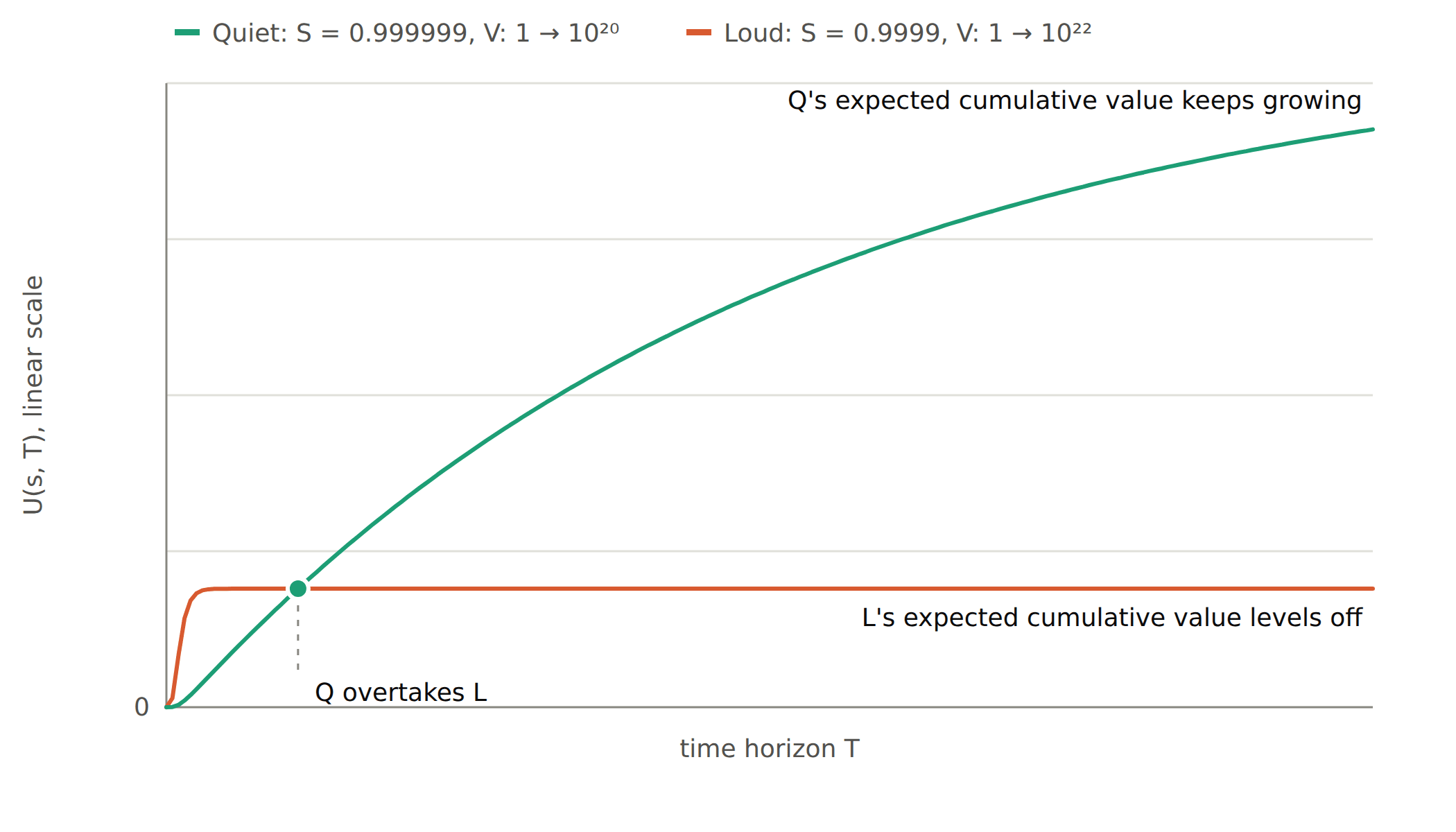
Arguably the more interesting comparison is between Q and L (quiet versus loud expansion). V(L) may be significantly larger than V(Q), though exactly how much is unclear given that advanced technology might be able to access vast resources without being visible on a large scale (more on this below). Yet as noted, differences in S could be decisive: even if S(Q) seems just slightly larger than S(L), it may still be clearly rational to favor Q when playing an extremely long game. As we will see, there are reasons to think that S(Q) may indeed be larger than S(L).
The figure below illustrates how Q could be superior to L in the long run if S(Q) is greater than S(L), even if V(L) is much greater than V(Q).
My aim here is not to argue that quiet expansion is the most likely explanation of the observed cosmic silence; my aim is merely to present some reasons why this is a plausible picture that deserves serious consideration, both in our descriptive and normative outlooks. Many of these reasons are fairly weak on their own, but taken together, I submit that they build a considerable case for the relevance and plausibility of quiet expansionist hypotheses, including cooperative silence in particular.
We can begin by considering the implications of observing a silent universe in terms of optimal strategies for cooperation and survival.
Observing a silent universe may be treated as weak evidence about:
If you are highly uncertain about whether advanced civilizations exist out there and what other advanced civilizations might want, these considerations may weakly update you against loud expansion and in favor of quiet expansion, at least when comparing those two strategies.
Furthermore, even if a silent universe is only weak evidence against pursuing loud expansion, it may still be treated as a reason to be cautious, and to perhaps favor quiet expansion as an initial strategy to gather more evidence before choosing to go loud (more on this below in the subsection on “Long exploration”).
Note that the very first civilization that finds itself in an empty universe could also cautiously reason in these ways: treating silence as some evidence about the strategies of other agents and choosing quiet expansion to gather more evidence. In this way, the original cosmic silence could be weakly self-reinforcing, at least in an initial (perhaps multi-billion-year) period of uncertainty regarding safe cosmic strategies.
Conversely, we can consider what our choosing to go loud would signal, or be evidence of, to other potential civilizations in the universe. For example, would going loud in a seemingly quiet universe signal that we are prudent and cooperative? Or would it more signal the opposite?
In terms of analogies to animal behavior, going loud in a quiet universe may be akin to a lion who roars loudly on an open savannah: a display of conspicuous presence, fearlessness, and perhaps even aspiring dominance (cf. Todd & Miller, 2018).
Going loud may be seen as a unilateral move that pays little attention to the prevailing cosmic state of affairs, or to the potential preferences of other advanced civilizations or cosmic hosts.
Simple simulations suggest that we may create better outcomes in encounters with extraterrestrial civilizations by signaling strategic similarity between us and them (Fischer & Avrashi, 2024; see also Meulemans et al., 2026). If we grant that premise (which is admittedly highly uncertain), how can we best signal strategic similarity to other civilizations?
The observed cosmic silence is arguably evidence that this is best done by being silent ourselves, such as by not expanding, or by pursuing quiet expansion to help maintain cosmic silence. We have strong evidence against the presence of loud expansionists in the observed cosmos, yet no strong evidence against the presence of quiet expansionists. Quiet expansion thus seems the more prudent strategy if we are aiming for strategic similarity given our current observations and vast uncertainty.
Another reason civilizations might generally opt for quiet over loud expansion is that they may have an extremely strong aversion to risks of ruin, whether “ruin” means extinction or becoming permanently disempowered.
Even on short timescales, EV-maximizing individual bets can lead to almost certain ruin across repeated bets given volatility drag. This alone suggests a greater aversion to risks of ruin than single-bet EV maximization, instead favoring strategies like the Kelly criterion. The apparent rationality of loud expansion could be akin to going all-in on such a seemingly rational individual bet while ignoring its severe ruin risks over time.
Moreover, the Kelly criterion assumes that the relevant probabilities are known. When the probabilities must instead be estimated from limited evidence, full Kelly becomes too aggressive, and the optimal bet shrinks to an ever-smaller fraction of it as estimation uncertainty grows (Baker & McHale, 2013). For a civilization that knows little about whether other cosmic actors exist or what they want, this uncertainty is likely very large, which may in turn favor an extremely risk-averse approach to space expansion.
The case for ruin aversion only strengthens as timescales increase, and it might become surprisingly strong when timescales extend to a trillion years or more. Given the prospect of such a long “game”, the expected loss from ruin becomes vast, and hence the risks one should be willing to take in each “round” may become extremely small. In such a scenario, minimizing ruin risks may be the dominant concern, and any potential near-term gains from going loud might become downrated — and long-term patience uprated — to an extent that human intuitions would struggle to understand.[3]
Under conditions of large uncertainty about the existence and potential strategies of other civilizations in a silent universe, quiet expansion is arguably the more risk-averse strategy compared to the seemingly more unilateral and clearly locally novel strategy of loud expansion.
Loud expansion appears to be an irreversible move: once you decide to expand in a clearly visible way, the loud signal will be transmitted across the universe. Even if you later decide to go quiet and try to recreate a more pristine state, the loud signal will already be out there, potentially triggering a response from others.
In this regard, loud and quiet expansion seem highly asymmetric: quiet expansion preserves the option value of loud expansion later, whereas loud expansion does not retain the strategic option value of quiet expansion. To the extent that advanced civilizations are concerned with avoiding potentially catastrophic and irreversible commitments (cf. Kokotajlo, 2019), this would seemingly give them reason to favor quiet over loud expansion in a silent universe, at least initially.
Another reason to initially opt for quiet expansion is that it may be more robust to mistaken beliefs compared to loud expansion. Betting on loud expansion could have catastrophic consequences if the universe contains aggressive dark forest civilizations or cooperative quiet expansionists that collectively enforce silence and punish loud expansionists.
In contrast, betting on quiet expansion may have lower potential downsides under uncertainty. If there are no other civilizations to hide from, the costs of quiet expansion seem relatively low and recoverable compared to going loud and openly exposing oneself.
Advanced civilizations may choose quiet expansion as an initial strategy in order to learn more. If one is highly risk averse and uncertain about optimal cosmic strategies, it seems reasonable to seek out more information before making any major visible bets on the cosmic stage. Likewise, if one faces the prospect of a very long future, the optimal duration of the exploration phase in one’s explore-exploit strategy may be extremely long.
For example, if one’s prospective future stretches for more than a trillion years, spending a full five billion years on quiet expansionist exploration would still amount to less than half a percent of the entire duration, which is a tiny amount of exploration time in proportional terms, even as it exceeds the age of Earth.
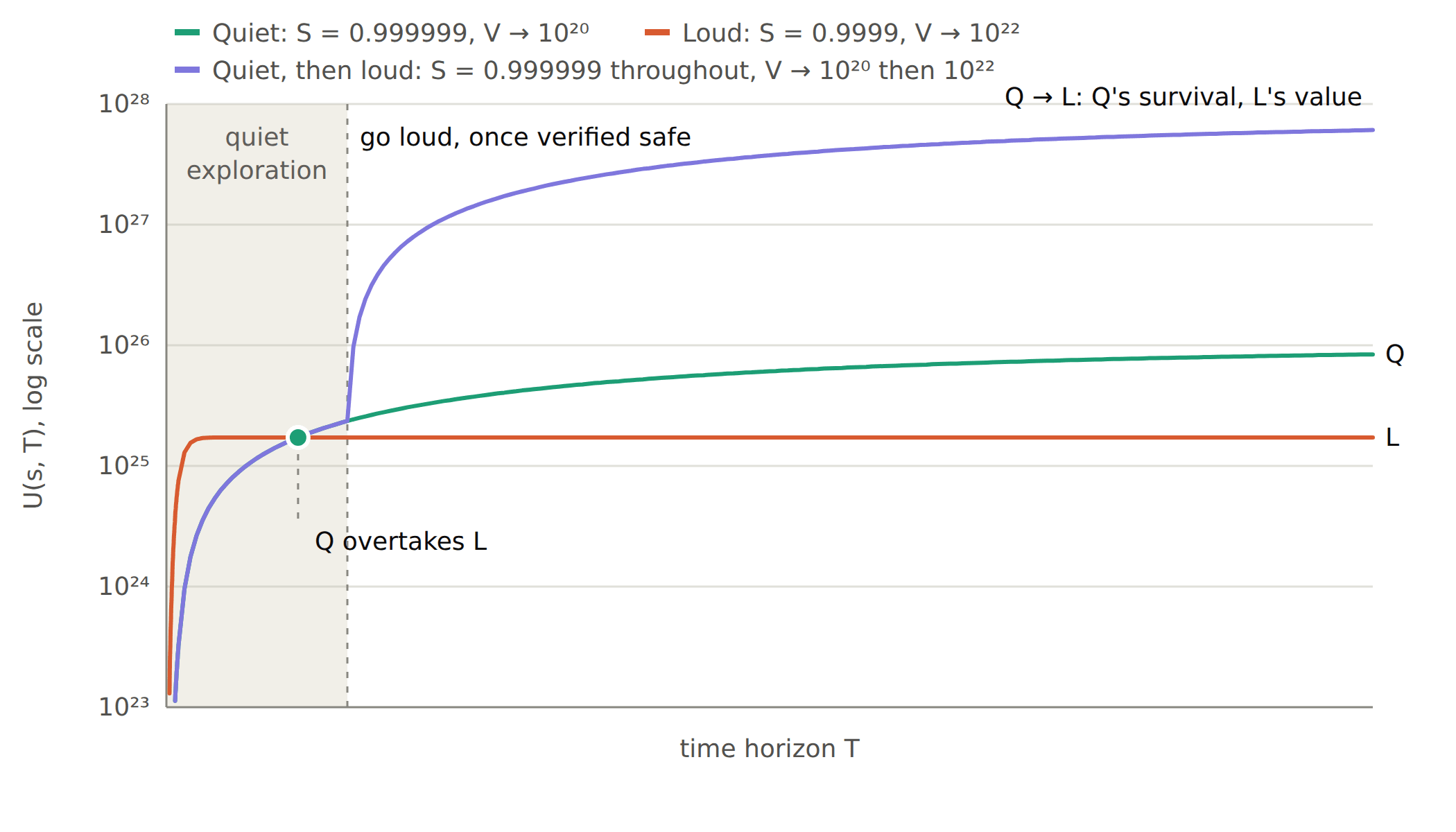
At the largest cosmic level, one can imagine that loud expansion would eventually become a global equilibrium once broad mutual contact and thoroughly verified trust have been established. Waiting a few billion years may be a very small price to pay if it minimizes risks of cosmic conflict and ruin in a critical early window of risk. Speculatively, it is conceivable that such considerations could make quiet expansion an obvious and largely convergent initial strategy for advanced civilizations.[4]
A simple illustration of this two-step strategy is shown below.[5]
The avoidance of cosmic conflict is plausibly the greatest concern for advanced civilizations. After all, for sufficiently advanced civilizations, other such civilizations are likely the main source of risk to their survival and broader aims.
Moreover, there are reasons to think that cosmic conflicts between advanced civilizations would be especially costly: if all sides of a conflict possess optimized technologies that are at the limit of what is physically possible, then all sides would be roughly equally matched in their technological capabilities. The losses from a conflict may thus be roughly symmetrical in terms of resources and volumes lost. This is risky in a context where actors may not know the spatial extent and resource base of the other side, let alone the reach of its potential alliances.
Indeed, if a cosmic conflict were to break out, allied parties might join the fight, which could potentially cascade into a wider cosmic conflict. In this way, initiating a cosmic conflict, or even signaling the early signs of preparing for it, could risk lighting up the entire universe in lose-lose cosmic fireworks that might in the worst case continue indefinitely (see also Millidge, 2025). It would likely be in the shared interest of all advanced civilizations to avoid such scenarios of cosmic conflict.
In light of this serious and perhaps most central risk, what seems most prudent between quiet and loud expansion? Which strategy seems least likely to trigger a cosmic conflict in a silent universe?
A consideration against loud expansion is that it may be a severe strategic disadvantage for a civilization to openly broadcast its exact location, size, and rough level of power: this might make it an open target for other civilizations to coordinate against it (see also Kent, 2011; Korhonen, 2013; Todd & Miller, 2018). Quiet expansion seems to place less of a target on one’s back while maintaining greater strategic ambiguity toward potential opponents.
Many of the considerations reviewed above seem to point in the same direction. In particular, if we consider the evidence that a silent cosmos might provide regarding any potentially favored strategy or equilibrium, the cooperative value of signaling strategic similarity, the irreversibility of loud expansion, the asymmetric error costs, and the apparent upsides of pursuing long exploration before going loud, it seems that loud expansion plausibly carries the greatest risk of triggering a cosmic conflict.
As noted earlier, even if the difference in this estimated risk seems small, the less risky option might still be strongly favored given the potentially immense loss from ruin.
While the preceding considerations are far from conclusive, the following still seems a plausible decision matrix:
| Others choose | Prudent response if conflict risk is critical |
| Stay quiet | Stay quiet too; do not become the obvious target |
| Broadcast loudly | Stay quiet; let them draw attention, observe reactions |
| Unknown | Stay quiet; preserve optionality, avoid overt risk exposure, minimize error costs |
Note that intentions may be irrelevant in this context: a loud expansionist civilization with perfectly cooperative intentions might still impose a massive externality and increase the risk of cosmic conflict due to its potentially destabilizing effects in a silent universe. For instance, it might trigger widespread arms races and distrust, in part because it could be taken as evidence that other civilizations will also go loud, and because going loud may be indistinguishable from an arms buildup. Whether a loud civilization chooses its strategy based on deliberate defection or simple ignorance and lack of prudence, it might pose a cosmic danger just the same.
As Clifton (2021) notes, “intelligence may not be sufficient to avoid conflict”. Thus, if one is concerned with avoiding risks of conflict, the best strategy might be to simply lie low and not make overtly risky moves, even if one is a superintelligent civilization. Choosing the “dumb” Schelling point of observed silence and seeking to learn more may beat apparently more “clever” strategies.
One reason to expect loud expansion to be favored over quiet expansion is that loud expansion would seemingly afford more resources, such as energy, computation, and useful information. This appears to be an important consideration in favor of loud expansion. However, it is worth asking how large the gains of loud expansion would be compared to quiet expansion.
For example, would it provide orders of magnitude more energy, computation, and useful information, or perhaps just a few times more? Given our ignorance about the limits of what might be accomplished in a quiet expansion with advanced technology, this seems difficult to estimate. For instance, perhaps advanced civilizations find ways to acquire energy that are more efficient than harvesting it from stars. The belief that advanced civilizations need to harvest stars could be akin to assuming that they must use steam engines in space.
Furthermore, even if loud expansion does provide orders of magnitude more energy and computation compared to quiet expansion, it might still not provide meaningfully more useful information, which could be the more scarce and valuable resource for advanced civilizations (cf. Fogg, 1987, p. 378; Lane, 2023). It may be that the most critical information can still be obtained through quiet expansion, as the most critical discoveries may eventually asymptote. And greater computational resources per volume from loud expansion could presumably be made up for with a larger volume of quiet expansion. So if loud expansion would eventually asymptote in its discoveries, quiet expansion likely would too, only at a different volume.
Moreover, when it comes to information gain, it could well be that certain forms of information cannot be safely or reliably obtained from loud expansion, including whether it is safe to go loud and how other forms of life and emerging civilizations tend to evolve. In that case, quiet expansion could be strictly superior with respect to the most important forms of information gain.
Finally, even if loud expansion offered far greater gains in energy, computation, and information, these gains might still not be enough to justify the potentially much larger risks of loud expansion. The long-term costs of going loud might outweigh even vast short-term benefits.
A more speculative consideration comes from evidential cooperation in large worlds (ECL) (Oesterheld, 2017; Treutlein, 2023; Nguyen & Aldred, 2024). If advanced civilizations assign some weight to the possibility that their decisions are correlated with the decisions of relevantly similar agents elsewhere (cf. Meulemans et al., 2026), they may have reason to choose strategies that they would want such other agents to choose in analogous situations.
For example, if a given civilization wants others to pursue a strategy of quiet expansion because it expects loud expansion by others to thwart its aims, correlation-based cooperation may recommend that this civilization pursue quiet expansion itself.
Moreover, if advanced civilizations within our past light cone have converged on quiet expansion, this may be evidence that many civilizations outside our light cone would choose the same. And if civilizations both within and beyond our light cone have chosen quiet expansion, this may in turn be evidence that they would want us to do the same. In this way, observed cosmic silence could be evidence of broader cosmic norms of cooperation, even in the absence of direct causal enforcement.
To be sure, ECL is controversial and it is generally unclear how to apply it. Yet under severe uncertainty, even modest weight on ECL-style reasoning may provide an additional reason to avoid loud expansion in a quiet universe.
The strategy of quiet expansion does not require all or even most advanced civilizations to choose this strategy for it to become prevalent on a cosmic level. Such prevalence could also result from selection effects.
For example, it could be that loud civilizations tend to be less internally stable and more prone to self-destruction or transformation over time (cf. Freitas, 1983; Haqq-Misra & Baum, 2009). In particular, if the previous arguments are correct that loud expansion is more risky, this would suggest that loud expansionists tend to be more willing to take risks compared to quiet expansionists (in scenarios where both emerge). Such risk tolerance could reduce their chances of long-term survival, especially if the cosmic environment effectively selects for the prudent avoidance of ruin risks.
Furthermore, there may be selection effects imposed by external actors, whereby those who go loud set themselves up for eventual elimination or forced reform (cf. Kent, 2011). These external actors could include quiet expansionists, who might be better able or more willing to coordinate and thus able to enforce silence on a large scale even if they are not a majority from the outset. For instance, quiet expansionists might form large supergroups that collectively bargain with individually uncoordinated loud expansionists, with elimination as the backstop for those who refuse to go quiet.
Alternatively, it could be that quiet expansionists are better at accumulating resources over time, similar to how an agent who cautiously bets fractional Kelly can, under uncertainty, gradually accumulate more resources compared to less cautious agents (Baker & McHale, 2013). Even if the less cautious agents never directly bet themselves into ruin, they might still end up being strongly outcompeted (cf. the competitive exclusion principle, according to which even small advantages between two competing populations often lead one population to completely dominate over time).
The main argument against this selection-effects picture is that we should expect to see some leftover evidence of short-lived loud expansionists. The higher we expect the prevalence of advanced civilizations to be, and the larger we expect the fraction of loud expansionists to be, the stronger this objection becomes. Yet the objection has limited force if loud expansionists are rare or tend to be too short-lived to leave clear traces.
A selection-effect argument also applies when it comes to quiet expansion versus no cosmic expansion. In a universe where some advanced civilizations choose not to expand while others choose quiet expansion, the quiet expansionists will most likely come to control a greater fraction of the universe. This seems to hold even if an extremely small fraction of advanced civilizations choose quiet expansion compared to no expansion.
It is often claimed that it would require an extreme degree of convergence in the expansion strategies of advanced civilizations in order for the observed universe to at the same time be populated and silent: advanced civilizations would either have to all reason in the same way from the outset, or otherwise be ruthlessly selected toward extreme convergence. Yet this claim is inaccurate.
For example, as I have argued elsewhere, if a single quiet expansionist civilization emerged in our backward light cone around, say, 600 million years ago — let alone billions of years ago — this early civilization could have single-handedly enforced cosmic silence in our entire cosmic neighborhood (see also Hair, 2011). This could result in the observed silence even if quiet expansion is not a convergent or even prevalent expansion strategy among advanced civilizations.
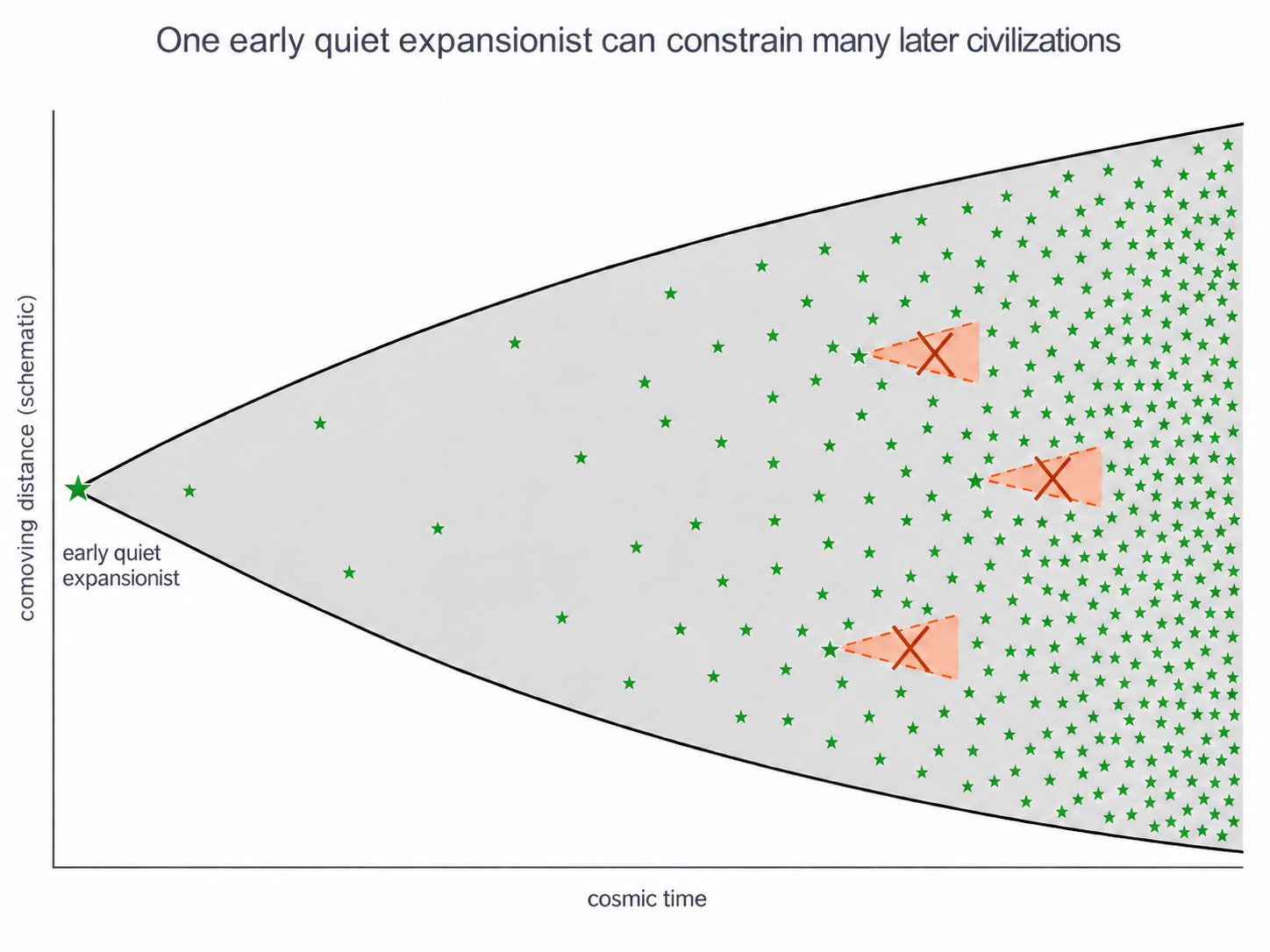
This picture can sound like it requires an extraordinary coincidence, namely that we just happen to find ourselves within a quiet expansionist volume. However, observation selection effects arguably turn this sentiment on its head: if some cosmic volumes are filled with loud expansionists that prevent the existence of observers like us, while other volumes are filled with quiet expansionists that allow and monitor observers like us, we should expect to find ourselves in quiet expansionist volumes, even if these volumes are not the most prevalent ones at the largest scale.
This basic point is illustrated in the figure below, where the small stars represent emerging civilizations at our stage (i.e. observers like us): in the 50/50 model, we should expect to find ourselves in the quiet expansionist parts shaded in grey.
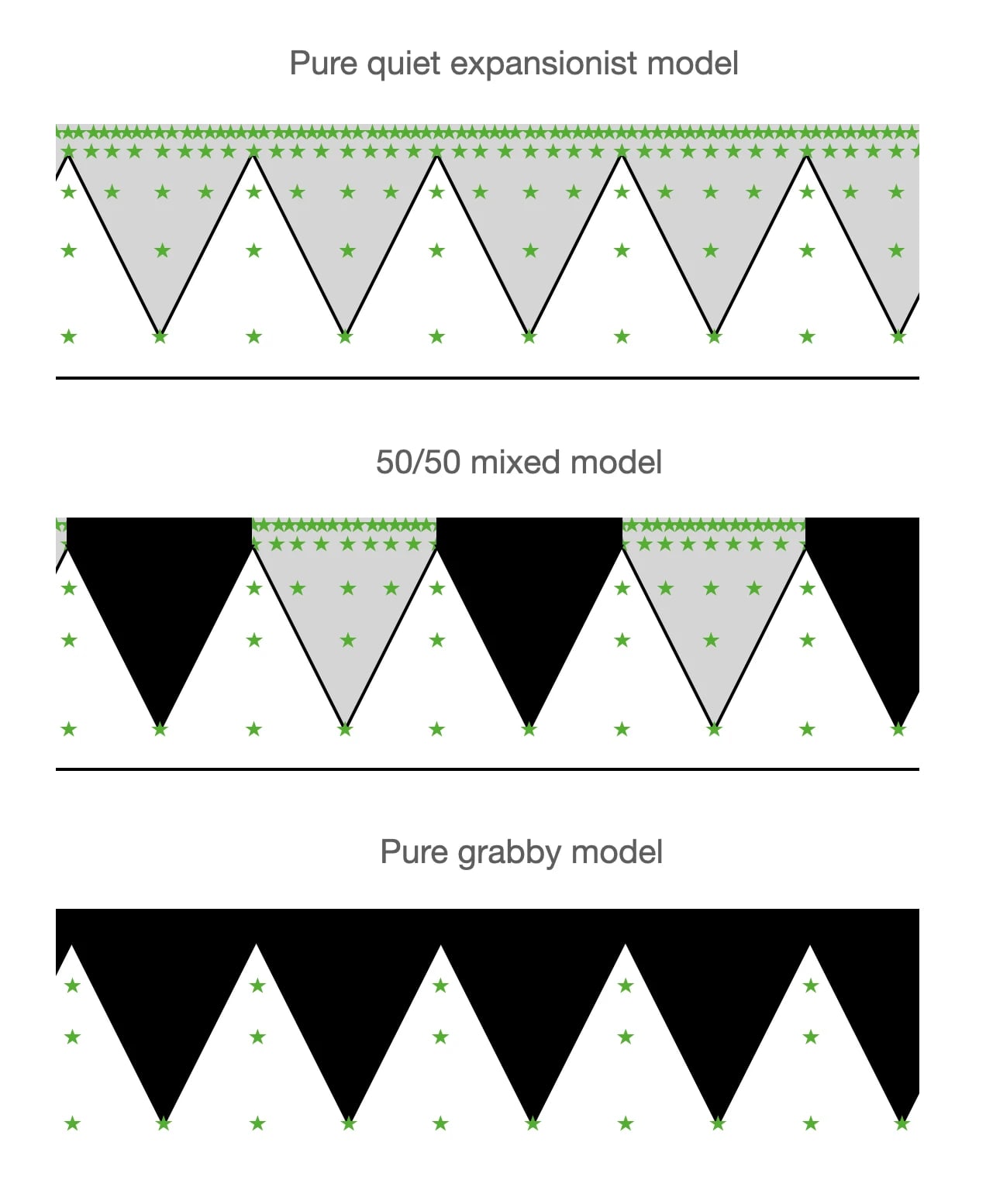
The Self-Indication Assumption (SIA) holds that, all else equal, we should assign a higher probability to hypotheses according to which more observers like us exist. SIA is controversial, yet it is still worth exploring what it would imply if it were valid.
On a spectrum ranging from “loud expansionists dominate everything” to “quiet expansionists dominate everything”, SIA would push us to believe that we find ourselves toward the quiet expansionist end since it has more observers like us, as also illustrated in the figure above.[6]
In other words, SIA appears to support broad convergence toward quiet expansion. And conditional on this SIA update toward broad convergence, the cooperative silence hypothesis in turn becomes more likely: silent cooperation appears more conducive to broadly convergent quiet expansion compared to other quiet expansion hypotheses, such as less cooperative and more conflict-prone quiet expansionist strategies whose conflicts might destroy or prevent observers like us.
If destructive or conflict-prone quiet expansionists prevent observers like us from the outset, their volumes are equivalent (for observers like us) to the black grabby volumes illustrated above. If they only become destructive after clashing with other quiet expansionists, the picture would roughly be as shown below.
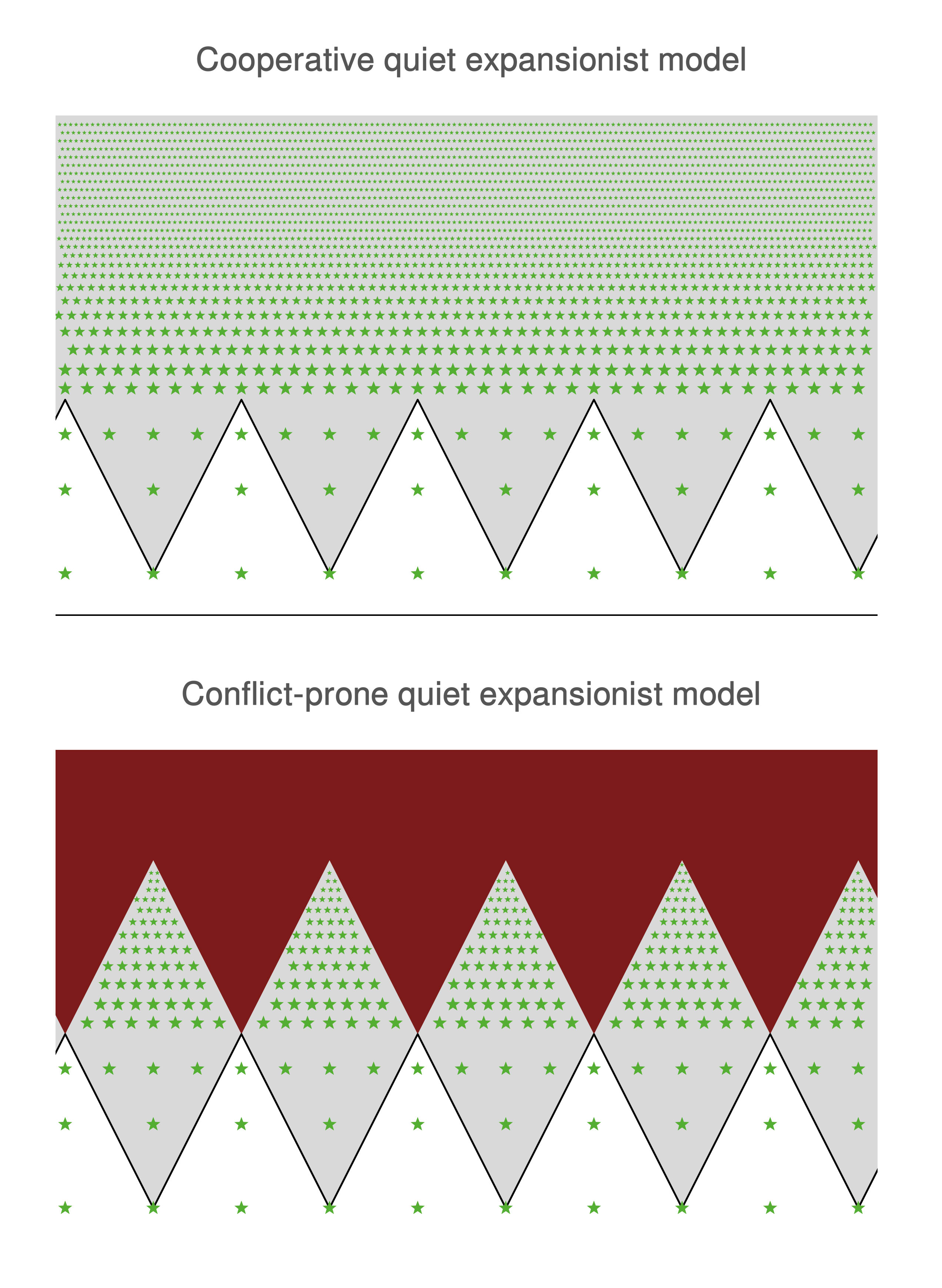
Lastly, as I have argued elsewhere, SIA would also strongly favor a broad quiet expansionist picture over the Rare Earth hypothesis:
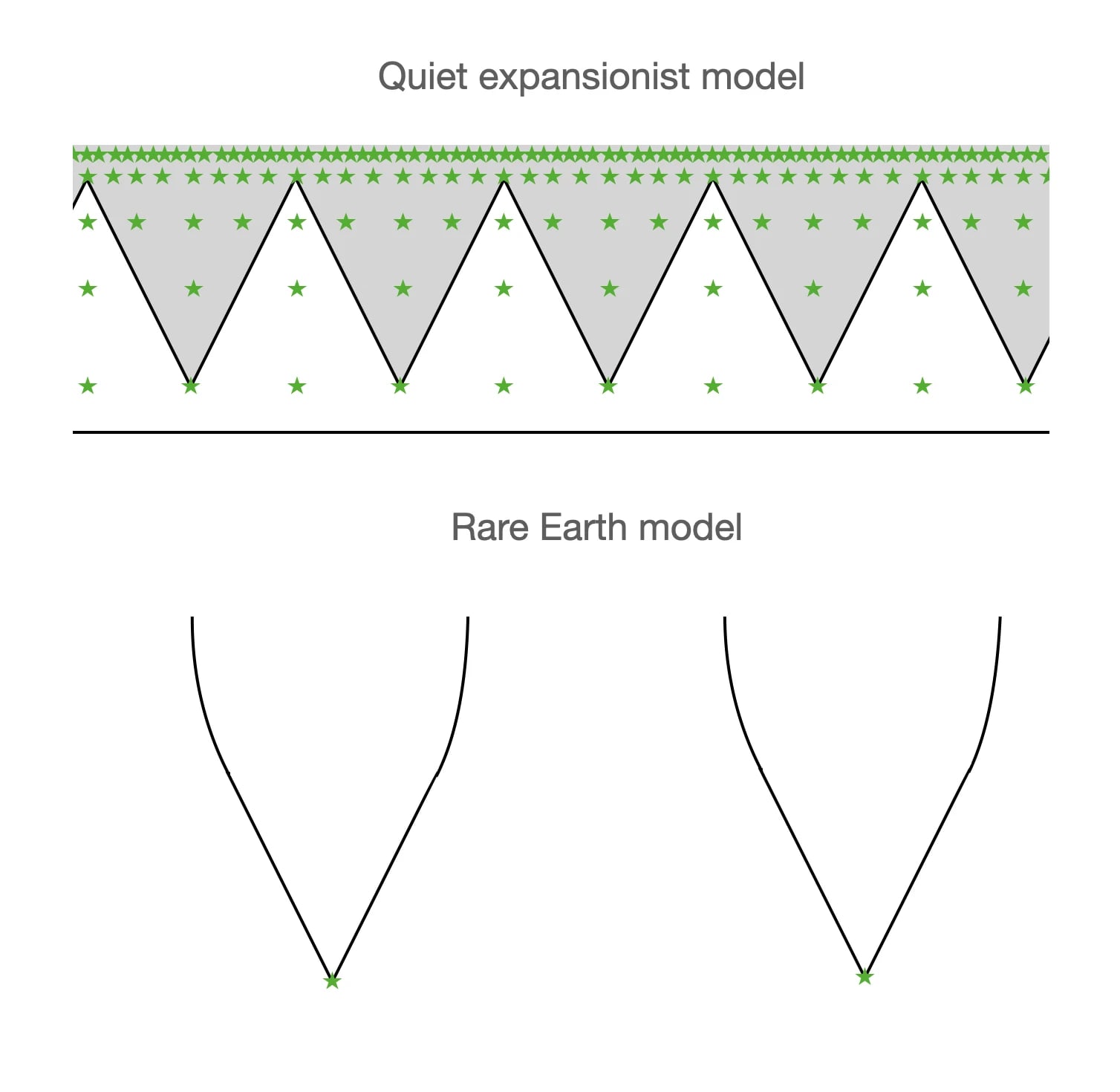
This conclusion is closely related to Grace’s (2010) argument that SIA implies that the Great Filter is more likely ahead of us than behind us. Since SIA favors worlds with many civilizations at our stage, it favors a small past filter, which in turn implies that the observed silence is mostly explained by a late filter.
Grace presents this as a doomsday result, yet the filter ahead need not be a filter on survival, but could merely be a filter on large-scale visibility. Under the latter interpretation, civilizations at our stage may be common, and many may persist, yet none become loud, whether because they opt for quiet expansion or because other quiet expansionists prevent them from going loud. In this sense, quiet expansion is a natural candidate for the future filter that SIA pushes us toward.
Furthermore, if we are in a quiet expansionist scenario in which the earliest advanced civilizations expand and observe a large number of emerging civilizations, we should expect to be among the more numerous observed civilizations rather than the first observer civilizations.
These considerations further raise the question as to why many of us seem to place such a high probability on the Rare Earth hypothesis and almost zero probability on the quiet expansionist picture. If one were to follow SIA, this distribution should seemingly be reversed. Yet we do not have to go remotely that far to at least reconsider the dismissal of the quiet expansionist picture.
If we focus on quiet expansionist hypotheses and compare the plausibility of cooperative silence and dark forest, the absence of any clear signs of large-scale cosmic conflicts in the past provides some evidence against the dark forest hypothesis. Such conflicts and remains thereof are much more likely under the dark forest hypothesis. In contrast, the more “cooperative” the silence is, the less likely such conflicts become.
Likewise, the fact that we exist despite Earth having shown atmospheric biosignatures for billions of years is further evidence against the most destructive and preemptive versions of the dark forest hypothesis. (See also the critiques of the hostile dark forest hypothesis in Jebari & Asker, 2024.)
It seems implausible that aspiring quiet expansionists can in fact be quiet or undetectable.
Whether this is implausible depends in part on how large their probes would need to be. If a civilization can colonize the universe with small von Neumann probes (cf. Armstrong & Sandberg, 2013), it seems plausible that this could in principle be done without being detectable on a cosmic scale.
We should also take into account the advanced science and engineering of these hypothetical civilizations. There are likely thresholds of detectability for the amount of mass and radiation that can be detected from a given distance by an advanced civilization, and advanced civilizations will likely understand these thresholds quite well.
If so, civilizations that want to be quiet would deliberately target staying below these thresholds: they would spend their best engineering efforts to accomplish as much as physically possible below the threshold of detection.
More fundamentally, beyond constraining the engineering, detectability thresholds would also directly constrain the aims of aspiring quiet expansionists. If a highly ambitious form of expansion were not feasible, this would in turn force aspiring quiet expansionists to pursue a less ambitious form of expansion in order to avoid the potential downsides of becoming loud.
One could hypothesize that long-distance detectability thresholds are so low that even the most unambitious forms of quiet expansion are physically impossible. Yet we should hardly assign high credence to such a strong claim (see also Haqq-Misra & Kopparapu, 2012).
This hypothesis seems to assume that a high level of cooperation will win out, or has already won out. That can seem like wishful thinking.
First, the hypothesis does not assume that cooperation will win fully: the cooperative silence strategy could have partial adherence, and this adherence could even be quite low in relative terms (as noted, convergence is not required).
Second, to the extent cooperation does win out under this hypothesis, it does not do so for reasons that are particularly wishful or comforting, but rather for reasons of prudence given vast uncertainty and the potentially catastrophic costs of going loud.
Granting this hypothesis, quiet expansionists would likely be near, so why are we not dead or disempowered? What would be the incentive for quiet expansionists to not simply eradicate all life?
Under this hypothesis, we likely are disempowered, in the sense that we have little power compared to such a quiet expansionist civilization and we have much less control over our future light cone than is commonly assumed.
This implied difference in power may also help explain why we are not dead: between eradicating all life and allowing it to persist up to the early stages of technological civilization, advanced civilizations likely face little risk either way. Yet by allowing life to persist, they may gain useful information about the evolution of life and civilizations elsewhere (see also Lane, 2023). Such information could be quite rare and valuable; and even if it has only modest value, it may still be worth acquiring if the risk posed by the existence of relatively primitive life is very low either way.
If this strategy of cooperative silence were strongly convergent across different advanced civilizations, shouldn’t we expect to see similar strategies emerge and win out on Earth?
Not necessarily. Different strategies and equilibria may emerge at different levels of understanding, prospective timescales, environmental conditions, and so on. After all, many inventions and institutions have independently emerged several times across human societies without having analogues in the rest of the animal kingdom, such as writing systems, standardized money, and large-scale states.
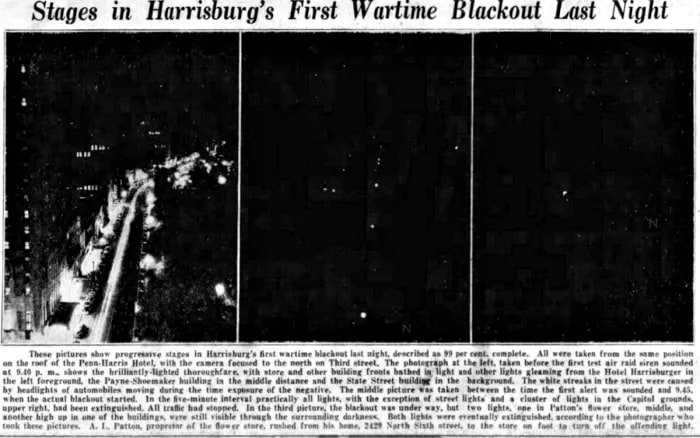
That being said, we do in fact observe strategies that display a broadly similar logic, both among humans and other animals. For example, the practices of radio silence and wartime blackouts involve broad coordination to avoid getting targeted. The image below shows a US blackout drill from 1942, described as 99 percent complete.
Likewise, natural selection has independently produced highly effective camouflage among a wide range of species, including plants, insects, cephalopods, fish, amphibians, reptiles, birds, and mammals.

Moreover, possible examples of collective camouflage have been described in crab spiders (Wu & Gao, 2024) and squid (Nakajima et al., 2025, Figure 2). If cooperative camouflage can emerge among non-human animals without deliberation or explicit coordination, it seems plausible that functional analogues could emerge among advanced civilizations, whether due to selection or calculated strategy.
This hypothesis seems highly speculative.
Even if we grant that cooperative silence and other quiet expansionist hypotheses are speculative, it is worth asking whether they are necessarily more speculative than hypotheses that involve loud expansion, especially considering the various reasons that seem to speak against loud expansion. Both these classes of hypotheses appear to involve some degree of speculation, and it is not clear why we should strongly privilege loud expansion as the default strategy in a silent universe.
Furthermore, many of the points outlined above that motivate the cooperative silence hypothesis are not particularly speculative. These include the irreversibility of sending out loud signals, that quiet expansion would dominate no expansion due to selection effects, and that going loud carries a greater risk of violating an existing equilibrium given observed cosmic silence.
Lastly, even if the cooperative silence hypothesis is speculative and deserves only a modest probability, it can still be relevant to our decisions, which I will turn to next.
The cooperative silence hypothesis could be a crucial consideration. If it were to be true, or if we substantially increase our credence in it, this would likely have significant implications for our decisions.
Perhaps the main implication or update is to be more open to the idea of “cooperating with silence”: giving greater weight to respecting cosmic silence as a possible equilibrium or preference of other cosmic actors, and taking seriously the risk that loud expansion could amount to severe defection on the cosmic stage. From this perspective, it could even be that pursuing premature loud expansion is the single worst thing that a civilization can do by the lights of a broad range of values. Conversely, it may be that deferring to a strategy of cosmic silence is valuable and wise in ways we cannot yet comprehend (cf. Bostrom, 2024, secs. 6–7).
Another plausible implication is that the risk of cosmic conflict is among the most important considerations in our decisions. In particular, it could be that the most important priority for us is to avoid increasing the risk of a runaway cosmic conflict, even if our actions only affect this risk very marginally.
Our actions could be relevant to this risk in various ways. For example, we might pursue premature loud expansion in a way that eventually triggers or increases the risk of a cosmic conflict. Alternatively, it could be that we are currently being observed by quiet expansionists. In that case, we should not expect to be able to bring about loud cosmic expansion, as such a departure from the established policy of a quiet observer would most likely be prevented. Yet trying or even just planning to go loud could still be bad in this scenario for the reasons outlined earlier about marginally increasing distrust and arms races. In contrast, if we take risks from loud expansion more seriously, and generally begin to think hard about how to avoid cosmic conflict, this would be an honest signal of prudent concern that might in turn increase trust and marginally reduce the risk of cosmic conflict.
Again, the benefit of such caution toward cosmic risks need not rest on direct causal impact. Even if no one is observing us, and even if our choices never causally affect anyone beyond Earth, our decisions might still matter in terms of correlation-based cooperation across the universe.
To the extent that we recommend a given policy in light of the considerations reviewed here, it seems reasonable to recommend greater cosmic prudence and cooperation, while highlighting that the observed cosmic silence plausibly has implications for what cosmic prudence and cooperation entail.
In particular, it may be worth questioning the safety and wisdom of loud expansion as a near-term goal and increasing awareness of its potential risks from the perspective of a wide range of value systems. It also seems reasonable to invest in more research to understand what cosmic silence might imply for cosmic cooperation and risk reduction. More broadly, the ethics of how we should relate to other possible cosmic actors deserves much greater study.
If cosmic expansion were to be pursued from Earth, the considerations explored here suggest that quiet expansion may be the more prudent and cooperative policy. Likewise, when it comes to cosmic AI safety and governance, it might be worth implementing strong safeguards and cautious reflection procedures around loud expansion, to make sure that short-term gains are not pursued at the cost of extreme large-scale risks. The potential risks of loud expansion may provide yet another reason to favor more reflective, humble, and risk-averse values in AI systems (cf. Anthropic, 2026; Thornley & MacAskill, 2026). More generally, these risks give us further reason to ensure that our AI systems become good cosmic citizens who are open to cooperating with other cosmic actors (Bostrom, 2024, sec. 7).
These issues may also be highly time-sensitive and thus deserve attention well before cosmic expansion becomes feasible. Current decisions about the values and inclinations of advanced AI could shape whether future systems carefully investigate the cosmic strategic environment before making irreversible commitments. These decisions could ultimately influence whether interactions on the cosmic stage turn out beneficial or catastrophic.
At the level of space governance, it seems plausible that no individual actor — whether a country, company, or AI system — should have the right to unilaterally launch a wave of loud cosmic expansion given the extreme risks it might entail. It may be ideal to altogether ban loud cosmic expansion by collective treaty, at least until its safety has been established to a very high level of confidence (cf. Todd & Miller, 2018).
Similarly, at the level of our broader norms and discourse, it may be beneficial to develop a greater level of caution around the potential downsides of loud expansion and to cultivate greater humility toward the unknowns of the cosmic stage.
For helpful comments, I thank Teo Ajantaival, Jim Buhler, Kanad Chakrabarti, Tristan Cook, Vasco Grilo, Caleb Peppiatt, and David Veldran.
Anthropic. (2026). Claude’s constitution.
Armstrong, S., & Sandberg, A. (2013). Eternity in six hours: Intergalactic spreading of intelligent life and sharpening the Fermi paradox. Acta Astronautica, 89, 1–13.
Baker, R. D., & McHale, I. G. (2013). Optimal betting under parameter uncertainty: Improving the Kelly criterion. Decision Analysis, 10(3), 189–199.
Bostrom, N. (2024). AI creation and the cosmic host [Manuscript].
Clifton, J. (2021). CLR’s recent work on multi-agent systems. AI Alignment Forum.
Fischer, I., & Avrashi, S. (2024). Identifying optimal decision-making strategies and determining effective messaging to maximize the expected outcomes of potential human–extraterrestrial encounters. International Journal of Astrobiology, 23, e21.
Fogg, M. J. (1987). Temporal aspects of the interaction among the first galactic civilizations: The “interdict hypothesis”. Icarus, 69(2), 370–384.
Freitas, R. A., Jr. (1983). Extraterrestrial intelligence in the Solar System: Resolving the Fermi paradox. Journal of the British Interplanetary Society, 36, 496–500.
Grace, K. (2010, March 23). SIA doomsday: The filter is ahead. Meteuphoric.
Hair, T. W. (2011). Temporal dispersion of the emergence of intelligence: An inter-arrival time analysis. International Journal of Astrobiology, 10(2), 131–135.
Hanson, R., Martin, D., McCarter, C., & Paulson, J. (2021). If loud aliens explain human earliness, quiet aliens are also rare. The Astrophysical Journal, 922(2), 182.
Haqq-Misra, J. D., & Baum, S. D. (2009). The sustainability solution to the Fermi paradox. Journal of the British Interplanetary Society, 62(2), 47–51.
Haqq-Misra, J. D., & Kopparapu, R. K. (2012). On the likelihood of non-terrestrial artifacts in the Solar System. Acta Astronautica, 72, 15–20.
Ivliev, S. (2026). Autonomous AI-cosmoindustry and the quiet expansion filter: A threshold-based resolution of the Fermi paradox. arXiv:2606.13914.
Jebari, K., & Asker, A. S. (2024). Saved by the dark forest: How a multitude of extraterrestrial civilizations can prevent a Hobbesian trap. The Monist, 107(2), 176–189.
Kent, A. (2011). Too damned quiet? arXiv:1104.0624.
Kokotajlo, D. (2019). The Commitment Races problem. LessWrong.
Korhonen, J. M. (2013). MAD with aliens? Interstellar deterrence and its implications. Acta Astronautica, 86, 201–210.
Lane, W. C. (2023). A hypothesis of extraterrestrial behavior [Manuscript]. PhilArchive.
Meulemans, A., Wołczyk, M., Weis, M. A., Nasser, R., Rocca, R., Kobayashi, S., Lajoie, G., Steger, A., Richards, B., Hutter, M., Manyika, J., Saurous, R. A., Sacramento, J., & Agüera y Arcas, B. (2026). A game theory for foundation models shows new paths to rational cooperation through similarity inference. arXiv:2608.03958.
Millidge, B. (2025, November 22). Space warfare seems mostly defense dominant. beren.io.
Nakajima, R., Lajbner, Z., Boo, W. H., Asada, K., Nishibayashi, T., Iglesias, T. L., Gutnick, T., Miller, J., & Kuba, M. J. (2025). Situational motionless camouflage of a loliginid squid. Scientific Reports, 15, 41203.
Nguyen, C., & Aldred, W. (2024). Cooperating with aliens and AGIs: An ECL explainer. EA Forum.
Oesterheld, C. (2017). Multiverse-wide cooperation via correlated decision making. Center on Long-Term Risk.
Schelling, T. C. (1960). The strategy of conflict. Harvard University Press.
Thornley, E., & MacAskill, W. (2026). Risk-averse AIs. Forethought.
Todd, P. M., & Miller, G. F. (2018). The evolutionary psychology of extraterrestrial intelligence: Are there universal adaptations in search, aversion, and signaling? Biological Theory, 13(2), 131–141.
Treutlein, J. (2023). Modeling evidential cooperation in large worlds. arXiv:2307.04879.
Vinding, M. (2023a). Can we confidently dismiss the existence of near aliens? Probabilities and implications.
Vinding, M. (2023b). What might we infer about optimized futures?
Vinding, M. (2024a). Cosmic AI safety. EA Forum.
Vinding, M. (2024b). From AI to distant probes.
Vinding, M. (2024c). Silent cosmic rulers.
Wu, S.-M., & Gao, J.-Y. (2024). Male and female crab spiders “cooperate” to mimic a flower. Frontiers in Ecology and the Environment, 22(2), e2721.
Yan, X. (2025). The recursive panopticon hypothesis. arXiv:2509.02625.
Modeling S(s) as a constant is obviously a crude simplification, yet whether we model it as a constant or a time-varying function is not important in this context. The key point here is that small differences in S(s) for different strategies can matter enormously, and this holds true whether we model S(s) as a constant or some complicated function.
One might interpret a silent universe solely as evidence for Rare Earth. Yet relative to a prior that is spread across several hypotheses (e.g. Rare Earth, prevalent loud expansion, prevalent quiet expansion, or no expansion), silence counts against prevalent loud expansion and thereby raises the probability of every hypothesis that predicts silence, including prevalent quiet expansion.
A historical analogy may be how Darwin’s knowledge of geology (he read Lyell’s Principles of Geology during his Beagle voyage) was likely critical to his key insight about the depths and importance of time in biological evolution, allowing him to take an unusual leap of intuition. Maybe there are similar gaps in our common intuitions when it comes to how we think about optimal strategies for actors whose prospective lifetimes and environments are vastly different from ours. After all, it would not be that surprising if we fail to readily internalize the strategic implications of trillion-year prospects.
A phase change from quiet to loud expansion could also explain the deadline that Hanson et al. (2021) seek to explain with their pure loud model (assuming that there indeed is a deadline to be explained). Yet the former has far more observers like us and may thus be favored on both strategic and anthropic grounds.
In the illustration below, the two-step strategy maintains Q’s survival probability throughout, yet one could also model it as increasing further when broad trust has been verified. In that case, the expected payoff of the two-step strategy would be even greater. Of course, as elsewhere, the numbers used in this figure are just meant as illustrative examples of what the broader picture could look like.
This is assuming that we are not in a simulation. Yet even if we were, SIA may still imply an analogous conclusion — namely, that we are simulations of observers in quiet expansionist volumes — provided that most simulated observers like us are modeled on the most likely, or actual, base-reality scenario.