Summary
- If you trust there is as little variation in the probability of sentience as suggested by the values used by Ambitious Impact (AIM) and Animal Charity Evaluators (ACE), or presented in Bob Fischer’s book about comparing welfare across species, I believe there are other factors which may be more important for the probability of a small donation increasing animal welfare:
- Donating to incremental instead of hits-based interventions.
- Donating to smaller organisations.
- Donating to organisations in lower income countries
- I wonder to what extent people donate to interventions targeting animals which are more likely to be sentient to boost the probability of increasing welfare. People routinely take actions which are super unlikely to actually matter:
- I calculate driving a car for 10 km in Great Britain without a seatbelt leads to 1 additional death with a probability of 1 in 73.0 M. AIM uses a probability of sentience of shrimps which is 34.2 M times as high.
- Andrew Gelman found the probability of a voter in a small United States (US) state polling around 50/50 in a close election nationally changing the outcome of the national election could get as high as 1 in 3 million. AIM uses a probability of sentience of shrimps which is 1.40 M times as high.
Context
Many people care not only about increasing animal welfare in expectation, but also about decreasing the probability of harming animals, and increasing the probability of helping animals. For example, some prefer averting i) 1 h of pain with a given intensity with certainty over ii) 100 h of pain with the same intensity with a probability of 1 %, even though there is an expected reduction in pain of 1 h in both scenarios.
Animals which are not sentient cannot experience any happiness or suffering (positive or negative conscious experiences), regardless of their conditions. As a result, interventions targeting animals which are more likely to be sentient have a higher chance of helping them, at least if they do not accidentally harm them. I think some people overestimate how much this matters for the probability of a small donation increasing animal welfare.
Factors boosting the probability of increasing animal welfare
Donating to interventions targeting animals which are more likely to be sentient
Below are the probabilities of sentience estimated in Bob Fischer’s book about comparing welfare across species. The expected (mean) probability of sentience of shrimps is 41.7 % (= 0.40/0.96) of that of pigs.
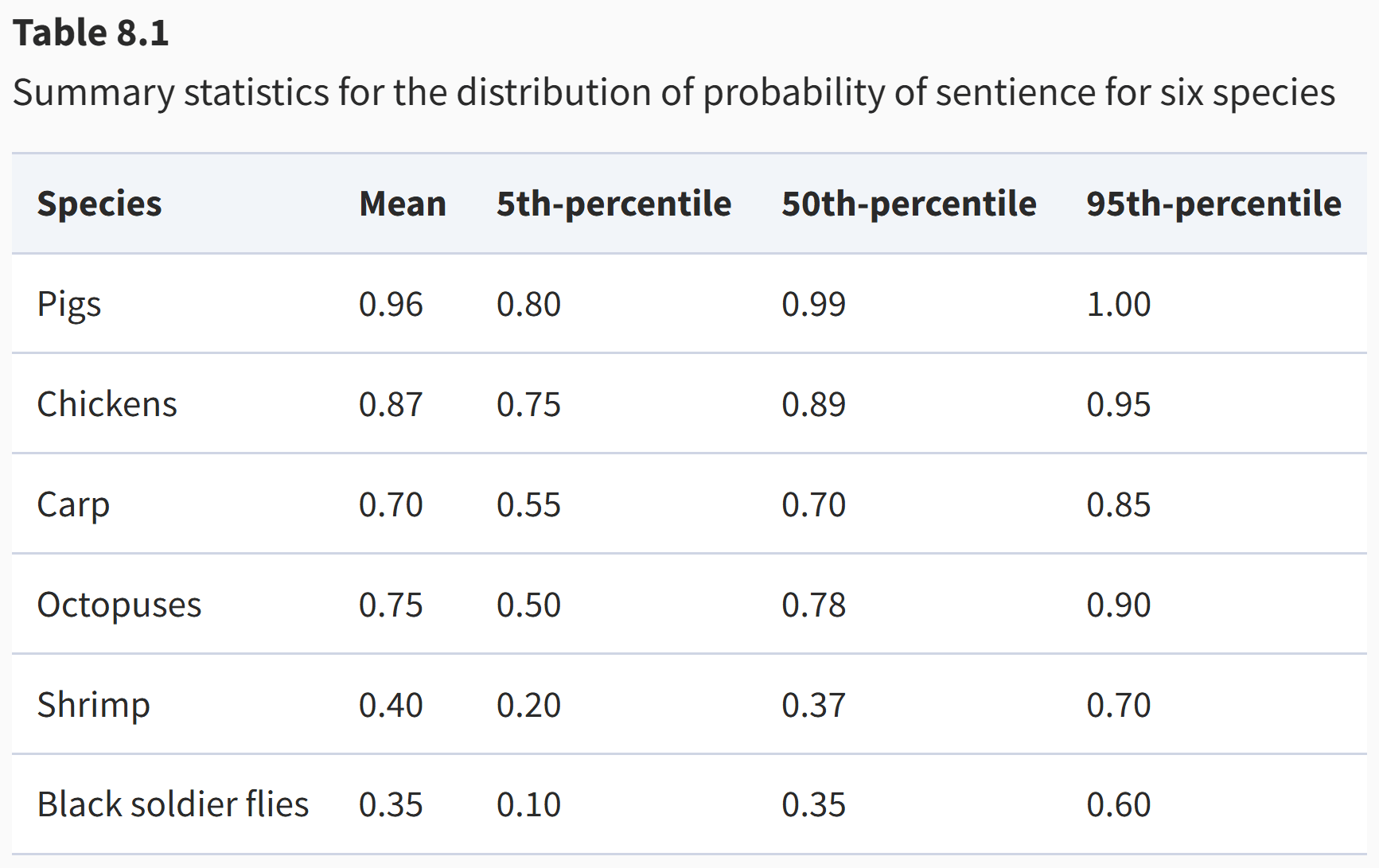
AIM used a probability of sentience of pigs and shrimps of 92.5 % and 43.3 % in their estimation of SADs in 2025, which are in close agreement with the above. You can ask Vicky Cox for the sheet with AIM’s SADs. AIM uses SADs in cost-effectiveness analyses (CEAs) of organisations targeting animals they could incubate, and ACE in CEAs of organisations they could recommend. For those probabilities, donating to interventions targeting pigs instead of shrimps makes donations 2.14 (= 0.925/0.433) times as likely to help the target animals (all else equal).
I do not know the extent to which the probabilities above are accurate. I suspect one can get dramatically different results for different models, like 10-6 to 99.999 % for shrimp, and I have very little idea about how to aggregate them in a principled way. However, if you trust there is as little variation in the probability of sentience as suggested by the values used by AIM and ACE, or presented in Bob’s book, I believe there are other factors which may be more important for the probability of a small donation increasing animal welfare. I discuss these below.
Donating to incremental instead of hits-based interventions
As an example of an incremental (though very scalable) intervention, the Shrimp Welfare Project’s (SWP’s) Humane Slaughter Initiative (HSI) offers electrical stunners to producers to decrease the pain of farmed shrimp during slaughter, which would otherwise occur via air asphyxiation. Aaron Boddy, SWP’s chief strategy officer, said on 7 October 2024 that “Each stunner costs us [SWP] $55k and we ask the producers we work with to commit to stunning a minimum of 120 million shrimps per annum”. So I estimate a donation of 1 k$ to SWP increases the probability of one more stunner being offered to producers by roughly 1.82 % (= 1*10^3/(55*10^3)).
As an example of a hits-based intervention, Dansk Vegetarisk Forening (DVF) “influences agricultural and food policy, advocates for redirecting subsidies and public funds toward plant-based and higher welfare initiatives, and engages decision makers to integrate animal welfare into sustainability frameworks”. It raised 1.7 M$ in 2024. Assuming that a donation of 10 % of this, 170 k$ (= 0.10*1.7*10^6), would increase the probability of them achieving one more significant win by 10 %, a donation of 1 k$ would increase it by roughly 0.0588 % (= 1*10^3/(170*10^3)*0.10).
Based on the above, donating 1 k$ to SWP instead of DVF would make the donation 31.0 (= 0.0182/(5.88*10^-4)) times as likely to help the target animals. This factor is 14.5 (= 31.0/2.14) times that related to helping pigs instead of shrimps.
Donating to smaller organisations
I expect larger organisations to spend more per project, and therefore need more donations to start a new project. In addition, I anticipate donations resulting in new projects are more likely to increase animal welfare than ones increasing the spending on existing projects. So I think donating to organisations spending less per year boosts the probability of increasing animal welfare.
The Humane League (THL) spent 25.1 M$ in 2025. The Center for Wild Animal Welfare (CWAW) budgeted 120 k$ (= 60*10^3*2) for 2026. So THL’s spending in 2025 was 209 (= 25.1*10^6/(120*10^3)) times CWAW’s budget for 2026. THL spends much less per project than 209 times what CWAW spends per project. Yet, I can easily see the donations needed for THL to start a new project being more than 2.14 times those needed by CWAW, which is the factor related to helping pigs instead of shrimps.
Donating to organisations in lower income countries
The Animal Welfare Fund (AWF) made a grant in the 2nd half of 2025 to Star Farm Pakistan to support cage-free work in Pakistan. The real gross national income (GNI) per capita in Pakistan in 2023 was 5.45 k 2021-Int$, 454 2021-Int$/month (= 5.45*10^3/12). If organisations targeting animals in Pakistan increase their working time in increments of this, donating 1 k 2021-Int$ to them would increase their working time with certainty. The real GNI per capita in the US in 2023 was 74.1 k 2021-Int$, 6.18 k 2021-Int$/month (= 74.1*10^3/12). If organisations targeting animals in the US increase their working time in increments of this, donating 1 k 2021-Int$ to them would increase their working time with a probability of roughly 16.2 % (= 1*10^3/(6.18*10^3)). Consequently, donating 1 k$ to organisations targeting animals in Pakistan instead of the US would make the donation 6.17 (= 1/0.162) times as likely to help the target animals. This factor is 2.88 (= 6.17/2.14) times that related to helping pigs instead of shrimps (for AIM’s probabilities of sentience).
People routinely take actions which are super unlikely to matter
I wonder to what extent people donate to interventions targeting animals which are more likely to be sentient to boost the probability of increasing welfare. People routinely take actions which are super unlikely to actually matter.
I think many people today would use seatbelts even if this was not mandatory. Yet, there were only 2.7 road fatalities per 1 billion miles driven by cars in Great Britain in 2024 (see Table 4), 1.68*10^-8 road fatalities per 10 km (= 2.7/(1*10^9*1.61)*10). The National Highway Traffic Safety Administration (NHTSA) estimates using a lap and shoulder seat belt decreases the risk of death of front seat passengers by 45 %. So I estimate there would have been 3.05*10^-8 road fatalities per 10 km (= 1.68*10^-8/(1 - 0.45)) driven by cars in Great Britain in 2024 if no one had used seat belts, 1.37*10^-8 more per 10 km (= (3.05 - 1.68)*10^-8). This is analogous to driving 10 km without seatbelt leading to 1 additional death with a probability of 1 in 73.0 M (= 1/(1.37*10^-8)). AIM uses a probability of sentience of shrimps which is 34.2 M (= 0.468/(1.37*10^-8)) times as high.
Many people vote in elections. However, Andrew Gelman found “that if you’re in a ‘safe state’ like California, the odds of your vote changing the outcome of a presidential election really is effectively zero (the model spits out 1 in 100 trillion, but it’s very hard to assign meaningful probabilities to something so unlikely). Something similar would be true for voters in ‘very safe seats’ in the UK or Australia”. “By contrast, in a small US state polling around 50/50 in a close election nationally — for instance New Mexico, Iowa, or New Hampshire in the 2000 elections — the probability could get as high as 1 in 3 million”. AIM uses a probability of sentience of shrimps which is 1.40 M (= 0.468*3*10^6) times as high.


This position many animal advocates hold (even if only implicitly) was indeed rationalized/explained with difference-making risk aversion by Clatterbuck and Fischer (2025). And in this case, p(sentience), and moral weights more broadly, indeed seem important, actually.
I think it's very plausible people are inconsistent in how difference-making risk averse they are for different things. However, let me play devil's advocate:
Thanks for the comment, Jim.
I think people would say they use seatbelts because it is mandatory (in many countries) and safer. However, I agree the decrease in the severity of accidents is too small for most people to actually care about it. I assume the most important reason is that it is something that most people close to them do. Likewise, I think most people prioritise animals with a higher probability of sentience like chickens instead of shrimps because it is what most people close to them do. I guess it has little to do with the actual probability of sentience of the animals in question.
In contrast to you, I would be surprised if people who prioritise animals with a higher probability of sentience like chickens instead of shrimps are significantly less likely to vote. I believe the vast majority of people do not care about the probability of their vote changing the election. I guess most people see voting as fulfilling their duty to improve society.
Interesting. I think there's something to this analogy, though ofc the social pressure to put your seatbelt on is far higher than that to prioritize chickens over shrimp.
Yeah, maybe they just rationalize their motivations with moral weight arguments while their real drive is something else (see Simler & Hanson 2018). And highlighting potential biases we have might be helpful. On the other hand, you may wanna mainly stick to red-teaming the importance of p(sentience) as a potential crux (by, e.g., red-teaming Clatterbuck and Fischer), anyway, if that's the reason people give (even if it might not be their real motivation deep down). I generally find this to be the most productive. People rarely update just based on noticing or being reminded of a bias they may have.
That also seems part of the picture, yeah! And notice that this bolsters my broader point that it might not be about EV max and that there might be no inconsistency between voting and being difference-making risk-averse.
I think social pressure mostly comes from people who are close to us. So I believe there can be significant social pressure to prioritise some animal welfare interventions even if society at large cares little about them. For example, people who have worked on helping dogs and cats for 10 years will make friends and professional connection working on the same area, and this in turns makes it harder to change to other areas.
People funding or working on animal welfare interventions are often in a tiny minority who were persuaded to eat mostly plant-based to be consistent with their views about non-farmed animals, particularly pets. So those people may be significantly more likely than random people to prioritise animals with a lower probability of sentience if they notice they are happy to support other activities like voting which have a super low chance of positively influencing outcomes.