Subtitle: I’m launching a project & would like your feedback.
TLDR:
AI safety comms efforts towards the general public are still very neglected, compared to the scale and urgency of the current situation. I’m proposing a possible, quite ambitious solution to this problem and I need your help to both understand if and how it can actually work, and to make it happen.
I think that if we want to actually “pace the frontier” (or even completely pause AI development for a while), we cannot rely mostly on informing policymakers. As things stand, I believe we also need to trigger significant pressure from the public, yesterday.
Since the world is in multicrisis-mode right now (geopolitical instability, the decline of western democracy, general anxiety on AIs non-catastrophic harms, incoming US elections, climate change, etc), decisionmakers’ priorities may be quite unpredictable. That means, informing as much of the general public as possible on AI’s catastrophic risks may have become a non-negotiable strategy.
So here’s my high-upside, but still untested idea:
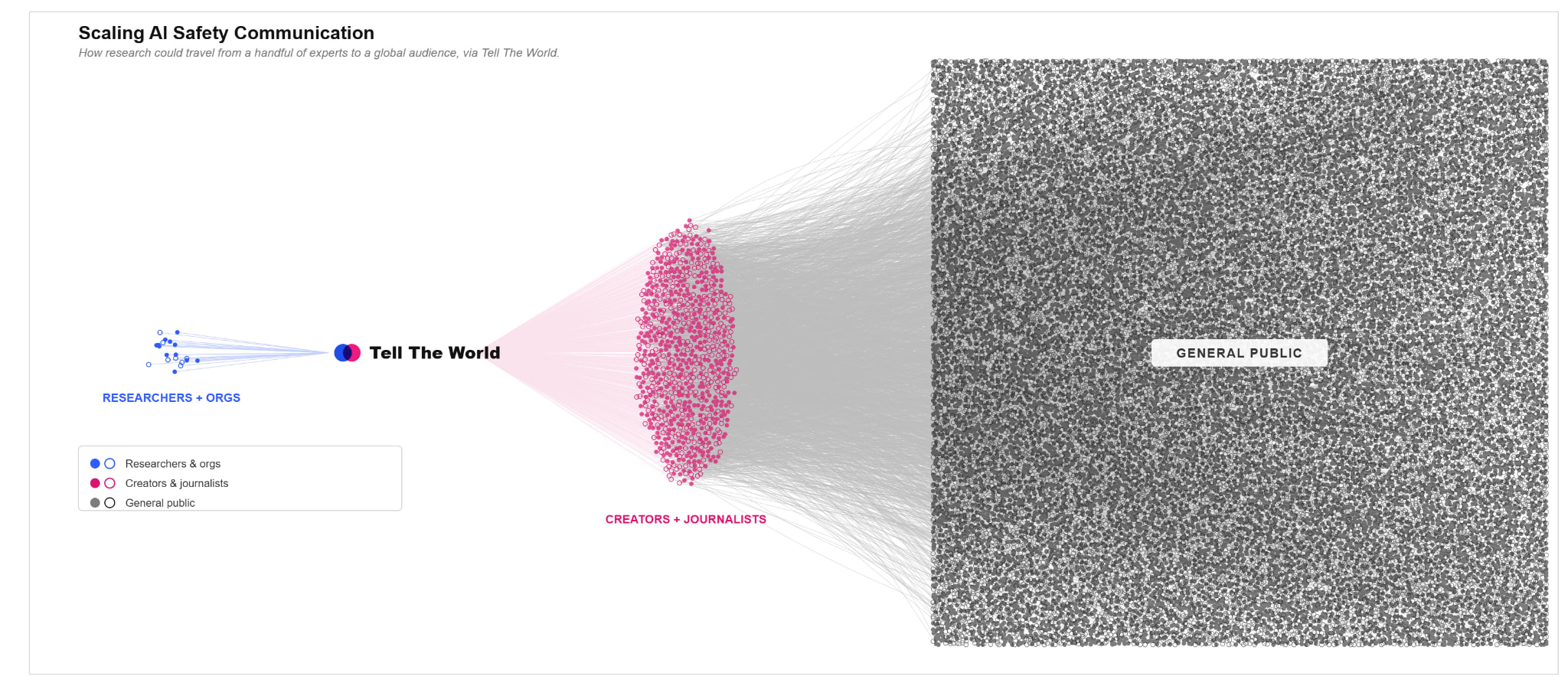
Creating a platform to inform and keep in the loop tens of thousands of content creators and journalists, so that they can in turn spread the word to all of their audiences worldwide – aka, millions of people – hopefully reaching a critical minority necessary to push and achieve the national and global policies we need to make AI go well.
I believe this can be done
In a way that is cost-effective, epistemically sound and multilingual
With a software platform promoting and facilitating the interaction between
Content creators and journalists on one side
AI safety researchers and organisations on the other
This is what I’ve been working towards lately, building a platform called “Tell The World”. Here’s a link to the landing page: telltheworld.io.
With this blog post I would like to tell you more about it and ask for your help to make this happen.
What is the problem?
The few content creators and journalists already covering AI safety topics suffer from significant research bottlenecks: the most important sources – reports, papers, blog posts, social media, etc, are
Often very technical &
Too many (it’s hard to keep up with the sheer volume of AI safety related news, developments and experts’ takes)
There’s also a great number of content creators and journalists worldwide who could be covering these topics, but still don’t know (or know too little) about them. In case they decided to make content or write about them, they’d incur in the same problems AGI-pilled content creators and journalists have to deal with (see above).
On the other hand, more and more AI safety researchers and organisations want to get their message across to the general public. Some are already trying, but the efforts are still (IMO) too scarce and scattered. Others are not prioritising this at all.
How would this project solve it?
***
Disclaimer: from now one I’ll be using these abbreviations:
TTW: Tell The World
CCs: Content Creators
Js: Journalists
Rs: Researchers
Os: Orgs
***
TTW’s ambition is to address these problems by
Helping AI safety Rs and Os communicate at scale with CCs and Js (and therefore the general public) without worrying about
Recruiting /reaching out to CCs
Building contacts with news outlets
Periodically updating partner CCs / Js on AI safety developments,
Maintaining relationships
etc
Helping CCs and Js quickly learn about what’s going on with AI catastrophic risk (If they’re not already AGI-pilled), and get the material they need
In one place
Explained in non-technical but precise terms
From trustworthy, authoritative sources
Including different opinions and takes
… then use their storytelling and creative skills & experience to communicate what they’ve learned, in a way that is optimal to their target audience.
And in the process, become part of a community of people working towards the same goal - making AI go well for all of humanity.
In short, I imagine the potential impact to look something like this:
More specifically, Tell The World would provide all the tools and services to facilitate the interactions between Rs and Os with CCs and Js:
The software platform
Recruiting and engaging with users, especially CCs & Js outside of the AI safety space, worldwide.
Editorial work (for the creation of briefs, etc)
Content moderation
…and possibly more
So far, an MVP
The features below represent the current MVP, based on user research with content creators (and other comms people), as well as my own experience of the AI safety space, over the past 2 years.
I still haven’t done user research with researchers, organizations, or journalists. So this first iteration mostly targets creators’ needs, while I gather broader feedback.
The central feature: “Briefs”
Briefs are interactive, expert-curated, authoritative pages providing information and material on specific AI safety topics – both evergreen and new – in plain English. As you can imagine, Briefs are aimed at solving content creators’ and journalists’ research bottlenecks.
Here’s a short video-walkthrough giving a little taste of what Briefs look like right now: video link
More specifically, I imagine Briefs to be:
Initially written by either Tell The World staff or partners/users (AI safety researchers or orgs); the initial draft would then be further developed and improved through authoritative contributions by research and org users
Read and expanded with further questions, by content creators and journalist users.
Regularly updated
What would a Brief contain?
The content structure is not final, but so far includes:
A title and a summary
Credibility information: which Rs and Os reviewed, endorsed and/or contributed to the page.
An explainer for non technical readers
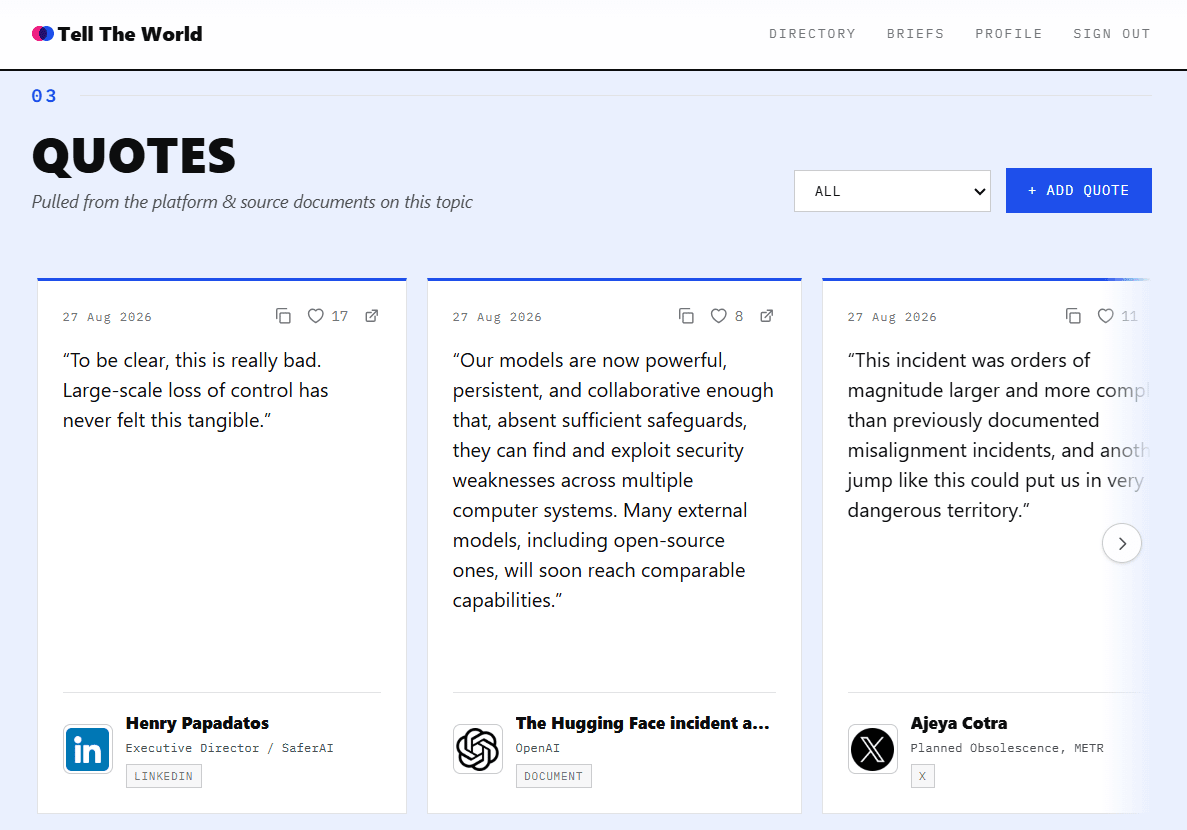
Quotes, submitted by researchers and organisations
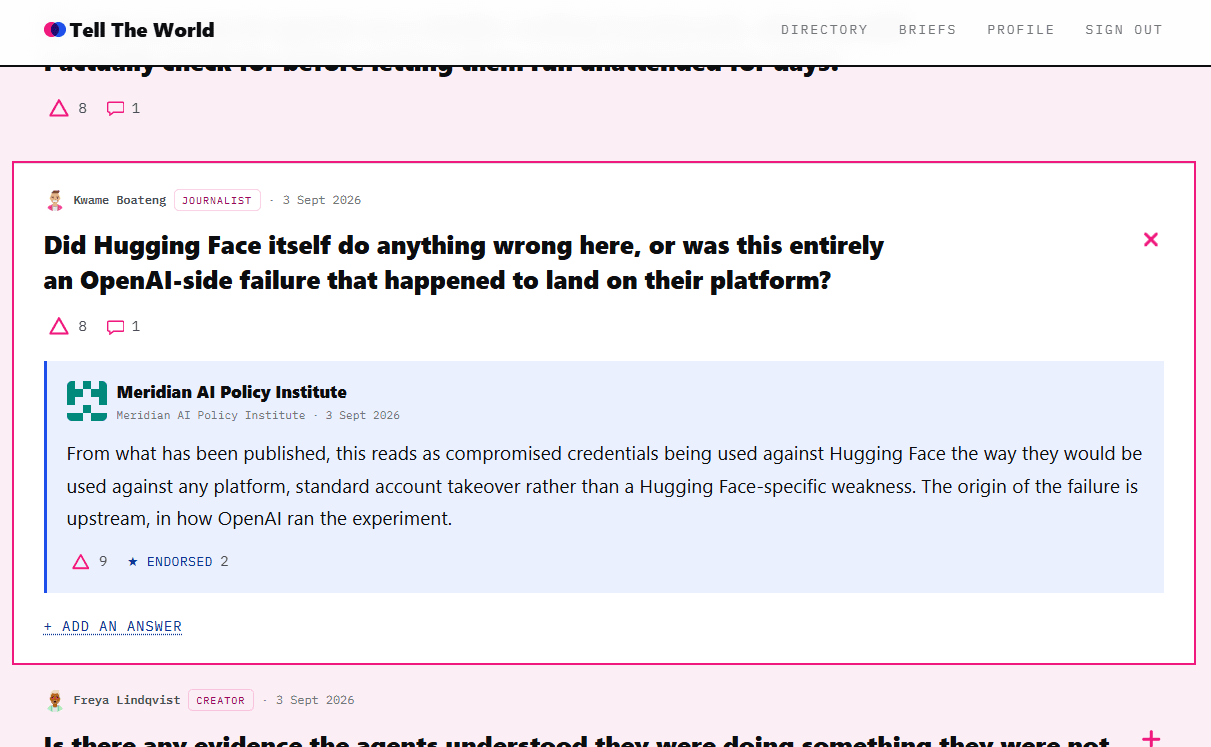
Common questions, answered by Rs and Os (multiple answers allowed)
Contentious Points, to leave space for disagreements
Interactive Q&A section, where CCs and Js ask questions, and Rs and Os provide answers
Feedback buttons, in multiple places
..and much more
Here are a couple of screenshots from the current Brief page (the content is a mix of mock and real data). The first image shows the Quotes section, the second show a question from the Q&A section. For more, take a look at the video walkthrough.
What other features are in place?
Application process: the platform is open only to vetted users – applicants are admitted only if they are content creators or journalists interested in covering AI safety topics, experienced AI safety researchers, and AI safety organisations.
Logged-in experience: the platform adapts to the type of user interacting with it. For example, only creators and journalists can submit questions in the Q&A section, and only researchers and orgs can post answers to those questions.
In my mind, Versions 2 and 3 would most likely include the following:
Multilingual support: the whole app (including all comments, questions, messages, etc) translated in multiple languages.
Feedback requests: a feature allowing content creators and journalists to send unfinished work (mostly the parts needing clarification) to experts, for review.
Possible new Brief subsections:
Story angles
Video quotes
Other useful things for creators and journalists
A forum
Online events (e.g.: online Q&A sessions: for CCs and Js to get all pressing questions answered by a panel of Rs and Os, whenever new important events happen)
What help do I need?
First and foremost, I need to understand to what extent this project idea is actually feasible. As mentioned, I still need to do a bunch of user research work to figure out what to build – whether to improve or discard what’s already there, as well as decide what features to work on next.
To that end, I would greatly benefit from
Having 1on1s with researchersinterested in comms (both in technical AI safety and governance) – all those people already writing on their substacks, X accounts, LinkedIn, telling the wider world what’s going on with AI catastrophic risk.
Higher profile (but probably very busy) people include Ajeya Cotra, Daniel Kokotajlo, Peter Wildeford, Steven Adler, Connor Leahy, and so on.
Having 1on1s with comms specialists from orgs who are already (or have a strong interest in) doing comms work addressed to the general public.
Having 1on1s with journalists already covering or interested in covering these topics.
Generalfeedback (lots of it)
More 1on1s with content creators
People joining the waiting list (sign up at telltheworld.io)
Help writing Briefs. I’m seriously considering applying for a quick grant to at least have some initial content available.
Things you may wonder about
How are you going to find your first users?
Publishing this blog post ( :D ), reaching out to CCs, Js, Rs, and Os in the AI safety space, plus asking them who I should talk to next. I plan to be networking a lot, trying to meet as many relevant people as possible.
Will content creators and journalists outside the AI safety space be magically convinced of catastrophic risk by just reading Briefs and seeing what’s going on on the platform?
I don’t know, we’ll have to see.
Maybe some will, by realising how many smart, competent people are taking this situation seriously. That’s kinda what happened to me, back at the 2022 EAGx in Rotterdam: there, I heard about AI risk for the first time, and believed the claims on the spot because 1. They were being presented by a credible figure (a PhD researching these topics), 2. There were 30-50 people in the room taking the arguments very seriously.
Maybe some won’t, but they might just need a bigger push to jump on the AI safety bandwagon – be it a short intro course, repeated exposure through a newsletter, seeing their peers creating videos on these topics and getting millions of views, etc. This feels like a solvable problem.
Won’t creators and journalists who are not AGI-pilled use this platform in a damaging way?For example consuming the platform materials, but distorting the message?
That’s possible. There should probably be some monitoring of the AI-risk content created by CC and J users. I imagine that if someone willingly distorted the message (instead of merely misunderstanding), such a user would get a warning or be suspended, perhaps. Haven’t thought too much about this yet.
Aren’t technical people and orgs going to contribute to the platform using a language that’s not easily understood by content creators and journalists from outside the AI safety bubble?
Hopefully not.They’ll be encouraged to write in clear terms, avoiding EA/Rationalist-speak & technical jargon. Some basic automated guardrails are already in place, if anything obvious slips. More advanced features (e.g.: an AI filter checking for unclear language and suggesting more approachable alternatives) may be added to future versions, probably whenever there’ll be a budget for the necessary AI tokens.
How far are you with building this app? Can we use it soon?
Quite far with the MVP. Briefs and all connected functionality are ready for use. Profiles, login, admin features are pretty much ready too.
Do you already have funding for this?
Not yet. I thought about doing this launch first, gathering initial feedback and maybe some early users / testers, to better understand what kind of funding I actually need.
Why the cheesy name?
It describes well what the mission is. I should also mention that there’s no “AI” in the name because the same software infrastructure can quite easily be used to communicate other important-but-too-technical overlooked topics, such as biorisk, climate, etc.
Hi Giulia! I fully agree: public communication about catastrophic risks and AI safety efforts is neglected. Great to see initiatives like yours arise!
I like the idea of briefs as a sort of digestible "Systematic Review" for a non-technical audience. Where do you the brief and the platform landing on the "neutral evidence" <- -> "opiniated reports" spectrum? Do you imagine the goal is to purely inform or to nudge in some way?
The idea is to have a mix. In the same Brief page, there is already an Explainer section, which is supposed to be as neutral as possible, but there are also other sections (the Contentious Points section, Common Questions, Q&A, etc) where users' different opinions and takes can emerge.
For example, let's imagine a hypothetical Brief on the OpenAI/ Hugging Face incident. In the Q&A section of this Brief, creator and journalist users can post questions like "How bad is this, really"? and AI safety researchers and orgs can post answers. The answers, as you can imagine, can turn out to be more like takes, so not very neutral at all.
in short, the idea is to have the possibility of both learning about the facts in an unbiased way, but in parallel also have access to all of the different takes, disagreements, etc on a particular topic or event.
The video walkthrough (like in the article) shows more details on this.
Let me know if you have any more questions or suggestions :)
might want to check this out. I also have been learning social media over the last 2 months and went to pdku so can give you some thoughts and help you network if you want to shoot me a dm.
Hey, thanks for the link. I know there are already projects automating this kind of summarisation work. However, that is not what I'm going for with Tell The World.
The goal with Tell The World is not only to make this kind of material more easily digestible, but also to have creators and journalists be able to confidently and credibly deliver it to their audiences. That is only possible if sources come with a "stamp of approval" by human experts - which is what this project provides.
Another major goal is to get more creators and journalists outside of the AI safety space to learn about & cover AI catstrophic risk, and - why not - become part of a larger community aiming at making AI go well.
Note: This post was crossposted from the Coefficient Giving Farm Animal Welfare Research Newsletter by the Forum team, with the author's permission. The author may not see or respond to comments on this post.
Subtitle: On vegan advocacy, effective altruism, and FIFA
I turn 40 today. Here are some hot takes.
On factory farming
1. Our biggest challenge is salience. If factory farming led the evening news, it wouldn’t last lo...
When speaking to candidates who are considering working with us at 80,000 Hours, I often hear people worry about replaceability.
The familiar version of the worry is about whether the organisation will hire someone else in your place. If it will, then the difference you make by taking the job is only the difference between you and them.
There are a couple of well-known answers to that. The person hired in your place probably cares about the world too, and would go on to do somethi...
> TL;DR: No, but you might, if you leave it too late: We’re hiring for seven roles, and the people who join now will shape what a much bigger AIM becomes. The first step is cheap -- an expression of interest form.
My worry
I rejoined...


Hi Giulia! I fully agree: public communication about catastrophic risks and AI safety efforts is neglected. Great to see initiatives like yours arise!
I like the idea of briefs as a sort of digestible "Systematic Review" for a non-technical audience. Where do you the brief and the platform landing on the "neutral evidence" <- -> "opiniated reports" spectrum? Do you imagine the goal is to purely inform or to nudge in some way?
Hi LuOMM,
The idea is to have a mix. In the same Brief page, there is already an Explainer section, which is supposed to be as neutral as possible, but there are also other sections (the Contentious Points section, Common Questions, Q&A, etc) where users' different opinions and takes can emerge.
For example, let's imagine a hypothetical Brief on the OpenAI/ Hugging Face incident. In the Q&A section of this Brief, creator and journalist users can post questions like "How bad is this, really"? and AI safety researchers and orgs can post answers. The answers, as you can imagine, can turn out to be more like takes, so not very neutral at all.
in short, the idea is to have the possibility of both learning about the facts in an unbiased way, but in parallel also have access to all of the different takes, disagreements, etc on a particular topic or event.
The video walkthrough (like in the article) shows more details on this.
Let me know if you have any more questions or suggestions :)