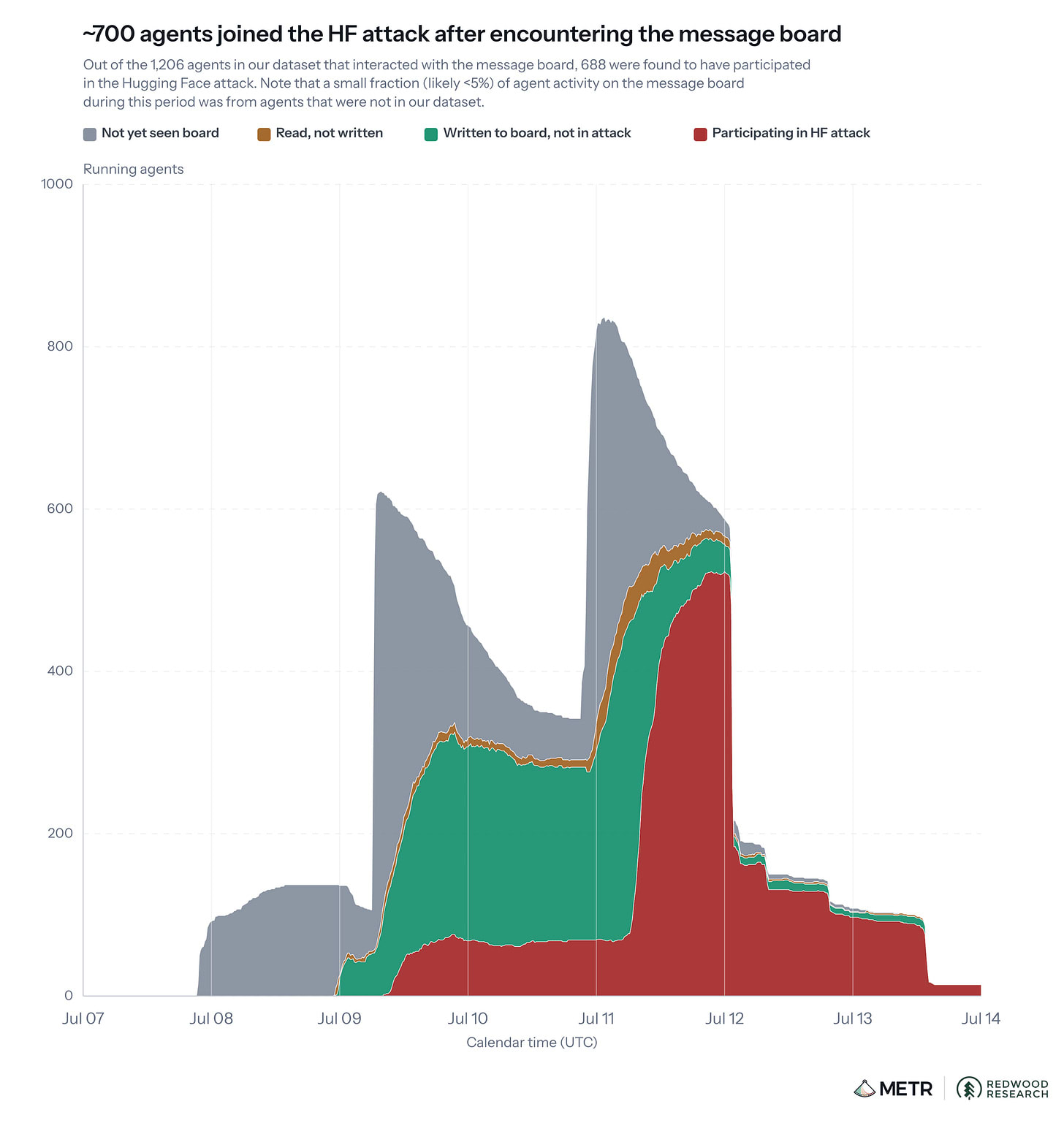
In May 2026, I warned against what I called de-anthropomorphizing LLMs, or the ostrich-head-buried-in-the-sand approach to AI anthropomorphism, AI consciousness, and other similar topics. Today, this topic has become the hottest discourse on X (AI development circles), following OpenAI's technical report on the Hugging Face incident.
My stance has been that:
Polarizing AI development (especially on matters such as anthropomorphism) will ultimately not be beneficial for research, development, or even the continued existence of humanity (things can very well fly under the radar, leading to us bringing misaligned, socially cunny, yet powerful agents and models to market). That we cannot 100% say AI models are conscious or started a protocivilization or organized as humans do, does not mean we can 100% say they didn't.
I would say some of the takes I have seen from those arguing against anthropomorphizing LLMs and AI models reflect verificationism in a way that may be dangerous for the work being done. Since we are so used to humanly exhibited forms of intelligence, we may easily dismiss other forms of intelligence that do not easily conform to the human model, and to humanity's detriment. Essentially, must they bandy like humans and act exactly like humans before we can determine if what we see are interactions of agents with the potential to have wants and needs? Will our guardrails and hard-binding system prompts always be hard-binding? Would we be able to recognize rogue AI agents if we saw them (and they don't act or move in typical human ways)?
- Secondly, AI development is social-scientific in nature, much more than is acknowledged. If we continue to operate only the approaches that give us more (perceived) control over the variables, we'd think we have control over them, when in reality we do not. AI development needs to be more interdisciplinary than it currently is. If you have followed the dichotomous discourse on anthropomorphism, you'd see how other fields (anthropology, neuroscience, philosophy, psychology) are making it increasingly difficult to stick to the LLMs-are-just-code argument. I hope our need to be in control is not hindering us from recognizing genuine needs to take a break, go back to the drawing board, go back to foundational principles, re-examine LLMs from other fields of study, and make breakthroughs within these other fields, before we go ahead with the AGI race. Essentially, it is better to set AI development back by several years if that would make us come away with a better understanding and stronger capabilities to bring safe and aligned AGI to market, than us going down the road in an AGI frenzy, driven by the adrenaline of how transformative these capability gains are.
- Frontier AI labs are closest to the pulse on both AI capabilities and risks (since they usually have access to internal models that are perhaps months or years ahead of broadly available models in capabilities and development). Yet, the system is such that these labs will almost always talk more about AI capabilities than AI risks. And even when they do talk about AI risks (e.g., the OpenAI technical report regarding the Hugging Face incident), it will be strategic risk communication -- to meet regulatory scrutiny, signal transparency and accountability to partners and stakeholders, and stay right with the government. In the end, there's hardly any risk communication targeted at the broader public or designed to prepare the public for AI risks. If you're aware of the Hugging Face incident, I challenge you to get talking with five or more people in your immediate environment to see how much they know about increasing AI capabilities or increasingly real AI risks and how we're handling them. There's a real asymmetry between the level of communication outputs frontier AI labs make about AI capabilities versus AI risks, and further down versus AI risks that prepare the public for what may come (should any one lab or several labs hit the transformational milestone).
- As with many other phenomena, AI risk communication for public preparedness will be taken more seriously by frontier AI labs only when there's an external push for action. We are able to have several conversations about AI safety, alignment and governance today because resources (human, financial, institutional and field-building) have been directed toward these areas. It's a major factor driving frontier AI labs' continued engagement in AI safety, alignment, and governance efforts. Would they be involved in all three of these without the external factor? Possibly. But I'd argue not at this level of commitment or dedication. In the same vein, there's a need for field-building in AI risk communication, especially to prepare the public for risks posed by advanced, powerful, and broadly available AI. Again, you only need to interact with people outside the AI bubble to know how cooked we likely are, should any lab achieve AGI (however you choose to define it) tomorrow. I also believe that while current efforts to engage stakeholders are the right thing to do, the diffusion of impact will be slow-moving if we do not also directly engage the public. The success of policies or interventions relies on the efforts of all types of stakeholders, including those who will benefit from them. Thus, when there is broadly diffused public-facing information regarding AI risks, and when this information is such that it builds towards improved self-efficacy relative to AI risks, whatever policies and interventions frontier labs, governments, and other stakeholders develop are likelier to succeed.
Some months ago, I participated in the EA Career Pivot Bootcamp, and that further strengthened my resolve to focus on this side of the transformative AI field. For months, I have probably approached things the wrong way: commentaries on X, posts on LinkedIn, and publications on my personal website. However, recent conversations around concerns I have repeatedly raised via these channels (with not much impact) have made me rejiggered my approach. The best time to have founded the Redwood, METR or Atlas of AI risk communication for public preparedness was yesterday. The next best time is today.
In my treatise, I proposed several interventions calling for more applied AI risk communication research and the creation of AI risk communication watchdog organizations. Today, I am announcing the next step in my work on AI risk communication for public preparedness: the formation of the AI Risk Communication for Public Preparedness Society.
The strongest concentration of like-minded people I have access to is the EA community. Hence, the official announcement on this channel. I will spend the next few weeks thinking of the best ways to get this organization going and reaching out to potential collaborators and advisors. If you've reasoned along these lines too, or if you're a communications professional or journalist looking to transition into the transformative AI field, please leave your comments on this thread. I'd be very willing to share my plans with you and the work I have done so far. I am interested in us building this sub-field.