Comments

There has been a recent surge of EAs working on a range of issues related to space governance.[1] I think this is a good thing and I'm excited about it. While the wave is still rising, I want to suggest we use the terms "intrasolar governance" and "extrasolar governance" to refer to space governance within the Solar System and outside of it, respectively.[2]
I like this distinction because many issues in intrasolar governance are being decided now by existing institutions, companies, and governments, and cannot be punted (or, deferred) to superintelligent AI (ASI), whereas most extrasolar decisions can and should wait. More speculatively, a boundary on intrasolar governance may help relegate long-term decisions to a clearer decision point rather than a gradual expansion further and further into deep space. I return to that point at the end.
Longtermists discuss the governance of galactic civilisations, including galactic surveillance mechanisms, galactic civilisation-destroying activities,[3] and star system allocation frameworks. EAs also discuss intrasolar governance issues. These differ considerably from extrasolar governance in how far they can be deferred to superintelligent AI (their "puntability") and in their strategies for impact. They include governance related to space weapons, the industrial explosion (AI-driven industrial growth, including into space), space compute, launch capacity, critical space infrastructure vulnerabilities, planetary defence, and space mining laws.[4]
The terms intrasolar and extrasolar governance are defined by location. The reason to separate the two groups is that our strategy for impact differs: intrasolar governance depends on engaging with the space law and policy institutions (as well as governments, companies, and individuals) that are deciding it now, whereas extrasolar governance will depend on civilisation-wide factors (and most notably the race to superintelligent AI). The two are causally linked (an arms race in the Solar System could, for example, lead to uncoordinated interstellar expansion). Definitions:
Intrasolar governance: the governance of activity inside the Solar System, from Earth orbit out to the edge of the Sun's gravitational reach. Nearly all of today's space activity, and so nearly all of today's space law and policy in practice, is intrasolar.[5]
- Extrasolar governance: the governance of activity in the affectable universe beyond the Solar System.
- Space governance: the field as a whole, and any issue that spans both.
In practice: intrasolar governance can be used to refer to issues that are being decided over the next few years by existing institutions; extrasolar governance can be used for questions to keep open until after superintelligent AI; and space governance for the field and for anything that spans both. The rest of the post makes the case for this stellar terminological breakdown.[6]
Terminology is important. The names we have for things shape how ideas spread and how people make decisions. As one example, a study asked 2,267 US adults whether climate change is real, and Republicans' answers depended on the wording. When the question said "climate change", 60% of Republicans agreed that climate change is real, whereas when it said "global warming", 44% did. Democrats were unmoved, and I expect experienced funders to be closer to the Democrats here.[7] Of particular importance to this post, naming categories also changes whether decisions get made at all: people often judge and allocate within the categories they are handed, and let a default stand wherever no category forces a choice.[8] This category effect could matter for which areas people notice when allocating money within and between cause areas,[9] and whether decision-makers act on our research and ideas.
A coined term helps most if it describes the thing accurately and people actually use it: it should be transparent, consistent with other terminology in the field, and free of misleading connotations.[10]
On that note, "intrasolar governance" could be misread as the governance of activities inside the Sun, but I don't expect that to be misread that way often.[11] I think "Solar System governance" is worse because it connotes governing the whole Solar System as one thing, which I associate with centralised control over everything in it,[12] it's also very long,[13] and, unlike intrasolar, it has no natural pair (intrasolar pairs with extrasolar, whereas Solar System governance doesn't pair so well with, e.g. interstellar governance (and switching Solar System governance for "intrastellar" governance sounds too similar to "interstellar" governance)).[14] I also think "interplanetary governance" fits poorly because it leaves out asteroids and the space between celestial bodies. I also considered "galactic governance" for the far half, but it excludes everything beyond the Milky Way. Not everyone agrees on these terminological trade-offs, but I think "intrasolar" balances them well, and hits the mark on the things I care about most, which I will now discuss.
Using the term "space governance" on its own can make it harder to prioritise causes. I've argued before that it can be confusing to refer to space governance as a cause area. Rather, it is an area of expertise or a field that can be applied to a range of causes, similar to the application of international governance to AI safety, pandemic preparedness, or global health. Any cause whose problems extend into space has a space governance component to varying degrees. In thinking about how we apply space governance to different cause areas, there are various differences between intrasolar and extrasolar governance that help make this a useful conceptual carve up for cause prioritisation. I think these are the three most important ones:
Puntability: Space governance was listed as a "puntable" area in an EA Forum post about which questions we can punt to superintelligent AI because decisions around how "we split up galaxies and enforce that allocation" would "benefit from much more AI strategic advice". I think this is true of extrasolar governance, though thinking about it still helps us choose which futures to aim for now.[15] Intrasolar governance is different: many intrasolar decisions are being made now, before ASI, so ASI is not guaranteed to arrive in time to help the FCC decide whether to approve SpaceX's one-million-satellite application for space-based data centres, help the US government decide whether to deploy thousands of space-based interceptors, or help the operators of critical space infrastructure respond to growing cyber threats. It would have helped that post to use the term "extrasolar governance" and leave the intrasolar decisions out.[16]
What determines the outcomes. Extrasolar governance will likely be the product of activities across all of human civilisation over the next few decades,[17] whereas intrasolar governance is a product to a much greater extent of events and decisions made in the space domain.[18] Terrestrial geopolitics feeds into it too, and the two are causally linked: whoever takes power on Earth, for instance using ASI, is likely to take power in the Solar System, and from there over the long-term future.[19] However, extrasolar governance handles the export of human civilisation to the stars, so it will carry path-dependent effects from across that civilisation: our values, goals, epistemics, coordination mechanisms, relationships, and how, when and whether we create superintelligent AI. This means that intrasolar and extrasolar governance have different strategies for impact. Progress on intrasolar governance requires engaging with existing space law and policy institutions. Progress on extrasolar governance mostly does not, because I expect those institutions to have little direct leverage over extrasolar outcomes compared with human civilisation as a whole and superintelligent AI. Present-day space governance institutions may have indirect leverage through who comes to control mass and energy in the Solar System though, because whoever comes to dominate the Solar System will likely control the future.[20]
Background assumptions. Discussions of extrasolar governance are based on different assumptions about which physical regime applies, what engineering is possible, and what society looks like. I expect existing space law and policy to need little consideration when assessing the range of possibilities for extrasolar governance, though it may matter as precedent.[21] The physical regime is also different: extraordinary quantities of mass and energy enable technologies like interstellar lasers and stellar engines, light-speed delays make it very hard to coordinate or enforce rules across star systems, and we may encounter alien civilisations. The stakes also differ: extrasolar governance concerns the governance of almost all the matter and energy any Earth-originating civilisation could ever reach. Grouping these assumptions under "extrasolar governance" keeps those discussions separate from present-day space law and policy, avoiding the need to justify the range of assumptions associated with extrasolar governance every time it is discussed.[22]
Those are the main important differences, but there are some caveats. Sometimes issues do actually span intrasolar and extrasolar governance, for example, the launches of the first interstellar missions may be governed from the Solar System, or the possible persistent path dependent effects of AGI-based institutions in space may expand beyond the Solar System. But issues cross the border between Earth and space too, and it's still useful to differentiate "space governance". The aim is that when someone reads "extrasolar governance", the reader knows that what follows rests on different assumptions, motivations and strategies for impact from present-day space law and policy, which is almost entirely intrasolar.
It's worth noting that the split is not that helpful for assessing neglectedness or tractability, which are still helpful to be judge based on specific outcomes: space governance has a wide scope and draws on many disciplines. On neglectedness, instead of counting how many people are working on intrasolar governance, we might ask about specific outcomes we are aiming for (e.g. ensuring AI governance regulations apply to space compute), and then investigate how many FTEs are also working towards that outcome. And on tractability, it would be a mistake to disregard intrasolar governance as intractable because many of the decisions are determined by international geopolitics, as many others aren't, like antitrust cases against SpaceX, initiatives to track potentially hazardous asteroids, or building up cybersecurity for critical space infrastructure.
The main competitor I see to carving up space governance by location is to carve it up by time: activities in space before versus after the creation of superintelligent AI (pre-ASI and post-ASI space governance). We can visualise this against intrasolar and extrasolar governance using four boxes, with some activities, like space mining rules and space compute, straddling the line between pre-ASI and post-ASI:
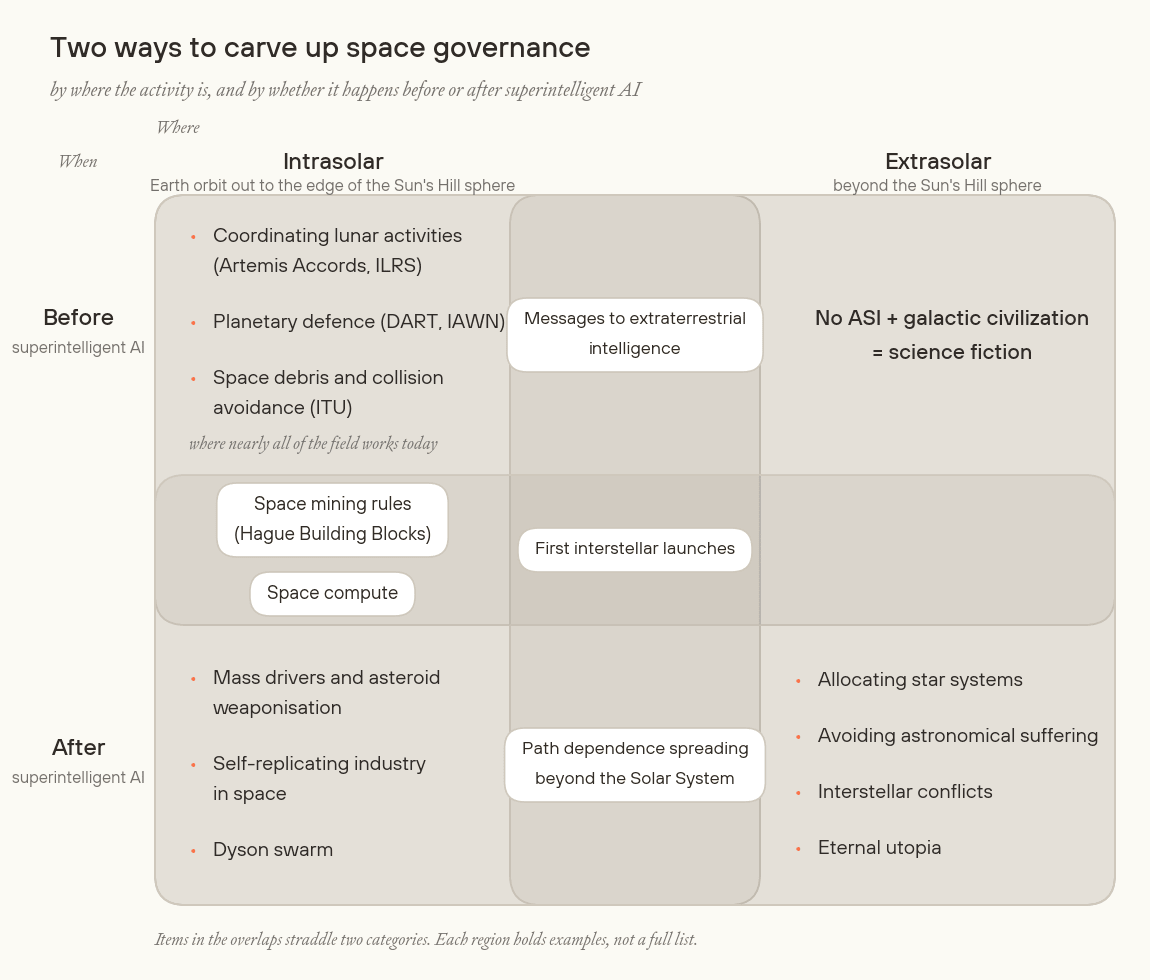
Both splits are useful, and I prefer location as the field's primary framing, for two reasons. First, it stays stable if timelines shift or AI progress pauses, whereas a time split could move issues between categories when expectations about AI change.[23] Secondly, the pre-ASI/post-ASI split already exists as a general frame that every field can apply, so there is little to gain from applying it to space governance specifically, in the same way that nobody needs the terms "pre-ASI" and "post-ASI international governance", whereas there is a lot to gain from dividing international governance into maritime, air and space governance. The time split is still useful inside intrasolar governance: carving out the activities that will most likely occur post-ASI, like space mining rules and space compute, is helpful, and in practice all extrasolar governance decisions are likely to be made in a world with superintelligent AI, so the "puntability" question maps onto the location split.
Keeping the extrasolar future an open question. The last reason I will give to adopt these terms is the most speculative. The split fits my reading of viatopia, a state of society on track to reach a near-best future, which starts from the idea that we don't yet know what utopia should look like. The terms separate intrasolar governance, where EAs and policymakers might act now to prevent extreme power concentration and keep society coordinated, from extrasolar governance, where we should stay extremely uncertain about the best course. Two ways this could help:
Not spreading a harmful meme. Conflating intrasolar and extrasolar governance may itself be a harmful meme that strengthens present-day path dependent effects on the long-term future. When space law and policy practitioners read our work on extrasolar governance, it can sometimes sound like we're discussing ideas relevant to space governance decisions today.[24] But the background assumptions are very different: worlds radically transformed by superintelligent AI, in which people or superintelligent AIs might be allocating star systems to people, racing to other star systems, or creating astronomical suffering. I don't think anyone should be making any concrete decisions about extrasolar governance yet, and I think we should reflect deeply before we do. However, mixing in these long-term space governance questions into space law and policy discourse may bake in more long-term decisions and goals into present-day space policies.[25] I would rather present-day policy did not set goals for all eternity, as the US proclamation last week did when it discussed "unleashing a competitive and thriving commercial space industry, and ensuring American space superiority for all eternity".[26] Present-day space policy and goals for the long-term future should be two different things, and bringing long-term considerations into space law and policy may make statements like this more likely (and plausibly affect the goals of important decision-makers heading into an intelligence explosion).[27]
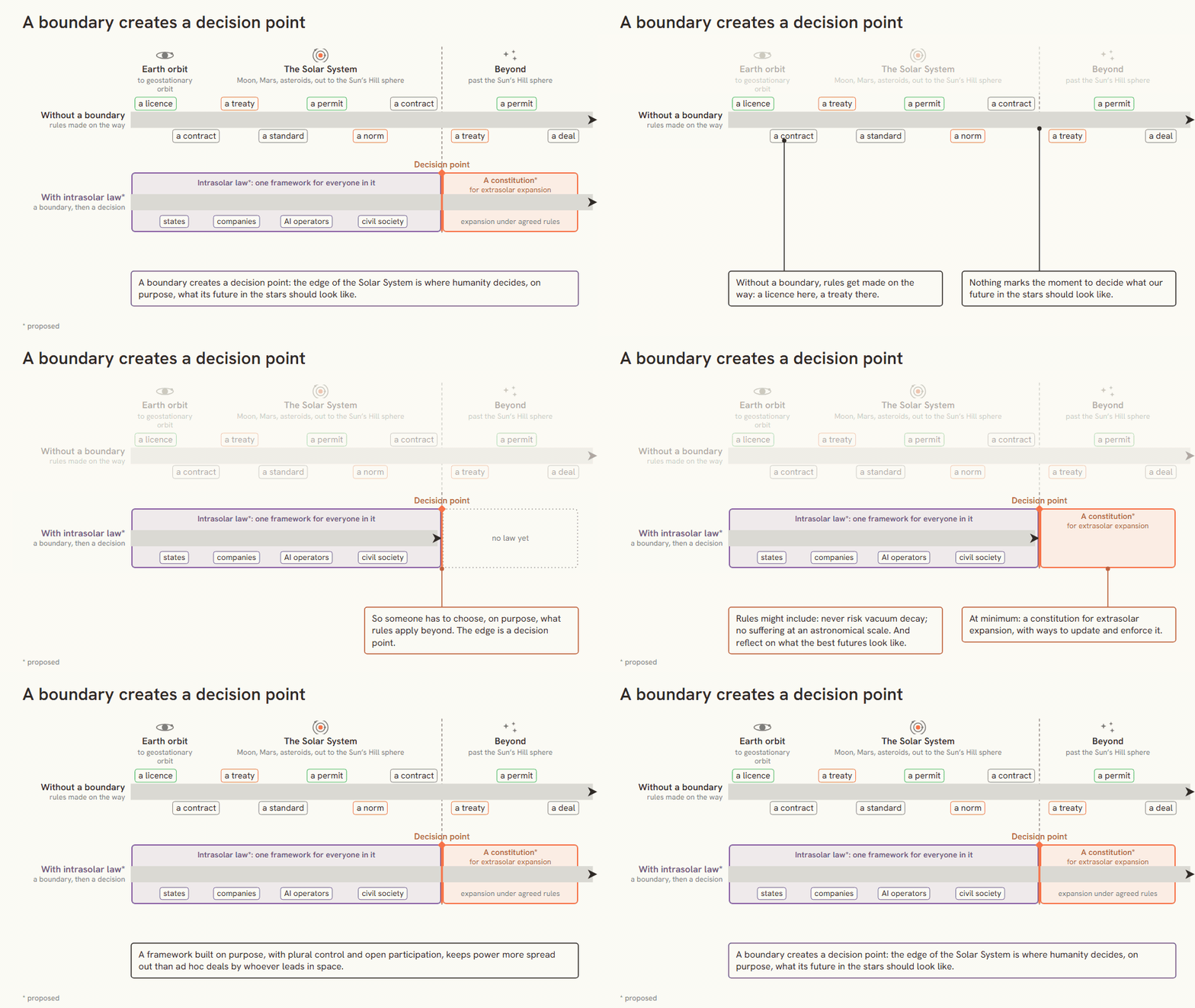
Making extrasolar governance a separate decision point. The flip side is that the separation may improve how people conceptualise space governance, by preventing intrasolar governance decisions from becoming the default framework for extrasolar governance. I would prefer that human civilisation decides on purpose what to do about our future in the stars,[28] rather than proceeding on a default trajectory (it seems unlikely that we'll happen to stumble across a near-best future). A different category increases the chances that people notice it, and the boundary creates an implicit decision point. Today's space law has no outer edge. If intrasolar governance were understood as a body of law and policy with one, so that nothing beyond it carried law by default, then someone would have to choose on purpose what rules apply beyond it. However small the effect of a term, it's a step in the right direction: if EAs do have a big impact on space governance, the framing we introduce could shape how decision-makers expect to and plan to make decisions about the long-term future.
If intrasolar governance is understood and conceptualised as its own body of governance with an outer edge, then how we govern activities beyond that edge becomes an open question rather than an extension by default:
As we expand into a new field, the terminology and framings we introduce matter. Intrasolar and extrasolar governance are useful terms: they could help us think about space governance more clearly and plan for impact, and they make it easier to notice which parts of the field are being worked on. Intrasolar governance is being decided now, and progress on it depends on engaging the space law and policy institutions, governments, and companies deciding it, whereas extrasolar governance is easier to punt to superintelligent AI, and we should avoid locking in aspects of it now. Separating the two terms may help reserve extrasolar governance for deliberate reflection and decision-making.
- ^
My guess is that the number of EA FTEs working on issues on space governance has risen from ~6 FTEs to >15 FTEs over the past year, and I'm aware of other researchers and organisations strongly considering doing more work or funding more work on space governance soon. I expect the number of EA-aligned FTEs working on or commenting on space governance to grow a lot more over the next year or two.
- ^
These are terms that neither the space or EA communities currently use. They are actual words. I didn't make them up, but they are rarely used in mainstream space governance. I'm mainly borrowing the terms from the scientific community, primarily astronomers who sometimes use them to refer to objects within and beyond the Solar System.
- ^
( ◑ ◑)
- ^
Even if these decisions are made badly, I don't think that hoping for superintelligent AI to reverse them is the right option. Many of these decisions affect the development of superintelligent AI and could affect the geopolitics and power dynamics as superintelligent AI systems arrive. For example, space compute could affect the application of AI safety regulations (compute outside the reach of AI safety rules, sometimes called dark compute), and building up the necessary capabilities to build space compute could give an agent a first mover advantage if compute moves off Earth. Additionally, military space capabilities like surveillance and space-based interceptors, and in particular, the integration of AI into military space decision-making, could affect how easy it could be for agents to use AI and space assets to seize power.
- ^
Though, currently, space law applies to all space activities with no spatial limit (except, of course, not on Earth or within the atmosphere). The 1967 Outer Space Treaty sets out the basic rules for space, including a ban on placing weapons of mass destruction in orbit, on celestial bodies or elsewhere in space, and a bar on national appropriation of outer space, "including the moon and other celestial bodies", whether by claim of sovereignty, by use or occupation, or by any other means (though how far this covers resource extraction is contested). In this context, "other celestial bodies" can be read as referring to all other objects in the universe.
- ^
What I expect the terms to do, and not do. I expect them to change what people notice. Intrasolar governance discusses decisions being made now by named actors, and the usual reasons to defer to superintelligent AI do not apply to it. Concretely, the terms change two things: which questions a reader treats as deferrable, and which institutions a researcher plans to engage. I do not expect them to change how funders make final allocation decisions, which turn on the merits of specific outcomes. Punting also assumes the transition to superintelligent AI goes well enough that the choice is still ours to defer; if it does not, extrasolar governance is settled by whoever controls that AI, which is the default trajectory the last section is about. The two benefits in the last section, not spreading a harmful meme and creating a decision point, are more speculative.
- ^
Schuldt, Konrath and Schwarz (2011) asked 2,267 US adults whether the phenomenon is real: Republicans agreed at 60% for "climate change" and 44% for "global warming", Democrats were unmoved by the wording, and the authors trace the gap to what each term points attention at. The effect is general. The same cut of beef rates better as "75% lean" than as "25% fat" (Levin, Schneider and Gaeth 1998 on attribute framing, the kind of framing effect that has replicated most reliably), and describing crime as a "beast" rather than a "virus" shifted readers toward enforcement while only 3 to 15% of participants, depending on the experiment, identified the metaphor as having influenced them (Thibodeau and Boroditsky 2011). A term's connotations also drift: Pinker's euphemism treadmill is the observation that a neutral word for a charged thing takes on the charge and has to be replaced, because the concept and not the word is in charge.
- ^
People treat partitioned categories as separate accounts and decide within each: Thaler (1999) on mental accounting, and Fox, Ratner and Lieb (2005) on partition dependence, where the categories a person is handed drive separate allocations and experienced decision-makers are less affected. Where no decision point exists, the default carries: organ donor consent runs from 4% to 28% in European countries whose default is refusal and above 85% where the default is consent (Johnson and Goldstein 2003, Science 302: 1338 to 1339), and requiring new employees to decide on pension enrolment raised participation by 28 percentage points over leaving them unenrolled by default (Carroll, Choi, Laibson, Madrian and Metrick 2009, Quarterly Journal of Economics 124: 1639 to 1674). The limits: the partition effects are modest and came out weaker in a 2025 registered replication of the partition-priming studies, experienced agents show smaller effects, and none of this binds an agent who has already decided what to do.
- ^
Ahem. I promise there is no intentional psyop in this post to get more people to fund work on intrasolar governance by separating it from space governance. I do think intrasolar governance has been neglected (and that extrasolar governance has received ~the appropriate amount of attention). I think it's possible that a reason for intrasolar governance being neglected by EA funding bodies over the past few years is that it was not a separate category from space governance, which was often conflated with extrasolar governance (which is often interpreted to be quite intractable or not pressing to work on). I expect that separating intrasolar governance from space governance/extrasolar governance will cause more people to notice this area that requires funding. However, I don't expect this terminology to affect how funding bodies make final decisions about allocating funds. Indeed, the "global warming" vs "climate change" framing does not affect whether Democrats think it's real. Additionally, the effect of adding categories increasing funding to them shrinks for people with more experience discriminating among the options, and I expect EA funding bodies to be sufficiently experienced and rigorous. I think the main reason that there hasn't been much funding for space governance so far is that there haven't been that many good projects to fund that are focused on transformative AI and the long-term future. What I do expect is that me naming and pointing at intrasolar governance is likely to get more people to notice it and start thinking about it. That is, of course, a very common and reasonable motivation for naming something.
- ^
Sartori's "Concept Misformation in Comparative Politics" (American Political Science Review 64: 1033 to 1053, 1970) gives the ladder of abstraction: the wider the range of cases a term covers, the thinner its content, and a concept stretched past the cases it was built for stops meaning anything. Collier and Mahon (1993) set out how to adapt a category to new cases, and Gerring's "What Makes a Concept Good?" (Polity 31: 357 to 393, 1999) lists the criteria: resonance, domain, consistency, fecundity, differentiation, causal utility and operationalisation. The terminologists' standard, ISO 704, asks that a new term be transparent (its meaning can be read off it), consistent with the field's existing terms, free of misleading connotations, economical, and able to generate derived forms. Two studies show what happens when a term fails the fit test: one interviewee in a twenty-person study read the IPCC's "tipping point" as "too late to fix anything" (Bruine de Bruin and colleagues 2021), and across seven studies the same medical condition given a more medicalised name pushed people toward more invasive treatment (Nickel and colleagues 2017). The philosophers' version is conceptual engineering: choose a concept for the job it has to do and say that this is what you are doing (Burgess and Plunkett 2013; Haslanger's ameliorative method in Noûs, 2000).
- ^
I have started using intrasolar governance within my network, and the fact that it plausibly refers to activities within the Sun has come up as a reason to reject the term. The obvious alternative is to just use "Solar System governance", but then I think that has the connotation of governing the Solar System, which is not what I want to go for (I want the term to be a suitable term for describing activities on the Moon, Earth orbit, or the whole Solar System). I also like that intrasolar pairs with extrasolar (which is a term astronomers already use), and "Solar System governance" doesn't have very good pairs.
- ^
That is not necessarily what we want, but my main worry is that it has negative valence for those concerned about authoritarianism.
- ^
This hampers adoptability.
- ^
and, paired with "Solar System governance", does not read as a pair.
- ^
Most notably, by thinking through what problems viatopia will have to overcome. Also, it might help us plan for post-AGI philanthropy by thinking through what futures we might be wanting to aim for in space, and whether funding could us get there.
- ^
Anecdotally, some EAs have been surprised that I was working on space governance from an impact-focused perspective before I really took transformative AI seriously. I think this surprise comes from the conflation of space governance and extrasolar governance.
- ^
Assuming rapid AI-driven industrial growth into space.
- ^
Space is, of course, significantly affected by terrestrial geopolitics too.
- ^
Intrasolar and extrasolar governance is a more concrete carve up of my previous argument for 3 stages of competition for the long-term future, which included the Earth, the Solar System, and the galaxy. The Earth is covered by anything that isn't space governance, and space governance gets split up into the Solar System and the rest of the universe (absorbing the galaxy).
- ^
I think the race to ASI is a big determinant of that, but that space activities could also play a role, e.g. through mechanisms like lock-out.
- ^
I grant that existing law could matter as precedent and as the default that early expanding agents inherit: the Outer Space Treaty's ban on national appropriation (Article II) and its rule that states bear responsibility for their nationals' activities (Article VI) are the obvious starting points. I expect that influence to be weak for extrasolar governance, because the treaty was drafted in 1967 for the Moon and nearby bodies, because treaties of this kind get reinterpreted rather than amended as activities change (the 2015 US Commercial Space Launch Competitiveness Act reads Article II as permitting ownership of extracted resources, and the 1979 Moon Agreement's attempt to tighten the rules attracted no spacefaring parties), and because the agents that govern extrasolar expansion will be shaped by the wider civilisational factors above, not by treaty text. What would change my mind is evidence that agents who are expanding beyond the Solar System treat today's space law as binding, for instance if its core provisions survive the next round of lunar and asteroid resource disputes.
- ^
Instead, just link to this section of this EA Forum post! I would actually recommend AI 2040 and its space governance epilogue as a good guide to the assumptions behind decisions we might make about extrasolar governance: https://ai-2040.com/?choices=plan-a-root#playbook-epilogue
- ^
I also prefer the location split because location is universal and uncontroversial. Framing space governance by superintelligent AI makes the framing harder to adopt among space law and policy practitioners, because it requires people to agree that we will create superintelligent AI and that it will be the dominant determinant of how to think about space governance.
- ^
This is based on anecdotal evidence, but I have high confidence that space law and policy practitioners who read work from EAs on extrasolar governance are baffled by its apparent naivety about existing space law and policy.
- ^
Aside from the terminology, this is also more generally an important consideration when interacting with the space domain on issues related to longtermism.
- ^
The words are from the proclamation The American Declaration of Freedom in Space, signed on 3 November 2026.
- ^
This applies to my own work too: I plan to bring in the long-term considerations that bear on present-day decisions, such as keeping options open and avoiding early lock-in, while stating clearly that extrasolar questions rest on different assumptions and should not be decided yet.
- ^
One of my worries is that, even if we avoid anarchy or extreme power concentration, space expansion could progress, with nations and companies making new laws and policies as they go, without some major inflection point where human civilisation decides what our future should look like in the stars. At minimum, I think that whoever expands beyond the Solar System should agree on a constitution for extrasolar space expansion and the mechanisms for updating that constitution over time and enforcing its rules. The rules might include not risking the initiation of vacuum decay, which could destroy the universe as we know it, and not causing suffering at an astronomical scale through torture or slavery. Ideally, we would also reflect about what the best futures could look like and make sure we're not fundamentally mistaken about moral epistemology.