Dimagi wants to raise $1.8 million to support 30,000 additional small and vulnerable newborns in Uganda, bringing the total to 50,000 by the end of 2027, in partnership with the Ministry of Health.
Our Connect Kangaroo Care program is built on the Connect platform for scaling cost-effective interventions through high-performing local implementers.
To date, we have enrolled approximately 9,000 newborns in Uganda and secured funding to reach approximately 20,000 in total, including those already enrolled, toward our 50,000 goal.
Assuming 8–12% baseline mortality, a 15–20% reduction in mortality because of Kangaroo Care, and $60 per SVN, supporting Kangaroo Care costs roughly $2,500–5,000 per death averted.
Contributions of $10,000, $100,000 or $1 million would fund part of the identified need and contribute to the larger goal.
What Connect Kangaroo Care does
We focus on preterm and low-birthweight newborns. These small and vulnerable newborns (SVNs) struggle with basic survival functions of heat regulation, feeding, and infection control.
Kangaroo Care includes continuous skin-to-skin contact, breastfeeding support, and vigilant care-seeking. (Kangaroo Care is also known as Kangaroo Mother Care.) Frontline workers deliver the home visits.
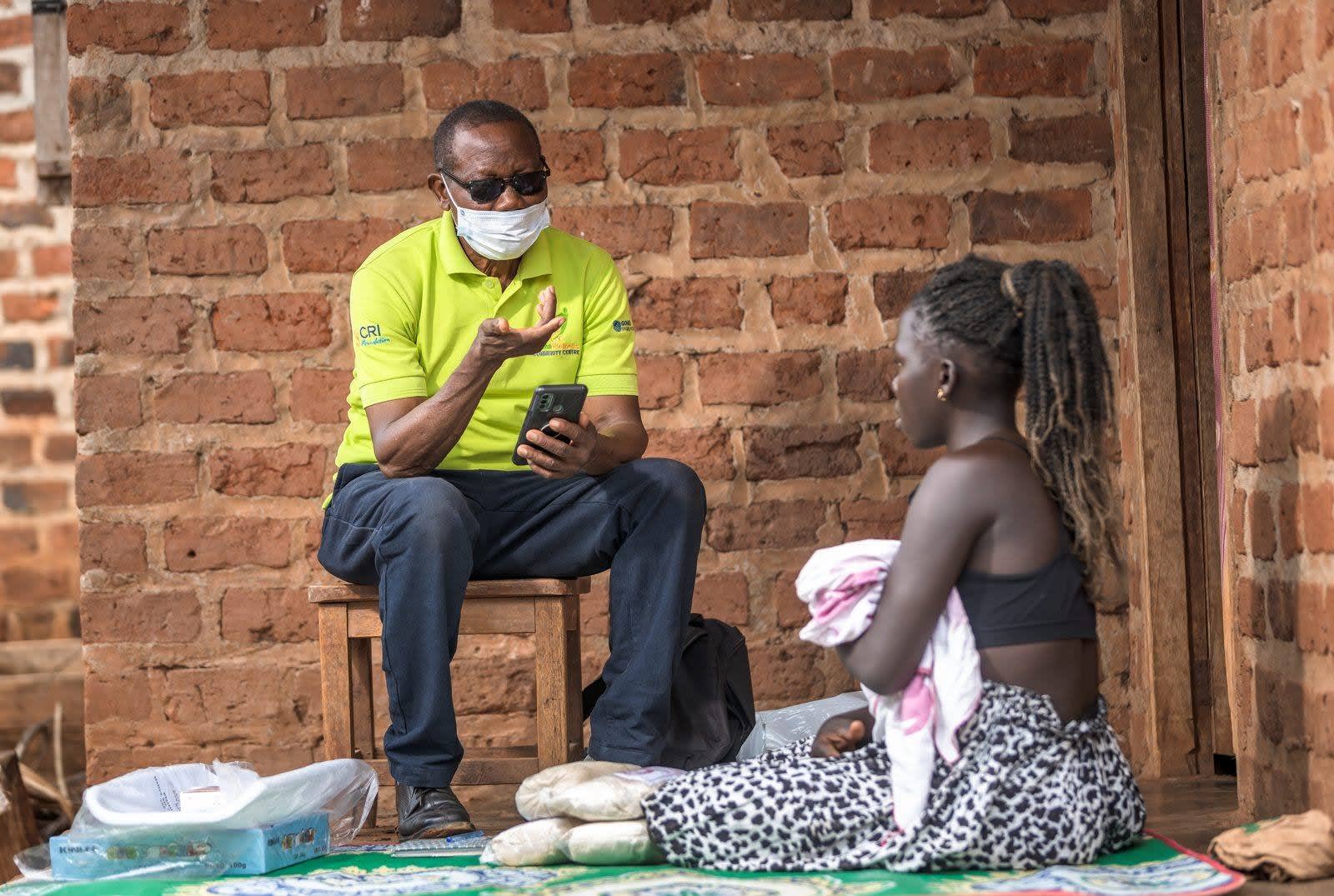
A frontline worker uses a smartphone during a Kangaroo Care home visit. Photo credit: Nama Wellness, Uganda.
Over the last two years we developed a scalable, community-based, digitally-verified approach to help caregivers adopt proven, Kangaroo Care practices. We have promising results of Connect Kangaroo Care across six local organizations in Nigeria, Uganda, and Kenya, as well as a pilot in India.
We are funded by GiveWell, Eleanor Crook Foundation, The Life You Can Save among others to scale Connect Kangaroo Care.
With Connect Kangaroo Care, Dimagi contracts qualified organizations to implement the intervention. In turn, the organizations recruit and train staff, procure essential supplies, and set up linkages with facilities as well as systems to identify home birth of SVNs. Workers conduct home visits focused on skin-to-skin support, breastfeeding, thermal care, danger-sign screening, and referral when needed.
Workers use the Connect smartphone app as a job aid for service delivery, providing structured guidance for each home visit, including counseling protocols, assessment checklists, and educational materials. The app captures GPS, photos, and timestamps for verification of services. At each visit, it guides the worker to weigh the baby and photograph the scale reading, review the past 24 hours of skin-to-skin care, check KC positioning and breastfeeding, screen for danger signs, and provide encouragement. Every case is digitally documented with a weight trajectory based on weight measurements captured across a series of home visits.
Connect’s in-app guidance for photographing a newborn’s weighing scale reading.
How we are scaling Connect Kangaroo Care
Connect Kangaroo Care is currently delivered in Uganda, Nigeria, Kenya, and India. We adapt the delivery model to local health systems and assess how well it works in each setting. As more funding becomes available, we renew and expand support for local organizations that deliver high-quality care cost-effectively and have the capacity to reach more newborns in neglected areas. With Connect we can use a variety of metrics, records and data to assess how each organization delivers which informs and improves our funding decisions. Working across multiple countries and a wide range of organizations and settings helps us understand how costs and capacity change as the program scales. For example, organizations operating in rural areas may have higher transportation costs than those working in urban settings where public transportation is readily available.
Dimagi establishes contracts with organizations that include an initial setup fee and fixed payments per verified completed case. Organizations then pay frontline workers for completed visits that meet stipulated program requirements, using the app records. Marginal funding allows us to either increase the number of cases funded for an existing Connect organization or onboard new partner organizations.
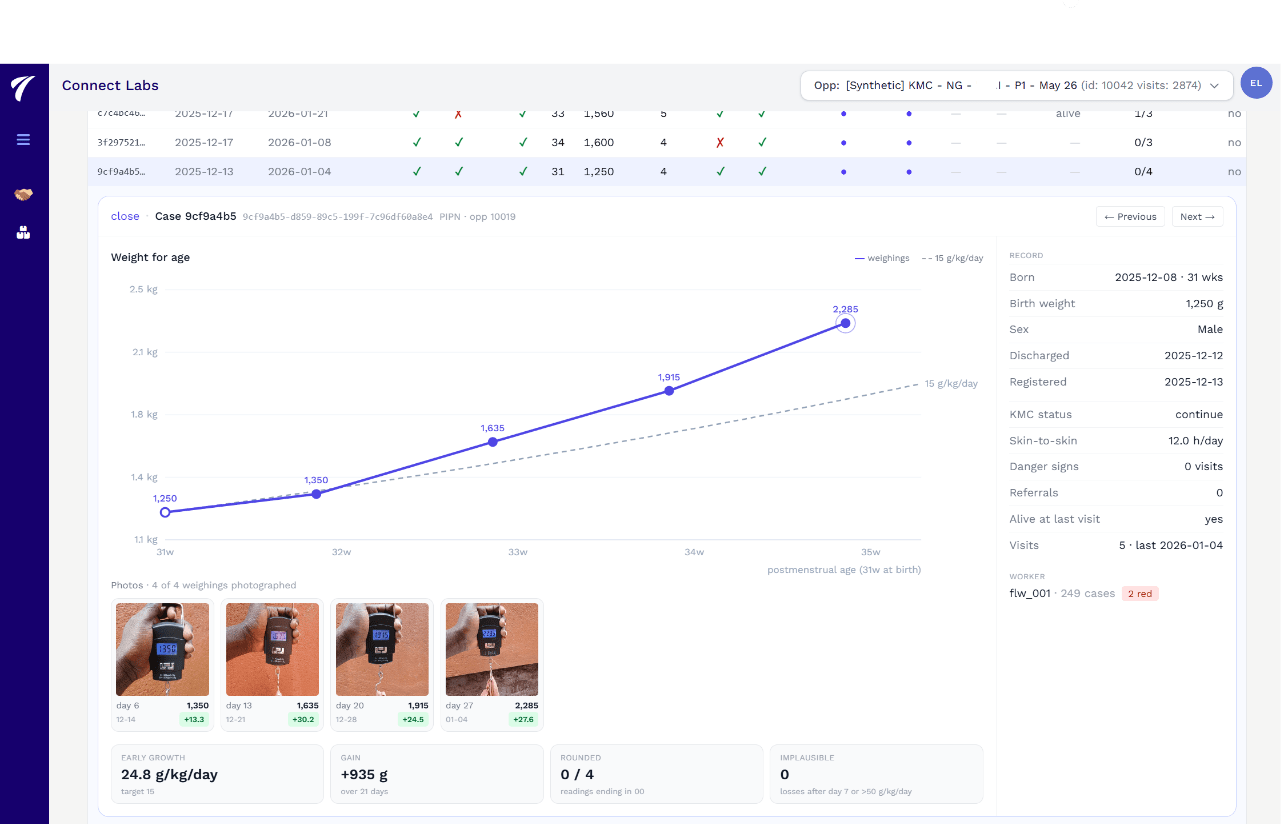
Our dashboard tracks and visualizes information captured through the Connect app. For Connect Kangaroo Care, it tracks early enrollment and home visits after facility discharge and home births, danger signs identified and referrals made, caregiver-reported exclusive breastfeeding and skin-to-skin care, and mortality. These indicators are monitored in near real time through our dashboard. We are strengthening the use of these measures to identify weak performance or suspected fraud and take corrective action. As more funding becomes available, delivery quality, costs and capacity will inform decisions about renewing or expanding funding for individual organizations.
Illustrative Connect dashboard view of SVN growth monitoring using synthetic data.
Funding needs: sustaining and expanding delivery
Our delivery partners in Uganda include Preterm Infants Parents Network Uganda (PIPNU) and Nama Health Impact. A core strength of our delivery model is the ability to leverage organizations’ strong relationships with health facilities and their embeddedness in local health systems. In Uganda, this resulted in Dimagi and PIPNU signing an MoU with the Ministry of Health to reach at least 50,000 SVNs over two years. The MoH has also suggested we conduct operational research and other evidence generating activities as part of this effort. Earlier this year, Uganda’s Ministry of Health committed $30,000 in in-kind support for Connect Kangaroo Care through PIPNU, including supplies, nurse supervision and facility improvements. This commitment unlocks $150,000 in donor matching support. The Ministry’s letter also states its intention to include newborn follow-up care in its 2027/28 workplan and budget, with the aim of contributing cash from that budget cycle onward. Additionally Nama Health secured matching funding from CRI Foundation to deliver support for an additional 260 newborns over the next 4 months.
In Uganda, our existing funding will allow us to reach a total of 20,000 SVNs by the end of 2027. We predict that these funds will be fully exhausted by June 2027. To reach our target of 50,000 SVNs and avoid shutting or slowing down operations in Uganda, we seek $1.8 million in additional funding to reach the remaining 30,000 SVNs at a cost of $60 per SVN.
What additional funding would enable
$60 covers one newborn’s full course of Connect Kangaroo Care: enrollment after facility discharge or home birth, then 4-7 verified home visits over the first 4-6 weeks. At each visit a frontline worker weighs the baby, supports skin-to-skin care and breastfeeding, screens for danger signs, and refers to a facility when needed. The $60 pays the local organization’s fixed per-case payment (worker pay, supplies, and supervision) and Dimagi’s cost to run and verify the program. In Uganda, contributions could support the following:
Contribution
Newborns supported (illustrative)
Estimated deaths averted
$10,000
About 170
2–4
$100,000
About 1,700
20–40
$1 million
About 16,700
200–400
Illustrative model estimates assume $60 per newborn, 8–12% baseline neonatal mortality and a 15–20% relative reduction in mortality.
Observed weight gain in Connect Kangaroo Care
In our data, early weight gain predicts survival, a real-time signal of whether a program is working.
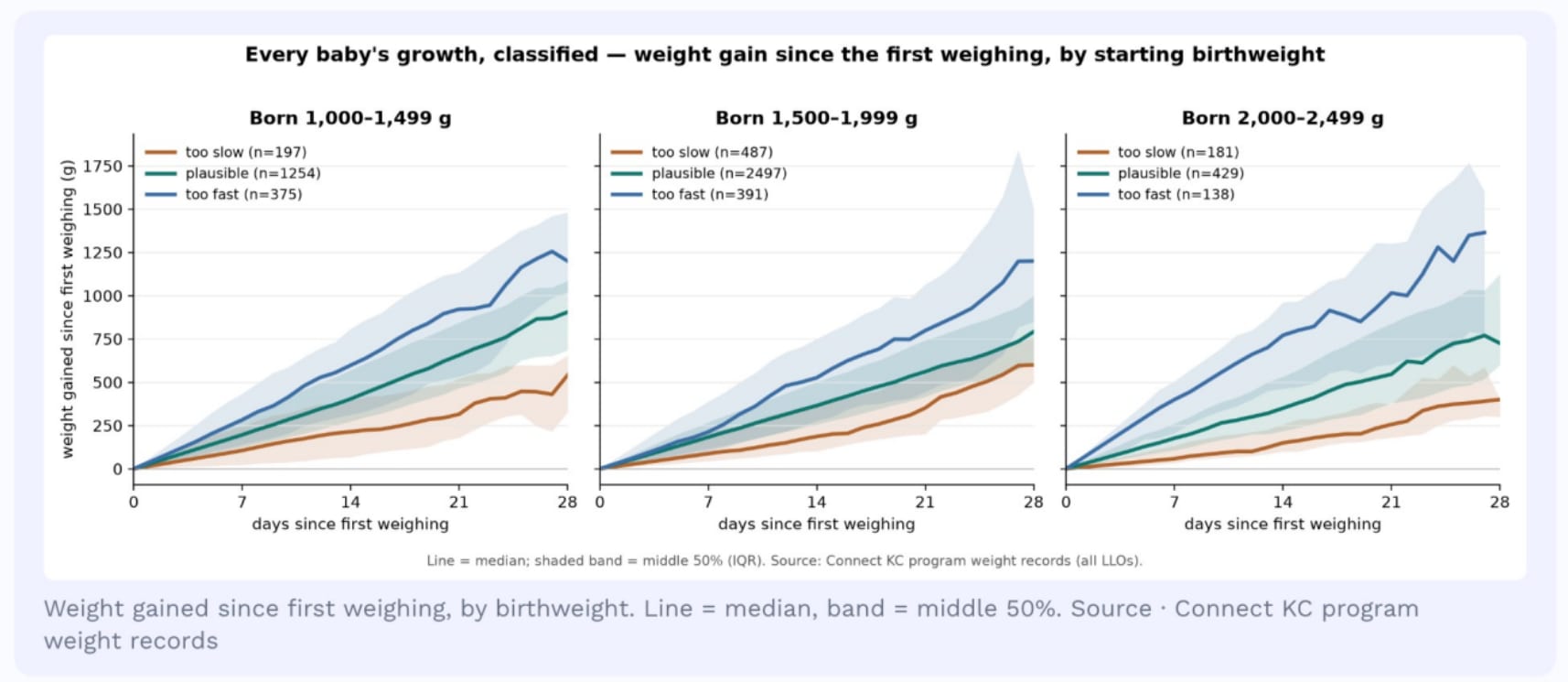
The following graph shows weight gained since the first weighing, by birthweight, across Connect Kangaroo Care organizations.
Figure: weight gained over the first 28 days since the first weighing, grouped by birthweight. Lines show medians; shaded bands show the middle 50% (interquartile range). Source: Connect Kangaroo Care program weight records across organizations.
In PIPNU’s Uganda cohort, we identified 2,074 infants who were alive at day 14, had a recorded weight near day 14, and we had data on whether they survived to day 28. Each additional 100g gained by day 14 is associated with a 0.6 percentage point reduction in mortality risk, or roughly a 13% reduction in odds (OR=0.87, 95% CI 0.80–0.93, p<0.001).
Evidence, cost-effectiveness and key uncertainties
Kangaroo Care is a cost-effective solution to reduce SVN mortality. A 2016 Cochrane meta-analysis found that Kangaroo Care initiated in facilities after stabilization reduced mortality among low-birthweight infants by about 40% at discharge and one third at latest follow-up [Cochrane 2016]. An RCT of community-Kangaroo Care found a 30% reduction in 28-day mortality [Mazumder 2019].
The key drivers of the model are the cost of Connect Kangaroo Care, the baseline neonatal mortality for areas served by the program, and how much Connect Kangaroo Care reduces that mortality. The true effect could be smaller. We have uncertainties around understanding the true cost of the intervention which may also vary as we expand to other parts of Uganda.
We have ongoing collaborations with facility-based Kangaroo Care programs in India (Ansh) and Nigeria (First Embrace), among others, and academic leaders in the field. GiveWell recently funded us to support SVN mortality studies in Nigeria and Uganda.
Note: This post was crossposted from Planned Obsolescence by the Forum team, with the author's permission. The author may not see or respond to comments on this post.
Subtitle: If acceleration compounds, the naive extrapolation implies superintelligence within a year
This post discusses a public METR report on AI R&D acceler...
TL;DR:
* When we started Rethink Priorities (RP) in 2018, our mission was, simply put, to close the knowledge gaps that stopped people from improving the world as much as they could. That hasn’t changed much, but the landscape we’re doing it in is shifting.
* In 2027, we plan to grow our core GHD, Animal Welfare, and Worldview Investigations teams to take on emerging priorities across causes, including those that the forthcoming transformative AI is creating.
...
This was cross-posted from the Animal Charity Evaluators blog.
We update our list of recommendations annually. This year, we announced our recommendations on November 10.
Most people who care about animals arrive at the same impas...