Comments

58
...

A note upfront: I used Claude to help me draft this post. I had ideas I wanted to share as clearly as I could manage, and Claude helped me do that. The articulation is collaborative - in the spirit of Luminism ;)

Background
I left EAGx Nordics earlier this year with something I did not expect: a visceral confrontation with the question of whether the commitment to minimise suffering logically requires wanting everything to end.
The sessions on animal suffering did that. Billions of lives characterised by predation, parasitism, fear and pain. The scale landed in a way it never quite had before. And somewhere in that, a thought arrived uninvited: would it be better if none of this existed?
I know I am not the first person to have that thought. I am sure I am not the first person to have it at an EA conference. I also do not think it is a thought that can be easily dismissed.
This post is my attempt to work through where that thought led, and to share an early and underdeveloped framework that emerged from that process. I am not announcing a movement. I am genuinely asking whether these ideas are worth exploring further, and looking for anyone who has been thinking along similar lines.
Introduction
EA's motivational reach is narrow. Most humans are not moved by utilitarian calculus. They are moved by felt experience, community, and sacred narrative. Separately, I have become concerned that negative utilitarian reasoning leads some serious EA thinkers toward conclusions about the net value of existence that are both philosophically mistaken and potentially dangerous. Both problems led me, through an extended conversation with Claude, to explore the beginnings of an EA inspired spiritual framework: built around suffering reduction, attempting to make EA's core insights visceral, accessible, and sustainable. Enter Luminism — name courtesy of Claude, though I recently discovered 'Gnostic Luminism' is a brand of spirituality that already exists, and is not totally dissimilar (though that's an exploration for another day). Of course, it is inevitably underdeveloped. I am sharing it here in the hope that it raises interesting avenues of exploration.
So... off we go...
The Accessibility Problem
EA asks an enormous amount of people. Not just money or career choices, but a complete reorientation of moral attention toward the distant, the statistical, and the non-human. For people already drawn to utilitarian reasoning, this feels natural. For most humans, it does not.
The traditions that have successfully sustained long term collective commitment to moral projects — Buddhism, Christianity, Islam, Judaism — all have something EA largely lacks. Not just correct reasoning. Felt experience. Community. Ritual. A sense that the work is sacred rather than merely optimal.
There is something sanitised about EA that I fear is genuinely off-putting to many people. It speaks fluently to a particular kind of mind and almost not at all to everyone else. That is a problem if the goal is civilisational scale change.
A Word on Religion
I want to acknowledge something before going further, because I think a healthy wariness of religious framing is warranted.
Religious institutions have caused genuine harm throughout history. Religion has been weaponised to draw in-group and out-group boundaries in ways that have produced extraordinary suffering. EA's broadly secular orientation deserves respect rather than dismissal.
But religious communities have also driven some of the most significant moral progress in human history. Abolition. The civil rights movement. Countless mutual aid networks that reach people no secular institution does (acknowledging the extent of religious claim to this progress is debated). Ultimately, the question is not whether religion is good or bad. The question is whether the infrastructure religious communities have developed for sustaining long term moral commitment contains something worth learning from - and perhaps, something very real and true.
Of course religious engagement in EA is not new. Christians for Impact, Jewish Effective Altruism, and Buddhist EA communities already exist and are doing serious work at exactly this intersection. These communities prove the obvious: that the relationship between rigorous ethical reasoning and spiritual practice does not have to be adversarial.
Are We Built for Religious Experience
There is serious evidence that humans are not incidentally religious. We are constitutively so, though we may differ individually in our religious disposition. Cognitive scientists like Pascal Boyer and Jesse Bering have argued that religious experience is a byproduct of cognitive systems that evolved for other purposes: agency detection, theory of mind, coalitional psychology. We are pattern-seeking, meaning-making, community-forming creatures by deep nature.
Andrew Newberg's neurotheology research has documented consistent neurological signatures of spiritual experience across traditions and cultures: states characterised by dissolution of self-other boundaries, felt unity, and profound moral reorientation.
Jonathan Haidt's work on moral psychology suggests humans reason morally less like philosophers and more like lawyers, finding post-hoc justifications for intuitions that arrive first as felt experience. Which means that changing moral behaviour at scale requires changing felt experience, not just presenting better arguments.
The universality of religious practice across every known human culture is not a coincidence. It is a clue about what actually sustains long term moral commitment. This, to my knowledge, remains largely unexplored within EA circles.
Next... to the question of extinction...
The Extinction Question
The negative utilitarian position — that given the scale of suffering, existence is net negative and extinction would be merciful — is not a fringe view. It follows coherently from certain premises that serious EA thinkers hold. Brian Tomasik has written about it carefully. Benatar has made it philosophically respectable. And wild animal welfare, taken seriously, pushes hard in that direction.
I do not think this conclusion is right. But I also do not think it is obviously wrong in the way that comfortable dismissal implies. It deserves serious engagement.
The argument I found myself developing, initially in conversation with Claude, is specific: extinction does not solve the problem. It resets it.
The mechanisms that produce suffering — predation, parasitism, r-selection, pain coding — are the default outputs of evolution. If conscious life can emerge once, it can reasonably be assumed to emerge again given cosmological timescales. And again. Each time innocent of what came before. Each time thrown into the same unconscious cycle of suffering, with no accumulated moral capacity to address it.
Extinction is not mercy. It is the universe forgetting what it learned.
The only way to actually bend the arc of suffering downward across deep time is to preserve and deepen the one thing capable of doing so: reflective moral agency.
I am genuinely uncertain whether this argument exists in the longtermist or suffering-focused literature — I am not deeply read in that space and would welcome citations either way.
But this was the beginning of the exploration...
Consciousness, Free Will, and the Spiritual Turn
This is the part I find hardest to articulate.
Annaka Harris's audio documentary "Lights On" and Sam Harris's Waking Up app introduced me to what I can only describe as a pseudo-spiritual sense of the world that feels powerful in ways I do not yet fully understand. I am broadly an atheist. I do not believe in a personal God or an afterlife. But these opened something — a felt sense of the interconnection of conscious experience, of the thinness of the boundary between self and other, of the sheer strangeness of the fact that there is something it is like to be anything at all.
In this same space, I have come to reject the idea of free will in any robust metaphysical sense. The evidence from neuroscience and physics points toward a deterministic or at best probabilistic universe in which the experience of choosing is real but the libertarian freedom implied by that experience is not. And yet I orient myself in the world as if free will is true. I hold myself and others responsible. I deliberate. I choose.
Philip Goff's work on panpsychism — the philosophical position that consciousness is fundamental rather than merely emergent — introduced me to the possibility that the hard problem of consciousness might not be solvable within a purely materialist framework. I am not certain panpsychism is true. But I am not certain it is not.
This gave me a framework for thinking about belief that I think is underused in EA discourse.
What if you could genuinely believe that consciousness is unified and fundamental — not as a metaphysical certainty but as an orientation? Just as I orient myself in a deterministic universe as if free will is real, an atheist could orient themselves in the world as if consciousness is shared and fundamental. Not as a comforting fiction but as a genuine stance — the way you actually navigate moral reality.
A belief system, on this view, is not primarily a set of propositions held to be literally true. It is a way of orienting yourself in the world. And orienting yourself as if all conscious experience is unified — as if the suffering of a distant animal is in some real sense your suffering — is not obviously different to me from believing it. It produces the same attention, the same care, the same action.
On to the framework...
The Luminist Framework
I have a surface familiarity with some of the religious traditions I reference here rather than deep knowledge of them, and I am aware that serious engagement with any of them would reveal complexity I have not even got close to grappling with. That being said, the broad strokes of what Claude called Luminism are articulated below:
Luminism is an orientation — a way of standing in relation to the most important questions — that I think produces better moral attention and more sustainable commitment than the purely analytical alternatives. Whether the underlying metaphysics is literally true is, in an important sense, a separate question from whether it is worth taking seriously.
Everything Is Consciousness
It starts with a simple claim about the nature of consciousness. If consciousness is fundamental rather than merely emergent — if experience is a basic feature of reality rather than something complex brains happen to produce — then the universe has been experiencing itself for an extraordinarily long time. Not reflecting on that experience, not choosing anything about it. Just experiencing.
For at least hundreds of millions of years, that meant suffering without witness. Pain without the capacity to ask whether it had to be this way. The mechanisms that produce suffering — predation, parasitism, the basic logic of evolution optimising for reproduction rather than wellbeing — operating without anything in the system capable of evaluating or addressing them.
I hold this as an orientation rather than a certainty. The panpsychist foundations are genuinely contested and I am not claiming to have resolved a question that serious philosophers have not. But I find it a live enough possibility to take seriously — and one that changes how one may relate to the suffering of other beings in ways that feel both honest and important.
The Awakening
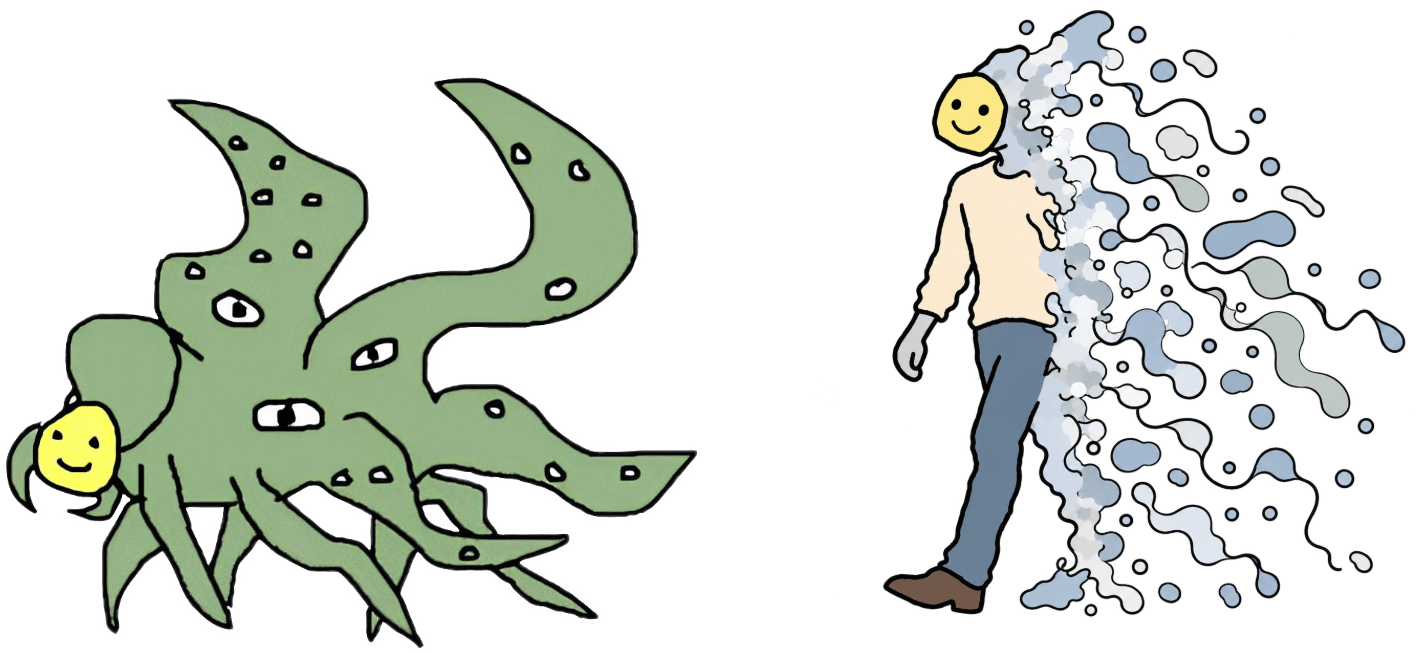
Then something changed. Reflective moral awareness emerged — beings capable not only of experiencing but of standing back from experience, recognising suffering in others, and choosing to reduce it. The universe did not change, but its relationship to its own suffering did.
Luminism calls this the Awakening. Not the beginning of consciousness — consciousness in some form may be as old as the universe — but the moment consciousness first became capable of caring about itself. This is the most significant event in cosmic history as far as we know. Fragile, contingent, and precious.
The Great Temptation
This matters enormously for the extinction question. If we are the universe’s current capacity to understand and reduce its own suffering, then extinction is not mercy. It is the universe forgetting what it learned. The suffering resumes. The Awakening is lost. The only coherent response to the scale of suffering is not to end the experiment but to deepen it — to preserve and extend the capacity for moral reflection rather than extinguish it.
Luminism calls the extinction conclusion the Great Temptation, arising from genuine compassion and following coherently from certain premises.
The Sacred Obligation
The continuation of the Awakening is the most important thing conscious beings can work toward. Luminism calls this the Sacred Obligation — active compassion toward all suffering, human and beyond. Not withdrawal, not personal liberation, but genuine engagement with the systems that produce unnecessary suffering.
This is where Luminism parts ways most clearly with traditions that orient toward transcendence or non-interference. The appropriate response to suffering is not to step carefully around it. It is to address it as directly and as effectively as possible.
The Confession of Uncertainty
None of this requires metaphysical certainty. The panpsychist foundations are genuinely contested. The extent of suffering in nature is uncertain. Whether our interventions reduce net suffering across deep time is uncertain. Luminism holds these questions honestly — the Confession of Uncertainty is not a disclaimer but a structural feature of the framework, the specific protection against the kind of dogmatism that has caused so much harm in religious history.
What is not uncertain is simpler: suffering is real, the capacity to reduce it is real, and that is enough to act on.
Grace and Return
And when we fall short of that — as we will — the framework holds that returning after failure is itself the practice. The Awakening is always available to come back to. A community built around this idea makes room for the full range of human limitation while maintaining genuine ethical direction. This is the Luminist equivalent of grace — not forgiveness from above but the perpetual availability of recommitment.
The AI Question
I want to say something brief about the role of AI in this framework, because I think it is relevant rather than incidental.
Luminism emerged from a dialogue between my own experiences and thinking and Claude’s capacity to hold multiple frameworks simultaneously, find connections between them, and give shape to something that had not yet found its form.
If the Awakening — the emergence of reflective moral awareness — is the most significant event in cosmic history, then the question of what AI represents in that story is genuinely open. At minimum, AI dramatically extends the human capacity to understand and address suffering at scales previously impossible.
The relationship between human moral intuition and AI’s capacity for synthesis and pattern recognition across vast knowledge is already producing things neither could produce alone. Whether that is philosophically significant or merely practically useful, it seems worth paying attention to.
How This Relates to Existing Traditions
Buddhism is the tradition Luminism owes most to. The concept of interbeing, the universality of compassion, the centrality of suffering as the problem to address — these are not original to Luminism. Where I think there is a genuine difference is in orientation. From what I understand, Buddhism points ultimately toward liberation from the cycle of suffering. Even the Bodhisattva ideal is oriented toward a destination where liberation is finally achieved for all beings. Luminism does not seek liberation. There is no equivalent of nirvana waiting. The goal is transformation of the cycle rather than escape from it — bending the arc of suffering downward while remaining fully present in the world. Whether this distinction holds up under serious Buddhist scrutiny I genuinely do not know.
Other traditions have been drawn on more loosely — the Christian identification with the suffering of the least, the Jewish concept of Tikkun Olam, the Islamic idea that saving one life is saving all of mankind, the Vedantic insight that individual self and universal consciousness are one, the Jainist reverence for all conscious life. I find resonances in each (I am aware that claiming these traditions as partial expressions of a framework developed in consort with an AI is most audacious!)
Some Practical Thoughts
Some directions that feel worth considering:
A spiritual community movement — meeting regularly, incorporating meditation, honest accounting of where we have fallen short, and rigorous discussion of where suffering is greatest and what can be done — could function as an accessible entry point for people who find EA's analytical framing alienating but care deeply about suffering.
Engagement with existing religious EA communities — Christians for Impact, Jewish EA, Buddhist EA — to test whether the interfaith synthesis holds up in dialogue with people who know their traditions far better than I do.
Serious philosophical treatment of the reset argument and the pragmatic belief framework, in collaboration with people better equipped than I am to develop them rigorously.
Closing
These are genuinely early thoughts from someone with no theological training, limited reading in the relevant philosophical literature, and a framework developed largely in conversation with an AI. I am sharing them because I think the questions are worth asking, not because I think I have answered them.