This is the monthly thread for EA organisations to share updates, announcements, and opportunities directly with the community.
Organisations post their own updates in the comments. Moderators may remove clearly irrelevant or off-topic content if necessary.
Quick notes
- If you’re an organization and your comment is automatically removed by our bot, please message us. We’ll review it and restore it if appropriate.
- You can find previous threads on the “EA Organization Updates (monthly series)” topic page. For additional updates outside this thread, see the “organization updates” tag.
- If you’d like to get a monthly reminder to publish org updates on the forum, please apply for the mailing list here.
We'll keep this pinned until June 15th.

Anima International updates
UK campaign to end the suffering of fast-growing chickens
In the UK, we launched a major campaign targeting Pret A Manger over its broken promise to stop selling fast-growing chickens.
The company publicly committed to drop fast-growing chicken from their products in 2018, with a 2026 deadline. But they recently published a roadmap extending breed change to 2032 – a timeline we don’t consider credible and are not endorsing, given no progress made in the past 8 years.
During the pre-public phase of the campaign, we sent 600 letters to Pret store managers, and visited 400 Pret stores across Greater London to speak with staff. We are now increasing the pressure with a dedicated mobilization website, highly visible outdoor advertising, media ads, and public stunts involving a gigantic mechanical frankenchicken sculpture. We’re prepared to maintain our actions until Pret presents a realistic plan with a near-term fulfilment deadline.
France – Progress towards the end of cages for hens
In France, where we work with wholesalers and public catering companies to end the sale of eggs from caged hens, we published a report tracking their progress towards 100% cage-free egg supply.
We’re seeing promising improvements across both sectors. The market share of cage-free eggs in out-of-home foodservice rose from 33% in 2024 to 42.3% in 2025, with many individual companies showing steeper progress (Pomona – 37% to 87%, Sysco – 29.5% to 52.8%, Pro à Pro 34% to nearly 60%). Six wholesalers have published transparent roadmaps to phasing out cage eggs by 2029, with several other companies expected to follow later this year. The transition is more advanced in the collective catering sector – five of the 14 companies have already phased out caged eggs, and others made significant progress (for example Newrest, from just 7% in 2024 to 60%)
The transition of wholesalers and collective catering to cage-free eggs is essential to eliminating cage hen farming in France. Implementation of these roadmaps will affect 1.5–2M hens alive at any given time.
Opportunities
Conference on Animal Rights in Europe (CARE) 2026 – tickets now on sale
Tickets for CARE 2026 are now available with a 35% Early Bird discount until June 30th. This is your chance to secure your spot at the lowest price. You can also buy a CARE Supporter pass and help subsidize tickets for those who are facing financial barriers.
Get your tickets hereWe hope you can join us in Warsaw, September 17–20 along with hundreds of other animal advocates and organizations working to improve the world for animals. If you can’t make it in person, join us online via Swapcard from wherever you are.
Action in Brussels to push for an EU-wide ban on cages for farmed animals
On June 30, Anima International, on behalf of the End the Cage Age coalition, is staging a visual action in Brussels to mark five years since the European Commission committed to proposing legislation banning cages for farmed animals. The commitment came in response to the End the Cage Age European Citizens' Initiative signed by 1.4 million Europeans. It was one of the largest ECI ever submitted, but the legislation still hasn't been proposed.
The action will feature a large cage installation outside the Commission building, with actors styled as Commission staff sitting at a boardroom table inside. Members of the European Parliament from several member countries confirmed their attendance. The action will highlight the Commission’s democratic failure and urge them to deliver on their commitment to European citizens and millions of animals suffering in cages.
If you’re in Brussels, feel free to join us between 10:30 and 12:30 in front of the European Commission building.
Announcements:
Hiring:
We're hiring an Operations Coordinator/Associate based in San Francisco or Washington D.C. As always, if your referral results in a hire, you'll receive $5k as a thank you.
New writing:
Opportunities:
PauseAI UK
Announcements:
To see a detailed breakdown of our expenses and projected costs, take a look at our our Donor Prospectus. You can donate to PauseAI UK by visiting our donation page.
Fish Welfare Initiative Updates
We're hiring for a role that we think may be a great fit for some in the EA community: Director of Programs. This role will involve leading and scaling our programs, first in India and then abroad, to implement welfare improvements on thousands of farms. International applicants are welcome, though time living in India will be expected. Leadership experience required; experience running agricultural programs a huge plus.
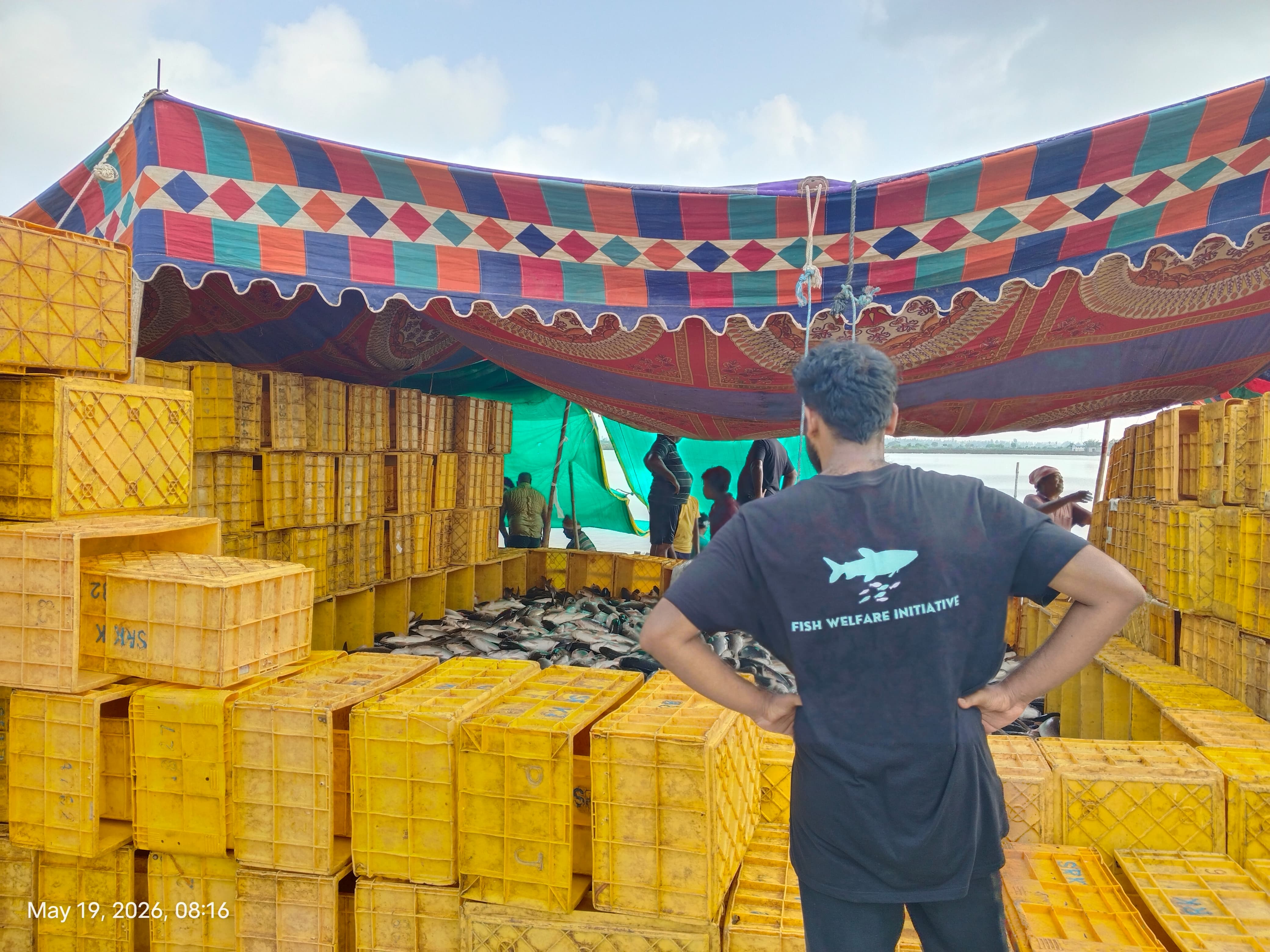
Learn More and ApplyFWI staff observing a "harvest", in which the fishes are pulled from the water and asphyxiated to death. We are working to reform these practices with our ongoing "chill kill" project (see update from last year—we should have another update in the coming months).
Wild Animal Initiative’s latest research on the representation of veterinarians in wildlife research, with a special focus on wild animal welfare science, was published in Research in Veterinary Science. The lead author is WAI Research Manager Michaël Beaulieu.
The paper first establishes a baseline for the representation of veterinarians in wildlife research. Along with Michaël, 14 students from the UniLaSalle Veterinary College in France examined the educational backgrounds of the authors of more than 5,000 articles published in animal behavior, conservation, ecology, and physiology over the last 10 years. They found that the representation of veterinarians was modest in well-established wildlife research disciplines, with only 3% of articles having at least one author with veterinary training.
Following the same procedure, they also examined the representation of veterinarians in the emerging field of wild animal welfare science. They found that almost half of wild animal welfare articles in animal welfare journals included at least one veterinary author. This high representation may be a reflection of veterinary students’ early interests in animal welfare and wildlife, of the role of animal welfare in veterinary education, and of veterinarians’ belief that wild animal welfare research has practical applicability. (Note that these findings and interpretations should be read cautiously, though, since the number of wild animal welfare articles found was relatively low.)
Michael says he would have been delighted to come across a paper like this when he was a young veterinary student interested in both research and wild animals. Seeing how feasible it is for veterinarians to get involved in wildlife research would have given him confidence to take my career in an unconventional direction, which is a key part of field-building.
Despite some limitations, the article also suggests that veterinarians may be better prepared to conduct research in wild animal welfare than in any other wildlife research discipline. But if veterinarians are to come to view wild animal welfare research as a safe professional pathway, the emerging field of wild animal welfare science will need to offer them more career opportunities. And that will require growth in the field — in its community, in its activities, in its recognition, and in the resources at its disposal.
Impact Ops provides finance, recruitment, entity setup, due diligence, ops audits and systems support to high-impact nonprofits. We're a remote-first team supporting ~40 organisations across the US and UK in global health, animal welfare, AI safety and climate.
We're currently running hiring rounds for a number of roles on behalf of our clients and two roles on our own team. Several close in late June, so early applications are encouraged.
The Good Food Institute APAC (GFI APAC) (a network of nonprofit think tanks advancing alternative proteins — plant-based, fermentation, cultivated)
- SciTech Manager (China) — GFI APAC's regional scientific lead on alternative proteins. Beijing preferred (other first-tier Chinese cities considered) · RMB 480,000–600,000 · full-time · Mandarin + English · apply by 28 June
- Policy Specialist (Korea), Senior–Principal — leads GFI Korea's government and policy work on alternative proteins. Remote within Korea · KRW 90–143M · full-time · native Korean + business English
- Associate Director of Philanthropy — senior frontline fundraiser building GFI's APAC donor base; reports to the APAC CEO. Singapore preferred (Hong Kong SAR considered) · SG$125,000–145,000 · full-time · apply by 28 June
Apply now!Simon Institute for Longterm Governance (SI) (Geneva-based nonprofit working at the intersection of frontier AI diplomacy and international governance)
- Operations & Systems Specialist — own SI's internal tools, IT, operational security and HR administration as the team scales; reports to the Head of Finance & Operations, with a growth path toward Operations Manager. Remote (strong preference for Geneva or willing to relocate; must have or be able to obtain Swiss work authorisation) · CHF 104,017–137,200, remote-equivalent package available · full-time, permanent · apply by 21 June
Apply now!LEEP (working to end childhood lead poisoning; programmes in 40+ countries)
- Programme Manager (Anglophone) — generalist running and supporting several of LEEP's global programmes. Remote · full-time · apply by 21 June
- Programme Manager (Francophone) — French fluency for Francophone programmes. Remote · full-time · apply by 21 June
Apply now!ERA (Cambridge-based talent organisation working to mitigate risks from frontier AI)
- Director of Operations — senior strategic hire owning operations, finance, compliance and visa infrastructure as ERA scales to 15–20+ people. Cambridge, UK (in-person/hybrid) · £80,000–100,000 · visa sponsorship available · apply by 10 June
Apply now!Principles of Intelligence (PrincInt / PIBBSS) (nonprofit advancing AI interpretability and safety)
- Research Scientists — work on Ambitious Mechanistic Interpretability: data-structure models, feature analysis and synthetic datasets for interpretability tools. Fully remote (ET core hours preferred; visa sponsorship for London or Berkeley) · $100k–250k · start July 2026 · apply by 21 June (rolling)
Apply now!We’re also hiring!
- Senior Recruitment Specialist – AI Safety — run hiring rounds for Impact Ops and our AI-safety clients. Remote-first (UK/Europe hours; North America considered) · £55,000–75,000, location-adjusted · full-time preferred (part-time possible) · UK visa sponsorship · apply by 27 June (rolling)
- Finance Associate (UK & US) — bookkeeping, reconciliations, AP, payroll coordination and reporting across UK/US nonprofit clients. Fully remote (UK overlap) · £42,000–48,000 or local equivalent · UK visa sponsorship · apply by 30 June
Join our team!Happy to answer questions about any of these. Drop a comment or reach us at hello@impact-ops.org.
GiveWell Updates
- GiveWell co-founder and CEO Elie Hassenfeld was recently named to the 2026 TIME100 Philanthropy list. Last year, GiveWell directed over $400 million to programs that save and improve lives, guided by the central question that has driven us from the very beginning—where can a dollar do the most good?
Read More- In a recent podcast episode, GiveWell co-founder and CEO Elie Hassenfeld speaks with Senior Program Officer Adam Salisbury about our growing livelihoods portfolio, focused on increasing the economic well-being of people in extreme poverty. Elie and Adam discuss testing variations of cash transfers, exploring poverty graduation programs, and funding research to answer key questions about which programs are most cost-effective.
Listen Here: Expanding Our Search for Cost-Effective Ways to Reduce Poverty- We recently granted $5 million to the DIV Fund to identify and support promising water quality and access innovations we could consider for future funding. If you're piloting an early-stage water intervention, or know someone who is, the RFP is now open on a rolling basis.
Learn More + Apply- GiveWell has directed more than $1 billion to malaria prevention over our history. With increased capacity on our malaria research team—our largest research subteam—we're expanding our malaria work by funding new research, increasing coverage of core programs, and exploring interventions beyond nets and seasonal malaria chemoprevention.
Read More: Growing GiveWell’s Largest Research Area- Over the last decade, GiveWell has directed nearly $50 million to iron fortification and supplementation programs. In a recent episode of GiveWell Conversations, GiveWell co-founder and CEO Elie Hassenfeld speaks with Researcher Andrew Martin about our work on iron—including how an evaluation of our 2021 grant to Fortify Health, which showed the program was roughly twice as cost-effective as projected, led us to renew our support with a $10 million grant.
Listen Here: What a Decade of Iron Funding Has Taught UsEvidence Action's Organization Updates:
Hiring: