Headline finding: I audited 17 AI Safety Talent programmes. Zero of 17 have published any comparison group, rejected-applicant follow-up, matched control or randomisation. Not one. Every programme that mentions a counterfactual does it by asking participants to self-report.
Background
At least $70 million...
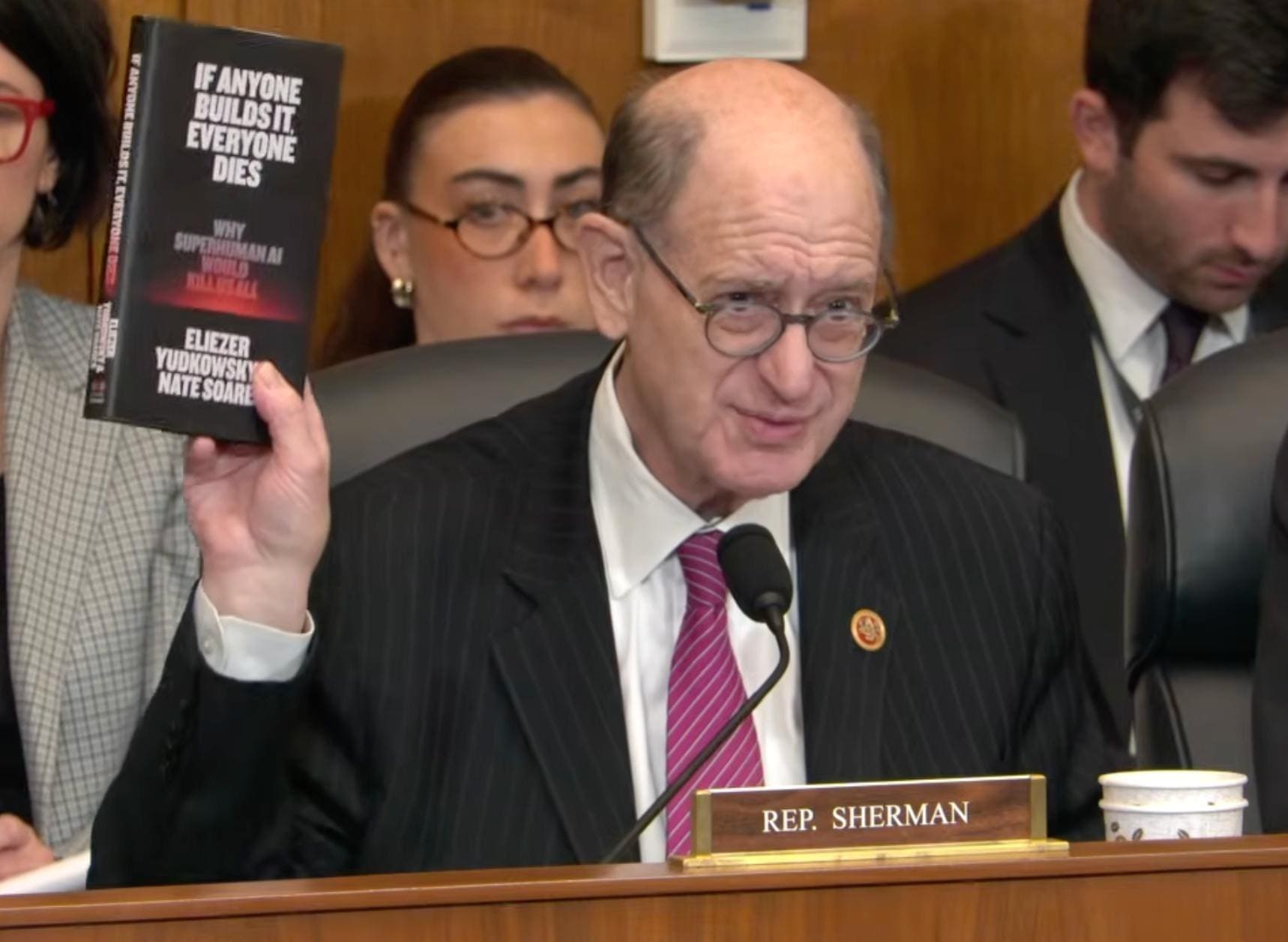
In celebration of still being alive and fighting, we are giving away 1,000 Amazon e-books of “If Anyone Builds It, Everyone Dies”. Feel free to send a copy to yourself, a loved one, or a friend—we need all hands on deck.
Today marks exactly one year since If Anyone Builds It, Everyone Dies: Why Superhuman AI Would Kill Us All, by Eliezer Yudkowsky and Nate Soare...
A year ago I posted that YCombinator (YC) companies didn’t seem to be growing faster since the release of ChatGPT in 2022. I reran that experiment and found that 2023+ YC companies are arguably growing a bit faster than pre-2023 companies (including AfterQuery, ...


I'm curious how the Effective Altruism community addresses fiscal substitution in the "global health and development" cause area? Do any of the top GiveWell recommended charities find ways to track how their impact applies to government spending in their host countries?
I found this via Tyler Cowen's Marginalrevolution.com -
"While donor-driven programs undoubtedly saved millions of lives, they also created unintended distortions in national health priorities.
Many governments in sub-Saharan Africa and parts of Asia actually scaled back domestic health investments, as donor program filled key gaps in HIV/AIDS, maternal and child health, and infectious disease control.
In some cases, domestic health budgets shrank in real terms, even as external funding increased. This phenomenon, often referred to as “fiscal substitution,” led to national health systems that were heavily donor-dependent, externally managed, and vulnerable to funding shocks.
Notably, this reliance emerged despite countries pledged to allocate at least 15% of their national budgets to health.
More than two decades later, only a handful has met this target." (this is from Redefining Global Health in the 21st Century by Michael John Alastair Reid and Eric Paul Goosby).
GiveWell accounts for government spending through quantitative adjustments for 'fungibility' and 'leverage', estimating both the probability that their funding alters government budgets and the comparative value of those displaced funds. These adjustments are explicitly included in their cost-effectiveness models. You can go through their spreadsheets and check out their inputs and assumptions.
What about new charities?
Charities incubated by the main EA global health incubator, Ambitious Impact (AIM), view government adoption not just as a bonus, but as their primary strategy for massive, cost-effective scaling.
Unlike established organisations that often run parallel to public systems, AIM’s incubation model heavily favours non-profits designed to systematically plug 'execution gaps' in public health. Their goal is to build, prove, and hand over the playbook to state and national governments.
Lafiya might be a good example. They distribute modern contraceptives in northern Nigeria through a network of community health workers called "Lafiya Sisters". They do not view themselves as a permanent, independent health provider; their explicitly stated scaling strategy is to "work with governments to execute, pay for, and take ownership of the model".
Disclaimer: I knew this info but was feeling lazy so got AI to write it up.
Thank you for taking the time to reply! I'm curious what your prompt was? Before posting here I asked claude the same question and got something that was more confusing to me than your answer.
I can't remember, to be honest, nothing fancy...