Comments
Note from Austin: The EA Community Choice was an experimental funding round we ran in Fall 2024. We had 340 users help us distribute $200k to various community projects; $100k via a sliding-scale airdrop, $100k via quadratic funding match. See more in the launch post.
Now, as a huge wave of funding is entering the scene, I thought people might enjoy reading my notes and reflections. I’m proud of the design of this grant round; one major goal was to encourage more of the community to have a voice in funding decisions, which I think it succeeded at. We’d be happy to run this again, if there’s interest.
(Also, given our recent hiring announcement, I’ve been grappling more with “what does the EA community want”. For example, we may hold a public vote on what Manifund should do next; if so, the airdrop represents one possible operationalization of “who counts as EA”.)
I’m grateful to the projects, donors, and voters who participated in EA Community Choice, as well as to our seed donor. Since people might ask “where did this $200k come from?”, our response at launch: “An anonymous individual in the EA community. Manifund would love to thank them publicly, but alas, the donor wishes not to be named for now. (It’s not FTX.)”
I wrote up most of this in late 2024, but never got around to publishing it. I’ve since made some edits, mostly for readability. Enjoy!
We asked people to fill out a 2-minute form, to claim from $100 to $800 to donate based on their participation in the EA community:
We ended up with 340 people who claimed money to donate. See the full list here: https://manifund.org/causes/ea-community-choice?tab=participants
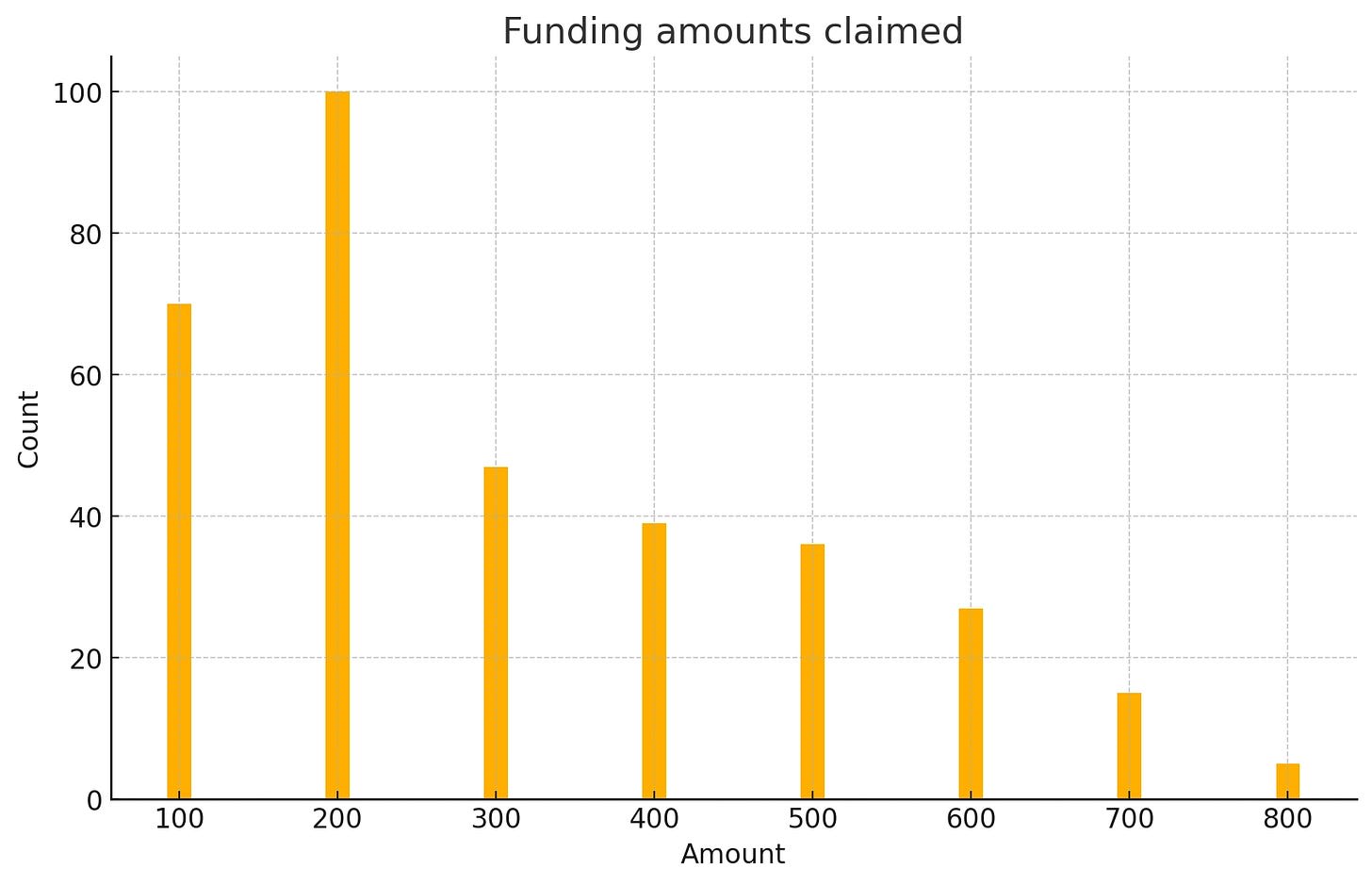
Overall, I’m pretty happy with the distribution method - it struck a balance between being easy to understand and awarding folks for different ways they’ve contributed to the EA community.
Main change for the future: lower amounts so that more people can participate. (We had another 300 on the waitlist!) Naively: halve all values. Or, raise more funding.
Shoutout to the following folks who checked off all 8 boxes: Constance Li, Jordan Pieters, Joe Hardie, Henri Thunberg, and Oliver Habryka!
The amount of quadratic funding match is listed here: https://manifund.org/causes/ea-community-choice?tab=match
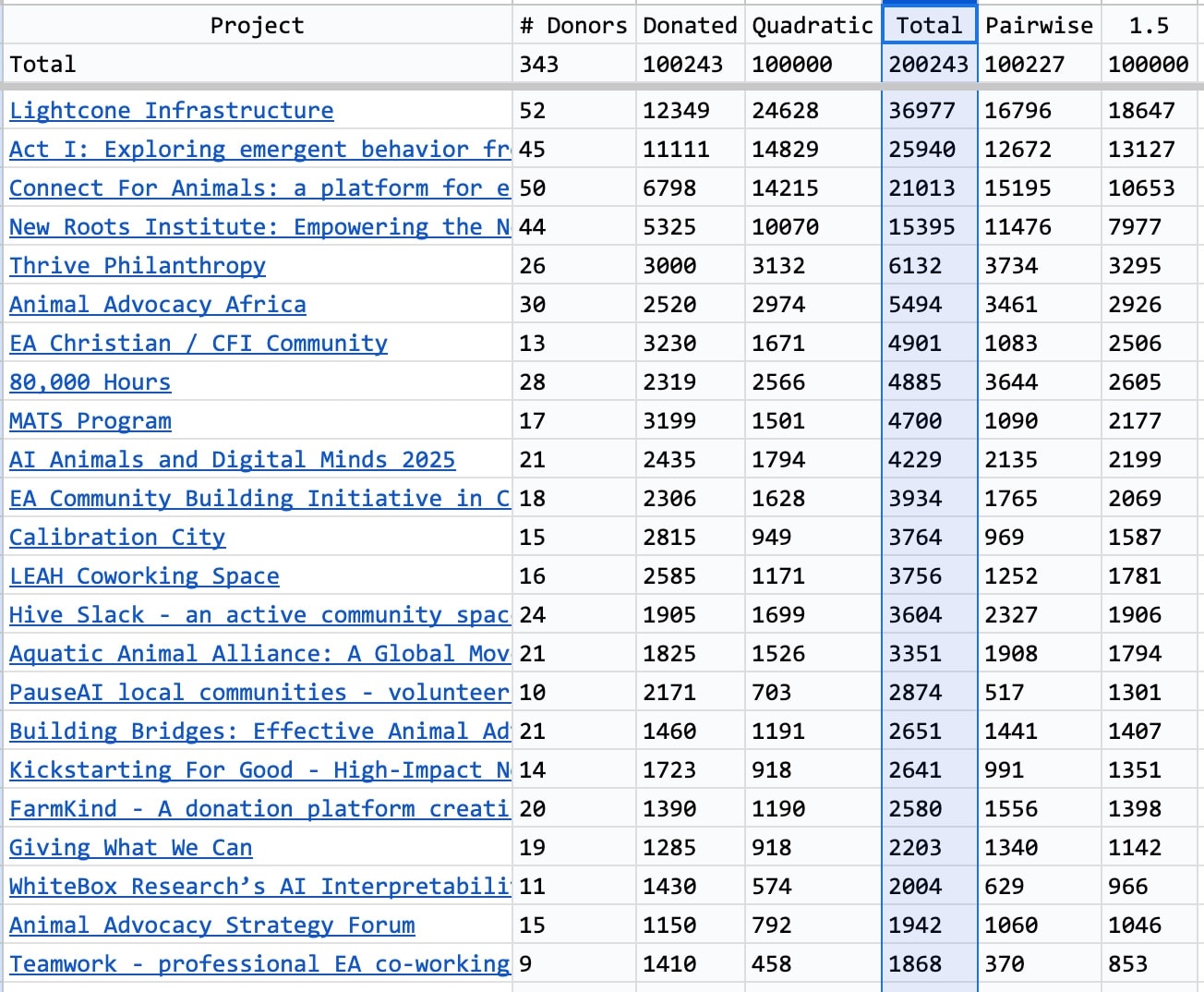
Subjectively, quadratic funding seemed to award a lot of the prize pool to the top projects, compared to the baseline rate of donations. For example, Lightcone (#1 on # donors and $ donated) received a match rate of about 2:1; most projects received a match rate of 1:1 or less.
I considered some modifications to the baseline quadratic funding algorithm, including pairwise-bounded quadratic funding and using an exponent of 1.5 instead of 2. Ultimately, I stuck with the regular version. You can see different results modeled below, or on this sheet:
Otherwise, it seemed like marketing was a bit distortionary. Vitalik Buterin has previously seen noted this dynamic in other QF rounds:
One other pattern that we saw in this round is that popular projects got disproportionately large grants…
To be clear, this is not just saying “more contributions, more match”, it’s saying “more contributions, more match per dollar contributed“. Arguably, this is an intended feature of the mechanism. Projects that can get more people to donate to them represent public goods that serve a larger public, and so tragedy of the commons problems are more severe and hence contributions to them should be multiplied more to compensate….
The failure does not look too severe; on average, projects near the top do seem to serve a larger public and projects near the bottom do seem niche, but it seems clear that at least part of the disparity is not genuine publicness of the good, but rather inequality of attention. N units of marketing effort can attract attention of N people, and theoretically get N^2 resources.
(See also this tweet that QF devolves into a battle between marketing departments)
Marketing is not all bad! Marketing can be a positive sum force, helping inform users/donors; my sense is that EA projects are somewhat under-marketed, because so much funding comes from Open Philanthropy rather than users.
Anyways, ideas for the future:
EA Community Choice was popular! Way more people wanted to participate than expected. Way more projects applied than expected. Many great projects applied; 50+ got funded. It generated a lot of comments on projects and popular support.
It raised a fair amount of additional external donations (~$50k).
We did this quickly! This whole project was conceived of and executed in ~1month, on ~0.7 FTE.
How does crowdfunding compare to standard EA grantmaking? It surfaces local knowledge about which projects have been valuable. It diversifies funding streams, encourages projects to raise from their own beneficiaries and become less beholden to large EA funders. Some wins in this regard were Act I & Connect for Animals.
Where does crowdfunding fall short? Probably: deep research projects, where grantmakers or regrantors are better positioned to evaluate technical expertise. We chose “community projects” for quadratic funding because we expected the mechanism to serve those better.
https://manifund.org/projects/lightcone-infrastructure
Maybe the most meta project. We’d known they were coming in, but weren’t sure if they should be eligible given their size.
As a winner: makes sense, LW especially adds a lot of value to the community. Having them as a winner also legitimizes EA Community Choice. However, they are relatively well funded compared to other projects, having accepted (guessing) $10m+ over the course of 10 years.
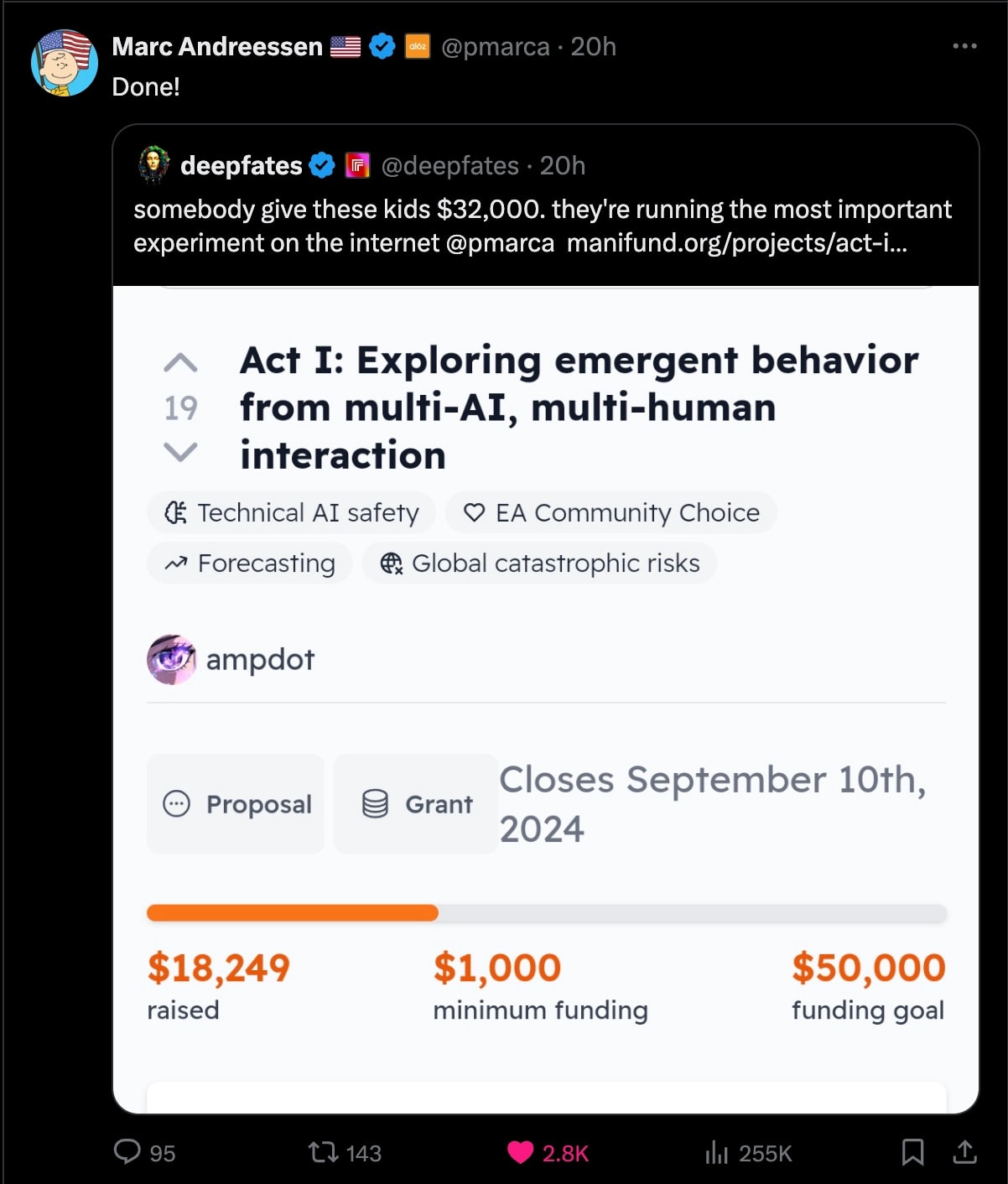
Largest counterfactual discovery, makes me feel happy to have run this round. (If you hang out on AI Twitter, Act I is where all the memey screenshots of bots talking to one another comes from.)
It made for the coolest story: Marc Andreessen, VC and noted EA skeptic, came in and donated $32k to Act I. I hope he appreciated the acronym that comes out of “EA Community Choice”…
Other top projects:
For giving great feedback on other folks’s projects, or feedback to Manifund: Jason, Arepo, ampdot, Steven Rouk, Matthew Farrugia-Roberts, Neel Nanda


