Comments
Cross-posted from the Welfare Footprint Substack.
Separating what we feel from what merely moves us
Pain and pleasure are the most immediate components of our happiness and misery, yet few of us have ever asked what they exist for at all. When I put the question to audiences in workshops and talks, it is usually the first time they have considered it.
I am focusing on this because, for animal welfare science, affective states are, of course, central to welfare assessment. And the answer to the question above is that Pain and Pleasure exist to guide behavior. With them we are guided toward what tends to support survival and reproduction, and away from what tends to threaten them, an idea already stated by Darwin (1887). Food, suitable temperatures, shelter and sex feel good so we behave to get them. Being hurt, thirst, illness, extreme temperatures and threats feel bad and therefore we behave to avoid them.
If bad feelings tell us what to escape or prevent, and good feelings what to seek or repeat, then how strong they are becomes the currency by which we weigh the pros and cons of actions in the complicated world (Cabanac 1992). Depending on how intellectually complex organisms capable of feelings are, these computations increase in sophistication and so increase the effectiveness of actions (Alonso & Schuck-Paim 2025b). Our intellect is, ultimately, a computational device for making decisions as effectively as possible with information that is largely indexed by different levels of Pain and Pleasure.1
But are affective states the only form of behavioral guidance? Are there forms of guidance that predate them, from before sentience (the capacity to feel anything at all, good or bad) emerged? Even bacteria behave adaptively, and they are certainly not sentient. And after sentience emerged, were there other mechanisms that do not depend on Pain and Pleasure? Situating the affective layer within a larger evolutionary architecture of behavior also clarifies what Pain and Pleasure are, by showing more sharply what they are not.
I propose distinguishing three broad forms of behavioral guidance, roughly in the order in which they emerged: pre-affective control, affective control and post-affective control.2 Organisms do not need to get rid of one to develop the next. They overlap, interact, persist and recombine, and more than one can be operative within the same act.
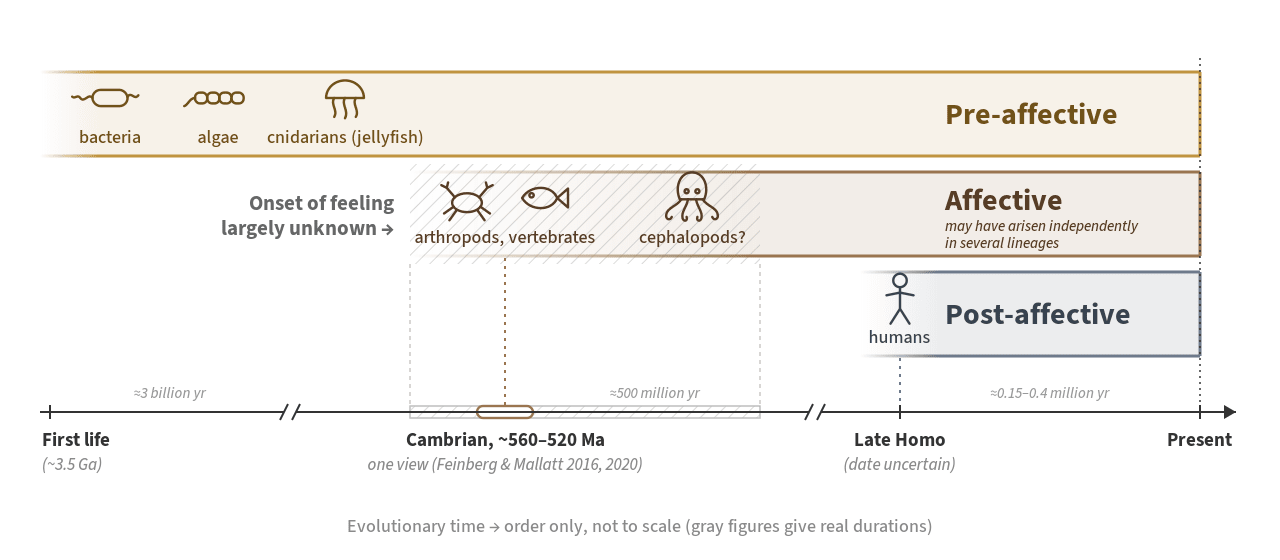
Three layers of behavioral guidance, each persisting once it appears. The time axis is not to scale: the gray figures give the real durations. When feeling first arose is largely unknown; one view places it in the Cambrian, ~560–520 Ma (Feinberg & Mallatt 2016, 2020). This is not a ladder: most lineages, such as bacteria and algae, remain pre-affective today, as on current evidence do jellyfish, and affective guidance may have arisen independently in several animal lineages.
Pre-affective control
The deepest layer is pre-affective control: guidance of behavior that works without anything being felt. By “pre-affective” I mean that it came earlier in evolution than feeling, and that it still runs alongside feeling in sentient animals. Living systems move, orient, regulate, avoid hazards, exploit opportunities, maintain internal stability and reproduce in ways that are already functionally organized, even when there is no reason to think that anything is felt. Adaptive behavior is therefore older than sentience. Bacterial chemotaxis is a paradigm case: cells move toward some gradients and away from others, a sophisticated but non-sentient form of regulation (Sourjik & Wingreen 2012).
In a simplified but still useful sense, pre-affective responses are built in by genes and development, and triggered by specific conditions in the environment. They are not necessarily rigid: their gain can be adjusted, they can adapt, and they can combine several sensory inputs. But they do not require the organism to experience those conditions as good or bad.
Thus, when a bivalve opens and closes its valves, a starfish reorients and moves, a jellyfish propels itself through rhythmic pulsation, or a plant bends toward light, we see behavior that has a simple explanation, with no need to assume anything is felt. These behaviors are paradigm examples of pre-affective control. In my view, attributing feelings to bacteria or plants simply because they behave adaptively confuses the presence of behavior with the presence of experience: adaptive behavior is exactly what pre-affective control produces, so it cannot by itself be evidence of feeling.
Affective control: Pain and Pleasure
With sentience, a new form of behavioral guidance becomes possible. Conditions are no longer only told apart; they are felt as good or bad, attractive or aversive, relieving or burdensome. From then on, what matters for survival also matters to someone. This capacity is what matters morally as the famous quotation from Bentham (1789) reminds us: “the question is not, Can they reason? nor, Can they talk? but, Can they suffer?”. Pain and Pleasure are central because they feel good or bad, and to different degrees, which lets the organism rank, compare and prioritize across needs and situations that are otherwise very different. I use Cabanac’s functional argument, that this system works as a “common currency” for comparing unlike needs (Cabanac 1992).3
The sentient organism can not only respond; it can care, in the simple sense that some things feel worth avoiding and others worth pursuing. This gives it a more unified way of steering behavior than pre-affective control alone (Cabanac 1996; Feinberg & Mallatt 2020; see also Alonso & Schuck-Paim 2026); in the brain, quite diverse pleasures activate similar circuitry, “a common neural currency” (Berridge & Kringelbach 2015).
This was a major evolutionary innovation, but which animals share it is arguably one of the great open questions in biology. Approaches differ in method as well as in conclusions. Some, applying a list of neurobiological criteria, conclude that consciousness arose at the origin of vertebrates in the Cambrian, so that all vertebrates are conscious, and that arthropods and cephalopods also meet the criteria (Feinberg & Mallatt 2016, 2020; Mallatt & Feinberg 2021). Others assess disputed taxa criterion by criterion and assign graded confidence rather than a yes-or-no verdict (Birch et al. 2021; see also Browning & Birch 2022 on precautionary reasoning).
Several of these authors, and others, have argued that sentience emerged independently in several lineages (e.g. Feinberg & Mallatt 2016; Ginsburg & Jablonka 2019; Birch, Ginsburg & Jablonka 2020). Feinberg (2024), for example, argues that sentience arose separately in as many as four animal lines: vertebrates, arthropods, cephalopods and velvet worms. Whatever view one takes on the exact boundary, the arrival of feeling changed how behavior is organized.
At the same time, affective control does not take over the whole of behavior. Not every adaptive act in a sentient organism is affect-guided, and not every affect-guided act is reflective or deliberate. Much affective behavior is rapid, embodied and habitual, and sentient organisms continue to rely on pre-affective control even when Pain and Pleasure become central regulators of action.
It remains present in reflexes, built-in rhythms such as breathing and walking, turning toward a sudden noise, hormonal and other bodily regulation, defensive reflexes such as startle and withdrawal, and much else, none of which needs anything to be felt. LeDoux (2012) argues that survival circuits (for defense, energy and nutrient balance, fluid balance, thermoregulation and reproduction) “are not causally related to emotional feelings, but obviously contribute to these, at least indirectly”. On his view, a defensive state can run without being felt; on Panksepp’s (2010), the subcortical FEAR and RAGE systems shared across mammals are themselves felt, a view Solms (2019) has developed, placing the origin of feeling in the upper brainstem rather than the cortex.
In my view, these are examples of both systems acting together. When something is urgent, the first response is triggered by pre-affective mechanisms, whether or not anything is already felt: when we stub a toe, the foot pulls back before the pain guides us. Affect (physical pain, fear) then comes into play, informing the animal so it can take more elaborate action in the new situation (see also Wall 1979). The affective layer is added to this older architecture; it does not replace it.
Post-affective control: values
The third layer is post-affective control. By this I do not mean behavior that has left Pain and Pleasure behind, but behavior that can be guided by explicit norms, ideals, principles and commitments: in short, by values.
Values are not simply strong wants, nor merely delayed hedonic calculations. They are normative commitments: moral, political, religious, legal, aesthetic or existential orientations that answer to ideas of right and wrong, sacred and profane, admirable and shameful. Values do not merely tell us what feels good or bad. They tell us what ought to be done, defended, rejected or sacrificed for.
As far as present evidence indicates, this layer seems only fully articulated in humans. Other animals may have rich affective repertoires, sophisticated cognition and socially complex behavior.4 What seems specifically human is acting on standards we can state: the ability to justify them, transmit them, contest them, institutionalize them and organize conduct in their name. That humans are distinctive in this way has been argued in work on shared intentionality and normative psychology (Tomasello & Carpenter 2007; Tomasello 2016, 2020; Kelly & Davis 2018).
This layer does not float free of the older ones. An intelligence with no Pain or Pleasure might calculate, but it would not straightforwardly count as valuing. Values require substantial cognitive capacities (memory, abstraction, language, future simulation, social representation and self-reflection), but they usually draw on feelings too (Haidt 2001; Tomasello 2020). Something usually has to matter before it can become a value. In that sense, values are, in my terms, “post-affective” in evolutionary position, not in the sense of being psychologically detached from feeling.
This matters because values can redirect, reinterpret and sometimes override the affective layer. We may endure Pain because we judge duty or loyalty more important, reject Pleasure because it conflicts with integrity or holiness, or even refuse self-preservation in the name of justice, love, truth or honor. Affective control alone does not fully explain such conduct. It makes more sense once post-affective control is recognized as a distinct form of guidance.
An objection: is duty just anticipated guilt or pride? A psychological hedonist, for whom all motivation comes down to Pain and Pleasure, would say that we do our duty only because we expect guilt if we fail and pride if we succeed, so no separate layer is needed. Haidt (2001) argues that moral judgment is driven mainly by quick gut feelings, which fits that reading better than mine. I partly agree: guilt and pride often motivate us, and values usually draw on feelings. But what we feel guilty or proud about is set by a norm, and norms can be taught, justified, argued over and changed.
Tomasello (2020), following moral philosophers, describes obligation as demanding rather than optional, and as tied to agreements such as promises, whose breach brings protest from one side and apologies, excuses, justifications or guilt from the other. If the hedonist is right, we should follow expected guilt or pride and nothing more. If I am right, our behavior should also change when the reason behind a norm changes, even if the expected feelings do not. I do not know of a study that tests this directly. A related sign is enforcing norms when we ourselves were not harmed. In one experiment, dominant chimpanzees retaliated when their own food was stolen but did not punish theft from others, even from kin; Riedl et al. (2012) suggest that such third-party punishment may have arisen in the human lineage.
Parental care shows how these forms of guidance coexist within the same act. At one level, it depends on pre-affective control: physiological organization, orienting responses, and patterned protection and provisioning. At another level, it is affective: distress when separated from offspring, pleasure in bonding, aversion to offspring suffering and positive engagement in nurturing. In humans, parental care may be further shaped by values: duty, responsibility, moral commitment, religious meaning or explicit ideals of parenthood.
An unexpected implication
An unexpected implication emerged from this exercise. High intelligence, long cherished by many of us as a uniquely human possession, no longer sets us apart as clearly, now that AI systems perform tasks once regarded as our hallmarks. Feelings, another candidate, cannot mark that boundary either: as discussed in the section on affective control, which animals share them is largely unknown, but felt experience is very likely ancient and widely distributed. If we still feel a need to locate something uniquely human, it may lie in the fully articulated form of the post-affective layer described above: our capacity to formulate values, examine and contest them, transmit them across generations, build institutions around them, and alter our conduct in their name.
This capacity is no guarantee of benevolence. Values can justify cruelty, exclusion, domination, and senseless violence as readily as they can support justice and care. Yet they also allow us to act for another’s welfare not merely because that individual’s condition makes us feel good or bad, but because we judge that their experience matters in its own right. They allow concern to extend beyond kinship, reciprocity, and species membership, leading us to reduce the Pain of unrelated humans and nonhuman animals and, wherever possible, expand their opportunities for Pleasure—even at a cost to ourselves.
References
- Alonso, W. J., & Schuck-Paim, C. (2025a). Welfare Footprint Framework: Methodological Foundations and Quantitative Assessment Guidelines. Center for Welfare Metrics (São Paulo).
- Alonso, W. J., & Schuck-Paim, C. (2025b). Do Primitive Sentient Organisms Feel Extreme Pain? Disentangling Intensity Range and Resolution. EA Forum.
- Alonso, W. J., & Schuck-Paim, C. (2026). When Feeling Is Worth It: A Cost–Benefit Framework for the Evolution of Sentience. EA Forum.
- Alonso, W. J. (1998). The role of kin selection theory on the explanation of biological altruism: A critical review. Journal of Comparative Biology, 3(1), 1–14.
- Bentham, J. (1789). An Introduction to the Principles of Morals and Legislation. London: T. Payne and Son. Ch. XVII, §1, para. IV, note (p. cccix).
- Berridge, K. C., & Kringelbach, M. L. (2015). Pleasure systems in the brain. Neuron, 86(3), 646–664.
- Birch, J., Burn, C., Schnell, A., Browning, H., & Crump, A. (2021). Review of the Evidence of Sentience in Cephalopod Molluscs and Decapod Crustaceans. London School of Economics and Political Science.
- Birch, J., Ginsburg, S., & Jablonka, E. (2020). Unlimited Associative Learning and the origins of consciousness: a primer and some predictions. Biology & Philosophy, 35(6), 56.
- Browning, H., & Birch, J. (2022). Animal sentience. Philosophy Compass, 17(5), e12822.
- Cabanac, M. (1992). Pleasure: the common currency. Journal of Theoretical Biology, 155(2), 173–200.
- Cabanac, M. (1996). On the origin of consciousness, a postulate and its corollary. Neuroscience & Biobehavioral Reviews, 20(1), 33–40.
- Cabanac, M., Cabanac, A. J., & Parent, A. (2009). The emergence of consciousness in phylogeny. Behavioural Brain Research, 198(2), 267–272.
- Darwin, C. (1887). Autobiography. In F. Darwin (Ed.), The Life and Letters of Charles Darwin (Vol. 1, p. 310). John Murray.
- Feinberg, T. E. (2024). From Sensing to Sentience: How Feeling Emerges from the Brain. MIT Press.
- Feinberg, T. E., & Mallatt, J. (2016). The Ancient Origins of Consciousness: How the Brain Created Experience. MIT Press.
- Feinberg, T. E., & Mallatt, J. (2020). Phenomenal consciousness and emergence: Eliminating the explanatory gap. Frontiers in Psychology, 11, 1041.
- Ginsburg, S., & Jablonka, E. (2019). The Evolution of the Sensitive Soul: Learning and the Origins of Consciousness. MIT Press.
- Haidt, J. (2001). The emotional dog and its rational tail: A social intuitionist approach to moral judgment. Psychological Review, 108(4), 814–834.
- Kelly, D., & Davis, T. (2018). Social norms and human normative psychology. Social Philosophy and Policy, 35(1), 54–76.
- LeDoux, J. (2012). Rethinking the emotional brain. Neuron, 73(4), 653–676.
- Mallatt, J., & Feinberg, T. E. (2021). Multiple routes to animal consciousness: Constrained multiple realizability rather than modest identity theory. Frontiers in Psychology, 12, 732336.
- Mayr, E. (1961). Cause and effect in biology. Science, 134(3489), 1501–1506.
- Panksepp, J. (2010). Affective neuroscience of the emotional BrainMind: Evolutionary perspectives and implications for understanding depression. Dialogues in Clinical Neuroscience, 12(4), 533–545.
- Riedl, K., Jensen, K., Call, J., & Tomasello, M. (2012). No third-party punishment in chimpanzees. Proceedings of the National Academy of Sciences, 109(37), 14824–14829.
- Solms, M. (2019). The hard problem of consciousness and the free energy principle. Frontiers in Psychology, 9, 2714.
- Sourjik, V., & Wingreen, N. S. (2012). Responding to chemical gradients: Bacterial chemotaxis. Current Opinion in Cell Biology, 24(2), 262–268.
- Tomasello, M. (2016). A Natural History of Human Morality. Harvard University Press.
- Tomasello, M. (2020). The moral psychology of obligation. Behavioral and Brain Sciences, 43, e56.
- Tomasello, M., & Carpenter, M. (2007). Shared intentionality. Developmental Science, 10(1), 121–125.
- Van Bourg, J., Patterson, J. E., & Wynne, C. D. L. (2020). Pet dogs (Canis lupus familiaris) release their trapped and distressed owners: Individual variation and evidence of emotional contagion. PLOS ONE, 15(4), e0231742.
- Wall, P. D. (1979). On the relation of injury to pain. The John J. Bonica lecture. Pain, 6(3), 253–264.
- Pain and Pleasure are capitalized here to align with the broad sense used in the Welfare Footprint Framework (Alonso & Schuck-Paim 2025a), by which Pain includes both physically originated states, such as pain from injury, breathlessness, thirst, nausea or thermal discomfort, and psychologically originated states, such as fear, frustration, grief, anxiety, loneliness or despair. Pleasure likewise includes both physically originated states, such as satiety, warmth, sexual gratification or bodily comfort, and psychologically originated states, such as relief, social bonding, curiosity fulfilled, play or the joy of reunion.
- A brief note on terms. These expressions already have other uses in neighboring literatures. In psychology, “affective control” often refers to the regulation of affect or the exercise of cognitive control in emotionally charged contexts. In phenomenology, “pre-affective” can refer to a pre-reflective background of orientation, not to an evolutionary stage of behavioral guidance. “Post-affective control” is not a standard technical label. These terms are used pragmatically, because they show where each form of control sits in evolution: control before sentience, control through sentience, and control that becomes possible only after sufficiently sophisticated cognition emerges and works together with affect. They are this post’s own working terms, not WFF terms, so they are written in lowercase.
- I do not use the later proposal by Cabanac and colleagues that emotion and consciousness emerged in the early amniotes (Cabanac, Cabanac & Parent 2009), which would exclude amphibians and all earlier vertebrates, including fish.
- Apparently altruistic behavior needs a further clarification. The present framework concerns the proximate guidance of action, not only the ultimate evolutionary processes that stabilized it (Mayr 1961). Thus, when a dog helps or protects its owner, the best interpretation is usually not that it acts from values in the human sense, but that affective attachment, emotional contagion and learned responses converge in a largely automatic form of control; pet dogs, for example, released their seemingly trapped and distressed owners from a box while showing stress behaviors consistent with emotional contagion (Van Bourg et al. 2020). Ultimate explanations, such as group selection, also do not add motivational layers beyond the three described here. They belong to a different axis of explanation: not what immediately guides the organism’s behavior, but how such forms of guidance were assembled and maintained during evolution. As a historical aside, that second axis is where I started: my first published scientific paper was precisely about biological altruism (Alonso 1998).