Comments
55
...

I spent a little over two years in rural Zambia as a Peace Corps Volunteer. During that time, I came to meet a lot of people and learn about the local culture and lifestyles. Zambians are hardworking and very industrious.
Despite their resilience and access to natural resources, mostly fertile lands, they suffer greatly from poverty, lack of access to quality education, and poor health. There are many foreign NGOs, as well as foreign government organizations (like Peace Corps) working to improve lives, but the pace is too slow and oftentimes not sustainable as people and communities become accustomed to foreign aid and become less self-reliant.
Overreliance on foreign aid puts their future in a precarious position as foreign aid can be fickle. For example, USAID, which had a presence in Zambia (and other parts of Africa) for several years, providing healthcare and nutrition support, no longer exists. NGOs are dependent on donors to fund their work, and those donations are not always consistent. Mary’s Meals, a wonderful NGO providing free meals to school children at the school I was posted to, had to cut their staff and was beginning to phase out their presence in the community.
There are other factors besides unpredictable foreign aid that are preventing communities from becoming independent, taking charge of their own future well-being.
Due to climate change and shifting weather patterns, growing crops for profit and sustenance has become erratic. A foreign agricultural volunteer may come to introduce modern, more sustainable farming practices that reduce synthetic fertilizer use and reliance on drawing precious groundwater for irrigation.
The volunteer is usually there for a very short amount of time and because the newer methods may take a few years to show results, the sustainable methods are abandoned once the volunteer leaves. This is understandable if we put ourselves in the farmers’ shoes. Their family survives from season to season on the crops they produce, and one failed harvest could prove disastrous for them. It is hard for them to take a chance on something new with which they do not have a lot of experience.
In addition, siloed efforts to improve a particular area of concern leave a shaky foundation on which people can build their futures. For example, an NGO working to provide nutrition advice to pregnant and new mothers will not be very effective if the community doesn’t have a productive and sustainable way to grow nutritious food.
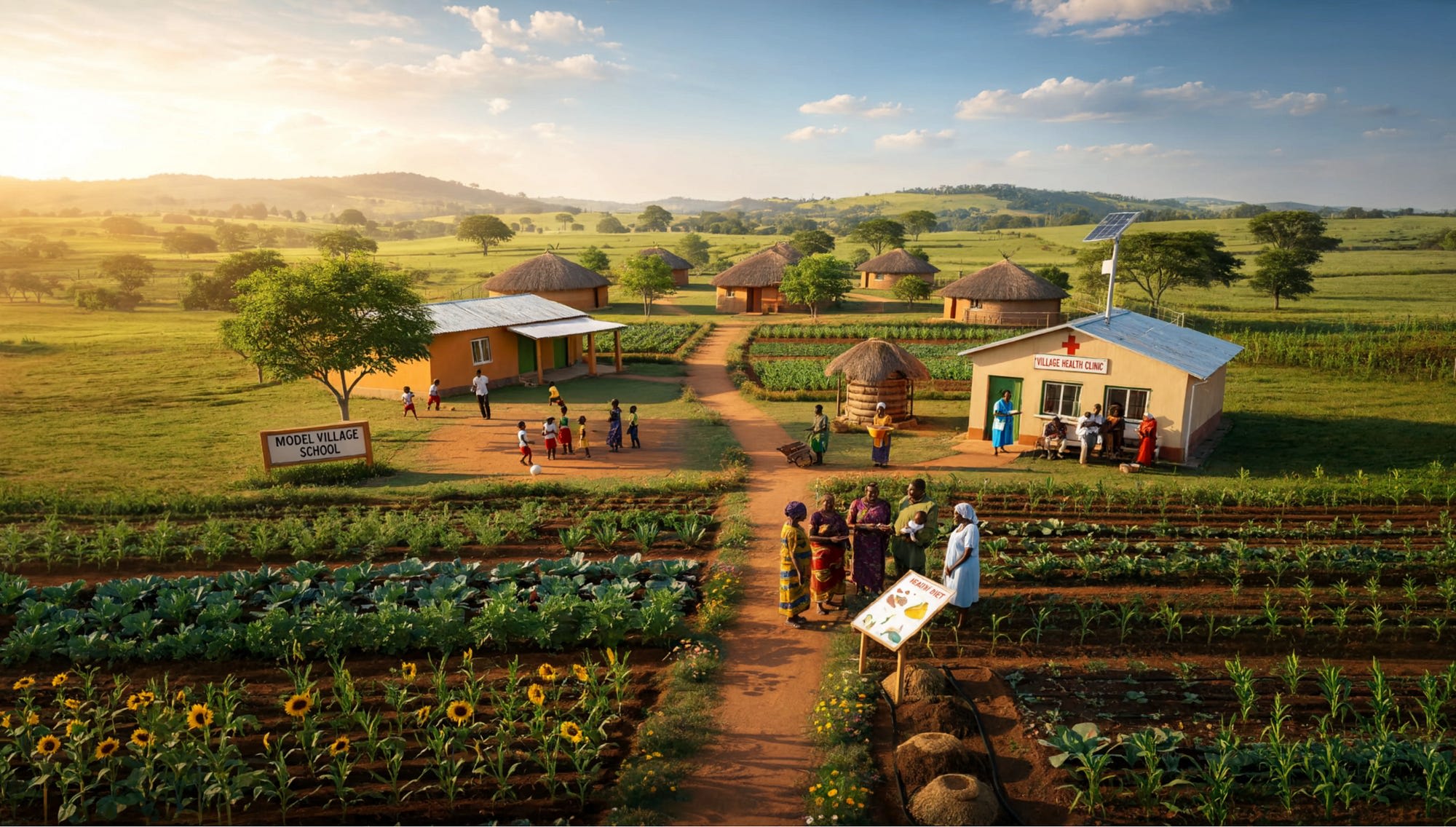
To boost self-reliance and confidence in newer, better and more sustainable practices, a holistic approach is required that addresses all the challenges of village life. The best way to achieve this is to establish a model village where sustainable farming practices, quality education and good healthcare are integral to daily life. The model village will lead by example to show that a better future for their neighbors is possible. The residents will practice this improved way of living, while inviting others from the region to train them on more modern practices without them risking their own livelihoods in methods with which they are unfamiliar.
The model village will require a large initial investment to get it off the ground, but it should set the goal of becoming self-sufficient and self-sustaining by year 30, by which time all outside assistance including personnel should be removed. The potential number of lives affected by this project could easily reach into the 10s of thousands and because cost of living is so low in Sub-Saharan Africa, the return on investment for such a project in terms of improving lives is immeasurable.
There are many people in the world who are looking to create a better world using the wealth they have built. Investing in a model village that provides a demonstrable and replicable way of a thriving community is one of the best ways to make it happen with great ROI. Just dividends earned from a diversified impact investment portfolio would be enough to fully cover the project’s operational costs without loss of principal. This input will decrease to zero over time as the village becomes self-sustaining through agricultural production, eco-tourism, and regional training programs.
Resources:
Originally posted to Medium.
