What eight stories of animal use ending can tell us about where to place our bets
Elaine Siu with Paul Shapiro
💁🏻♀️: Paul Shapiro has been making an argument for years, in essays and talks and, most recently, in a peer-reviewed commentary with a title that sums it up in a nutshell: “Good inventions, not good intentions: technological displacement of animal use and the drivers of social change.”¹
The argument goes like this: When a category of animal use ended, it almost never ended because people were convinced that it was unethical. It ended because somebody invented something better. Kerosene, not conscience, emptied the whaling docks of New Bedford. Steel nibs, not sympathy for geese, retired the quill. The commentary gathers eight such cases and lands where Paul has landed for many years: those who want to advance animal protection “may need to place greater emphasis on directing resources toward developing and scaling alternatives that can outcompete ethically problematic systems.”
I agree with him. I left a legal career ten years ago because I bought this theory of change. I have spent the decade since inside the field it produced, and now, as a PhD researcher, reflecting how the theory has actually worked out in alternative proteins. So when Paul and I started talking after he helped me with one of my recent posts, we found an ideological soulmate in each other (this isn’t an exclusive club, we’re trying to find others with this post!)
What follows is what we found when we asked: what other patterns emerge from putting his eight historical cases side by side? The comparison turns up insights, as well as questions, about the factors that enable a new technology to displace an animal product.
💁🏼♂️: From here on, “we” means the two of us, though Elaine did nearly all the initial drafting.
💁🏻♀️: And Paul did all the arguing thereafter.
First, if you don’t read the whole piece, here’s the tl;dr:
Better inventions have ended many uses of animals without requiring people to change their moral views.
Switching can be easier when manufacturers (buyers) replace a product component consumers (users) don’t particularly notice or value.
Alternatives don’t always have to perfectly imitate animal products. They need to offer something that works better for buyers or users (e.g. functionality, price, supply reliability).
Replacing an animal product doesn’t necessarily spare animals. What it replaces, and how much that replacement disrupts the economics of raising animals, matters.
Campaigns and policy can help alternatives succeed in cases where existing solutions are working fine for buyers and users.
No single invention can end all animal exploitation, but inventors can chip away at it, one use case at a time. This post sheds light on how to decide where we (philanthropic funding and movement resources) might want to prioritize our bets.
1. What do these successful technological displacement stories have in common?
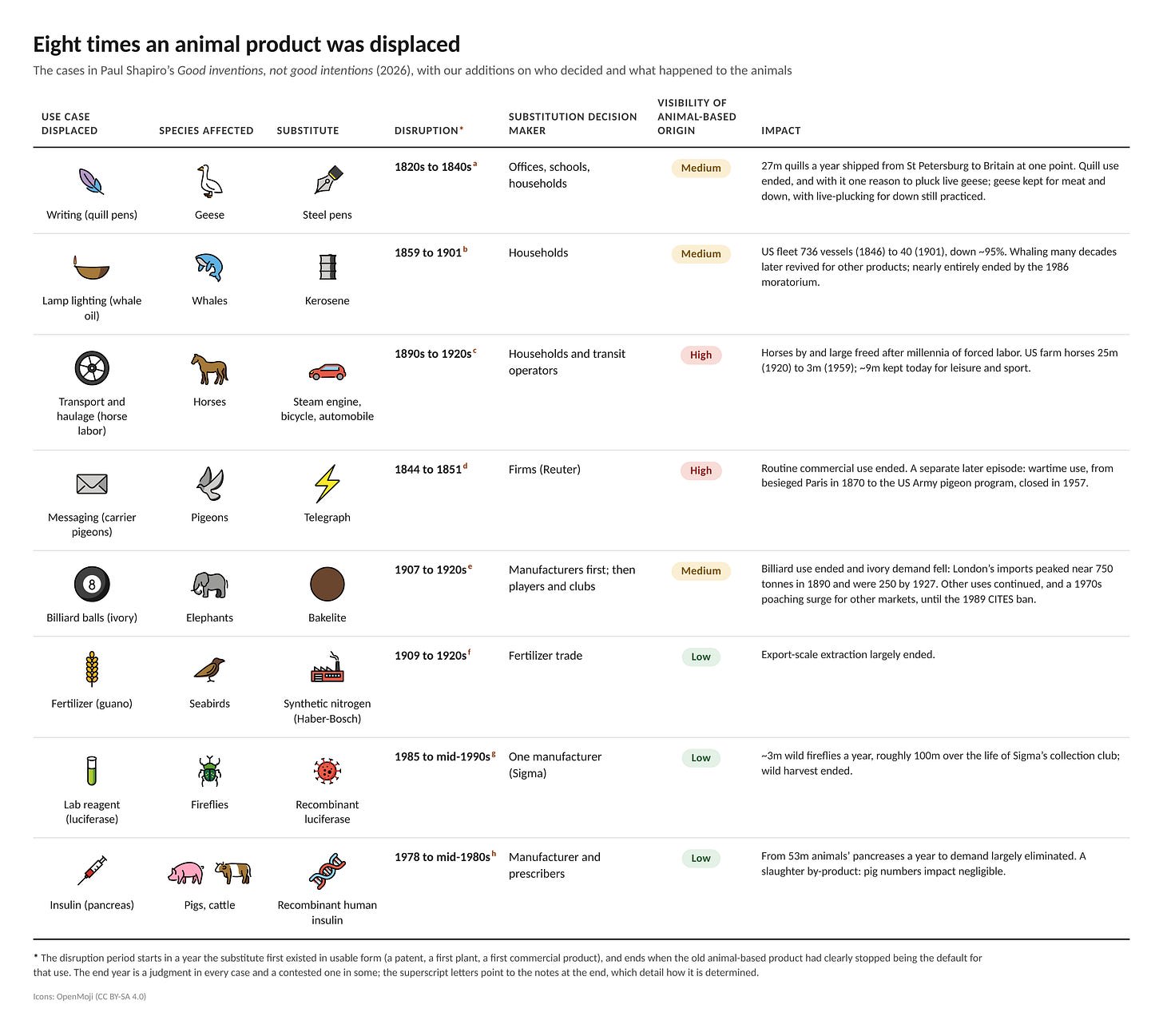
Aren’t these animal icons cute? Also, see the Notes section on this table below.
Measured from the first usable substitute to the point where the animal product stopped being the default, the eight displacements took between about seven and forty years. The fastest cases were insulin and telegraph, in about seven years², luciferase, in about ten, and synthetic nitrogen, in about eleven. Bakelite, steel pens and the automobile took closer to two to three decades to push the old product out of its main market; kerosene took about forty to see off whale oil.³
The faster cases have two things in common. First, the decision to switch sat upstream. A pharmaceutical company changed what went into the vial. A chemicals company changed where it sourced an enzyme. The fertilizer trade changed what type of nitrogen it shipped. Second, the animal was all but invisible to the person at the end of the chain. A diabetic injected whichever form of insulin the doctor prescribed. A laboratory bought luciferase either way. A farmer bought nitrogen whether or not it came from seabird poop. Nobody downstream had to be persuaded of anything, because nobody downstream could tell or cared, as long as it worked (and in most cases, worked better).
Should biomimicry still be the holy grail?
Here’s where something else in the table jumps out. In almost none of these cases did the substitute try to mimic the animal product. Kerosene wasn’t an imitation of whale oil; it was a different fuel that burned brighter, cleaner, and cost half as much. The automobile was never a mechanical horse. The steel nib was a better pen, not a synthetic quill. Luciferase from bacteria is the same enzyme, but nobody was trying to pass off a firefly. Insulin is arguably the one case of biomimicry; yet it’s copying human, not pig, insulin. Generally, the substitute won by being cheaper and better on the dimension the buyer actually cared about, not by mimicking so well that nobody could tell the difference.
Which brings us to the test the alternative protein field set itself. For most of the last decade the working assumption has been that an animal-free meat, milk, or egg has to taste identical to the animal version and cost the same or less (aka the favorite word in the field: parity), and then at least some people will switch. We thought biomimicry to perfection is the holy grail, and we built our scorecards around it. In 2019, Burger King launched the Impossible Whopper on the line that “virtually nobody can tell the difference.”⁴ Nectar, which runs the largest blind tastings of plant-based meat, tests every product against an animal benchmark and gives its TASTY award to those that at least half of omnivore tasters rate the same as or better than the animal; in 2025, 20 of 122 products made it.⁵ “I thought that animal-free meat would have to pass the Turing test of meat,” Paul said. But he’s now changing his mind.
Almost no case on the table passed “the Turing test,” and neither did the biggest shift in American meat eating in living memory. Beef peaked at 94 pounds per person in 1976 and was down to 59 pounds in 2025; chicken, at 42 pounds in 1976, passed beef in 1992 and reached 104 pounds in 2025.⁶ Chicken doesn’t taste like beef. Ask most Americans and they’ll tell you beef actually tastes better. Chicken successfully displaced a big portion of beef consumption because it was cheaper and perceived as healthier.
But chicken is still animal meat. Do we think tofu, tempeh, or seitan can create such a paradigm shift? Elaine is skeptical. Being born and raised in Hong Kong, she knows tofu has existed more than 2,000 years in China. Outside of Buddhist cuisine, it hasn’t really existed as a substitute for meat. It’s generally considered its own food, often eaten next to meat, not instead of it. If a “substitute” product isn’t a copy, how do we know it displaced the old one rather than sitting on the shelf beside it? Having said that, while tofu isn’t a new product in the East, it’s a relatively new addition to the mainstream supermarket shelves in the Western markets, and is trending lately.⁷ ⁸ Elaine would love to be proven wrong. Paul thinks it’s possible she could be, presuming innovative tofu brands make the food more appealing to omnivores.
So this first question points us to a few contributing factors to a successful technological displacement: when upstream buyers make the switching decision and consumers have little attachment to the animal ingredient, substitution may be easier. The alternative needs to deliver the qualities buyers value, without necessarily looking like its predecessor. For alternative proteins that seems to point us toward ingredients: the parts of the food system where a manufacturer makes the call and the eater never meets the animal. For example, how many consumers would notice if their supermarket packaged baked goods had fewer egg or milk ingredients in them? We’ll explore further the ingredientization of alternative proteins in the next question.
2. Why do some shifts spare more animals than others?
The obvious answer first. It depends on whether the use that was displaced was the reason the animal existed. Horses were kept to pull, and when the pulling stopped the horses went: around 25 million on American farms in 1920, under 3 million by 1959.⁹ Fireflies were caught for one enzyme, and when the enzyme came out of a bioreactor the catching stopped. In contrast, pigs were never raised for their pancreases. Eli Lilly bought the pancreases of 53 million animals a year as a by-product of slaughter, and when Humulin arrived the slaughter carried on essentially undisturbed.
Cheese tells the same story from a less distant past. Until 1990 most cheese was set with rennet from the stomachs of slaughtered calves. Then a fermentation-produced version of the same enzyme, chymosin, was approved in 1990. Cheesemakers switched, and today the synthetic version sets most of the cheese in America and Britain.¹⁰ The label still says “enzymes.” It’s the first question’s ideal: decided upstream, invisible to the eater, done in about a decade. But as far as we can tell, the shift is unlikely to have spared many, if any, calves, because the stomach came from calves who were being raised for much more than just their stomachs. This question points to the impact of displacement. Just because an animal ingredient is displaced, it doesn’t necessarily mean an animal’s life is spared.
When we tried to put numbers on how many animals each of these eight shifts spared, we mostly couldn’t. Horses, yes. Fireflies, yes. For the rest the honest answer is: we don’t know. One problem is that what we were trying to count is a counterfactual: the animals not raised and kept because a substitute was sold. And in the case of whales, clearly the slaughter halted for some time, but it’s hard to know how many were spared. Working out counterfactuals properly means modeling how a fall in demand for one product travels through a supply chain in which an animal yields many products at once, which is economics, and neither of us is an economist. (Plug: Someone needs to do this research, please!)
Is “ingredientization” a risk of mission drift?
Take whey. It’s a by-product of cheese-making that’s become valuable in its own right, and that cuts two ways. Precision-fermented whey at a hundred percent of the market would still leave cows kept for milk and cheese. But whey revenue now helps pay for those cows; one agricultural extension service reports that some cheese plants now earn more from whey than from cheese and are expanding cheese production to capture it, and it’s reasonable to think the reverse would also hold, that taking the whey market away would mean fewer cows than there would otherwise be.¹¹
Fluid milk is another example that illustrates the difficulty of measuring impact. Americans drink less cow’s milk than they once did, but demand for cheese and other dairy products has helped sustain the herd, as it takes far more milk to make cheese than to make milk. That doesn’t mean replacing fluid milk spares no cows: without that decline in demand, there might have been more. But the drop in fluid milk consumption hasn’t meant an equivalent drop in dairy cows.¹²
Eggs in processed products make a stronger case: nearly thirty percent of American eggs go to manufacturers as liquid, frozen or dried product, the buyer is a bakery or a food company, nearly no one eating a supermarket muffin knows or cares whether the egg is present, and the egg is the reason the hen exists.¹³ Replacing that market may not remove exactly thirty percent of the laying flock, since prices, exports and productivity could all move, but it targets a substantial share of egg demand and could materially reduce the number of birds used. That’s the kind of displacement that ticks both the ease box and the impact box.
For Paul’s company, BMC Ingredients, the important question is what its ingredient replaces. If mycelium replaces some of the beef in a meatball, there’s a direct reduction in the beef needed to make that product. If it replaces wheat in a noodle, that may be a good business opportunity, but it does little to help animals. Companies can be honest about that distinction without pretending they know exactly how many animals each sale spares. Building a successful ingredient business and reducing animal use can reinforce each other, but they aren’t automatically the same achievement.
So this second question points us to the impact of displacement. Is the substitute displacing a determining product (as opposed to a by- or co-product)? Does displacing an animal ingredient translate to lives spared? The alternative protein sector already makes counterfactual claims, for carbon, land and water. An animal-spared figure rests on the same reasoning, and would let companies assess themselves and let mission-driven funders compare projects on animals per dollar. As far as we know, no company reports anything like it yet. This reporting may have limited commercial demand, but could still help mission-driven founders and philanthropic funders decide which opportunities to support. The lack of an agreed methodology and reporting convention is currently a gap that significantly limits our understanding of animal impact.
3. What was broken in the old product?
In every case on the table, something was wrong with the old product for the buyer and/or consumer at the moment the substitute arrived. Quills needed sharpening weekly and dipping constantly, and writing with one was slow. Whale oil was getting scarcer and dearer for a decade before kerosene; sperm oil roughly doubled in price between 1845 and 1855. Horses needed rest and feed whether or not they worked, took up expensive city space, defecated everywhere, and broke their legs on cobbled streets by the thousands each month. Pigeons flew in one direction only, needed breeding, training and handlers, and carried a message the size of a note. Ivory was so short that a set of three billiard balls cost about $60 in the mid-1800s, roughly $1,500 today. Guano was running out; a newspaper headline in 1855 called it “The Guano Crisis.” Fireflies had to be caught by hand, three million a year, by children paid a penny apiece. Animal insulin depended on slaughterhouse supply while the number of diabetics kept rising, and it caused allergic reactions that human insulin didn’t. These weaknesses gave substitutes specific opportunities to compete.
Eggs had a narrow window of opportunity. Bird flu took the average American retail price of a dozen eggs from $1.67 in 2021 to a peak of $6.23 in March 2025. By July 2026 it was back to $2.19, roughly where it started once inflation is counted, and at the wholesale level prices fell through the floor: large eggs averaged 81 cents a dozen over the first eight months of 2026, 38 percent below the twenty-year inflation-adjusted average, because flocks were rebuilt faster than demand for shell eggs came back.¹⁴ ¹⁵ ¹⁶ The American Egg Board reports no broad move away from eggs by manufacturers, and the reason is mundane: an egg does half a dozen jobs in a recipe, replacing it means reformulating and re-testing, and that takes longer than a price spike lasts.¹⁷ The push was strong but brief: by the time a manufacturer could have reformulated, the reason to do so had gone. The third enabling factor, then: there’s something wrong with the old product, for the buyer and user, at the moment the substitute is ready.
Which raises the uncomfortable question for meat. Very little is broken about it for the person buying it. It’s usually fairly cheap, it’s everywhere, and it tastes the way they want. Personal health is the one area where some meat may be “broken” in a sense for some consumers, but more limited to people avoiding red meat. This is likely why plant-based substitutes for red meat (perceived as more unhealthy than other meats) are more popular than substitutes for chicken and fish. Yet still, nearly three-quarters of Americans consider meat a healthy food.¹⁸
If a push enables displacement, and nature isn’t providing one, where else can it come from?
Fur is one answer. Fur had no better substitute. Faux fur existed from the 1910s and was always the cheap option; a fashion editor in 1929 told readers never to economize on fur because it revealed “the kind of woman you are.”¹⁹ What broke fur wasn’t a product. It was a campaign that stigmatized it. Lynx’s posters in Britain from 1984, PETA’s from 1990, Harrods closing its fur department in 1990, and American fur sales down 44 percent between 1987 and 1991.²⁰ The industry blamed warm winters and a glut of pelts, and the later collapse (mink pelts from 112 million in 2014 to 17 million in 2022) has a Danish cull in the middle of it, so the numbers don’t isolate stigma cleanly.²¹ ²² But the pattern across forty years is of a product’s identity getting spoiled, and then the legal prohibitions catching up: fur farming banned across much of Europe, fur sales banned in California from 2023 and in Israel from 2021.
That’s the manufactured push factor. When nothing about the animal product is “broken” for the buyer or consumer, campaigners break its meaning, and the legal block usually arrives after the stigma has done its work. Foie gras is the live version: force-feeding is banned in around fifteen countries, from Germany in 1972 to Britain in 2006, and the rarer sales bans have followed, in California since 2012 and in New York City, where a ban passed in 2019 was upheld by an appeals court in March 2026.²³ Whether the same mechanism can work on commodity meats that nearly everyone eats isn’t yet known. Both fur and foie gras are luxuries that few people buy, which makes them easier to stigmatize than a commodity meat that virtually every person, rich or poor, eats daily. But it completes the picture. A better alternative provides a pull; campaigns and policy can strengthen the push away from animal use.
Where does this deeper dive take us?
The “protein transition” is not one displacement. It’s multiples, one for each species and each use case, and each has its own push and pull factors contributing to its success.
These cases suggest promising opportunities where manufacturers can switch ingredients, consumers have little attachment to their animal origin, and alternatives address a clear disadvantage of the existing product.
In our deep dive we also challenged a few assumptions. Is mimicry the key to successful displacement? Or should the field stop assuming identical taste is a precondition and start asking what the “next chicken” looks like (given it’s so successfully taken such a large bite out of per capita beef demand)? We still think making animal-free meat that tastes just like animal-based meat is a very worthwhile goal. But we’re less convinced that passing a blind taste test is the only route to success. Chicken didn’t have to taste like beef to take market share from it. An alternative could win by being healthier, more convenient, less expensive, or simply delicious in its own right.
We then sounded a note of caution: a market switch isn’t necessarily animals spared; that’s an additional counterfactual assessment. Eggs in processed food is our worked example where significant displacement would almost certainly occur. Other cases, like fluid milk, are less certain. It would be helpful to see more research mapping the other low-hanging fruits, which could in turn catalyze someone to be working on those opportunities. Ingredient substitutions may be easier to achieve, but their animal impact varies greatly, especially when they replace by-products of animals raised mainly for something else. (Again, eggs are an exception here.) This is our call-to-action for somebody who can build the displacement formula that lets everyone see the difference.
Campaigns and policy can complement invention by changing what buyers value and making room for alternatives. These approaches can reinforce one another. Where the market doesn’t supply a push, campaigns can, which is why work that stigmatizes an animal product, and the legal blocks that follow, belongs in a theory of change built on inventions rather than beside it.
So here it is: two pragmatic optimists’ learnings from eight historical cases. Technology offers a way to chip away at animal exploitation, one use at a time. No single invention has to replace everything we do to animals. Each can eliminate another reason to breed, confine, or kill them, bringing a world without those uses closer. For animals whose suffering has failed to move their buyers, a better product may be the best, and often only, realistic hope they have. The task is to keep creating those alternatives until, use by use, we no longer need to exploit animals at all.
Notes to the table
The start year is the year the substitute first existed in usable form (a patent, a first plant, a first commercial product), and is rarely in dispute. The end year is when the animal-based product had clearly stopped being the default for that use, and each one below says what marker we used.
a. Quills: 1840s. By 1844 steel nibs were the predominant pen at the Bank of England, whose storekeeper that year proposed replacing the clerks’ quill allowance with steel pens; the Bank still bought small numbers of quills until 1907. Bank of England Quarterly Bulletin, 1972. Britain led; the first US steel-pen factory opened in the late 1850s (Paul’s paper).
b. Whale oil: 1901. The US whaling fleet was down to 40 vessels, from 736 in 1846 (Tower, 1907, via Paul’s paper); it had already fallen to 124 by 1886 (NOAA Marine Fisheries Review).
c. Horses: 1920s. US horse and mule numbers peaked around 1916 to 1920 and fell every year after (USDA Census of Agriculture); cars outnumbered horses on New York streets by 1912 (ACCESS magazine). Horse streetcars went earlier, replaced by electric ones between 1888 and 1902 on operators’ decisions.
d. Pigeons: 1851. Reuter’s Aachen-to-Brussels pigeon service, the best-known commercial pigeon post, closed when the Prussian and Belgian telegraph networks connected in March 1851 (The Baron, Reuters history). Wartime use, from the siege of Paris (1870) to the US Army program closed in 1957 (Paul’s paper), we treat as a separate episode.
e. Ivory: 1907 to 1920s. The clock starts at Bakelite, the first substitute that matched ivory; Hyatt’s celluloid ball of 1868 (Neves et al., PNAS Nexus, 2023) and the composition balls sold from the 1880s didn’t run true. End year: Bakelite had become “the preferred standard” by the 1920s (Paul’s paper); in Britain the amateur billiards championship adopted composition balls in 1926 and the professionals in 1928 (Snooker Heritage).
f. Guano: 1920s. The least certain end year on the table. Peru’s export guano was largely exhausted by the 1870s and Chilean nitrate took its place; the 1909 Compañía Administradora del Guano turned the remaining harvest to Peruvian farms. Our 1920s marks synthetic ammonia being made at commercial scale in Europe and the United States after the First World War (Paul’s paper; Erisman et al., Nature Geoscience, 2008).
g. Fireflies: mid-1990s. Sigma closed its Firefly Scientists Club, which had bought about three million wild fireflies a year since the 1960s (Lewis, 2016, via Paul’s paper). Recombinant luciferase had been on sale since 1991 (Promega).
h. Insulin: mid-1980s. Over 80 percent of UK patients had been moved to human insulin (Insulin Dependent Diabetes Trust). Lilly withdrew its last pork insulin in 2005.
Note: LLMs were used to help research this article and create the chart.
Sources
1. Shapiro, P. 2026. Good inventions, not good intentions: Technological displacement of animal use and the drivers of social change. Sustainability: Science, Practice and Policy, 23(1): 2744379. https://doi.org/10.1080/15487733.2026.2744379
2. Insulin Dependent Diabetes Trust. A little bit of history: GM vs animal insulin. https://www.iddt.org/about/gm-vs-animal-insulin/a-little-bit-of-history/
3. Marr, P. 2013. The Chilean nitrate industry. Middle States Geographer. https://msaag.aag.org/wp-content/uploads/2013/09/3-Marr-MSG2014-final.pdf
4. Reuters. 2019. Vegetarian patty gets the Burger King Whopper test. April 1 (via CNBC). https://www.cnbc.com/2019/04/01/reuters-america-vegetarian-patty-gets-the-burger-king-whopper-test.html
5. NECTAR. 2025. NECTAR unveils Taste of the Industry 2025. Press release, March. https://www.webwire.com/ViewPressRel.asp?aId=335553
6. National Chicken Council. Per capita consumption of poultry and livestock, 1965 to forecast 2026, in pounds (USDA data, retail weight). https://www.nationalchickencouncil.org/about-the-industry/statistics/per-capita-consumption-of-poultry-and-livestock-1965-to-estimated-2012-in-pounds/
7. FoodNavigator-USA. 2025. Tofu enters a new era of popularity in the US. January 27. https://www.foodnavigator.com/Article/2025/01/27/tofu-enters-a-new-era-of-popularity-in-the-us/
8. Greaves, H. 2026. Finland sees tofu sales soar following new nutrition guidelines. Vegan Food & Living, April 16. https://www.veganfoodandliving.com/news/finland-nutrition-guidelines-tofu-sales-soar/
9. USDA. 1959 Census of Agriculture, Livestock and Livestock Products, Table 18. https://www.nass.usda.gov/AgCensus/archive/files/1959-Livestock_and_Livestock_Products-TABLES-913-Table-18.pdf
10. Journal of Dairy Science. 2025. (Fermentation-produced chymosin covers 80 to 90 percent of the US and UK coagulant market) https://www.sciencedirect.com/science/article/pii/S0022030225001614
11. Hall, F. M. 2026. Whey protein boom reshaping milk value, market dynamics for dairy producers. Iowa State University Extension and Outreach, April 16 (via Morning Ag Clips). https://www.morningagclips.com/whey-protein-boom-reshaping-milk-value-market-dynamics-for-dairy-producers/
12. USDA Economic Research Service. Dairy Data: milk cows and production by year; fluid beverage milk sales. https://www.ers.usda.gov/data-products/dairy-data
13. American Egg Board. Industry data, 2022 distribution by channel. https://www.incredibleegg.org/about-us/industry-data/
14. U.S. Bureau of Labor Statistics. Average price: Eggs, Grade A, large, per dozen, U.S. city average (FRED series APU0000708111). https://fred.stlouisfed.org/series/APU0000708111
15. WATTPoultry. 2026. US egg prices hit 20-year lows as feed costs expected to rise. September 28. https://www.wattagnet.com/egg/article/15836070/us-egg-prices-hit-20year-lows-as-feed-costs-expected-to-rise
16. WATTPoultry. 2026. Why oversupply, egg prices are hurting US producer margins. May 29. https://www.wattagnet.com/egg/article/15826363/why-oversupply-egg-prices-are-hurting-us-producer-margins
17. Bakery & Snacks. 2026. US egg prices plunge as manufacturers stick with real eggs. https://www.bakeryandsnacks.com/Article/2026/09/01/us-egg-prices-plunge-as-manufacturers-stick-with-real-eggs/
18. Meat Institute & FMI. 2025. The Power of Meat 2025: Sales at record high; Americans view meat as part of a healthy, balanced lifestyle. Press release, March 24. https://www.fmi.org/newsroom/news-archive/view/2025/03/24/sales-at-record-high--americans-view-meat-as-part-of-a-healthy--balanced-lifestyle
19. Smithsonian Magazine. The history of faux fur. https://www.smithsonianmag.com/history/history-faux-fur-180953984/
20. Reference for Business. Fur goods industry profile. https://www.referenceforbusiness.com/industries/Apparel/Fur-Goods.html
21. ACTAsia. 2019. China’s fur trade and its position in the global fur industry. https://www.actasia.org/wp-content/uploads/2019/10/China-Fur-Report-7.5.pdf
22. Fur Free Alliance. Global mink fur production halved in two years. https://www.furfreealliance.com/global-mink-fur-production-halved-in-two-years/
23. LegalClarity. 2026. Where is foie gras banned? https://legalclarity.org/where-is-foie-gras-banned-countries-states-cities/
Cross-posted from my Substack.
Epistemic status: I’ve puzzled over this for a long time but I’m not sure I came to the right answers. I'm sharing this partly because it might help others work on resource allocation, but mostly because some smarter reader might tell me how to do it better.
TL;DR:
* I he...
With the AI windfall, mental health may be taken increasingly seriously by mainstream EA. There’s increasingly room to explore the cause area and answer some of the biggest uncertainties; at the same time, costs of the most effective interventions are continuing to fall. StrongMinds is now treating for ~$35, about a third of GiveWell’s best guess from a few years ago, and is expected to...


Thanks for crossposting it Elaine!