Comments
With the first wave of AI lab IPOs, Effective Altruist funding is about to go from $2.5B/yr to $25B/yr.
That comes from roughly $50B/yr in new giving, a 10% increase in US philanthropy. Probably 50% of that giving will be EA-y as it flows through OAIF, Coefficient Giving, and Anthropic philanthropic advisors.
Most of the conversation about this money, like the excellent third-wave philanthropy, is about expanding supply in the talent market to absorb 10x more donation demand. This piece is about something less discussed: price discovery.
The problem? These donations don’t know where to go on their own.
Why? In capitalism, prices tell capital where to go. Money flows to cheap, good items.
In EA, QALYs per dollar tells donations where to go. Donations flow to cheap, good charities.
Traditionally, QALYs/$ was only found through costly research. For example, GiveWell researchers spend 70,000 hours a year to make their recommendations. This is why we’ve had only a handful of market makers clearing just a few billion a year.
But AI models decrease the cost of research by at least 10x. This is a big deal, and a core driver of EA 2.0. More money, cheaper price discovery.
Below: why price discovery is EA’s bottleneck, how AI is making it 10x cheaper, and the long-term implications.
1. The bottleneck: price discovery
There aren’t enough market makers to clear $25B/yr.
GiveWell was the primary market-clearing mechanism for global health during EA 1.0. They funneled billions of dollars to effective charities, and orgs like GiveDirectly and Against Malaria Foundation became nonprofit unicorns. The GiveWell model inspired similar meta-charities like Animal Charity Evaluators and Giving Green.
But the EA 2.0 market has 10x more GMV per year. We need 10x more GiveWells. A GiveWell for everything.
Think of it as a VC stack. Coefficient Giving, GiveWell, etc. are doing hits-based giving. This starts with many seed bets. The ones that work become growth-stage, and foundations pour capital into these new truths of the world. AMF went from seed to ~unicorn on that path, and recently raised $276M for malaria nets.
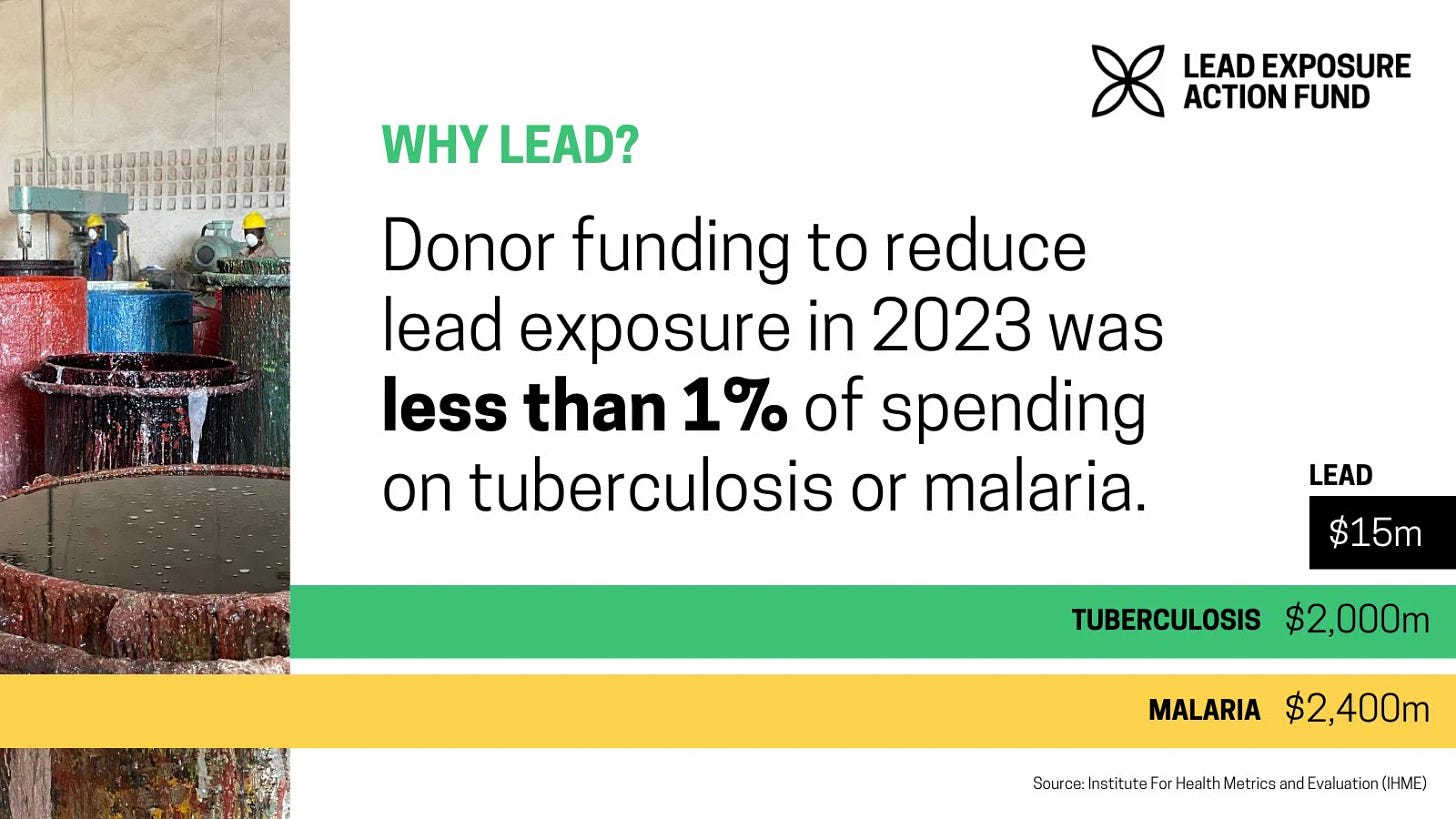
Things like lead prevention are just now hitting growth stage. Was $15m, now $100m, will be $1B.
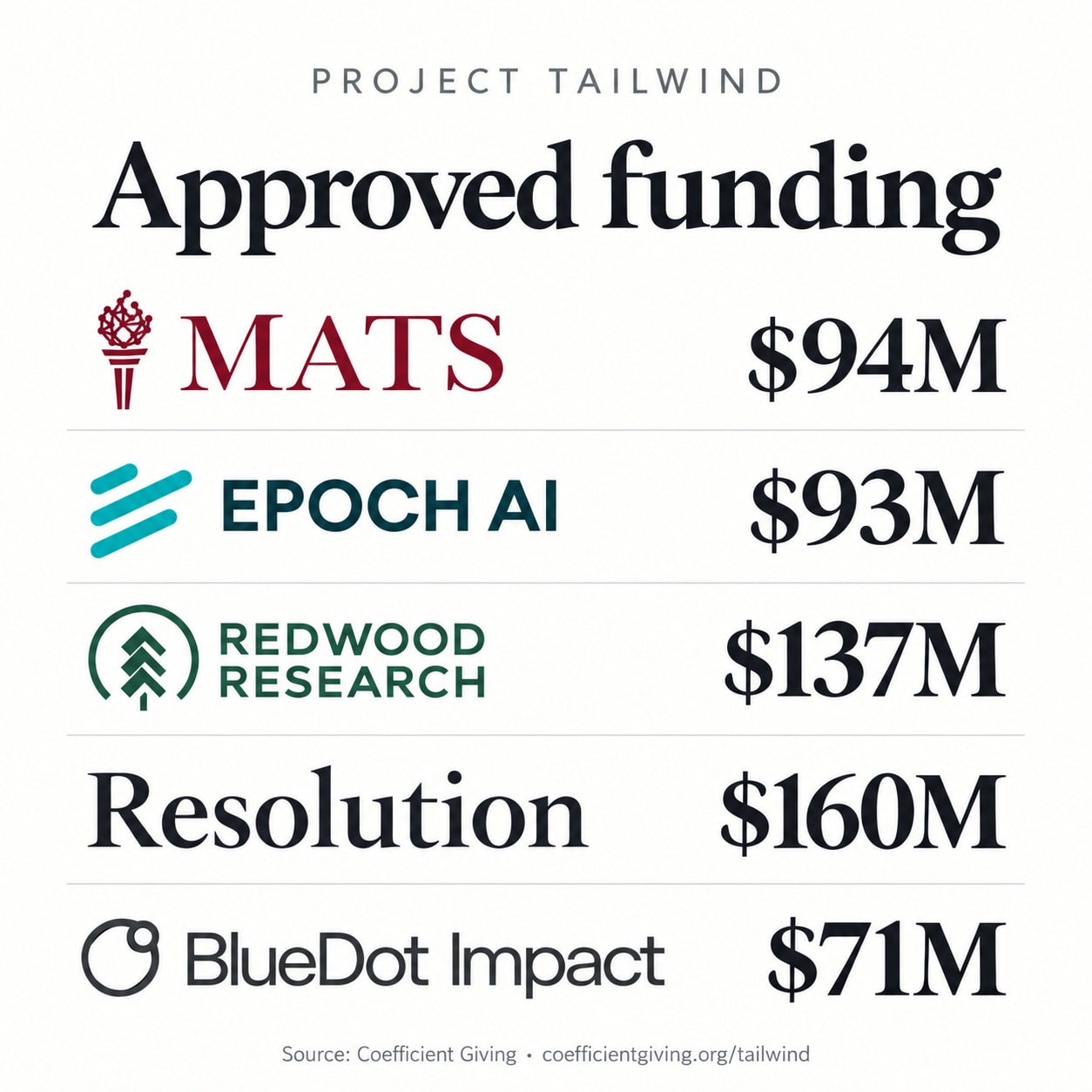
Indeed, this is how CG thinks of Project Tailwind. Seed funding for small orgs that can become big quickly like MATS, etc.
What are the proto market makers for EA 2.0?
Here are a few:
- GiveWell 1.0 hiring a bunch to increase grants from $500M/yr to $1B+/yr
- Orgs like GiveDirectly preparing to absorb 10x more funding by 2028. From $500M to $5B.
- New long-form magazines like In Development providing legitimacy to global health orgs and causes
- Rethink Priorities expanding consulting to produce research reports for heterodox EA causes like climate tipping points. (Part of a more general shift synthesizing two metrics: economists’ social cost with global health DALYs.)
- CG’s Project Tailwind for AI orgs and Launchpad Funds for global health
- Dozens of new philanthropic advisors to coordinate the donations
- OAIF becoming a thing! (Just started in March 2026. On Day ~90 of the singularity.)
2. Price discovery is getting 10x cheaper
The production function of GiveWell is research. Spreadsheets. This is a main value prop on their website: “Backed by 70,000+ hours of research each year”. It’s great! All the GiveWell folks I know are Excel Wizards.
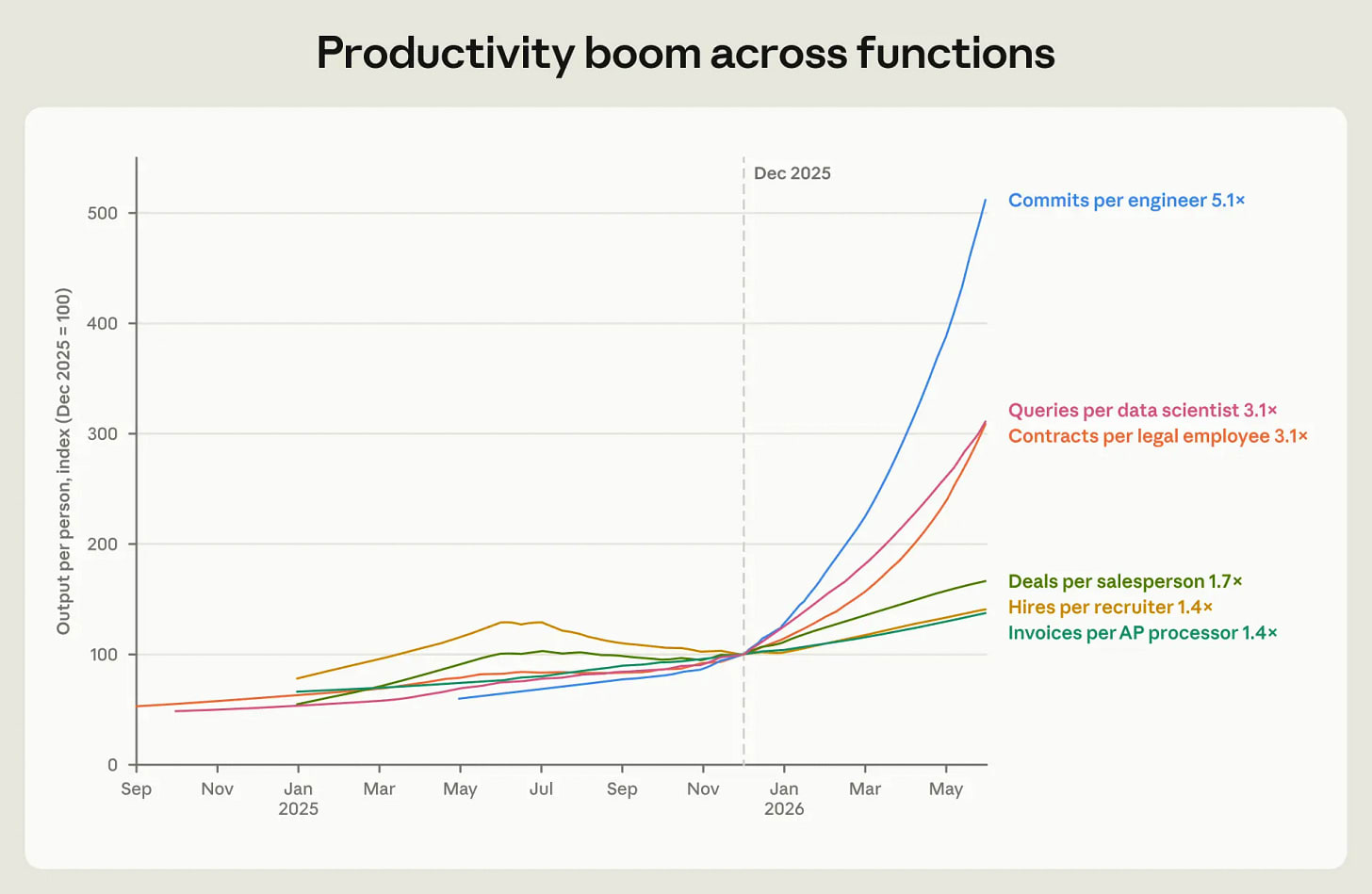
But research is commoditizing, just like other cognitive labor. For example, we’ve seen commits per engineer go up 5x in just the first half of 2026.
https://www.anthropic.com/research/employment-at-anthropic
Reports per researcher will also increase at least 10x. The EA ecosystem used to be gated by the number of opportunities that were legible and worth researching. But now:
- Individual orgs like Africa Jobs Fund can BOTEC every opportunity to follow the most impactful ones.
- Orgs like CASPR can model second-order effects and externalities of complex diseases like addiction. AI expands the scope of what is QALY-able.
- GiveWell is using a new AI reviewer to find errors in their calculations. “Vetting that took as long as a week now takes a few hours.” (!)
- Or, if you’re me, you can just point a few billion tokens at EINs across a dozen US cities to see the most cost-effective programs by city: GiveBetter.
GiveBetter found that Institute for Progress is the most cost-effective nonprofit in the US. $33,000/DALY: ~300x less cost-effective than GiveWell’s top charities, but likely ~1000x better than the median US nonprofit.
Not bad. Not bad at all. I didn’t even make the models say that. IFP is just an effective org!
3. Long-term implications
We’re still early.
EA 2.0 is less than a year old. 10x more money, 10x cheaper research, AI-native orgs.
Longer term, I expect a few things:
More orgs to move to an agent-first model
Where agents are long-running, and are the main readers & writers of the BOTEC data:
The most important part of the OpenAI math results isn’t the problems they solved, it’s the process they used:
On average, each result used three hours of ChatGPT Pro thinking compute.
Just three hours! Bills lying on the sidewalk! There’s so much low-hanging fruit across all knowledge domains. Tokenmaxxing is dumb, but it’s also smart.
2. Domain-specific harnesses for EA capital allocation
DSH’s have taken the startup world by storm. We’re just beginning to see this with EA orgs. I’m imagining EA harnesses with specific MCPs for cost-effectiveness, ways to look at econ RCTs, etc.
3. We’ll think of “cost-effective outcomes” as a new organizing primitive in a value stack, on the same level as “profit”
Idea machines are governed by a north star that self-organizes the human and financial capital within them.
For capitalism, this north star is profit. It governs the capitalist institutional stack: PE, hedge funds, LPs, VCs, companies, startups…and the humans in each. Every part of the stack is playing by the same rules. Outcomes come out. Profit mainly. Sometimes slop machines and slot machines. But mostly good.
EA’s “cost-effective outcomes” is a new north star. It governs the EA institutional stack. New, priced north stars are a perfect example of leverage point #3 and #4 from Donella Meadows—goals & the power to change system structure.
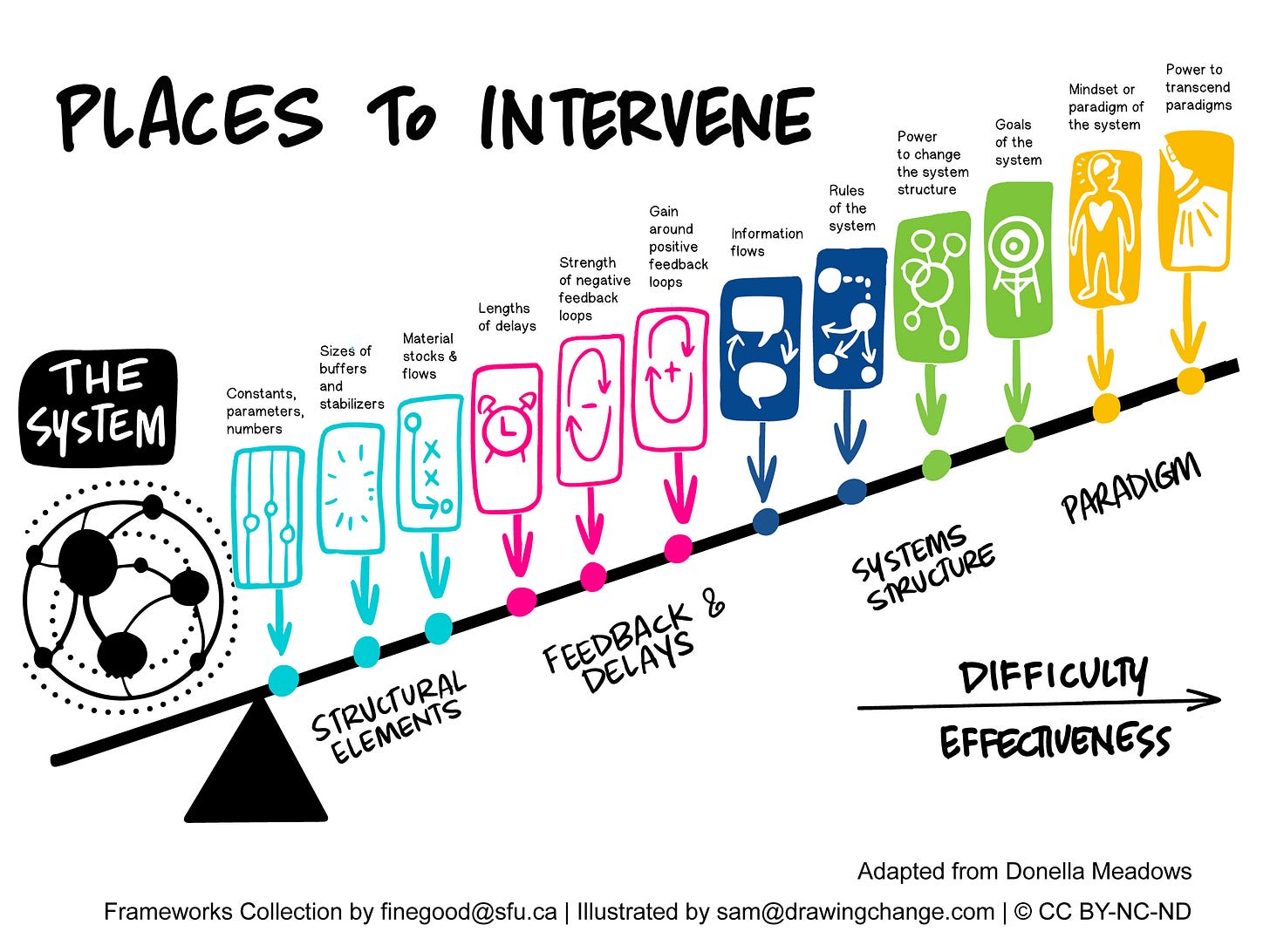
Meadows writes:
Further investigation of self-organizing systems reveals that the divine creator, if there is one, does not have to produce evolutionary miracles. He, she, or it just has to write marvelously clever RULES FOR SELF-ORGANIZATION.
That caps lock is from Meadows btw.
Curious to see EA 2.0 emerge. And curious for your thoughts!
–Rhys