Comments
Faunalytics’ new study, Who To Ask, What To Ask: Matching U.S. Audiences To Pro-Animal Actions, surveyed 5,778 U.S. residents to find out which audiences are most open to which actions for animals. The easiest asks are political ones. About 73% of participants were open to voting for a pro-animal ballot measure. Small diet changes also go a lot further than asking people to go vegan. Even the most receptive group gave favorable answers to just 14% of questions about going vegetarian or vegan.
https://faunalytics.org/matching-u-s-audiences-pro-animal-actions/
Background
Most animal advocates have limited time and money, and most campaigns ask a specific audience to take a specific action for animals. Knowing which audiences are most open to specific actions can help advocates spend those resources where they are most likely to be effective. A single outreach tactic rarely works for everyone, and the U.S. population is diverse. Even broad tactics such as leafleting are usually planned with the local audience in mind. Yet little research in animal advocacy tells advocates which audiences are most open to which actions.
In 2023, Faunalytics published an original research report entitled “Different Strokes for Different Folks,” examining how various demographic groups differ in their openness to pro-animal actions. That report provided valuable insights for advocates seeking to reach specific audiences. However, the original analysis examined each demographic characteristic separately, such as comparing women with men or younger with older adults.
In practice, advocates rarely target audiences defined by a single trait. They work with communities whose members have combinations of characteristics, such as rural conservatives, young urban professionals, or health-conscious parents. Understanding how open these groups are to pro-animal actions requires a different analytical approach.
Using the same survey data from 5,778 U.S. residents, we examined 19 participant characteristics: demographics (age, gender, race and ethnicity, household income, education, student status, region, rural or urban residence, children in the household, relationship status, and whether participants were the primary household shopper), political characteristics (political beliefs, party affiliation, likelihood of voting, and the partisan lean of the participant’s congressional district), pet ownership, and three attitudes (identifying as an animal lover, concern about climate change, and prioritizing one’s health).
We used two complementary approaches:
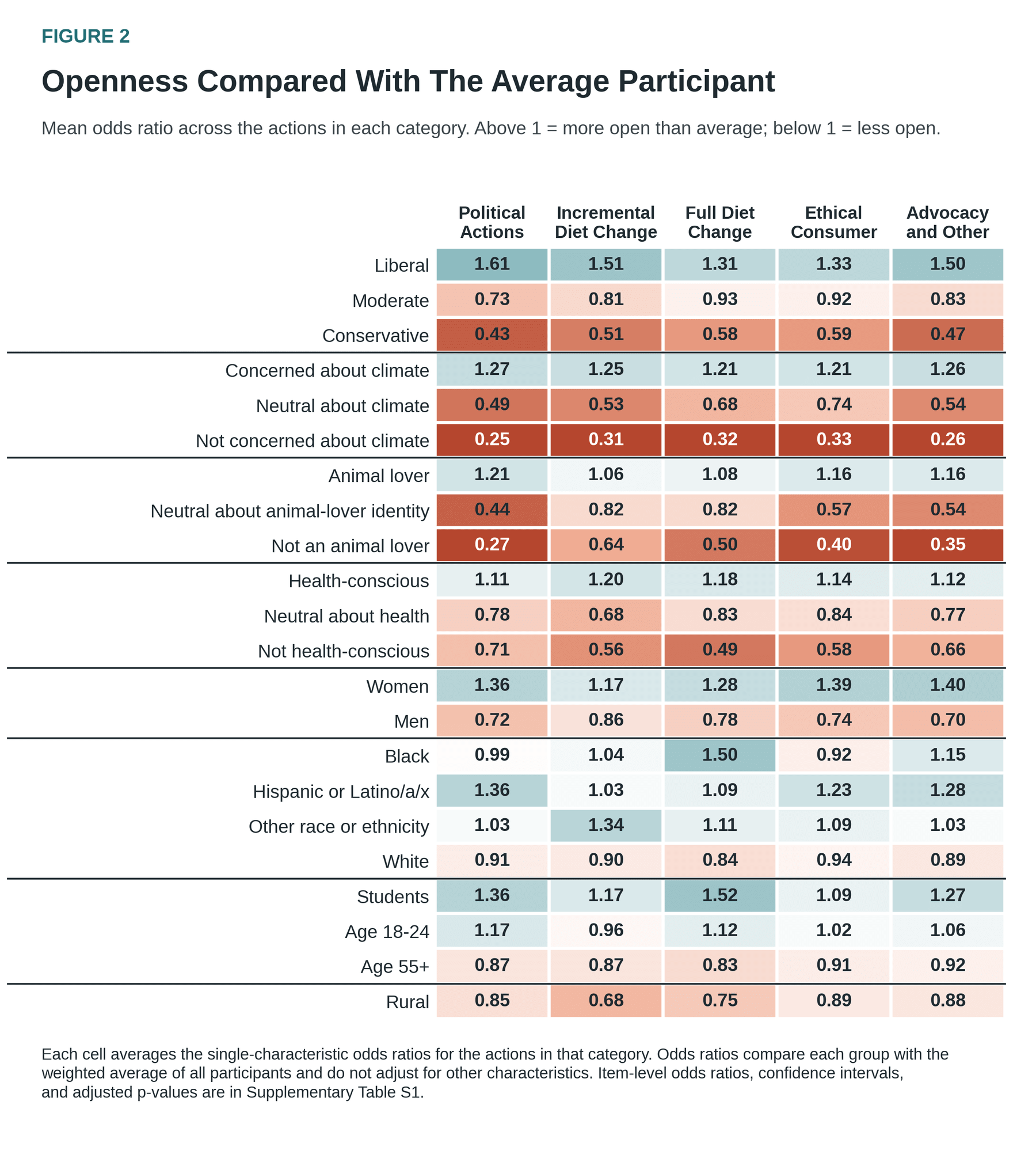
- Audience-First Analysis: For advocates who already know their target audience, we identified the actions to which that audience was more or less open than the average participant. For example, if you work with rural communities, which actions are they more or less open to than other participants?
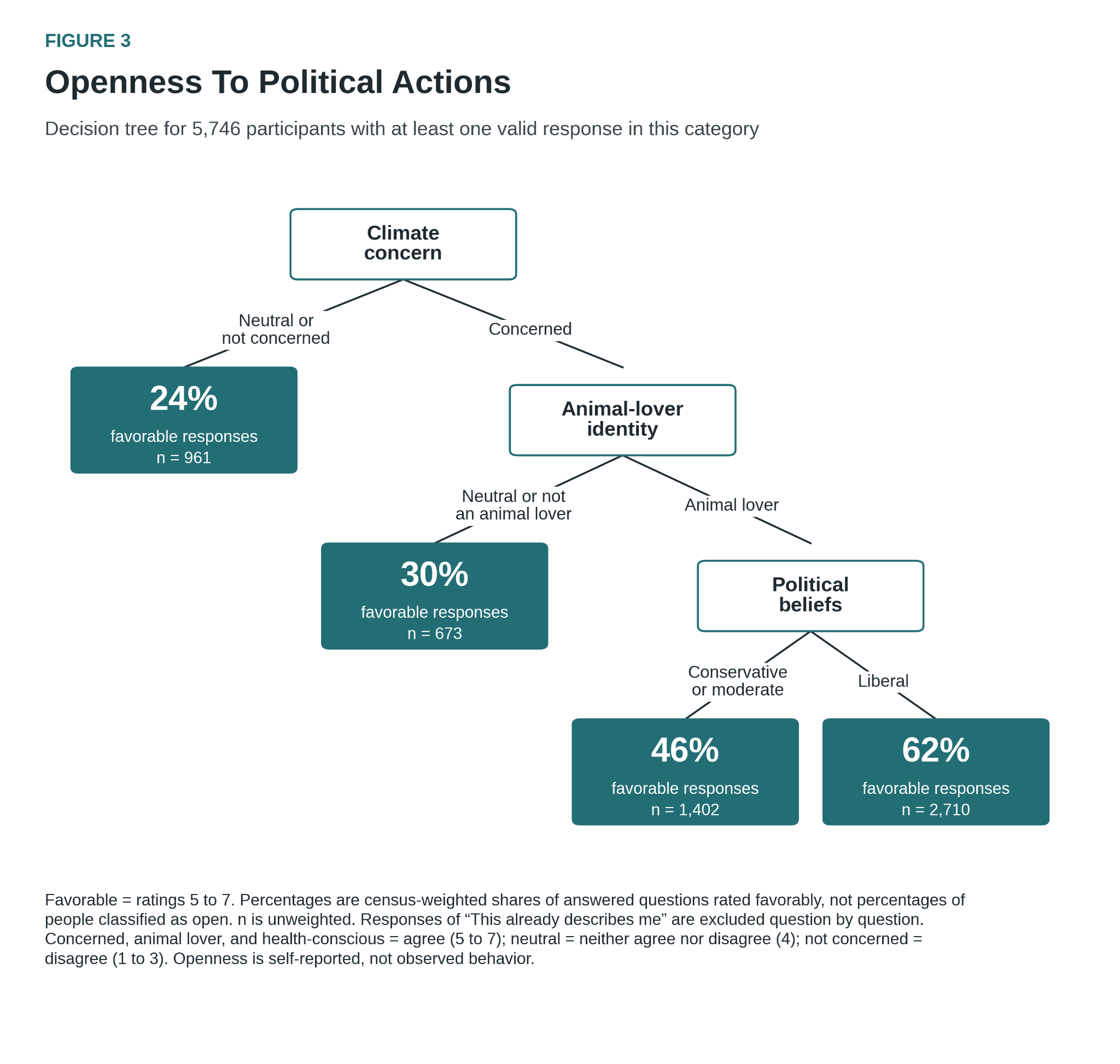
- Behavior-First Analysis: For advocates who have a specific pro-animal action in mind, we identified which groups of people are most receptive to those actions. For example, if you want to promote plant-based eating, who should you target? This analysis used decision trees, which divided people into groups using the characteristics that best distinguish participants who are more open from those who are less open. We report the percentage of favorable answers within each group, meaning a rating of 5-7 on the 7-point scale.
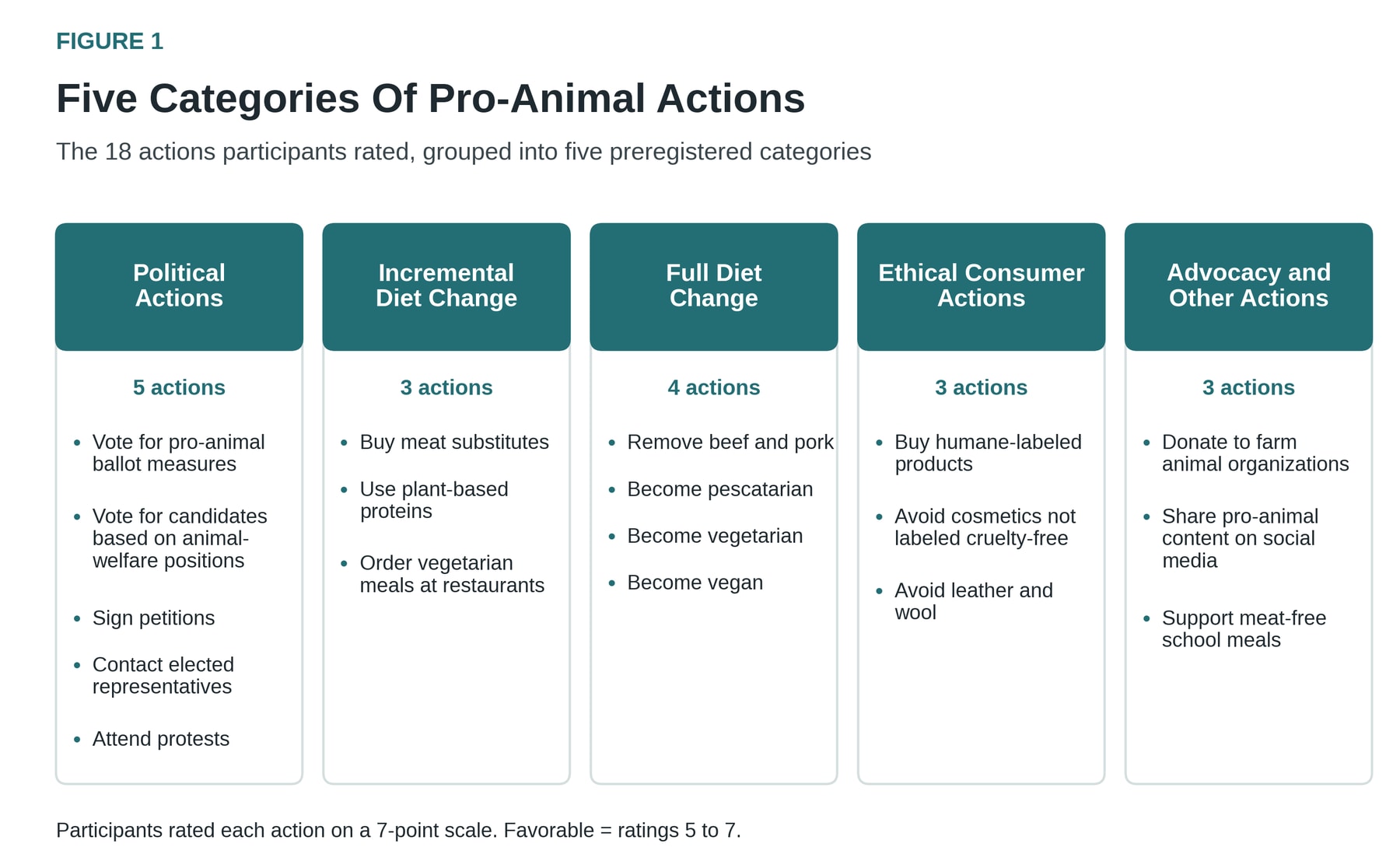
Together, these approaches provide practical guidance for advocates seeking to maximize their impact by matching their proposed actions to their audiences, or their audiences to their proposed actions.
Key Findings
Audience-First
- Political beliefs showed the largest and most consistent differences in openness to pro-animal actions. Liberals were more open than the average participant to all 18 actions we measured, while conservatives were less open to all 18 . The gap was widest for political and advocacy actions, such as signing petitions, contacting elected representatives, and attending protests. These findings suggest that political beliefs are an important factor in understanding how different audiences respond to opportunities to help animals. However, the differences were not equally large for every type of action.
- Black participants showed greater openness to full diet changes, including becoming vegetarian or vegan. Among the racial/ethnic groups studied, Black participants showed particularly high openness to all four actions involving major diet changes, such as eliminating beef and pork or adopting a vegetarian or vegan diet. However, this greater openness did not extend consistently to political actions, where Black participants generally responded similarly to the average participant. This suggests that openness to one way of helping animals does not necessarily translate into openness to other types of actions.
- Students were open to a wider range of pro-animal actions than young adults generally. Students expressed greater openness to a wide range of pro-animal actions, including political participation and diet changes. While younger adults were more open than average to some actions, such as signing petitions and attending protests, they did not show the same consistent pattern across all actions. Student status was therefore more informative than age alone. This distinction suggests that being a student may help explain openness to pro-animal actions in ways that age by itself does not.
- Not identifying as an animal lover was more informative than identifying as one. People who identified as animal lovers were only slightly more open to the 18 actions studied than the average participant. In contrast, people who did not identify as animal lovers were substantially less open to the actions we measured. This suggests that simply identifying someone as an animal lover may not tell advocates as much about their willingness to take action as expected.
- Combining two characteristics helps identify differences between audiences, but adding a third offers little additional insight. Combining characteristics, especially political beliefs with climate concern, animal-lover identity, or gender, helped distinguish more- and less-receptive audiences more clearly than looking at one characteristic alone. For example, people with similar political beliefs did not always show the same openness to pro-animal actions, particularly when they differed in their concern about climate change or whether they identified as animal lovers. However, adding a third characteristic to the combinations tested did not meaningfully improve these distinctions and resulted in smaller groups that were harder to analyze reliably.
Behavior-First
6. Climate concern was the first dividing line for every type of pro-animal action. In all five groups of related actions we examined, the decision tree first divided participants based on their concern about climate change (Figure 3). In every group of actions, the least receptive group included people who were not concerned about climate change. These findings highlight a consistent relationship between climate concern and openness to pro-animal actions, although they do not establish that increasing climate concern would lead people to become more willing to act.
7. The second most useful characteristic depends on the action being considered. By order of splits, identifying as an animal lover came second for political, ethical consumer, and advocacy actions. Being health-conscious was the second most useful characteristic for both incremental and full diet change (Table 1). For example, knowing whether someone identifies as an animal lover may help distinguish openness to advocacy or consumer actions, while knowing whether they prioritize their health may be more informative when examining willingness to change diets. Political beliefs, gender, and party affiliation helped identify additional differences between some groups.
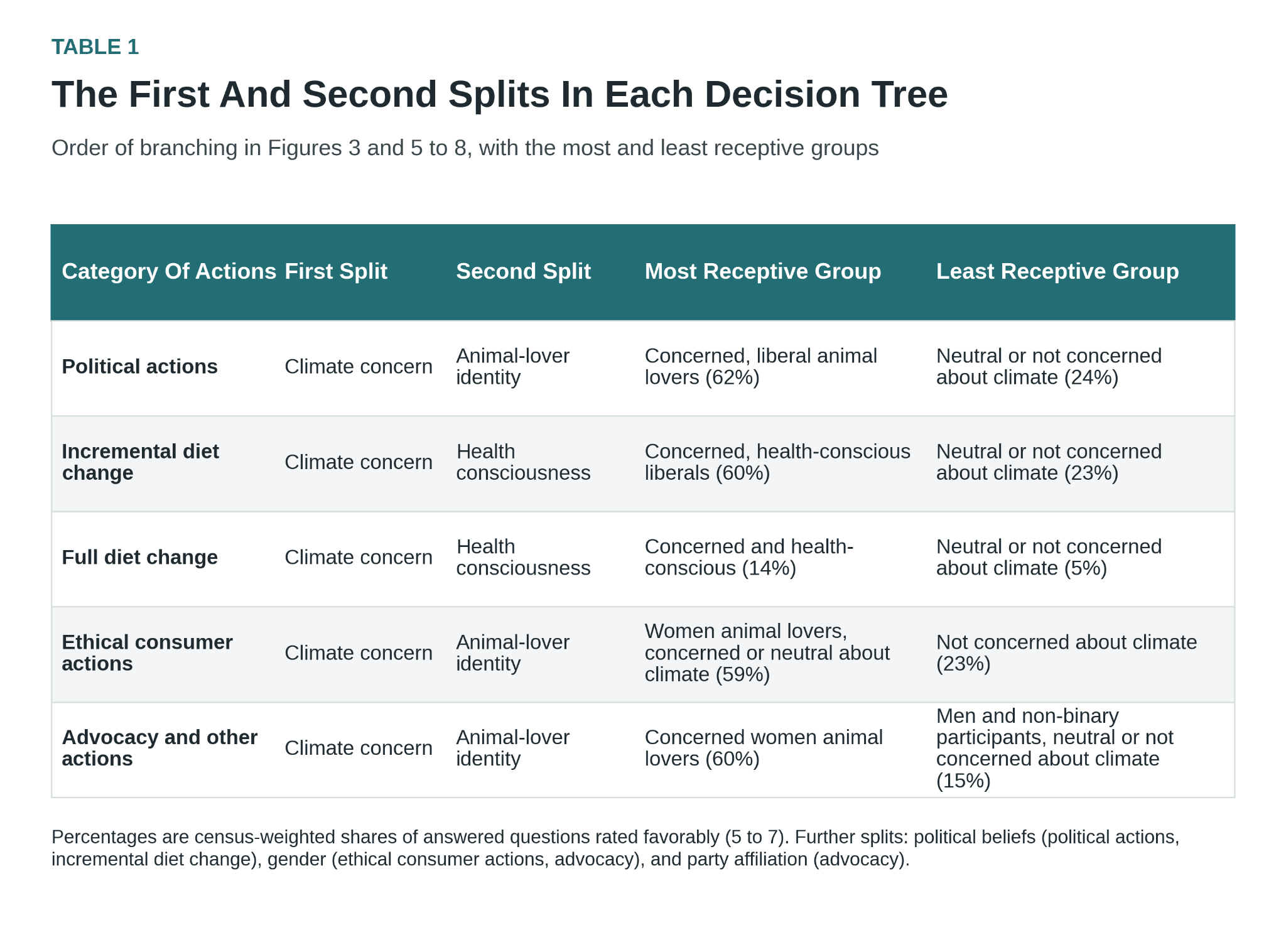
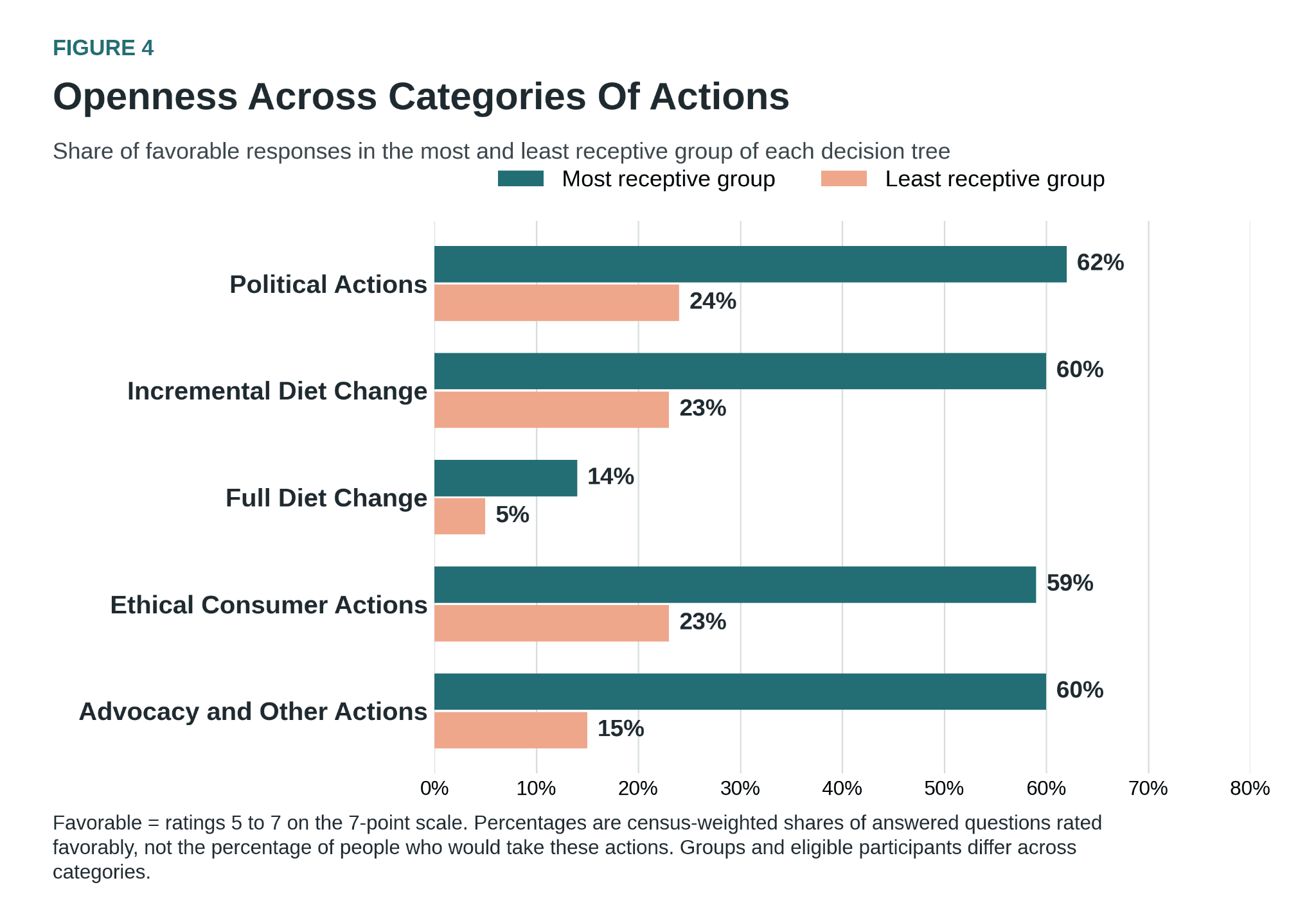
8. Full diet change is a hard ask for every audience, even the most receptive. Even the most receptive group (participants who were concerned about climate change and health-conscious) gave favorable answers to only 14% of questions about major diet changes, such as eliminating certain animal products or adopting a vegetarian or vegan diet (Figure 4). On the other hand, participants showed much higher willingness, on average, to engage in other actions including political participation, advocacy, ethical consumer choices, and smaller dietary changes. These findings suggest that smaller changes, such as trying plant-based proteins or choosing vegetarian meals, may be more approachable than asking people to make major changes to their diets.
Conclusions
This sub-analysis of Faunalytics' “Different Strokes” dataset provides practical guidance for advocates seeking to match their requested actions to their audiences, or identify audiences who may be more receptive to specific actions. These findings can help inform outreach strategies, although reported openness does not necessarily translate into taking action.
Key Takeaways
Audience-First
Political beliefs were strongly associated with openness to pro-animal actions. Conservatives were much less open to pro-animal political actions than liberals. However, differences in openness were generally smaller for dietary changes and consumer choices than for political and advocacy actions.
Different communities have different pathways to engagement. Black participants showed greater-than-average openness to full dietary changes, but did not consistently differ from the average participant in openness to political actions. Students reported greater openness to many of the actions examined. Women showed particularly high openness to consumer-focused actions, such as choosing cruelty-free cosmetics.
Two characteristics can reveal more pronounced differences in openness than examining one characteristic alone. Liberal women were the most receptive among the two-characteristic subgroups examined across all 18 actions (mean OR = 1.79). Conservatives who did not identify as animal lovers were the least receptive (mean OR = 0.21). In the six three-characteristic combinations examined, adding a third characteristic did not reveal clearer differences in openness, and the smaller subgroups reduced the precision of the estimates.
Behavior-First
Climate concern was consistently important across all five categories of actions. Climate concern was the first split in every decision tree. Participants who expressed concern about climate change generally showed only slightly greater openness than average, while those who did not express concern often showed substantially lower openness. The decision trees consistently identified differences in openness based on climate concern, although the way neutral participants were grouped varied across the five categories of actions.
The next most useful characteristic depends on the action. For political and ethical consumer actions, animal-lover identity was an important characteristic following climate concern. Animal-lover identity and gender were both important for advocacy and other actions. For diet change, health consciousness was particularly important after climate concern.
Full diet change is a challenging action to encourage, even among the most receptive audiences. Even the most receptive audience group had favorable responses to an average of only 14% of the full dietary change questions. This suggests that substantial dietary changes may be particularly challenging to encourage, even among audiences who reported relatively greater openness to them. The good news is that participants were much more open to the other kinds of actions. In the other four categories, the most receptive groups gave favorable responses to 59% to 62% of questions.
Overall, these findings can help advocates better understand which audiences may be more open to different pro-animal actions. However, advocates should use them as a starting point for developing and testing outreach strategies, rather than as definitive evidence of which approaches will be most effective.
5