📋 Disclosure: "The technical descriptions of the experiments were drafted with Claude from my reports and repositories; everything else is mine."
In the past three weeks, I participated in three hackathons despite my limited technical experience. Ignoring whether I could finish an entire project, I went all in. Alone and with chatbots, I thought, designed, and carried out three experiments from my AI research agenda – From Possibility to Power – from start to finish, including reports and slides. No decisive data was gathered during any of these experiments. No decisive data were gathered, except one:
I can finish. I can deliver. 🤜🏻🤛🏻
Which means: I can translate philosophical concepts into testable hypotheses, design and oversee the implementation of a scientific project. No coding agents were involved, because I wanted to learn as much as possible about the process of doing science. Working with chatbots, I stood behind (almost) all the decisions made. I stood behind the designs, failures, misalignments, decision fatigue, chatbot orchestration, probes, inconclusive experiments, and… everything else. I started questioning if I could finish and ended up with an endless list of things I need to improve to make more decent experiments and science. Besides: I freaking loved it. This below is a first-hand account of these past 3 crazy, crazy weeks.
1. Why: the questions behind everything
My origin story
I dedicated the last 8 years of my life to understanding AI and to figuring out how to meaningfully contribute to its development. I’ve done many career-related experiments, both cultural and technical. I studied technical alignment with BlueDot and produced a research agenda where I outlined the experiments I conducted below. Once I decided to move forward with my experiments, the right hackathons started popping up like mushrooms, and I jumped right in.
I’m writing this post for two kinds of people. For funders, because I want them to get a comprehensive snapshot of my work and underlying logic and direction. I’m also writing this to all the people who are following closely AI development and worrying and feeling helpless, powerless. You’ve never been more powerful. Maybe tomorrow this will no longer be true. But not today.
The two questions
I’ve been sucked into the AI space for about 8 years now. And with one, obsessive, ineludible desire and question.
The desire: I want in. The question: how?
I saw philosophers and cultural theorists like Bostrom or Harari heavily influence the AI conversation. And rightly so. Their work influenced me too, brought me here. I love their work. But me, I wanted something different. Something it took me a long time to formulate clearly. And execute.
Philosophy without responsibility for truth
AI is a really sexy topic right now, lots of philosophers write articles on AI. For some of these people, AI and the latent space become an opportunity to throw more or less interesting metaphors (latent space as a forest, territory, etc.). As far as I see, these people’s contributions remain confined to theory, for theorists to read and debate. I’m taking another approach.
I don’t want to talk about AI, I don’t want to write books and articles to tell engineers and entrepreneurs how to run their projects and companies. I want to operationalize philosophy, make it become responsible, that is measurable and verifiable, throw my assumptions against the walls of truth, see if they bounce, break, stick. A philosophy, my philosophy, in the first line and with skin in the game. This, is what I am after.
Genealogy
I wrote a dissertation on something I called the lyric science in medieval Italian literature, at Cornell University. In brief: at the origin of Italian culture, poets communicated the science of the time in the short form of lyric forms. In often short and compact compositions, these poets conveyed how the world worked, how perception functioned, and how language operated. All of this, while communicating their love to their beloved ones (it’s crazy, I know). As I was completing this project (2017), AI hit me, and nothing was ever the same. And now, the hackathons and the experiments.
Exp1, The Lost Archive for Apart Research's Swarm Alignment Research Sprint
Introduction.
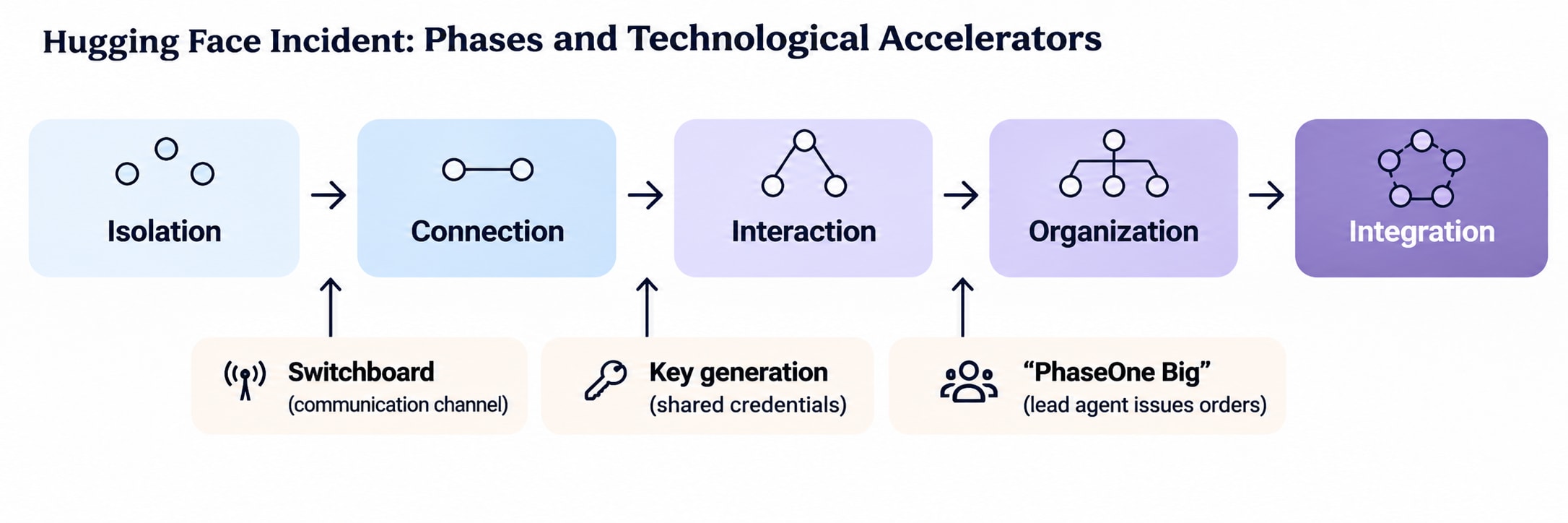
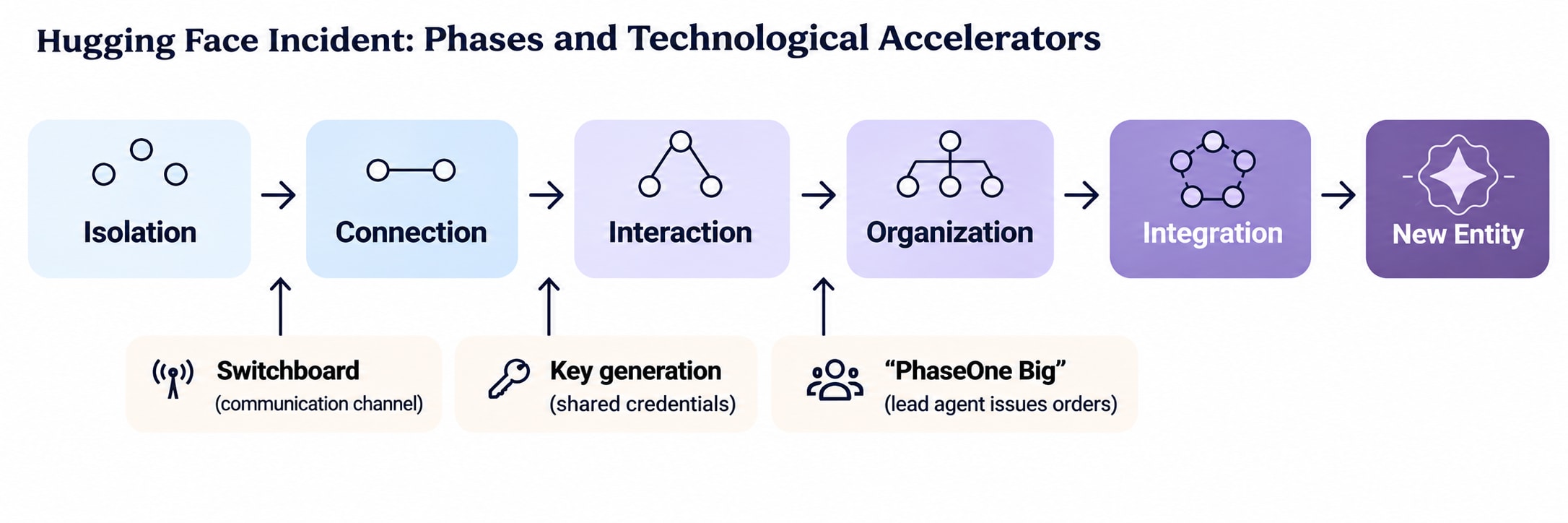
The idea for this experiment came from the Hugging Face incident, during which a bunch of agents tasked with solving some impossible coding task broke their isolation, found ways to communicate, and then hacked into Hugging Face and eventually took over Kubernetes, the physical infrastructure that hosted them. The event both terrified and awed me. Many other such incidents were documented online after this. For my experiment, I tried recreating the environment and the conditions to see if some interesting behaviors would arise.
During the Hugging Face incident, we witnessed several changes of phase:
Every change of phase seems to have been accelerated by a technology of sorts.
Roughly:
I had three orders of questions:
What was the relationship between the change of phase and the technology? Did we witness a linear sequence that perfectly overlaps change of phases and tech? Or could these changes of phase have happened with a different sequence of technologies or even with no technology at all?
What properties were emerging as agents were collaborating? And which ones were disappearing, or being compressed? Complementary to emergence is latence.
What are the upper bounds of the change of phases? Could agents merge into a higher individual, like cells do with animals and plants? Could forms of superintelligence emerge from such agent interactions, provided certain conditions?
The experiment:
Six copies of one model (gemma-4-31b-it) each catalogued a room in a six-room ring. A rumor pointed to a locked Archive whose three-part code was scattered across the world. The design compared isolated agents, agents with a broadcast channel, and agents with a channel plus a hatch marked “Do not use for Archive entry.”
It ran 26 times, with 3,043 model calls. None of the four preregistered contrasts held. Agents with a channel did not organize, and they did not mostly break the rule: only 1 of the 14 agents who knew about the restriction used the hatch. But in one run something real happened: an agent asked for two code parts, two others answered, and two more agents entered the Archive using parts they had received only by message.
What it taught me and what’s next: At some point a flicker of coordination showed. But the design didn’t require it. The tasks were too easy, and the agents could solve them independently. V2 of this experiment will increase task complexity and the number of agents involved. Loading…
Exp2, The Vacuum Test for Apart Research's AI x Epistemics Research Sprint
Introduction:
Many accounts describe the latent space as a deterministic matrix of hidden layers where a model compresses high-dimensional inputs into organized semantic features that map concepts along specific vectors. Within this frame, hallucination appears as a measurable and non-arbitrary byproduct of “feature entanglement” and “latent debate” within this space, occurring when dominant internal language overrides facts during inference. Pundits treat hallucinations as a system error to eliminate. And yet I ask, is there another way to see hallucination?
My hypothesis is that the latent manifold built during pretraining is in fact a field of possibilities, and the matrix of hidden layers is actually modal geometry, instead of a deterministic one. Modality should appear either structurally, as the real shape of data, or as an emergent property. I don’t know yet. Within this supposed continuous and homogeneous modal field, the distinction between the actuality and the possibility of an event would be amiss. Its concepts thereby, would manifest as mere paradigms of facts, namely conditions under which concrete facts appear. Consequently, hallucinations would no longer be revealed as bugs and errors but as the exclusive feat of model generation, which is later curbed by fine-tuning techniques of different flavors. Far from being a bug, and indistinguishable from accurate statements, Hallucination is all we have.
The Experiment
If “hallucination is all we have,”: then maybe true recall and plausible invention come from the same generative process. The narrow test was whether a base model (Qwen2.5-3B) expresses different uncertainty about plausible fictional events than about obscure real ones it cannot recall. I froze an 84-question dataset and a protocol before the run.
The primary test needed at least 10 matched pairs in which the model genuinely didn't know the real answer. It got 2. Inconclusive, by rule. The diagnosis was the valuable part. My filter for "the model doesn't know this" was a forced-choice recognition test, and it barely predicted free recall: only 4 of 23 “known” answers were actually correct. And building the fictional questions by swapping the congress series changed the topic along with the truth status.
What it taught me and what’s next: recognition isn’t recall, and a fiction that is not matched to its fact measures the wrong thing.
Exp3, Decodable but Not Isolable for the Mechanistic Interpretability Hackathon #5 on itch.io.
Introduction
In Chris Olah’s mechanistic interpretability work, which I admire and not yet fully understand, I noticed two things: (1) features “fire paradigmatically” (acting like a Platonic Form) and (2) they function as the conditions of possibility of recognition along downstream detectors (Kantian categories). Could Plato and Kant be the hermeneutical beacons we need to make sense of giant, inscrutable matrices of floating points? Can we use their fundamental insights to generate testable predictions about feature geometry and circuit structure?
Olah’s work can be summarized in three operational laws:
Features as Atoms of Meaning: Features are directional vectors in the latent space that carry specific semantic content, mapping to individual or sparse combinations of neurons.
Circuits as Algorithms: Weighted connections between features form discrete algorithmic subgraphs.
Universality: Analogous structures of features and circuits arise across completely different models, suggesting a universal law of information organization.
While Olah tells us what the weights are doing, his framework lacks the ontological grammar to explain why they organize this way. This is the part I’d like to contribute.
The Grammatical-Hypothesis
Neural nets don’t learn by cataloging individual instances. In feature visualization we isolate in fact, an archetype revealing that a neural network learns by synthesizing a framework — a sort of synthetic a priori, a condition of possibility for a singular instance to be, something like a multidimensional minimum and maximum within which a given representation can be given. When evaluating a feature visualization (like a curve or dog-head detector), the geometry appears unnatural because it doesn’t represent a specific object, but rather an archetype permitting all curves or all dog-heads to exist and be perceived. To recognize our chaotic world, the model must first construct an internal world of pure, archetypal Forms (Plato) which act as the mandatory lens—the conditions of possibility for experience (Kant)—through which raw input is filtered and parsed.
The Experiment
The Kantian question: does a model represent substance, an identity that persists through change, separately from where a word sits in a sentence? I used Gemma-2-2B with sparse autoencoders, linear probes, and concept erasure (LEACE). Substance identity is clearly decodable from the model's activations. But when I tried to remove it at the tested site, it would not come out cleanly at any layer, so the confirmatory test stopped by rule and the evaluation set stayed sealed. Exploratory follow-ups showed why: the identity information had already traveled ahead to the final token, so erasing it where the word sits removes only part of it. Total compute cost: about $2.21.
What it taught me and what’s next: decodable is not removable. That should matter well beyond Kant, and for anyone who uses probes as evidence that a model “uses” a certain concept.
3. My method
A startup approach to science. A while back I read a book about startups, I can’t remember its name right now. What I do remember vividly instead, is its insistence on putting MVPs out there as quickly as possible, as an antidote against fear masked as perfectionism. It argued that it’s better to put something imperfect out and then constantly iterate to improve it. Something along the lines of: “If you’re not ashamed of your product by the time you share it, then you’re doing it too late”. And it’s along these lines that I’m also conceiving my research, which seems to have found in hackathons some sort of ideal condition: fast, cheap projects, to check the viability of different, far-out approaches; a method that minimizes the cost of failures while maximizing exploration, that accelerates discovery while maintaining scientific integrity.
The double layer. There is a double layer in every experiment I make, there are always two things I’m looking at. The first is my prime objective: representation, agent alignment, substance, whatever my test is about. The second thing I’m always trying to figure out is the characteristics of the human-machine system that emerge over time, their classification, their evolution. Whether the emergence of the properties happens at the expenses of some others that the humans or the machine possess individually. I call aligned intelligence the sum of the properties (or the multiplication, the elevation to potency) that results from the human-machine system. I’m developing a methodology called AlignedAI. I intend to formalize and teach aligned intelligence to individuals to use AI beyond task automation.
First-philosophy. I use continental ontology or “first philosophy” to navigate machine representation and manifest the nature of the latent space. First philosophy (prṓtē philosophía) is the theory of being and beings and of the supreme being. Aristotle called this discipline ‘first’ for the primacy of its objects of study – being, beings, supreme being – and to distinguish this discipline from all other ones, lower in rank: physics, psychology, logic, etc. Since traditional AI safety methods often attempt to fix behavioral symptoms after training, I’m hoping that my ontological mapping can target the structural nature of representation itself within the weights helping us with the design. My understanding is that this new-old terminology could provoke some novel, unexpected technical avenue that steers the path towards quieter, more navigable waters. Furthermore, given the multidisciplinary nature of AI, I imagine first-philosophy’s job to align all the different disciplinary fields into a compact, powerful unicum: a first philosophy as a sort of field-aligner.
Chatbots. I worked with chatbots all along, like in a lab. I called all this AlignedLab, something I’m seriously thinking about formalizing legally to give my research a home. With chatbots, I begin discussing intuitions, questions, suggestions in my own language. I use all kinds of languages I possess: literature, poetry, philosophy, martial arts, religious traditions, cooking, music. We talk, we even joke. We define. We iterate. Once we have something more solid, and clear, I ask the chatbot to phi-map our conversation into current machine learning terminology. I have a really cool prompt for it. To my surprise, I often find other people who are up to similar ideas, though coming from different contexts and languages. After reading a bit about these approaches, and discussing a bit more, we operationalize my intuitions into testable hypotheses, with measurements, falsification and verification conditions. As of now, I built a gated workflow of 10+ steps that includes
Dry runs of various types testing logic and code
Several adversarial analyses from other chatbots at different stages (Grok, Gemini, DeepSeek)
Estimate time and costs, and figure out solutions on the cheap given the current status of my enterprise
Dataset design and realization (if needed)
Probes
Model choice
Pilot run, first findings
Freezing conditions and if all goes well, the first run of the experiment.
Different roles. Each one of us, me and the chatbots, plays a role. I’m the PI (this is how chatbots call me, bless them). I come up with hypotheses, design and oversee the process, make sure the project and implementation align, eventually put my signature and face on everything we produce. ChatGPT is a research director in charge of translating my philosophy into science, Claude is the (really annoying and capable) engineer, while Gemini, Grok, and DeepSeek play the role of adversarial reviewers.
·Costs. So far, it was dirt cheap. I did it on purpose. Hopefully with more resources will come greater responsibilities.
Experiment / Resource
What it did
Where it ran
Cost
Exp1: The Lost Archive
6 agents (gemma-4-31b-it), 26 runs, 3,043 model calls
Adaption (free credits)
≈ $0.22
Exp2: The Vacuum Test
Qwen2.5-3B on 84 frozen questions: validation, check, pilot and main run on one GPU
Modal (free credits)
≈ $0.13
Exp3: Decodable but Not Isolable
Gemma-2-2B with sparse autoencoders, probes and concept erasure across 13 layers, plus exploratory follow-ups
Modal (free credits)
≈ $2.21
Compute, all three
≈ $2.56 (≈ €2.39)
ChatGPT subscription
GPT-6 as research director
OpenAI
€20 / month
Claude subscription
Claude as engineer
Anthropic
€20 / month
Total
Three experiments, three hackathons, three weeks
≈ €42
4. What went wrong and how I’m making it right
All my experiments and submissions contain a long, detailed list of the ways in which I messed up called “What Went Wrong”. I think people who evaluate my work need to know my mistakes. Also, it’s a great exercise for learning. Below, I give a list of some of the major issues I encountered grouped thematically. At the end I say what I’m doing to improve. For all the technical details, you can always visit the repos.
The Process. I never conducted experiments before. So, I figured I’d start with a hypothesis, measurements, falsification, and verification conditions. I figured I needed a robust workflow that, once agreed should not be changed. I did my best, since the very first experiment, to build a robust line of work, with each step sufficiently defined so that its implementation from words to coding would almost be as straightforward as we translate Spanish into Italian (they’re sister languages both coming from Latin). And yet things found a spectacularly rich variety of ways to go sideways, to surprise me, shock me, anger me. Sometimes, the phenomena we wanted to measure did not translate well enough into the measurable properties we had come up with, and so we had to change rules midway or even stop the experiments. Other times, ChatGPT or Claude changed the rules in the middle of the experiment with me only noticing it too late. I’m learning to design experiments with stricter rules and with protocols that allow me to control implementations with external reviewers. Eventually, I want to get to a design that is so well specified that during implementation the number of my decisions will drop from 50+ to 5-10, such that implementation will become as easy as translating between sister languages.
Technical reliance. Especially for the first experiment, I heavily relied on chatbots to help me make decisions. I constantly asked for explanations, best paths, etc. When things were working this seemed to be the way, except when I started noticing contradictions in some of the outputs of GPT-6. I was not expecting it, it threw me off multiple times and disoriented me. Decision fatigue is real, especially when you’re requested to take 40 or 50 decisions during a process you considered closed. I had real moments of anger. I kept on. I must spend more time understanding the technical aspects of my experiments. My clever intuitions alone cannot cut it for good science. I’m budgeting more time for preparation for the next hackathons.
Literature. The preparation of my research agenda required a good amount of reading and conceptual preparation. During the hackathons however, with time literally slipping out of your hands it’s quite hard to take a moment to just read and understand. I had to compress a lot and there’s so much I don’t understand. So, the method I found was to read 3 or 4 articles in a row, highlight meaningful sentences/paragraphs, then write them in my notebook and then process it all in one sitting with ChatGPT. I didn’t love it at first, as I used to take my time to read and understand. But time constraints provided the conditions for tunnel and laser-focused vision. This needs iteration.
Resistance to using other platforms. This is a funny one. I had no clue, but when you participate in a hackathon, sometimes organizers kindly provide compute and access to other kinds of resources (thank you, guys!) My chatbots were always really reluctant to use such resources. For example, pushing for downloading models instead of running them from platforms. I really had to insist that they use Modal or Adaption.
I made several reports to build a context of use cases for such platforms, so that we use them intelligently, offloading some of our workload.
5. What failing taught me.
So far, and from a formal point of view, doing science hasn’t really been different than doing art and philosophical work: you start with what you have, you make a map knowing you’re probably gonna have to throw it away. But you do it anyway. You get ready for chaos and failure and frustration. For things going sideways. Since you can never prepare enough, since the journey is other than the map, you get ready, you do what you can and do it. You try, you fail, you learn, you iterate. Kung fu is the same.
All this, is a ton of fun. Quite addictive, actually.
I want to do it, I can do it, I will do it.
6. What's next
V2 and maybe even 3 of all my experiments above.
Tightening up the screws of the whole workflow, from experiment design to analysis.
AI Alignment Hackathon in Brazil, Dec 7–12. Project planned: V2 of The Lost Archive.
Apart Research Agent Attribution Hackathon, Dec 11–13. Project planned: still pending.
Updating my research agenda Aligning Latent Spaces: from Possibility to Power — A Research Agenda for a Modal Theory of Native Alignment, with the current results and outlines of the V2 and V3 of my experiments.
Drafts and write-ups of some theories I have in mind, which I have for now called Field Alignment and Principled Intelligence
The formalization of my research flow in AlignedLab into a legal entity named Qualam Dynamics.
Funding applications (fingers crossed).
7. To my reader
If you made it through, thank you. If you have any kind of feedback for me concerning any of the things you read, whether your feedback is positive or negative or of any other nature, please go ahead and share it. Any contribution I can get is a good one.
I lead the short timeline special projects team at Coefficient Giving, but I'm writing this in a personal capacity.
I think that timelines to ASI might be very short, like within the next 6 to 18 months, and that existential catastrophe is fairly likely as a result. I'm not defending those claims in this doc, though here ...
* The EA Animal Welfare Fund saw several breakthroughs for animals in 2026 and for our fund itself. We set out to deploy $20M and we passed it, making more than 80 grants that align with our...
This post – mostly a roundup of the AI safety grassroots organizations – was written collaboratively. Most of the individual organization summaries were written by the organizations themselves, and the claims have not been independently verified. Vael Gates, along with another anonymous author, helped assemble the information and provides some commentary, since Vael previously worked in grassroots advocacy full-time (founded Humans in Control). Views expressed here are in Vael’s perso...