Summary
- I believe expanding (or decreasing) agricultural land (crops or pasture) may increase or decrease the welfare/suffering/happiness of soil invertebrates. I do not think it robustly satisfies any of the conditions I identified below to ensure welfare increases, suffering decreases, or happiness increases.
- I see no escape from the uncertainty about the effects on soil invertebrates if one wants to increase welfare while accounting for all animals.
- I recommend funding the Arthropoda Foundation to support research indirectly informing how to increase the welfare of soil invertebrates.
- I would also like to see much more research on animal sentience, and, more broadly, on comparing welfare across species.
Conditions to ensure animal welfare increases
General framework
Say W refers to total welfare per year, P to population, and w to welfare per animal-year (quality of the living conditions). The total welfare per year is W=P∗w. Say f refers to the final state, and i to the initial state. The change in the total welfare per year is ΔW=Wf−Wi=Pf∗wf−Pi∗wi. The final population is Pf=Pi+ΔP, and the final welfare per animal-year is wf=wi+Δw. So ΔW=Pi∗Δw+ΔP∗wi+ΔP∗Δw.
If the change in welfare per animal-year is negligible, Δw can be set to 0, and the change in the total welfare per year is roughly ΔP∗wi. In this case, total welfare increases if i) population increases, and its welfare is positive (more positive lives), or if ii) population decreases, and its welfare is negative (fewer negative lives).
If the change in population in negligible, ΔP can be set to 0, and the change in the total welfare per year is roughly Pi∗Δw. In this case, total welfare increases if welfare per animal-year increases (better living conditions).
In the most general case, total welfare only necessarily increases if welfare per animal-year increases, population increases, and initial welfare is positive. Satisfying these 3 conditions ensures that all 3 terms of ΔW are positive.
The analysis above obscures different effects by subpopulation. Suppose there are N sufficiently independent subpopulations which are relevant to determine whether the total welfare increases or decreases. The total welfare is W=P1∗w1+…+PN∗wN. The change in the total welfare is ΔW=P1i∗Δw1+ΔP1∗w1i+ΔP1∗Δw1+…+PNi∗ΔwN+ΔPN∗wNi+ΔPN∗ΔwN. In the most general case, total welfare only necessarily increases if the welfare per animal-year of each subpopulation increases, the population of each subpopulation increases, and the initial welfare of each subpopulation is positive. Satisfying these 3*N conditions ensures that all 3*N terms of ΔW are positive.
At least 9 conditions to ensure the welfare of soil invertebrates increases
I think there are at least 3 subpopulations which are relevant to determine whether interventions increase or decrease the welfare of soil invertebrates. Macroarthropods (mostly ants and termites), microarthropods (mostly springtails and mites), and nematodes. I listed these by increasing population, decreasing individual number of neurons, and arguably decreasing sentience-adjusted welfare range. I am very uncertain about welfare comparisons across at least these groups. I can see effects on any of them determining whether total welfare increases or decreases. So I believe the total welfare of each of them has to increase to ensure that the total welfare across all of them increases. This leaves me with at least 9 (= 3*3) conditions to ensure the welfare of soil invertebrates increases:
- Improving the living conditions of soil macroarthropods/microarthropods/nematodes (3 conditions).
- Increasing the population of soil macroarthropods/microarthropods/nematodes (3 conditions).
- Targeting soil macroarthropods/microarthropods/nematodes with positive welfare (3 conditions).
At least 6 conditions to ensure the suffering of soil invertebrates decreases
Many people prefer increasing welfare by a given amount via decreasing suffering (negative welfare) than via increasing happiness (positive welfare), thus leaning negative utilitarian. Here is how the formulas I presented for welfare can be adapted to only cover suffering. Say S refers to total suffering per year, and s to suffering per animal-year (suffering intensity), where suffering is positive for moments of negative welfare, and 0 for moments of neutral or positive welfare. In addition, suppose there are N sufficiently independent subpopulations which are relevant to determine whether the total suffering increases or decreases. The total suffering is S=P1∗s1+…+PN∗sN, The change in the total suffering is ΔS=P1i∗Δs1+ΔP1∗s1i+ΔP1∗Δs1+…+PNi∗ΔsN+ΔPN∗sNi+ΔPN∗ΔsN. In the most general case, total suffering only necessarily decreases if the suffering per animal-year of each subpopulation decreases, and the population of each subpopulation decreases. Satisfying these 2*N conditions ensures that all 3*N terms of ΔS are negative. This leaves me with at least 6 (= 2*3) conditions to ensure the suffering of soil invertebrates decreases:
- Decreasing the suffering intensity of soil macroarthropods/microarthropods/nematodes (3 conditions).
- Decreasing the population of soil macroarthropods/microarthropods/nematodes (3 conditions).
At least 6 conditions to ensure the happiness of soil invertebrates increases
There might be people who prefer increasing welfare by a given amount via increasing happiness than via decreasing suffering, thus leaning positive utilitarian. Here is how the formulas I presented for welfare can be adapted to only cover happiness. Say H refers to total happiness per year, and h to happiness per animal-year (happiness intensity), where happiness is positive for moments of positive welfare, and 0 for moments of neutral or negative welfare. In addition, suppose there are N sufficiently independent subpopulations which are relevant to determine whether the total happiness increases or decreases. The total happiness is H=P1∗h1+…+PN∗hN, The change in the total suffering is ΔH=P1i∗Δh1+ΔP1∗h1i+ΔP1∗Δh1+…+PNi∗ΔhN+ΔPN∗hNi+ΔPN∗ΔhN. In the most general case, total happiness only necessarily increases if the happiness per animal-year of each subpopulation increases, and the population of each subpopulation increases. Satisfying these 2*N conditions ensures that all 3*N terms of ΔH are positive. This leaves me with at least 6 (= 2*3) conditions to ensure the happiness of soil invertebrates increases:
- Increasing the happiness intensity of soil macroarthropods/microarthropods/nematodes (3 conditions).
- Increasing the population of soil macroarthropods/microarthropods/nematodes (3 conditions).
Expanding agricultural land may increase or decrease the welfare/suffering/happiness of soil invertebrates
Takeaway
I believe expanding agricultural land may increase or decrease the welfare/suffering/happiness of soil invertebrates. I do not think it robustly satisfies any of the conditions I identified above to ensure welfare increases, suffering decreases, or happiness increases. I present my reasons below.
Living conditions
I have very little idea about how the living conditions of soil invertebrates vary across biomes. The only research on the welfare of soil invertebrates I am aware of are 2 projects on spiders funded by the Wild Animal Initiative (WAI), and they do not study how welfare varies across biomes.
Population
Soil arthropods
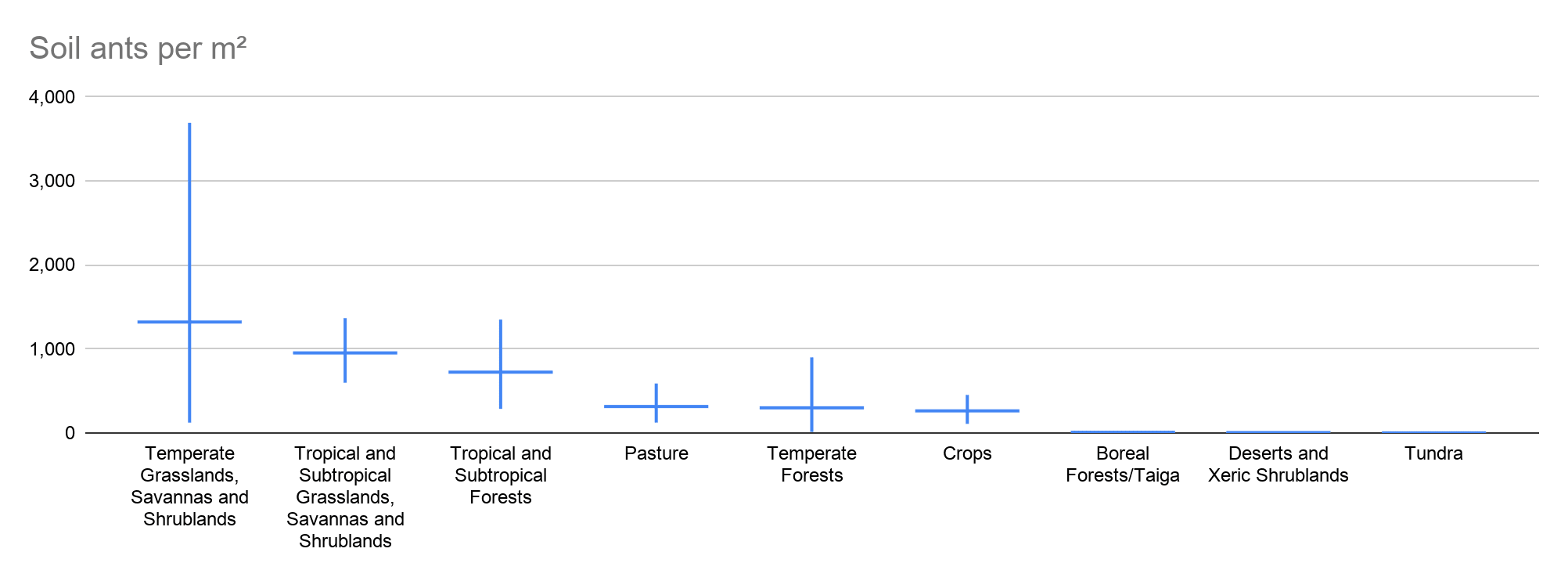
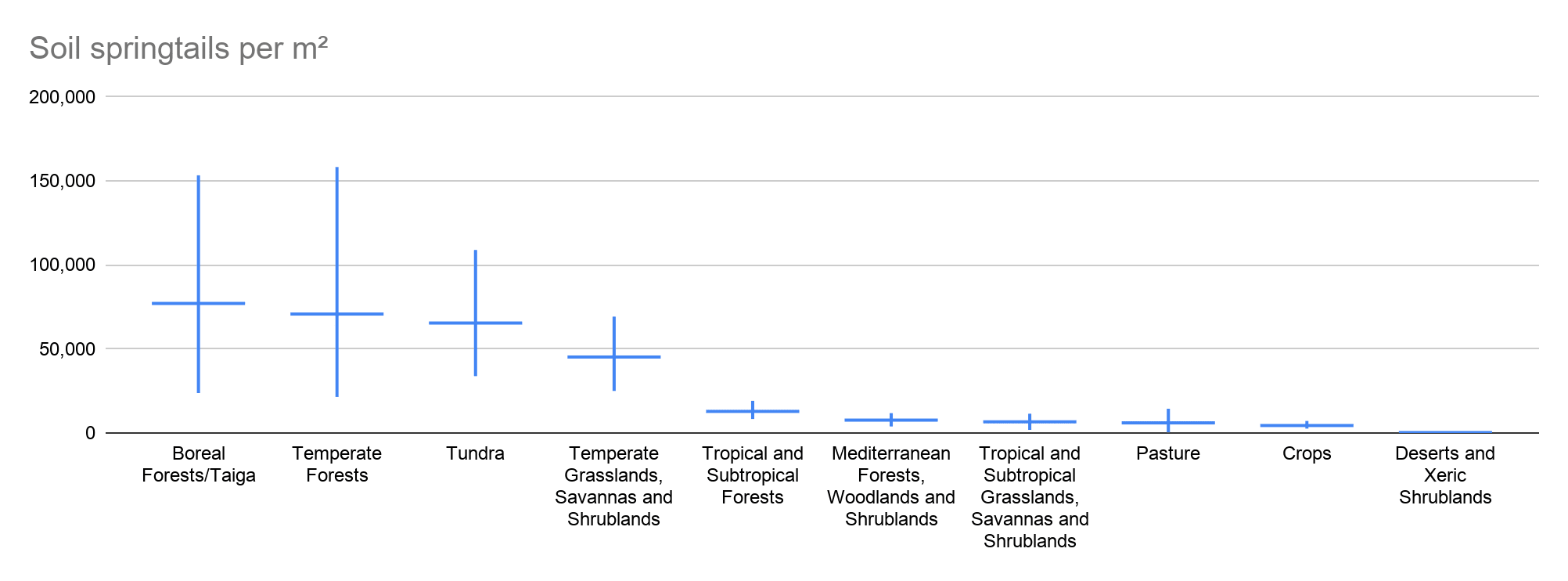
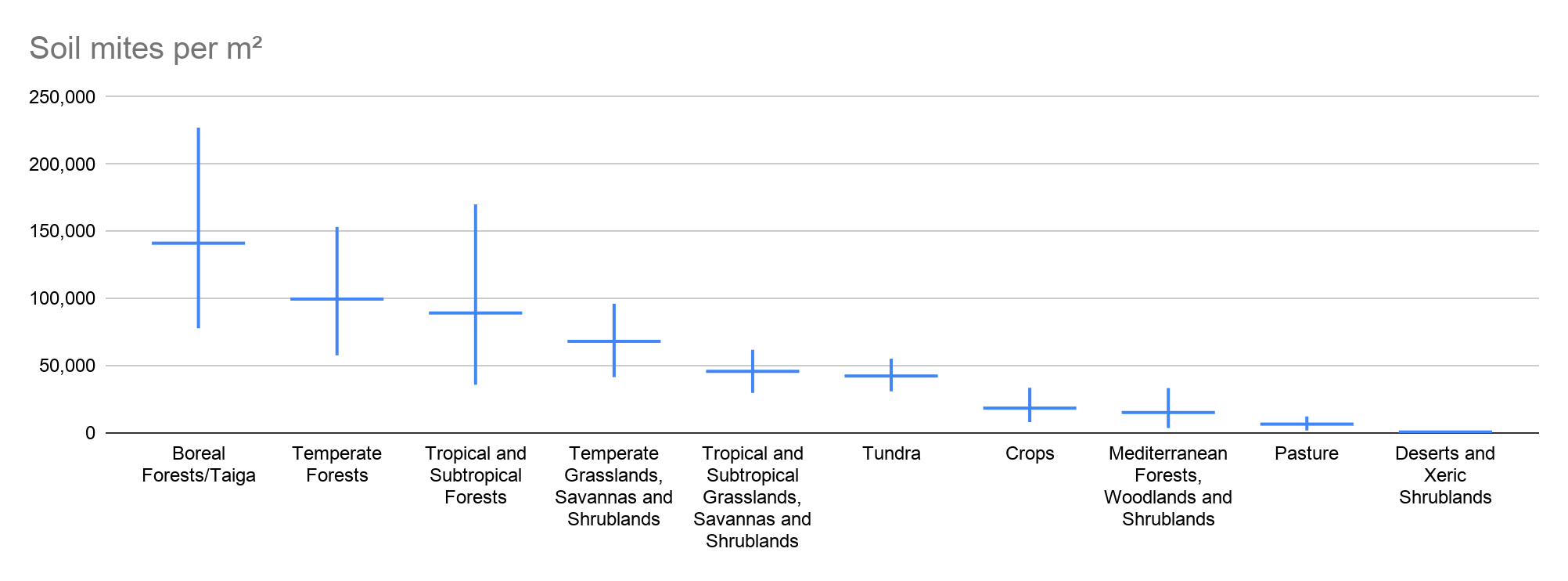
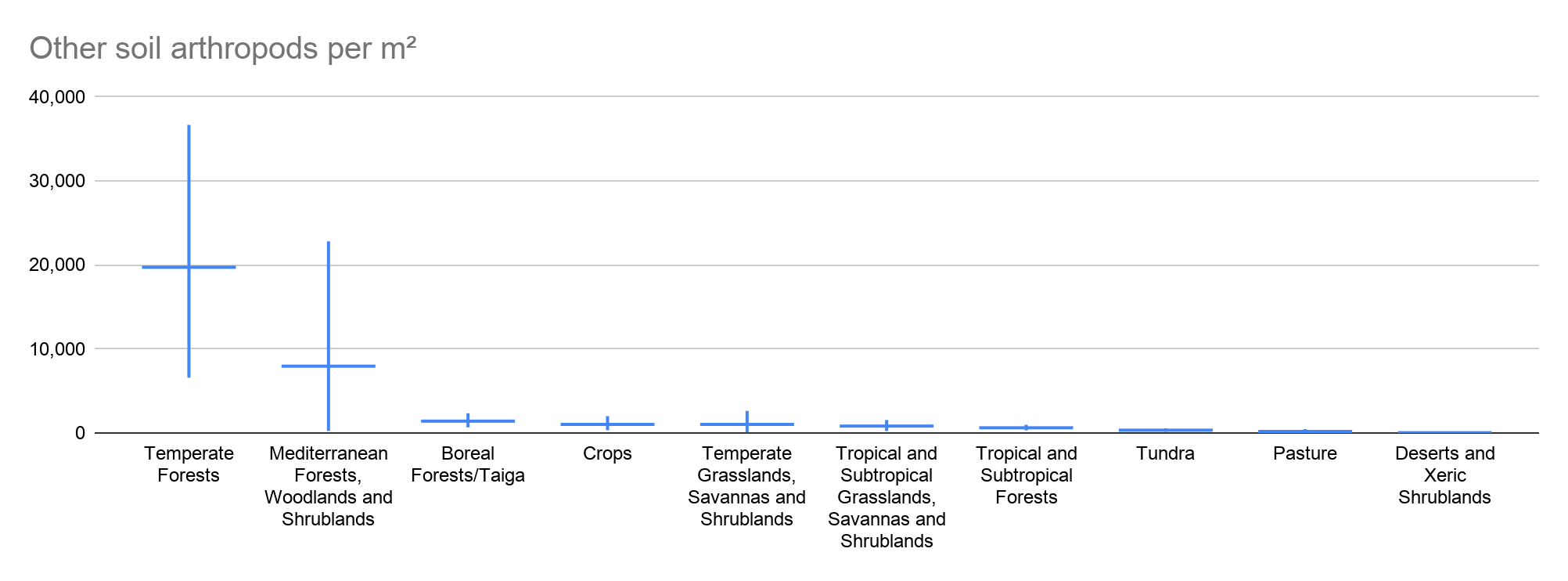
Below are graphs with data from Rosenberg et al. (2023) on the density of soil arthropods across biomes. I listed the biomes by decreasing density. For each biome, the horizontal bar refers to the mean density across the analysed sites, and the vertical bar to its 95 % confidence interval (CI).
Pasture or crops replacing i) temperature grasslands, savannas, and shrublands, ii) tropical and subtropical forests, or iii) temperate forests may increase or decrease the population of soil ants. There is overlap between the 95 % CIs of their mean abundance.
Crops or pasture replacing i) tropical and subtropical forests, or ii) tropical and subtropical grasslands, savannas, and shrublands may increase or decrease the population of soil termites.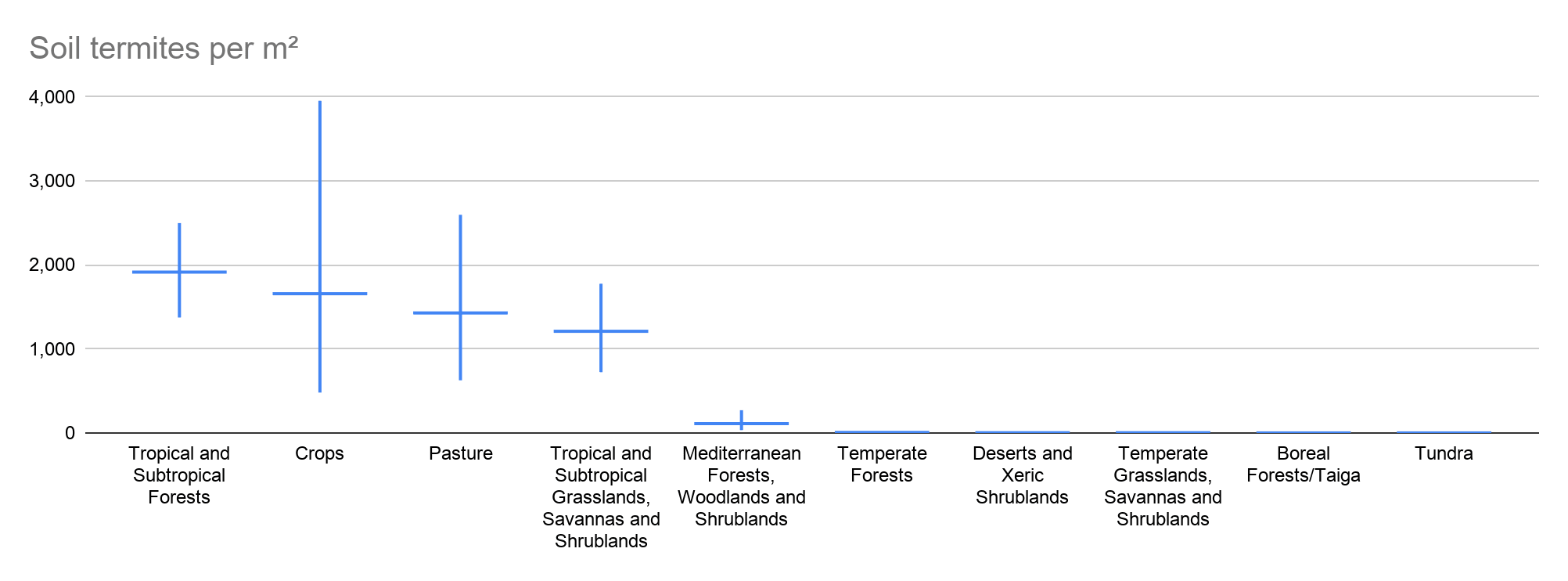
Pasture or crops replacing i) tropical and subtropical forests, ii) Mediterranean forests, woodlands, and shrublands, or iii) tropical and subtropical grasslands, savannas, and shrublands may increase or decrease the population of soil springtails.
Crops or pasture replacing Mediterranean forests, woodlands, and shrublands may increase or decrease the population of soil mites.
Crops replacing i) Mediterranean forests, woodlands, and shrublands, ii) boreal forests, iii) temperature grasslands, savannas, and shrublands, iv) tropical and subtropical grasslands, savannas, and shrublands, v) tropical and subtropical forests, or vi) tundra may increase or decrease the population of other soil arthropods. The same goes for pasture replacing i), iii), iv), v), or vi).
Soil nematodes
As I commented 8 months ago, I do not know whether expanding agricultural land increases or decreases the population of soil nematodes.
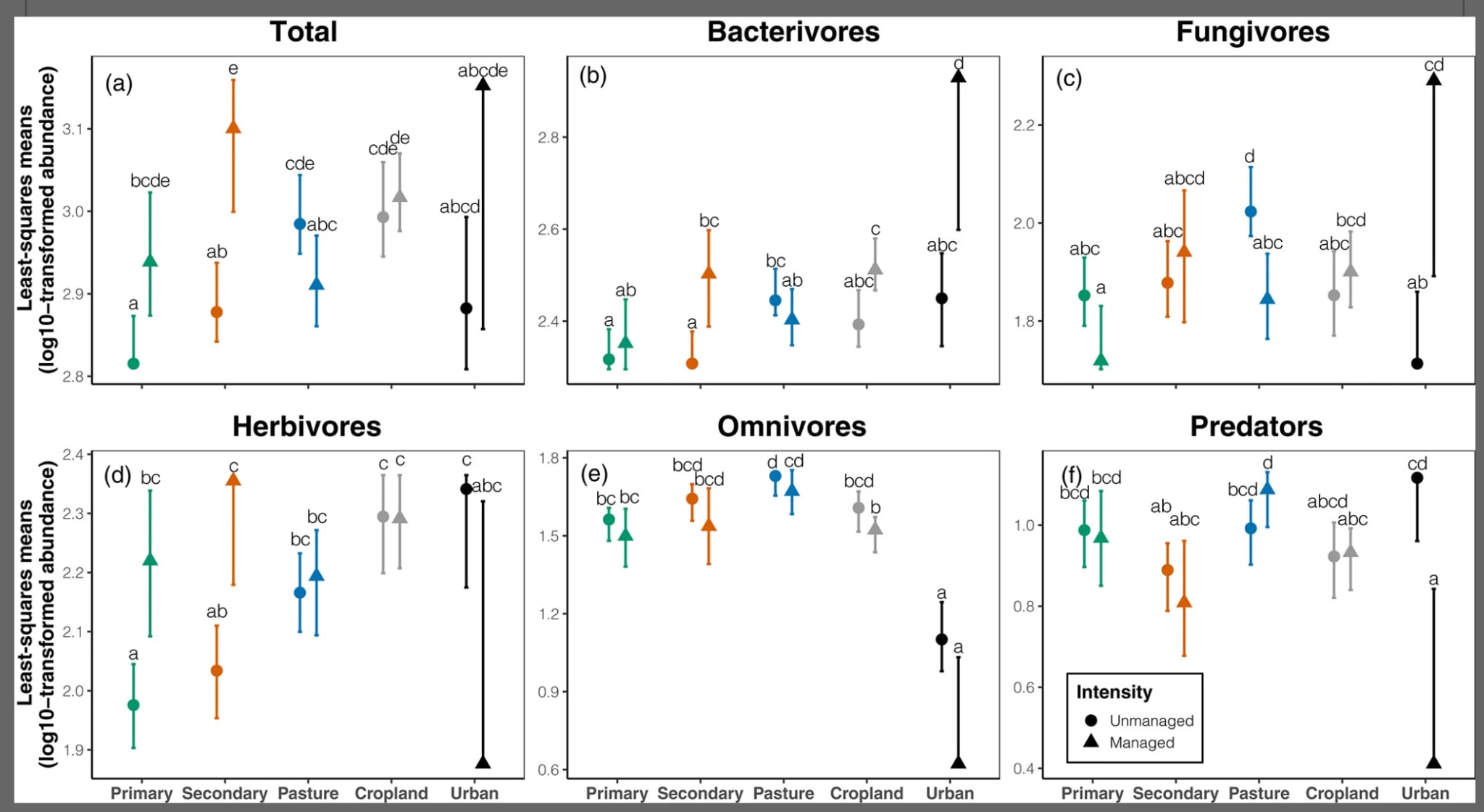
Figure 7 of Pothula et al. (2019), agricultural land replacing i) forest, ii) natural grassland, or iii) disturbed grassland may increase or decrease the population of soil nematodes.
![]()
From Figure 1a of Li et al. (2022) (summarised in White (2022)), managed “pasture (land used for the grazing of livestock)” replacing i) managed or unmanaged “primary habitat (undisturbed natural habitat)”, ii) unmanaged “secondary habitat (recovering, previously disturbed natural habitat)”, or iii) managed or unmanaged “urban [land] (land converted to dense urban settlement)” may increase or decrease the population of soil nematodes. The same goes for managed “cropland (land used for crop production)” replacing i) managed primary habitat, ii) managed secondary habitat, or iii) managed or unmanaged urban land.
Positive or negative lives
I am very uncertain about which soil invertebrates have positive or negative lives.
My recommendations
I see no escape from the uncertainty about the effects on soil invertebrates if one wants to increase welfare while accounting for all animals. I am not aware of any intervention supported by impact-focussed funders with effects on soil invertebrates robustly smaller than those on the target beneficiaries. Not saving human lives, not decreasing the consumption of animal foods or ingredients, not replacing fast with slower growth chicken, not replacing layers in battery cages with ones in cage-free aviaries or barns, not replacing standard with bird-safe glass, not replacing rodenticide with fertility control bait, and not even electrically stunning farmed shrimps.
I recommend funding the Arthropoda Foundation to support research indirectly informing how to increase the welfare of soil invertebrates. I do not recommend interventions that seemingly increase the welfare of soil invertebrates cost-effectively via changing land use. I have very little idea about whether these increase or decrease the welfare of soil invertebrates for the reasons above.
I would also like to see much more research on animal sentience, and, more broadly, on comparing welfare across species. I believe there is huge uncertainty, and ways of decreasing it. Here is some context about my uncertainty. In Bob Fischer’s book about comparing welfare across species, the tentative sentience-adjusted welfare range of shrimps is 8.0 % of that of humans. Welfare range is defined there as the difference between the maximum and minimum welfare per unit time among “realistic biological possibilities”. For sentience-adjusted welfare ranges proportional to “individual number of neurons”^“exponent”, and “exponent” from 0 to 2, which covers the best guesses that I consider reasonable, the sentience-adjusted welfare range of shrimps is 10^-12 to 1 times that of humans. Here are the sentience-adjusted welfare ranges of other animals for the same range of “exponent”.