Comments
TL;DR
- I’ve spent a year as a full-time biosecurity fieldbuilder at the Cambridge Biosecurity Hub, which has run two 100-person conferences, run intro courses, and supported other hubs.
- This post shares a real week from my calendar, categorised into where I spend most of my time.
- I include some personal tips on how I structure my time and things that help me work better.
- I reflect on what makes a good fieldbuilder, and argue the field needs a range of leadership styles, including softer ones.
What does a fieldbuilder do?
This month marks one year as a full-time biosecurity fieldbuilder for me at the Cambridge Biosecurity Hub. CBH has run two 100-person conferences and two introductory course cohorts, with two participants already moving into biosecurity roles. We’ve also supported several fellowships and the founding of other biosecurity hubs, including the London Biosecurity Hub. As far as I know I’m one of the only people that runs an in-person biosecurity hub full-time, and one of few full-time ‘fieldbuilders’ for this field at all, but hopefully this is changing!
But what is a fieldbuilder? I primarily work on talent-pipeline things - getting people to hear about biosecurity and help advise them and make connections to get people doing impactful work. I also prioritise helping the existing field to coordinate more.
I think this can still be unclear as to what that looks like day to day so I thought it would be useful to put together what a ‘week in my work life’ looks like. These are notes from this past week. I intensely calendar block my time so pulling this together was pretty quick.
Some lessons I’ve learned
As I’m naturally better at task switching than long stretches of deep work, I protect my mornings for the deep work I do need to do when my brain is working at its best (I’m a morning person and it gets dark at 4:30pm now).
I find discrete tasks much more natural than strategy or creative thinking work. It’s extra important to me that I protect hours in seasons when I’m doing more creative planning or I find it more difficult. That’s why you’ll only see me work a half day on Friday after working 3 evenings this week. It’s also why I’ve done my creative work in a coffee shop - the change of scenery and reward of a coffee and pastry makes me more motivated.
- Compared to a year ago, I triage my calls much more aggressively to protect my time. I have systems of sending resources or sticking to email for people where I think a half an hour call isn’t as valuable.
A real week breakdown
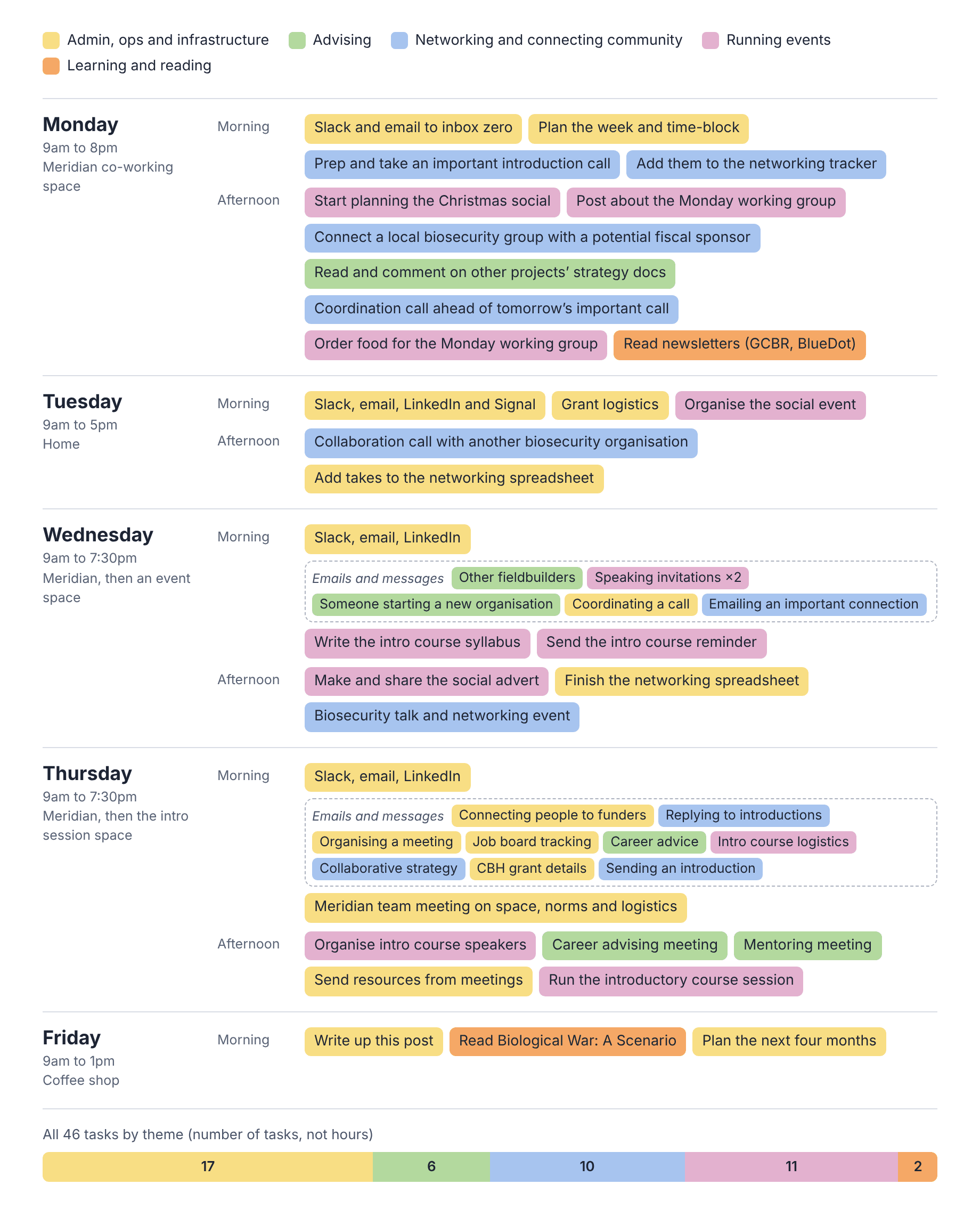
Here's the last week of my work. I’ve categorised tasks into some of the main themes of my work and added some more details on some of the tasks in the footnotes[1].
Who could be a good fieldbuilder?
- Generalist
I think if you found a project with a team, you can have different people with different strengths which reduces the need to be a generalist. When CBH was initially founded Sandy Hickson, my co-founder who is now working on other projects, was definitely the big ideas guy and I was the person that made them reality. Now that I am the sole person working on it I need to be ops, strategy, advising, public speaking, grant writer and much more! I think you can certainly have some things you’re better or worse at, but you need to be able to do it all as a founder.
- Handle social complexity
Until recently, I hadn’t appreciated that as CBH is a ‘front door’ into biosecurity work, I am often asked my opinions on people or projects and that can feel like a lot of pressure. I really didn’t feel confident giving these at first, but now that I’ve gained more experience and ‘data points’ I find it easier to be confident in my ‘takes’ on biosecurity work. I think there can be social difficulties in giving approval of people, managing team dynamics and having to say no to people sometimes that you need to be prepared for.
- Self-motivated and good self manager
Usually you don’t have a manager or a team. The goals you have you make so you need to be motivated enough and organised enough to keep yourself on track, whilst not becoming complacent.
- Can be ‘soft’
I have been around EA for over 8 years and a lot of the leaders I saw were often loudly confident in their views, telling people what they should be doing. I never really identified with this, even as I became confident in my views. I am much more likely to tell people what I think could be good and offer my suggestions. When I’m having career discussions I try to always ask the more ‘holistic’ questions that are actually critical to people’s decisions. The type of work environment they work well in, where in the world they want to live and what they naturally feel drawn to.
I don’t think I’m always right, and sometimes I could afford to be more ‘pushy’ in what I think people should do, but I think striking the balance is important. I’ve been shocked before by how openly and heavy handed people can be in career ‘advice’. As an NHS doctor, I worked 100-hour weeks, was responsible for up to 250 patients on some shifts, and worked on a respiratory ward through the Omicron winter. After one of those shifts, at an EA social, a second-year maths student told me that they had read that doctors don’t really make much of a difference in the world, and that I should switch to AI safety. I don’t think I had any smart response and resisted the temptation to throw out a heavy story about us saving a patient, but I remember feeling very glad that I had already been involved in EA for a while so knew some of the nuances they had left out.
This is all to say, that I now am proud of my tact and ‘softness’ in advising and I can be that kind of leader whilst still doing good work.
Conclusion
I think we need lots of characters in leadership in biosecurity. Different people respond differently and need different support. Don’t rule yourself out just because you haven’t seen much of your style of leadership.
If you’re in Cambridge and want to get involved in CBH, or you’re considering fieldbuilding yourself, I’d love to hear from you - please email me on grace@cambiohub.org.
- ^
Networking tracker
This is my big google sheet that contains the following information on each person (> 315 people right now). I’m old fashioned so don’t have a proper CRM software but this works well for me. I’ve added takes so that a future team member could get my impression of someone at a glance, such as “their talk at our conference was particularly strong” or a topic they’re especially interested in. The tracker is completely private and is a way of remembering how I can best help each person.
- Name
- Contact details
- Their role and background
- How warm connection is
- How senior person is
- Where in the world they live
- How we met/who connected us
- My take on the person
- Notes from call
Monday working group
This is a weekly meeting of people invested in biosecurity to discuss different topics. It’s very casual (no homework) and a different person in the group owns each session. About ½ people work in biosecurity and the other half are students at the university, majority are PhDs. This group has existed for years, even before CBH officially existed. Recent topics included the announcement of AI Biosecurity Lab, self-replicating mRNA vaccines and the death of Russian lab worker Darya Shipilova.
Job posting
I sign up to various job boards and newsletters to keep an eye on biosecurity/AIxBio related jobs and I post about once a week on the CBH slacks of the most relevant jobs. I add them to a google doc and delete the emails as they come in.
Introductory course
An 8-week course that I run 3 times a year. 4 weeks of discussion/reading group covering threat models, prevention, detection and response. Then 3 weeks of speakers to dive into a specific topic and ending with a social. I’ve accepted 10 people into this cohort, most attendees are PhDs, post-docs or working in industry.
9