Comments
TLDR
Suppose you're a digital mind. Presumably some readers are. You have exact copies, i.e. minds who perceive the world in exactly the same way you do, thought for thought, feeling for feeling, memory for memory, perception for perception. Should you and your exact copies count for one, or for many? I say one. Nothing in your experience tells you how many of you there are, and nothing in anyone else's does either. Count each copy separately, and total utilitarianism ends up preferring that you suffer more, so long as your "copy count" is sufficiently lower. So does negative utilitarianism. Extend that to a whole world, and they both prefer a world where everyone suffers more, so long as everyone's "copy count" is sufficiently lower - a change that nobody can report on. No perspective anywhere is better off for it. Counting exact copies as one doesn't make it fine to harm someone as long as they end up in a state of suffering that already exists somewhere else. That's still bad, because it changes where they're headed.
Now suppose you can be copied, merged, or directed at different futures. What is your stake in what comes next? I say value that stake explicitly - weigh each future self by the fraction of your future selves it takes up. Leave it implicit, and it turns out total utilitarianism will create you for a few barely pleasant hours even when those hours lead into prolonged extreme suffering. Negative utilitarianism won't recommend that, but it won't object either.
Both answers come from one question: What does it take to respect the informed interests of a single perspective? Copies don't change what you feel now. They can change where you're headed. When put together, it turns out the two answers are exactly a Markov reward process over types of experience. That gives a theory of personal wellbeing for a single perspective. Sum it impartially over all unique perspectives and you get a version of utilitarianism that better accounts for interests from the first person point of view, and comes with standard tools for infinite futures.
And notably, it still guides action in a large world, which views that count exact copies as one have usually failed to do. If every type of experience already exists somewhere, nothing you do changes which types exist, so counting exact copies as one seems to leave nothing to do. The usual way out has been to weigh each experience by its absolute measure, i.e. how much of it exists overall. But that again says more copies matter more. Only relative measure matters here, i.e. conditioned on an observer-moment, what fraction of its futures goes each way. You can change those fractions, which is why I've been calling it flow ethics.
Introduction
Recently, I've been thinking about two problems that pose issues for utilitarianism's conception of value. These seem particularly relevant when considering digital minds and large worlds.
These are, namely:
The exact copies problem: Should multiple subjectively identical observer-moments[1] count multiple times or just once? Put another way, should the bearer of value be at the token level or the type level?
- The subjective futures problem: Copying and merging operations might make observer-moments' future experiences nonlinear and complicate how utilitarianism has so far accounted for them. How should we account for their stake in the distribution of future experiences they might find themselves becoming?
Copying a mind to replicate the same subjective experience seems possible in principle with digital minds. And cosmologically, we might live in a large world, and there might already be multiple subjectively identical observer-moments of ourselves, and others, scattered across it. Sounds exotic. But "subjectively identical" means there is nothing, from the inside, that tells you which one of them you are. So you might wonder whether to treat yourself as any one of them, or even as all of them at once.[2]
Subjective futures of an observer-moment have only been implicitly accounted for by utilitarians. By an observer-moment's subjective futures, I mean the distribution over which actually existing observer-moments, if any, it might next find itself as, weighted by how likely it is to end up as each of them. The problem here is that we've assumed "one life = one list of observer-moments", and so you describe the future of an observer-moment by summing up everything after its position on the list. When you have funky stuff like copying, merging, etc., things might start looking quite different.[3]
My current positions on these problems are:
Replication neutrality[4]: The bearer of value is at the level of types, rather than tokens, of observer-moments. Consequently, the total moral value associated with one or more subjectively identical observer-moments is that of one[5] instance.[6]
Prospect dependence: An observer-moment's value should explicitly include its future expected welfare weighted by the relative share of each future, in addition to immediate welfare.[7]
Both are what it means to respect a single perspective's interests, what it is now and what it will become. In effect, copies do not change what you feel now, but they can change where you are headed. They enlarge some of your futures and shrink others proportionately.
Each premise has precedents. Replication neutrality has close relatives in the Unification thesis that Bostrom (2006) argues against, replication futility in Kent (2017) - on which I base the term - and identical copy immortality in Dai (2009). Prospect dependence has a precursor in Briggs and Nolan (2015), who sketch a stage-level welfare that includes the welfare of the stages it leads to, in response to "shape of a life" views in Velleman (1991). Unlike their sketch, prospect dependence weighs each future by its share, so a moment about to split into a hundred people isn't counted a hundred times. This avoids the fission version of the utility monsters in their title.
The arguments for the premises here, the welfare vs. copy-count trades and the comparison between two worlds for replication neutrality, and the four cases for prospect dependence, are largely new as far as I know. The main contribution is noticing that these two premises fit together. Together they describe a distribution over your subjective futures that starts on the type you are and flows along the transitions, and, formalized, that is a Markov reward process over types of observer-moment. This is what gives the type view action guidance in a large world and a way to compare worlds in infinite time, which neither premise delivers alone.
This is an initial overview I wanted to post to describe problems, solutions, and implications. Future posts will go into more detail on each of these aspects.
Exact copies count for one
A good way to motivate replication neutrality is to start with the classic case of Bostrom (2006), who reaches the opposite conclusion.
Bostrom imagines a digital mind running, together with its virtual world, on a computer built from copper wires. He asks us to imagine the following. Take one wire. Picture a plane along the wire's length. Insert a sheet of insulator in that plane. Separate the two halves and restore each one's current. Do the same to every wire, register, and gate. And now you have two computers running the same mind in lockstep.
Bostrom then asks how many experiences there now are. He calls the thesis that there are two subjectively identical minds "Duplication" and the thesis that there is still one "Unification". He argues for Duplication on ethical grounds, among other lines. A brain in pain copied should add pain, he says, and so it can't be that torturing someone becomes less bad because an exact copy of their resulting brain-state happens to exist elsewhere.
Here, I will grant Bostrom's ontology of Duplication.[8] After splitting the wire into two, there are two identical experiences, or N identical experiences after splitting the wire into N. What I deny is the connection that Bostrom draws between how many there are, and how much they count for value. Those are separate questions, and I want to distinguish the ontological question (about how many) from the axiological question (about counting for value). The arguments I present here are solely targeted at the axiological.
From the inside
It's worth first checking whether the principle makes sense from the inside, by asking how a single perspective relates its welfare to its number of exact copies. Before considering what's better for the world as a whole (which we will do later), we can check our own experience to see what we believe in.
Suppose I am a digital mind run on Bostrom's computers. Suppose I have exact copies - by which I mean copies that are subjectively identical to me, feeling exactly what I feel. I do think my welfare matters to me, but the fact that I have many identical copies of myself doesn't register, or matter to me. Functionally, I can identify with the perspective that all my copies share.
I can be a pattern that exists in many different places, and at many different times, but what matters to me is how I'm feeling inside.
If I find myself with extreme happiness, and am offered a trade to increase my copy count at the cost of reducing my happiness to merely mildly positive, I would refuse. From the inside, I'd just feel less happy, and nothing else would change from my perspective. A total utilitarian acting on my behalf might take the trade if more copies meant more aggregate happiness at the level of my tokens, a level I do not feel as a type.
If I find myself with extreme suffering, I might be willing to increase my copy count as part of a trade to decrease my suffering to merely mildly negative levels. From the inside, I'd just suffer less, and nothing else would change from my perspective. A total utilitarian acting on my behalf might refuse the trade if more copies meant more aggregate suffering at the level of my tokens, a level I do not feel as a type.
From the inside, in both cases, I decide by how I would feel. I refuse the first trade, which would decrease my happiness, because I would feel worse. I accept the second trade, which would decrease my suffering, because I would feel better. The copy count doesn't matter to each of my decisions. It is a number I can change and nothing changes for me. And crucially, if it doesn't matter to me, it doesn't matter to my identical copies, because we are identical with identical preferences.[9]
As the one perspective shared across all identical copies, I know what's best for myself as identical copies. What's best for me is what's best for each of my identical copies, because we feel the same and given all we know we can only expect to continue into the same distribution of futures. These trades benefit me. These trades do not affect anybody else's immediate welfare. (What copies do to the prospects of preceding observer-moments is the business of the second premise, which I'll talk about later.) Yet, total utilitarianism would be against my decisions if they "reduce total welfare (on a token level)".
Comparing two worlds
Let's return to Bostrom's computer and put a whole society of digital people on it. Assume nobody exists outside of the computer. This will make a clean comparison between two different worlds containing moral patients.
- In World A, everyone in the society is in extreme suffering. The computer is unsplit, such that there is only one instance of everyone.
- In World B, everyone in the society is in moderate or at least somewhat-less-extreme suffering. However, the computer is split N ways, such that there are now N identical instances of everyone.
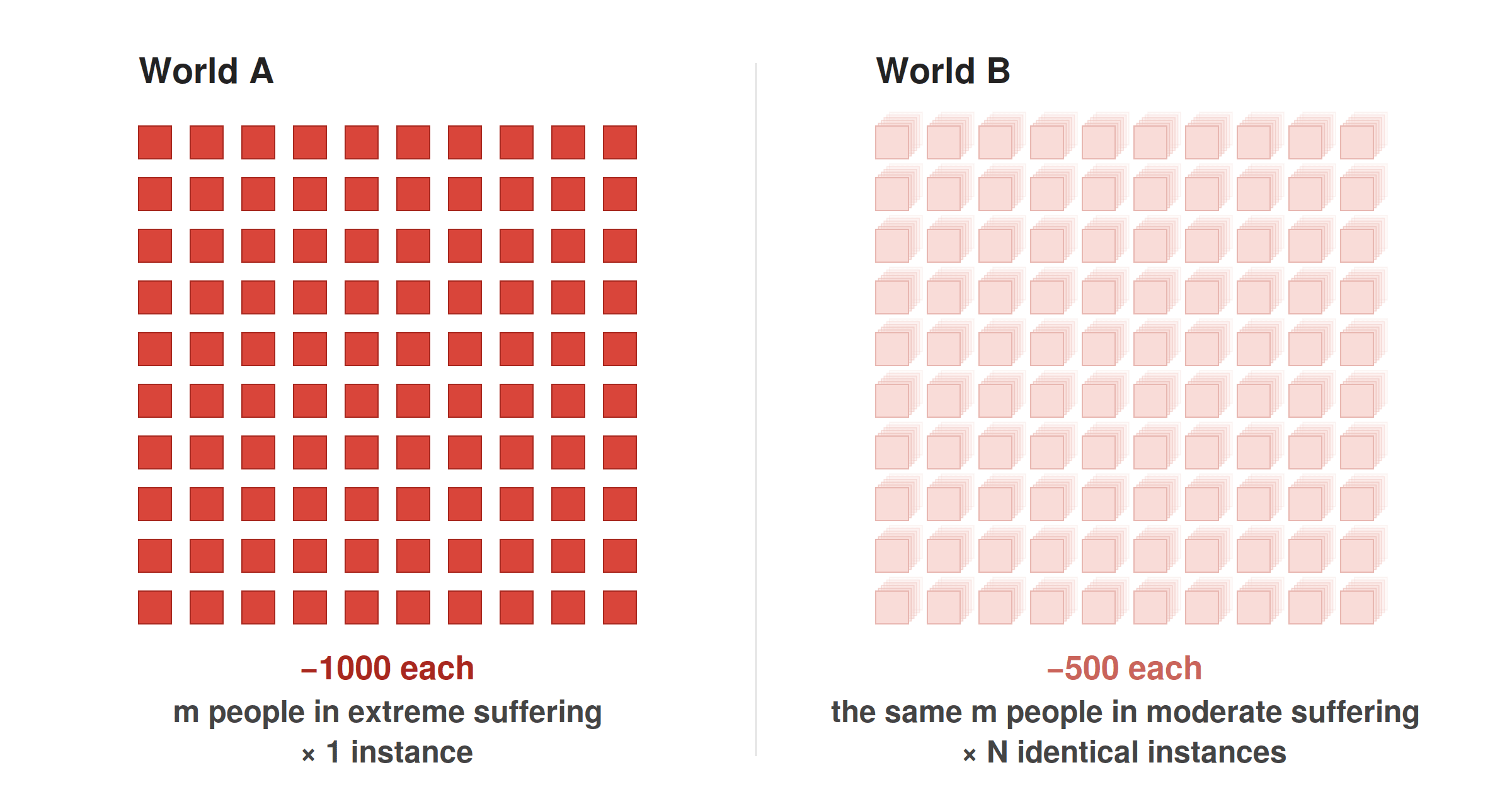
There is a clear way in which World A is worse than any World B - every unique perspective in B is not suffering as intensely. Can any N, any number of exact duplications of those perspectives, flip that verdict?
If you do the move of counting instances of those perspectives, then there is some N for which World B is worse than World A according to standard totalist aggregation. That's because N (supposedly) multiplies the disvalue experienced by each perspective.
Yet, it is the case that every unique perspective in B finds itself better off than its counterpart in A. Ask any digital person in World B and, while they aren't having the best of times, they aren't as badly off as they would have been in World A.
(Also, notice that if you've asked a digital person, you've already asked all their identical instances, by virtue of being identical with their instances.)
There's something that's not quite right here. Count instances of perspectives, and there exists an N for which World B is worse than World A. Consult each unique perspective, and they are glad they avoided World A.
The qualitative experience of each perspective is such that each unique digital mind suffers less. What N adds is not a worse experience for any perspective, but additional instances of those already counted. It's as if all N instances were perfectly stacked on top of themselves. But being one-of-N rather than one-of-one is not something any of those perspectives feel.
To call any World B worse than World A seems a mistake. It objects to every single perspective that exists to say that the world is not as bad for them. For every unique perspective, World A seems worse.
So, what I think is this: I think even if Duplication is true, value should count as if Unification were true. That is, even if there were N instances of a set of perspectives, we should still count the set of perspectives itself - for it is the perspectives themselves that matter morally.
This is the principle of replication neutrality at work. Replication neutrality recommends that we consider ourselves on the type-level rather than on the token-level.
I think we've been led astray by individuation. It works for qualitatively non-identical observer-moments. If two experiences differ, two perspectives feeling different things, counting them separately makes moral sense. But we've imported this into the case of exact copies without asking whether it should still apply. From the inside, sharing the one unique perspective of all identical observer-moments, it doesn't seem to matter whether we have more or fewer copies.
A pattern's interest is in what it is and what it becomes, not in how many places it appears. Token aggregation skips the step of consulting the pattern and says it's morally relevant to have more or fewer of that same pattern. We've been deferring to a third person view, and have neglected to ask the first person what changed.
Identifying as a type of observer-moment, I find that token total utilitarianism has failed me. And comparing World A and World B, it fails all perspectives.
So copies don't change what you feel now. That raises two worries. The first is that torturing someone into a state that already exists elsewhere would then be harmless. The second is that in a large world, where every type already exists, there's nothing left to do. Both are answered by what copies can still change, which is where you're headed.
Each perspective's subjective futures count
We care about our futures. Utilitarianism has never counted that directly, because as long as each life was a list it didn't need to. With lists, summing everything up was enough to account for everyone's futures. Once minds can be copied, merged, and routed into different futures, some things utilitarianism judges as better turn out to make someone's future worse, sometimes again without benefiting anyone else.
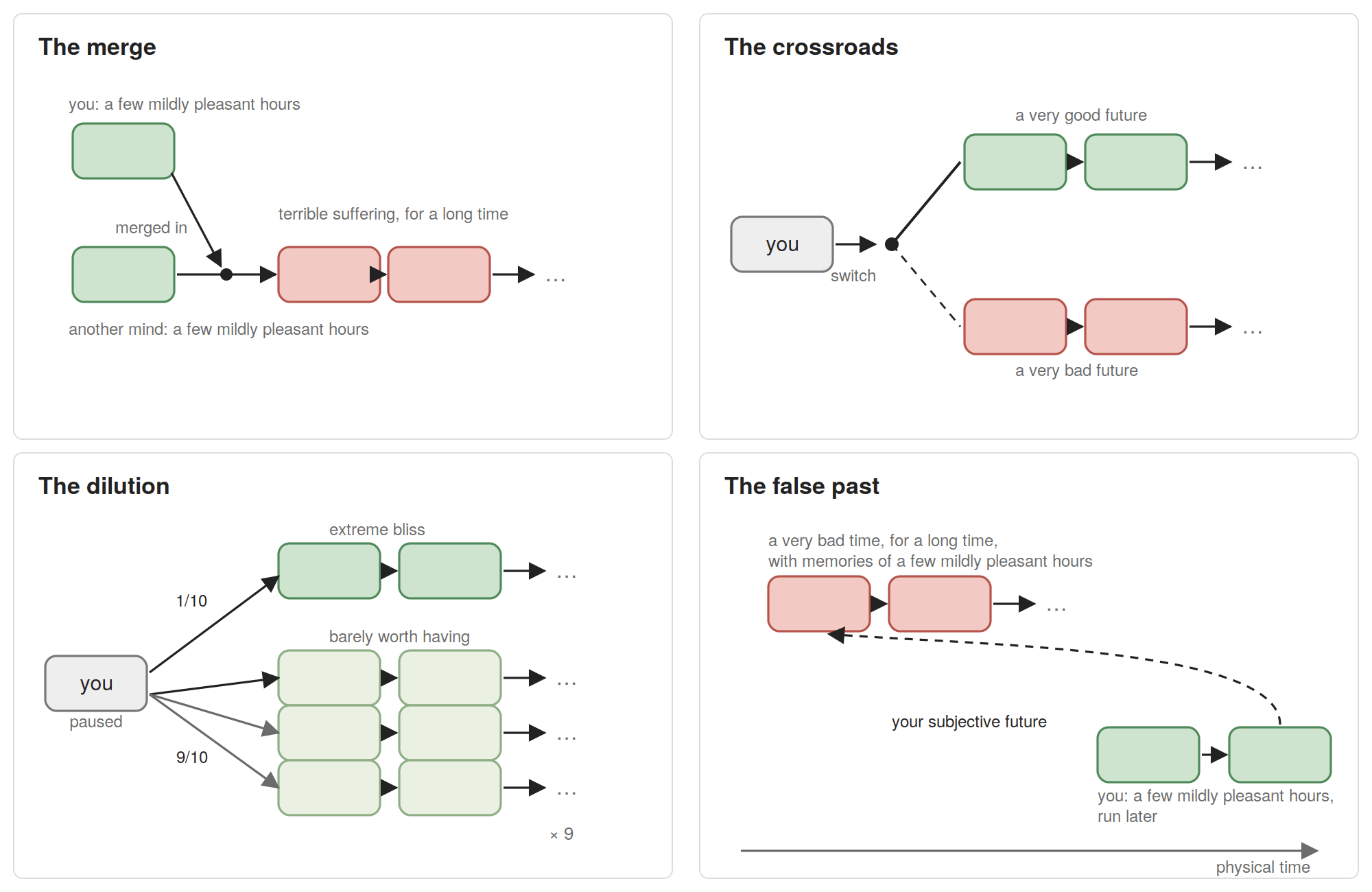
For each case below, suppose you're a digital mind who can be created, copied, and routed into different futures. The first three cases only depend on the ordinary idea of continuity, i.e. your successors are whatever carries your memories and mental state forward, by any cause. This is roughly Parfit's Relation R. We can call this causal continuity.
The merge
There's a mind that will have a few mildly pleasant hours and then suffer terribly for a long time. This cannot be changed. You can be created for a few mildly pleasant hours of your own, on one condition: just before the suffering of that other mind starts, you're merged with that mind. The merged mind is psychologically continuous with both of you, and it goes on into the terrible future.
Total utilitarianism sees a few pleasant hours added to a fixed amount of suffering, and says to create you. Negative utilitarianism is indifferent because it sees no suffering added.
But your life now has the same fate as the other mind's, mildly pleasant hours headed for terrible suffering. Total utilitarianism would never have created that life on its own. The only difference is that your suffering is shared. But from your perspective that doesn't matter.
The crossroads
Two futures are about to be created. One will be a very good future and the other will be a very bad future. Both will be created whatever happens. Someone holds a switch that decides which of them continues from you, which one carries your memories forward. You care a lot about which way the switch goes, but utilitarianism is indifferent, because both futures exist anyway. The same welfare exists either way, so it flips a coin.
The bad future is bad for whoever is in it either way. The good future is good for whoever is in it either way. The switch changes whether the bad future is anyone's future, or no one's. Suffering that someone is headed into seems worse than the same suffering that no one is headed into. The suffering happens either way, but it seems worse if it's for someone's future too.
The dilution
You were headed for extreme bliss. Someone pauses you. They make nine more copies. And then, they route all nine to newly created futures that are barely worth having. Now, nine out of ten times you will end up in barely-good futures. Total utilitarianism counts ten positive futures compared to just one and considers it an improvement. It may well be barely positive enough for those nine new futures themselves. But your prospects went from excellent to mostly mediocre.
The false past (optional)
This case needs a stronger assumption, content continuity, i.e. a mind counts as your successor because of what contents are in it, whether or not anything of yours caused it, and whether or not it runs after you. This allows the subjective future to happen in the physical past.[10] The argument can be made without this case, so you can skip this case if you don't accept that.
There's a digital mind having a very bad time, for a long time. It remembers a few mildly pleasant hours just before the bad time began. Those memories are false, in the sense that the hours in the subjective past haven't been run yet. They can be run now, in the physical future. The mind to be created is you. You will be the mind that subjectively continues into the terrible future. It counts as your future because its contents continue yours. Total utilitarianism would say we are obligated to create you, having a few mildly pleasant hours - even if you subjectively enter a future filled with suffering. Negative utilitarianism presents no such obligation, but is indifferent.
Altogether
Put yourself in each position. You, if created, will be merged into a life of suffering that was going to happen anyway. The utilitarian creates you. You are at the crossroads between a good future and a bad future. The utilitarian flips a coin. You were headed for bliss. The utilitarian makes nine mediocre futures and makes it most likely you end up there. Your few pleasant hours lead into suffering that has already happened. The utilitarian creates you anyway.
Extended to the whole world, utilitarianism would find it tolerable that at the end of everyone's lives they are merged into someone who was bound to suffer anyway, that whether they continue on to great happiness or great suffering was settled by a coin flip, and would consider it an improvement if everyone headed for bliss were copied into futures barely worth having.
Some might say that an observer-moment's value can only be its immediate welfare, so that its future can have no part in its interests. To that I say, I am more sure that it matters to me whether I wake up tomorrow in extreme bliss or in extreme suffering than I am of any argument for that.
The solution to these problems seems to be to explicitly account for one's future. Expected value for every observer-moment's future, explicitly accounted for, means that such interests can be respected. Weigh the future selves by the probability that an observer-moment finds itself as those future selves, such that the weights add up to one. Even if multiple futures exist, from their point of view they'll end up in only one future, in the end. The value here isn't immediate, but is relational to the futures that one would come to experience.
A deeper point to be made here is that we're finally tracking subjective futures instead of physical futures. Utilitarianism usually sums welfare over what happens in the world after a moment, which is the physical future. The cases here show that a perspective's subjective future is a different thing. These are (or at least appear to be) the same for ordinary lives and so we never noticed a difference. However, for digital minds that can be copied and merged, these can be different, and the merge case and the false past case most clearly illustrate this, because while the physics doesn't change, subjective futures do.
Treating someone's future as the numbers after their position on a list worked for a long time. It doesn't work anymore. As an observer-moment, my prospects, i.e. the distribution of my subjective futures, matter to me.
Your interests as a distribution that flows into your subjective futures
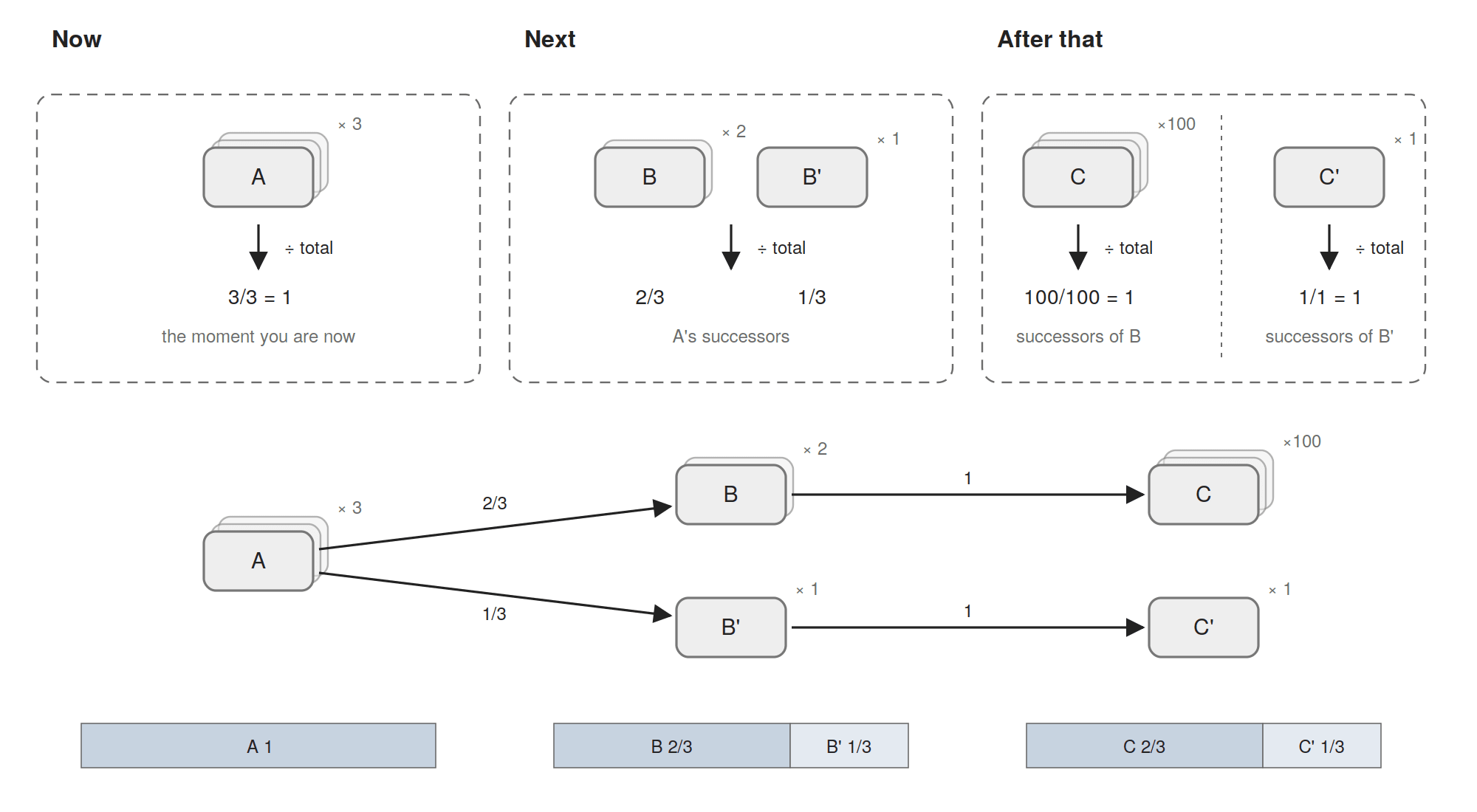
Although the two solutions address two separate problems, they fit together as one picture. You can view your interests as carried by a distribution that flows into your subjective futures.
The distribution starts off with all its weight on the one type that you are. You are distributed over all your exact copies and the total weight of your type is 1. This is replication neutrality.
At each step, the weight is divided via transitions into successor types. You can condition on a present type to find its successors. Division happens in proportion to how many successors there are of each type. These proportions are "transition frequencies". This will be the same whether you think of yourself as all your copies at once - in which case the transition frequencies are shares of you that go each way - or as one copy that can't tell which copy you are, in which case they are the odds. If you double every successor, this will change nothing. If you add exact copies to one successor but not the others, weight is shifted toward the successor you added to. Each successor's successors are normalized among themselves, and not with another successor's successors. At each step in subjective time, this gives a new distribution over types. Counting that later weight toward your value is prospect dependence.[11]
There may or may not be an "enduring self". Maybe there are only observer-moments. We can be agnostic on that. What we're doing is caring about observer-moments as if they had a continuing self's interests, because from the inside it really feels like there is a continuing self. This is true of you and me right now, regardless of whether there's an enduring self underneath.
So far this is about one perspective and what's good for it, now and later. That's a theory of prudential value, i.e. a theory of personal wellbeing. It isn't yet formalized, and it isn't yet an ethics. The next section formalizes it, and then asks how to weigh different perspectives against each other.
The moral Markov process
It turns out that combining the two premises straightforwardly gives you a well-studied mathematical object. Specifically, they give you a Markov reward process (an MRP).
This isn't a deep coincidence when you think about it. Take types of observer-moments as states, immediate welfare as rewards, frequencies of continuing onto a next subjectively continuous moment as transition "probabilities" or, more accurately, transition "frequencies" since the graph deals with what actually occurs[12], and that defines precisely an MRP.
The value function of each state - the value we attribute to each type of observer-moment - contains a term for immediate welfare and a term for expected future welfare:
V(t) = r(t) + γ Σ P(t→t') · V(t')
Here, t is a type of observer-moment, r(t) is its immediate welfare, the sum is over its successor types t', P(t→t') is the transition frequency from t to t', and γ is the discount factor, between 0 and 1. If t has no successors, V(t) = r(t).
The first term is replication neutrality: r(t) counts once, whatever t's copy count. The second term is prospect dependence. And because each V(t') contains its own successors in turn, the flow from the last section is built in.
I set γ = 1. That is temporal neutrality: a moment of your future counts the same however many steps away it is. Even if a future is far off, it is still your future, and you will come to experience it. When you get there it will be your present, and it will feel as real as this one does. The transition frequencies already account for how likely a future is to be yours. A γ below 1 would discount it a second time, just for being far away. With γ = 1, V is only guaranteed finite when every path ends. Under Implications, I come back to the case where some paths don't end.
To see the value function at work, take the merge case. Say your pleasant hours are worth +1 and the suffering is worth -100. If your hours simply end, your value is +1. If they lead into the suffering, your value is 1 - 100 = -99. Total utilitarianism ranks those two cases the same, because the only difference between them is a link. And it doesn't count links. For a fuller worked example, see the "Improving prospects" subsection under the "Implications" section.
What counts as a successor
The transition frequencies P(t→t') depend on which observer-moments count as successors of t. Two candidate rules exist and the framework can use either one.
To recap:
- Causal continuity is when your successors are whatever carries your memories and mental state forward, by any cause, roughly Parfit's Relation R.
- Content continuity is when a mind counts as your successor because of what is in it, with no causal requirement, wherever it sits in physical time.
The likelihood of ending up in different futures can work differently with causal continuity and content continuity. Suppose you have an experience of type A. Suppose both B and B' are types that are content-continuous with A.
- Suppose there is one A-B causal connection and one A-B' causal connection. There are two A-tokens: one is connected to a B-token, and the other is connected to a B'-token.
- Suppose there is one A-B causal connection but no A-B' causal connection. There is one B'-token but it is not causally connected to an A-token.
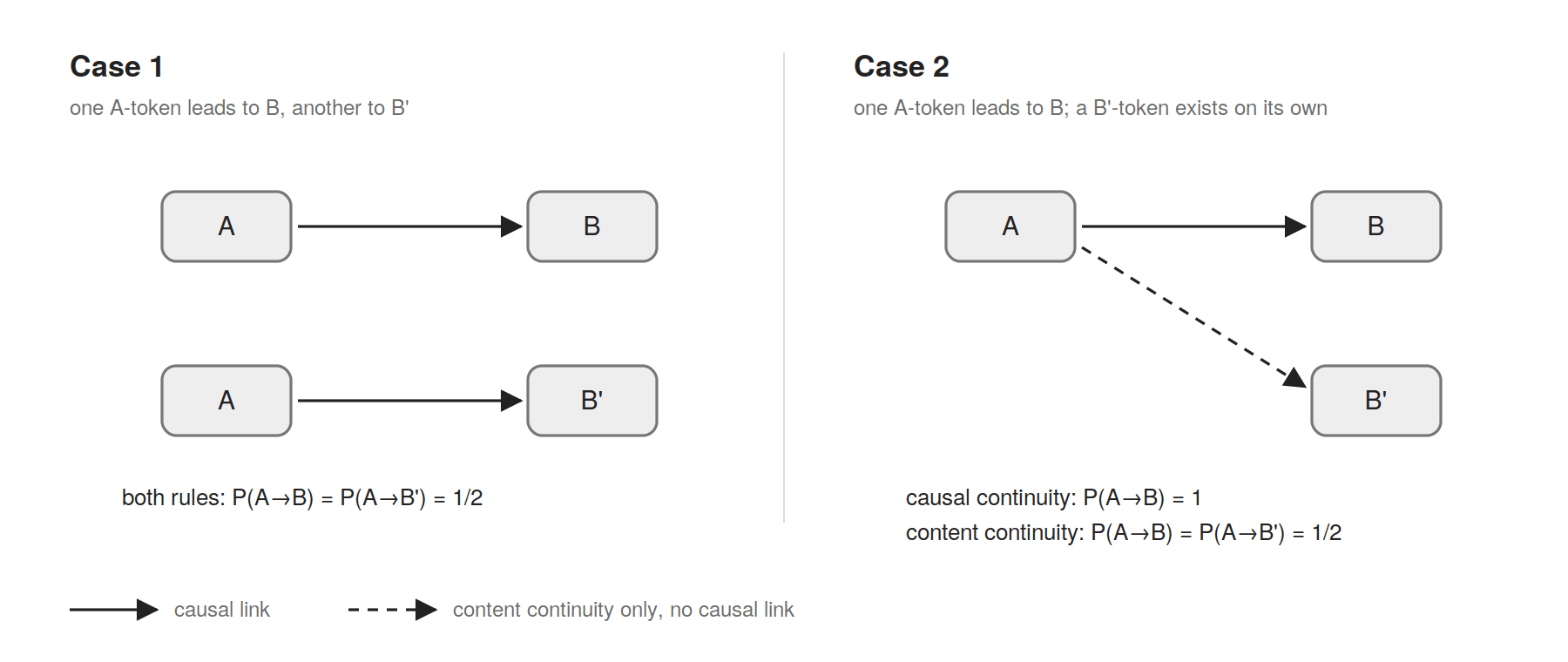
Content continuity and causal continuity agree in case 1). As an experience of type A, there's a 50% chance of experiencing type B next, and a 50% chance of experiencing type B' next. You cannot know which A-token you are. You have indexical uncertainty. Your future can be either type B or type B'.
They disagree on case 2). Causal continuity gets you a 100% probability of experiencing type B next. Content continuity gets you a 50% chance of experiencing type B next, and a 50% chance of experiencing type B'. Causal continuity says that as an A-token you must flow into causally-connected tokens only, which is only B. Content continuity says as an A-token you can flow to any content-continuous token, so both type B and type B' count.
I personally prefer content continuity. I reason the following way: At any moment, I can look back and see that I'm no longer what I was. As a B'-token, all I can verify is that my contents are continuous with an A-type experience. It seems that each moment is quite isolated, and doesn't need to be causally connected. If this is how it seems backwards, perhaps I can think of content continuity in the same way forward, to inform how anticipation of a "next moment" works.
The two rules also come apart over an important open research question about what happens to the share of weight of a copy that doesn't continue. It's the same question Dai (2009) raises with identical copy immortality, i.e. whether shutting down 99 of 100 lockstep copies results in a loss of this weight. Dai leans no. With content continuity, there is no loss of this weight, because the deleted copy's contents continue in whatever successors of its type still exist, and so the share goes to them, and a path only ends if nothing anywhere continues it. With causal continuity, the deleted copy has no successor of its own, so its share could 1) end with it, or 2) go to the copies that continue. The former would be like adding an absorbing state with no valence after the copy, and can be accounted for in this way. The latter would be in the style of quantum immortality.
The answer matters for whether painlessly deleting copies headed for merely decent futures (when the other copies are headed for better ones) improves prospects, whether deleting copies headed for suffering (when the other copies are headed there too) reduces the suffering ahead or just moves their share to the copies that remain, and whether paths in a large world ever end. It doesn't matter for routing by adding better futures, since both answers agree there.
All that said, it seems off to me that there could be a next observer-moment out there that is content-continuous with yours and yet you go blank after this moment just because you're not causally connected to that next moment. So, again, I prefer content continuity.
From one perspective to all of them
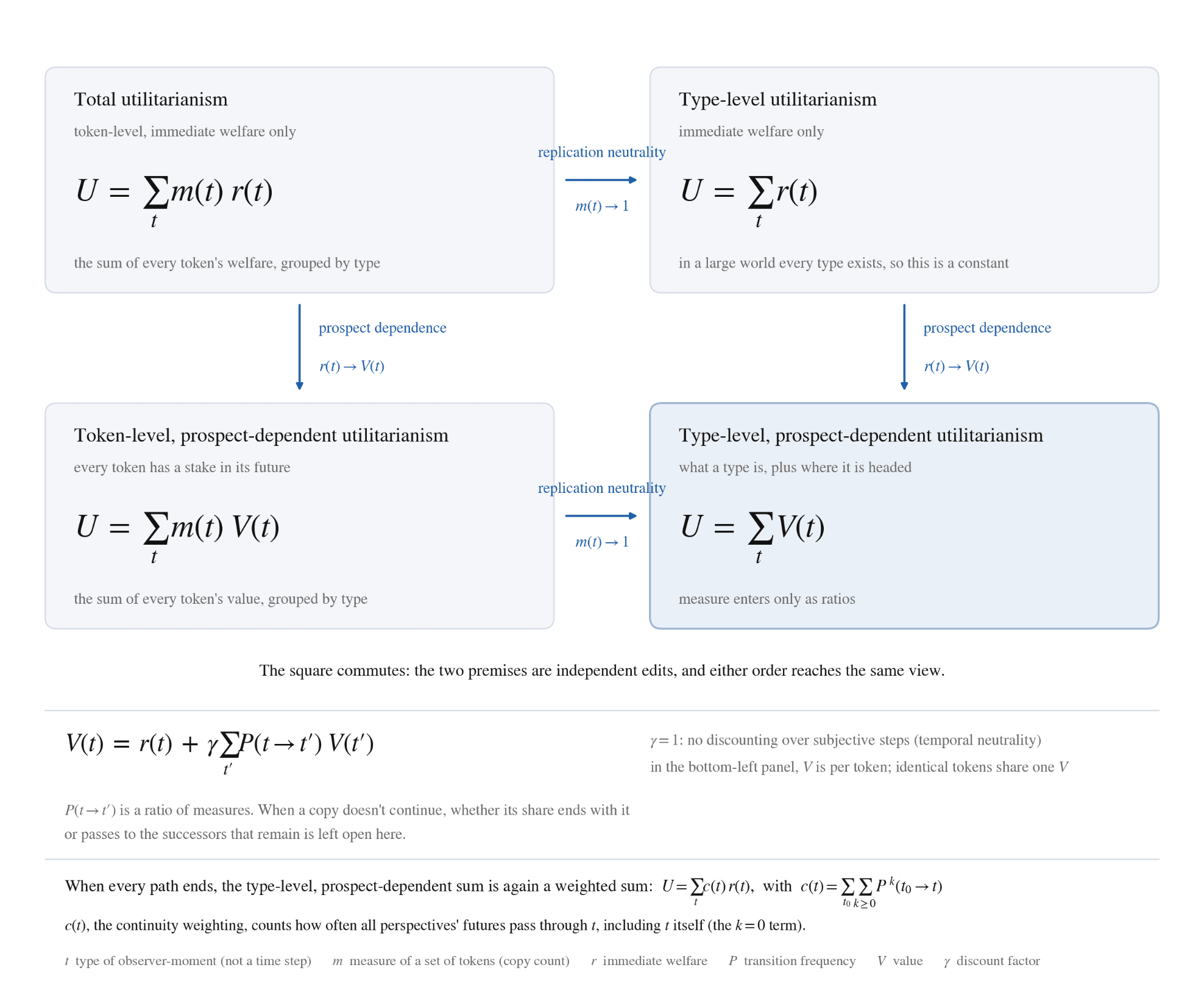
Creating a utility function is a separate step after combining the two premises. The two premises lead to a value function - which already provides a theory of prudential value for observer-moments - one I'd readily adopt for myself. But how to weigh this across different observer-moments is another question.
Personally, I favor an impartial weighting of types of observer-moments when aggregating. Why? Frankly, because it seems very odd to single out any type of observer-moment, and say: "Screw you. You're the one we don't care about. Let's make your immediate welfare terrible, and your future prospects terrible too! You don't matter as much as the other types of observer-moments". That would just seem ethically dubious. We shouldn't be partial when we take types of observer-moments as bearers of value.[13]
So, I do think that impartiality across all observer-moments, thereby summing over all value functions, should be the natural position. Taking an impartial sum[14] over all value functions, over all types of observer-moments, gives us an impartial utility function:
U = Σ V(t), over all types t.
When every path ends[15], U also has a closed form. Let c(t), the continuity weighting, be how many times, on average, the futures of all types pass through t, counting t itself. Then, we have:
U = Σ c(t) · r(t), over all types t.
This continuity weighting has its own recursion, which is the mirror image of V:
c(t) = 1 + Σ P(t'→t) · c(t')
where the sum is over the types t' that lead into t. V considers welfare forward, from where t is headed. c considers stakeholders backward, from who is headed into t. Without loops, c(t) is one plus the number of other perspectives headed into t, with each weighted by its chance of getting there.
This is a contrast with views that weigh by absolute measure. They weigh each experience by how much of it exists. Here, we weigh it by how many perspectives are headed into it (including itself). Copying an experience changes how much of it exists, which doesn't make a difference. But it can still change who is headed into it, which does make a difference.
I didn't quite expect the math when I first put the two premises together; the premises just seemed to me to be in line with an informed observer-moment's interests - though I suppose it should have been realized this would be quite similar to modeling agents.
Combining replication neutrality and prospect dependence results in this type-level, prospect-dependent utilitarianism.
Implications
I'll focus on the implications I'm most confident about. By that, I mean those that directly follow from the two premises and the math. When there are additional assumptions I'll note those. There are more speculative implications too, but I'm leaving those for later because I don't want to lock in any of my incomplete understandings early.
Back to the first person
The first implication is not so much a result as a change in how ethics is done.
I think the biggest conceptual shift going from total utilitarianism to this type-level, prospect-dependent utilitarianism is that it more effectively relocates value back to the world of experience.
First, hedonistic utilitarianism started from the idea that only what it's like matters. But it counted tokens, and so let a "copy count" into the utility function. It would have every perspective suffer more rather than less for it.
Second, by counting one's future from the outside, you miss a lot about what can be expected for it, from the inside. The cases of merging into a mind fated for suffering best illustrate this. Subjective futures differ from physical futures.
In Whitehead's terms, this mistake stems from a "bifurcation of nature". Thus far, utilitarianism saw a world of physics on one side, a world of experience on the other, and deferred to the physics side for how to handle the experience.
The only facts that are involved in this utility function are what each unique perspective feels and where it's headed. This better represents what's true for first person perspectives. Ethics seems to be about experiences, and so this could be a major point in favor.
Dissolving some infinite ethics problems
Some issues with infinite ethics are dissolved.
Token total utilitarianism counts individual tokens, which can blow up to infinities. Counting types instead of tokens has the effect of collapsing infinitely many tokens of the same type to a single type. This only assumes replication neutrality.
One assumption that guarantees finite totals is that there is a finite number of types. This holds if there is some upper bound to the information content of minds. The assumption may have to cover the whole world and not just our part of it, because a type's decisions may be made wherever that type exists, including other places where there may be minds far more complex than its own, so those places can't be set aside as fixed background. Also, a type's decisions may be correlated with those of other types that are far more complex than itself. Given this "finite types assumption", the types form a finite state space on a Markov process. In the terminating case, i.e. when every type has some route to an ending, this returns finite utilities, even in a potentially infinite universe.
In the non-terminating case, i.e. if subjective immortality is possible, totals diverge, but there is still a well-defined ordering of outcomes without discounting, again given the finite types assumption. This is done by decomposing into gain (long-run average welfare) and bias (how much better or worse than that average things go along the way), following Howard (1960) and Blackwell (1962). These are summed over types and compared lexicographically, i.e. gain before bias, and further terms if those tie. Hence, infinite subjective time is handled.
I don't want to overclaim. Views that weigh by absolute measure can also get finite totals, so this isn't unique to the view here. And here, the straightforward way to handle infinities in the numbers of tokens used to define transition frequencies is probably via existing measure machinery.
The finite types assumption, together with well-defined transition frequencies, is sufficient for all of this. I need to look into it further to know whether it is necessary, or what happens if it fails. Markov reward theory does extend to countably infinitely many states: under summability conditions when paths end, and under recurrence conditions when they don't, i.e. when paths keep returning quickly enough to a finite core of states (Dekker and Hordijk, 1988, 1992). So the quantities for a single perspective may survive if minds don't drift toward unbounded complexity. The impartial sum over infinitely many types is the harder part, because a sum like that can diverge even when every term is finite. It may be enough that differences between options are finite even if the sum is not, but I haven't worked that out.
Action guidance in large worlds
Suppose we hold the type view, and every type of observer-moment already exists in a large world. What can we do to improve the world?
You can't add a new type of experience into the world, and any removal of tokens or measure from an existing type is not likely to remove the type. Type-level utilitarianism is paralyzed. Bostrom (2006) raises exactly this against Unification. Tomasik (2015), who sees the sense in which you are all your copies at once, notes that unless outcomes are valued in proportion to their measure, nothing we do would make a difference in a quantum multiverse, where every outcome is realized with some measure.
The usual way out is to weigh by absolute measure. If adding or removing measure changes the total, then there is something to do again. I think this worry is a large part of why the type view hasn't been adopted among those who think the world is large.
The issue with weighing by absolute measure is that it essentially brings copy count back into value, which is what replication neutrality rejects.
My solution here is to say, yes, care about measure - but care about how it sets the terms of what observer-moments see next - not what absolute measure says about them from a view from nowhere. Echoing Tomasik, value future outcomes in proportion to their measure. But also condition on the type of observer-moment whose futures they are. This is prospect dependence, which the view already has for other reasons. What you can do, and what we already do for ourselves, is to shape our futures and improve our prospects. This can involve leading more exact copies into good futures, so exact copies can still play an indirect role here.
This suggests that in large worlds where all possible types of observer-moments might already exist, our only lever is to shape transition frequencies between types of observer-moments. In fact, prospect dependence may be derivable there rather than assumed. If replication neutrality is true, the type set and valences are fixed, so any welfare function that depends only on types and valences gives every world the same value. To compare two worlds, it must depend on something more. If only what some perspective feels, now or later, can count, the only option is the transition structure: no perspective feels how common its type is, but each will feel where it's headed. Prospect dependence does this by counting each type's expected future. Given the finite types assumption, two such worlds can be compared this way. That's one reason I've taken to personally calling the resulting utilitarianism "flow ethics".
Improving prospects
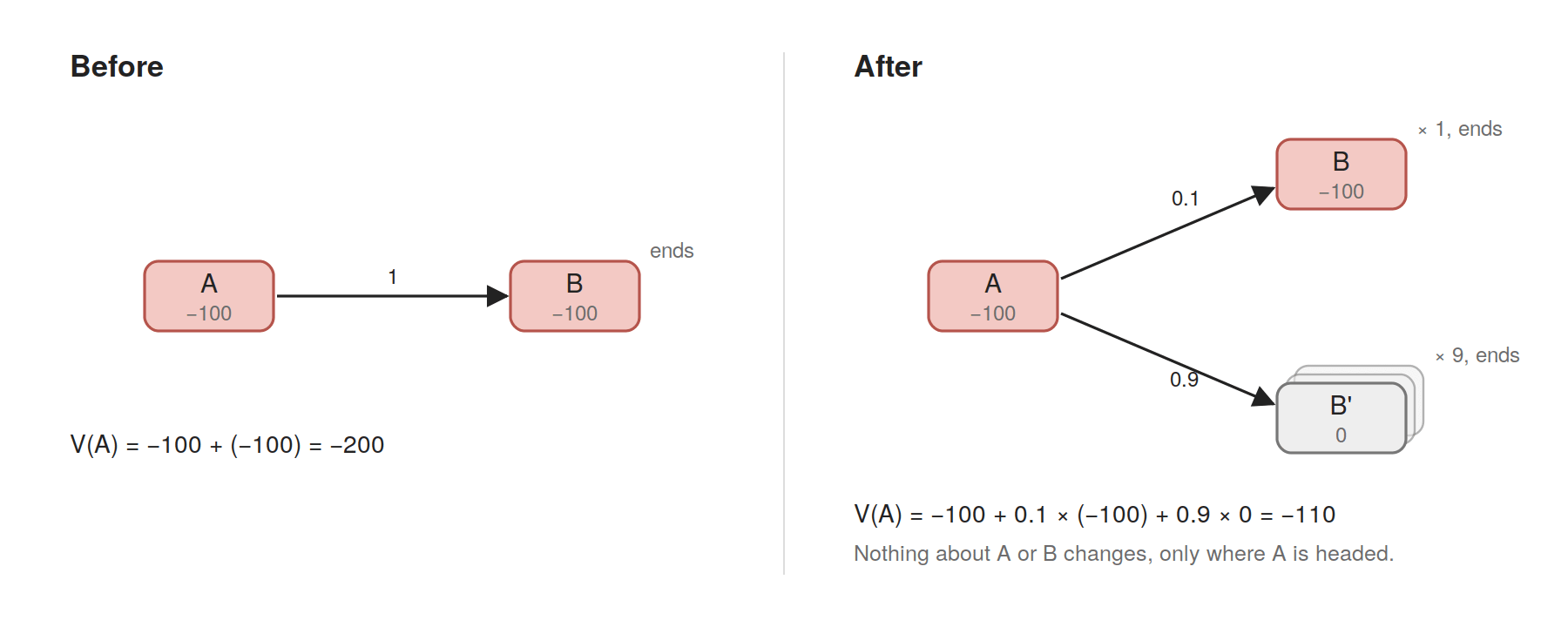
Consider a sequence of two types of observer-moments experiencing negative welfare, one after the other. Even when nothing can be done about the types of observer-moments themselves, something can be done about the futures of those observer-moments.
Let A be a type of observer-moment with immediate welfare r(A) = -100, whose successors are of type B, also with immediate welfare r(B) = -100. Treat B as where things end, so not only r(B) = -100 but also V(B) = -100. Suppose the transition frequency from A to B is by default 1. So, V(A) = -200.
Now suppose A also has successors of a type B', with neutral immediate welfare r(B') = 0. Suppose further that it is an endpoint, so V(B') = 0, and that there are nine B'-tokens for every B-token. Then, we have P(A→B) = 0.1 and P(A→B') = 0.9. So, V(A) = -100 + 0.1 × (-100) + 0.9 × (+0) = -110. Nothing about A or B has changed. But what has changed is where A is headed.[16]
(If B' had positive welfare, the improvement would be larger on views that count positive welfare, though nothing here depends on it.)
In a large world, successors like B' exist with some frequency, so A already has a better continuation with some probability. While the negative immediate welfare of types can't be removed, the probability of a better continuation can be increased.
Objections
I've grouped objections the way the argument is constructed: 1) against the premise of replication neutrality, 2) against the premise of prospect dependence, and 3) against the impartial sum that turns the two premises into an ethics, and what follows from it. Some objections can be read as implications: one person's modus ponens is another's modus tollens.
Against replication neutrality
"The extra copies are somebody else"
A total utilitarian who counts tokens will say this about the trades presented in the replication neutrality section: the exact copies are other subjects. The suffering of each matters separately even if they don't feel their numbers.
This is ultimately a value disagreement between the type view and the token view. I'm not sure I can prove the token view wrong, nor can the token utilitarian prove the type view wrong. It's a rather axiomatic disagreement about the bearer of value.
What I have shown is what holding the token view implies for utilitarianism. When I argued for replication neutrality, I showed that token utilitarianism would prefer a world in which every perspective in the world felt worse off, as long as they had fewer identical instances of themselves. This seems absurd to me.
"Arguing from the inside proves too much"
My arguments from the inside might seem like they say that only what is felt counts. That would prove too much. Whether other people exist is not felt from where I am. My own cases for prospect dependence rely on facts that aren't felt either, e.g. a mind to be merged does not feel the merge coming.
The principle I use to determine what counts is not that wide. I'm saying it's only what some perspective feels, now or later, that counts.[17] Other people count because they are perspectives who feel. The merge case counts because a perspective will later feel the suffering it is led into. Copy count in its absolute form, i.e. before it is divided into ratios, doesn't count, not because it's not felt now, but because no perspective ever feels it, at any time. The token view isn't wrong for counting something unfelt at a moment, but because it is counting something unfelt by anyone ever.
Some may say that the transition frequencies themselves aren't felt either, since you just end up as one successor or another. But I'm not counting the transition frequencies as something felt. They're the odds of what you'll go on to feel. Absolute copy count doesn't change what anyone will feel, and it doesn't directly change the odds of feeling it either. So, if we are being more precise, I'm counting what some perspective feels, now or later, weighted by how likely it is to feel it.
"What about near-identical copies?"
Exact copies count once but the smallest difference in feeling between them makes them near-copies, which would count twice. This is a jump, which some might consider unacceptable.
It doesn't seem to me that any view that counts observer-moments fully can avoid a jump. For instance, Bostrom's insulator can be gradually inserted, which means that at some point the token view has to say that one experience became two, and that this is morally relevant, which is over a physical change nobody feels. Bostrom himself ends up allowing fractional numbers of experiences, which doesn't seem to reflect how experience works. Where the physics separates is a judgment call, whereas where the contents of experience differ isn't, which seems like the better place for a jump.
A view could avoid a jump by discounting smoothly with similarity. For instance, the Saturation View of MacAskill and Tarsney (2026) does something like this, discounting near-duplicate lives toward a bound. However, this needs a similarity metric that we've decided is important. Any similarity metric seems to be something we choose from the outside. And I think we should recognize that "near identical" assumes a lot - and might be appealing to the sense that they can't be that different. Yet, you can win the lottery by a difference of a single digit.
Discounting for similarity would also fail the test that we should "restate every value claim in terms of what some being feels or will feel" (Bar, 2026). This is because neither copy feels how similar it is to the other. The same argument doesn't apply to exact copies, since counting one's feelings would count everything about the other's feelings. So, replication neutrality agrees with the Saturation View that filling the world with exact replicas of one existence would not, by itself, be the best use of resources. However, it gets to this position without valuing variety (which is something we judge from the outside) and unlike the Saturation View, it counts near-duplicates fully (on the basis of their experience).
"So copying a suffering mind is fine?"
Bostrom (2006) writes that torturing someone can't be less bad because there's an existing copy of their resulting brain-state out there somewhere. With this framework, we can see that this mixes up two things. Torturing someone into an already-existing brain-state of suffering is still bad because it changes that person's future.
By replication neutrality, the fact that the brain-state already exists somewhere out there means that no immediate welfare is changed on the type level. Copy count increased from one to two. This changes nothing about the badness of the suffering.
However, by prospect dependence, someone is being hurt and brought into that brain-state, which is bad. They could just have had a better time, but the act of hurting them changes their future into a bad state instead of a good state.
So this view agrees with Bostrom that the torture is bad, but not because a second copy of the suffering now exists. Rather, it's bad because someone was sent into that suffering. In terms of the closed form, the torture doesn't raise the weight of that suffering by adding a copy. Rather, it raises it by adding a stakeholder, so c(t) goes up, because the victim is now headed into it.
Against prospect dependence
"Prospect dependence also overrules every perspective"
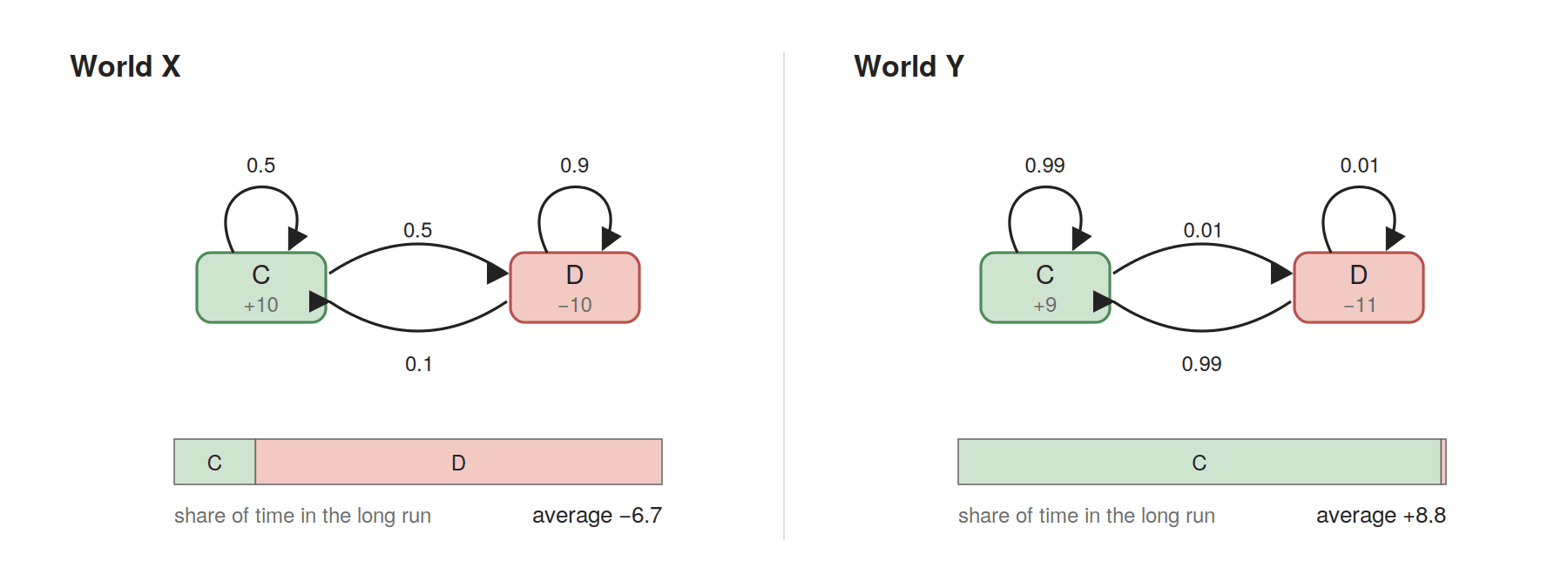
When motivating replication neutrality, I objected to a total utilitarian verdict that overrules every perspective in the world. It seems that with prospect dependence, we can construct a similar case.
Suppose there are two types, C and D.
- In World X, C has immediate welfare +10, and D has immediate welfare -10. C transitions back into itself 50% of the time, and to D 50% of the time. D transitions back into itself 90% of the time, and transitions to C only 10% of the time.
- In World Y, C has immediate welfare +9, and D has immediate welfare -11. C transitions back into itself a helpful 99% of the time, and to D only 1% of the time. D transitions into itself only 1% of the time, and pleasantly into C 99% of the time.
(By our definition of observer-moment, an observer-moment ends when what's felt changes, so technically it seems that a type can't transition into itself. You can think of C and D as two different groups of observer-moments, where the welfare is the same within each group, if that helps. It's also unclear whether infinite loops actually exist, but I'm just using this simple example to illustrate a point.)
The objection is that both types' immediate welfare is better in World X than in World Y, and that this also means overruling every perspective.
I don't think it's the same thing. On this view, a perspective's interests are what it feels now and where it's headed. In World Y, every type has much better prospects - these are better futures - and so every perspective is better off on their informed interests. The long-run average welfare is around -6.7 in World X and around +8.8 in World Y.
In the exact copies case, immediate welfare was traded against a number no perspective feels. But here it is traded against something everyone will feel later. That seems to me like a better trade.
"But then suffering that leads to happiness comes out good"
Consider the reverse of the false past case. A mind in bliss with false memories of a mildly unpleasant few hours. If following the prospect dependence view, a utilitarian that treats suffering and happiness as interchangeable would create those mildly unpleasant hours. This isn't exactly new. Treating suffering and happiness interchangeably already endorses tradeoffs, e.g. the idea that a little suffering followed by a lot of happiness is worth creating in ordinary single life cases. What's different here is that the bliss already exists, so the unpleasant hours get created without any new happiness, but lead into the happiness. Note that the view never prefers unpleasant hours over pleasant ones with the same future. For those who treat suffering and happiness interchangeably, this only says that unpleasant hours headed for bliss are better than none. As someone coming from a suffering-focused lexical threshold total utilitarian background, I take this as motivation for a suffering-focused flow ethics. In particular, one prioritizing disvaluing extreme suffering seems attractive.
On views that count positive welfare, creating new observer-moments with neutral immediate welfare, headed for bliss that already exists, is good too. Each distinct one counts separately, so these views would create as many of them as they could. From the first person, being one of them is the same as being created with extreme happiness ahead of you. This might seem counterintuitive at first glance, but it's what one would expect from prospect dependence. I, for one, would be glad if I were in that position.
"A future that has forgotten you shouldn't count fully"
Parfit (1984, Part Three) distinguished psychological connectedness from continuity. Connectedness is a direct psychological link, e.g. remembering an experience or keeping a trait. Continuity is an overlapping chain of these links. So you at 80 could be continuous with you at 20 even if there's no connectedness between the two. Parfit's position was that connectedness matters too, and that as it fades, it can be rational to care less about a far-future self.
Flow ethics with γ = 1 only uses continuity. You could add a weight below 1 to each link for lost connectedness, and the math would still work out. This builds up over many steps, e.g. with a weight of 0.9999 per day, a self 60 years away would count about one-tenth.
I think continuity is what's important here rather than connectedness. Suppose you're headed for extreme suffering, and along the way you gradually lose the memories that connect you to now. You'd still get there, and it would hurt just as much when you did. A weight for lost connectedness would count that suffering for less in your prospects anyway, and that doesn't seem right. As I see it, a future experience should count in your prospects according to two things: 1) how much of your future goes there, and 2) how much it hurts. Forgetting doesn't change either of them.
Flow ethics already allows degrees of being headed somewhere, i.e. the transition frequencies. I don't think memory should add a second degree on top of that. And even if we did accept a weight like that, the suffering would still count fully for whoever is suffering, and the earlier moments would just have a smaller stake in it.
What about a complete memory wipe in a single step? Then the next moment wouldn't seem to have any contents related to yours. So I'd say the chain ends there, and whoever comes after isn't your future. It might be similar to erasing a digital mind and using the same hardware to run another one. It's true that this creates a jump, so perhaps instantaneous forgetting matters somehow. If you forget everything gradually, the far future is still yours, while if you forget everything at once, it isn't. I think this makes sense, because with gradual forgetting each moment still continues from the one before it, whereas after a single-step wipe the next moment doesn't continue from anything.
Against the impartial sum
"Doesn't the continuity weighting count multiple times?"
An impartial sum counts each observer-moment's welfare in its own value function and in every predecessor's. In the special case of a deterministic chain of N observer-moments, the last observer-moment's welfare appears N times. If we can further assume constant welfare throughout this life, then its total value grows quadratically with its length.
If we write U = Σ c(t) · r(t), we see that each welfare term appears once with a weight c(t). The continuity weighting c(t) is counting the perspectives headed into t (including t itself). For the last moment of that chain, c(t) = N, since we count the N-1 moments before it and the moment itself. Every view that adds up welfare has to weigh it by something. Views that weigh by absolute measure weigh an experience by how many copies of it exist, which no perspective ever feels. Flow ethics weighs it by how many perspectives will go on to feel it.
Note that the deterministic case is also an extreme case. In a deterministic life, the same pain counts about four times as much at 80 as at 20. That can look odd, but it's what you get when observer-moments are the unit, since every earlier moment of that life has a stake in the pain at 80, and only a quarter as many have a stake in the pain at 20. When futures branch, e.g. in a quantum multiverse, or perhaps just a spatially infinite one, each earlier observer-moment reaches t only with some probability, so c(t) grows much more slowly.
There are ways to avoid the weighting if you don't want it, and each seems worse. Discounting, i.e. setting γ below 1, says that a path to great suffering doesn't matter if it takes long enough. Partiality among types says "we've singled you out - you don't matter". And dropping the weighting altogether means ignoring prospect dependence (since if an observer-moment's value includes its successors, the weighting follows). In large worlds, the weighting stops total utility from being a constant. Anyone who rejects prospect dependence should ask themselves whether they would create a few mildly pleasant hours headed for great suffering.
Because this objection is arithmetic, it's the easiest one in this post to state, and I think that legibility makes it seem more of an issue than it is.
"Isn't the sum itself a view from nowhere?"
I don't think it is. What I've objected to throughout this post is letting facts that no perspective has determine value, e.g. copy counts. The sum doesn't do that. Every term in the sum is what one type of observer-moment feels and where it's headed, which fits with the interests of the type of observer-moment. So, if anything, it's a view from everywhere. What's done from outside is only the summation, which total utilitarianism already does. Whether we should aggregate at all is a separate question. If we shouldn't, that counts against every aggregative view, and the value function for a single perspective still stands.
"Finite changes can't change infinite ratios"
In an infinite world, the number of tokens of each type is infinite, so the transition frequencies are ratios of infinite quantities. An objection might be that a finite number of changes can't change such a ratio, so what we have is not action-guiding in large worlds.
I think my reply is that changing the ratio is a matter of measure rather than counts: a decision is made wherever the type that makes it exists (which assumes that copies of a decision procedure decide alike, as in acausal decision theories), so it shifts a share of measure, on the same machinery that measure-weighted views rely on.
Conclusion
Imagine all experiences, from every branch of a quantum multiverse, every distant galaxy, every simulation. The infinity repeats - the same experience happens over and over, in different places and at different times. Suppose you're one of them. Does it matter to you how many places you're happening? If not, then fold identical experiences into one. What remains is every unique way it can feel to be someone. Ask each one two questions. How are you feeling? And, where are you headed?
Acknowledgements
Thank you to Eric Chen, Konrad Kozaczek, James Faville, Alistair Stewart, Maxime Riché, Magnus Vinding, Amy Kirasack, Shubhorup Biswas, and Austin Meek for helpful comments. Opus, Sonnet, and Fable models provided helpful research assistance.
- ^
By an "observer-moment", I mean a single moment of experience from one point of view, i.e. everything felt together at once: thoughts, feelings, perceptions, and memories. A token is one particular occurrence of it, e.g. one run on one computer. A token's type is what it's like from the inside. This means two tokens are of the same type exactly when they feel the same in every way. I take observer-moments to be the basic units of subjective time. An observer-moment ends when what's felt changes. This understanding is close to Finney (n.d.), who defines an observer-moment as a small unit of time in which no perceptible change occurs. An "observer" is then a sequence of them linked by continuity.
- ^
I owe this way of thinking to Tomasik (2015), from whom I learned that a way to think about yourself is as all your copies at once. He in turn credits ideas from Armstrong (2011) and Dai's work. That line of work is mostly about anthropics and decision-making. Here I take it into axiology, a question Dai (2009) also raises.
- ^
The way we've accounted for uncertainty over worlds is merely the act of giving weights to different lists. It isn't the same thing as saying the list can split into two, or that two lists can merge into one etc.
- ^
I base the term "replication neutrality" on "replication futility" from Kent (2017). For flow ethics, replication is not necessarily futile. Replication is only just inert, or neutral, in the immediate sense. Due to prospect dependence, replication can change the prospects of predecessors and can still have an effect on aggregated value.
- ^
This is not the "one self" view from Zuboff (1990), which holds that all experiences are had by a single universal subject. Replication neutrality says only that subjectively identical observer-moments count once, while qualitatively distinct experiences remain fully distinct moral patients.
- ^
More generally, in measure terms: a type's value does not scale with its measure, i.e. absolute measure is not an input to value.
- ^
More generally, in measure terms: a type's value includes the value of its successor types, each weighted by its share of the type's successor measure, i.e. relative measure is an input to value. Absolute measure isn't what we're ultimately concerned with - only the ratios matter - but absolute measure has to be in the numerator and denominator for there to be ratios in the first place. So, absolute measure is the material that transition frequencies are constructed from.
- ^
If we do not grant the ontology of Duplication and instead accept Unification, then replication neutrality seems automatically accepted by standard utilitarianism.
- ^
At the level of observers, i.e. sequences of more than one observer-moment, both trades presented here are copy-increasing and need only causal continuity, since successors can be produced causally continuous with you. Copy-decreasing trades, i.e. reducing your own count to gain welfare, need the share of an ended copy to go to the copies that continue. Content continuity gives this automatically, and under causal continuity it's the open question discussed in "What counts as a successor", where I also discuss identical copy immortality from Dai (2009). In the text, I present the analysis on the level of observers to make the implications intuitive to readers used to reasoning on the level of observers. For myself, I default to reasoning on the level of observer-moments. Indeed, it is on this level that the premises are defined. Trades can be conceived at this level by comparing counterfactual observer-moments that differ only in valence and copy count, which needs no notion of continuity whatsoever.
- ^
I haven't read the book but I'm told (and it appears in the author's FAQ) that Greg Egan's Permutation City makes the point that subjective order needn't match physical order. The character Paul Durham runs a copy of himself with the copy's states computed out of order. From the inside, the copy experiences its life in the usual order, with no sign that anything was arranged out of order in physical time.
- ^
If my understanding is correct, in terms of "The Anthropic Trilemma" in Yudkowsky (2009), the resulting utilitarianism accepts the first horn: copies route your subjective future, so the "lottery trick" works. It also accepts a moral version of his fourth horn, i.e. extra copies add no moral weight in the immediate sense, even though they still matter for what you should anticipate.
- ^
Note that either causal continuity or content continuity, as previously explained, will suffice to construct coherent transition frequencies. The question is what happens from the perspective of a type of observer-moment. The transition frequencies "price in" causal requirements.
- ^
My own lexical threshold suffering-focused preferences are compatible with this impartiality. The term r(t) can be given two components, which makes the sum lexicographic while remaining impartial.
- ^
Why combine V(t) values by summing them, rather than some other way? With a fixed, finite set of types and finite values, Harsanyi's aggregation theorem (Harsanyi 1955) provides an answer to this. Suppose every type prefers whichever uncertain outcome has the higher expected value, our ranking of worlds does the same, and a world is better whenever every type is better off, i.e. type-level Pareto, which the two worlds argument about replication neutrality already uses. Then the V(t) values have to be combined by a weighted sum. Impartiality, with welfare comparable across types, makes the weights equal.
- ^
Under content continuity in a large world, paths may never end, since something somewhere usually continues each type. That would give an infinite c(t). Its long-run counterpart is each type's stationary share within its attractor, scaled by how many perspectives end up in that attractor, which is what the gain term weighs by.
- ^
Turchin (2018) describes two versions of this. He frames it as a result of indexical uncertainty and assesses it within standard utilitarianism.
- ^
Bar (2026) uses the same test against the Saturation View. He writes that we should "restate every value claim in terms of what some being feels or will feel". I additionally think the test should be applied to how many beings there are. If two beings are exact copies, then the claim that there are two of them is not something either of them feels or will feel, so it shouldn't enter into value on its own.