As someone who worked for a Canadian Senator who has AI as one of her main areas of Parliamentary interest and activity, I have strongly upvoted this post and agree that AIGS is doing great work. I can personally attest to coming across their work in the course of my job advising my former boss. In fact, based on this post, I’d say AIGS is punching above its weight, as I would have assumed they were bigger / had more funding than this post indicates they do.
Bravo Wyatt! AI safety is the defining challenge of our generation and is absolutely a fight that is worth us fighting with all of our weight. For those gifted with the vision to understand the dynamics of how reckless and thoughtless our current path of global AI development is, it is our moral responsbility to do whatever we can to educate, mobilize, and empower others towards positive change. For a cause that is so important and consequential to the future well-being of literally everyone we know and love, it is a shame that fundraising is an uphill battle (even though it's inspiring to see it accelerate and improve). Sadly, it seems like most global citizens may need to witness more 'pain' first-hand before joining the fight. Thanks for your early & continued hard work.
I had the privilege of volunteering for AIGS on a couple of projects in 2024 and 2025. I knew bits of this story, but most of it was new to me. After reading it, I have even greater respect for the whole AIGS team and Wyatt in particular for persevering despite numerous challenges and setbacks. Thank you for all your hard work!
I found framing in the introduction to be helpful: imagining we find ourselves in a positive future and looking back on how we got there. We have the term pre-mortem for looking back from a hypothetical failure. But I don't know of a term for the positive version of that. It can be a useful technique for many different efforts, from planning a vacation to navigating transformative AI.
TLDR: Four years ago we quietly posted on the EA forum that an AI governance and safety community had formed in Canada. This is the remarkable story of what happened next. Information on how to join or support us is shared at the end.
Imagine humanity in a few years, and the development of advanced AI has gone well. We navigated the risks of catastrophic loss of control and kept the most powerful tools out of the hands of bad actors. The benefits and power it created were sufficiently shared. We ended up in a world the vast majority of human beings want to be in.
We’re shaking our heads and smiling in relief and disbelief that we all made it through, and agreeing “...a lot of things had to go well for this to happen, people and institutions around the world had to step up, and also - thank God for f*#king Canada...”.
In a world that will need all the help it can get to navigate AI, every country should set their sights that high.
And so we ask: What would Canada’s contribution have been? Did Prime Minister Carney leverage his Davos speech leadership into effective global coordination on AI? Perhaps it was seed funding for critical AI safety research that unlocked key technical solutions. Or we piloted the first full-scale national conversation on ASI, gaining key insights from the broader public and shaping a global narrative as to what success on AI even looks like.
At a minimum, Canadawould need to be situationally aware vis-à-vis superintelligence and making smart decisions.
But for the last few years, the main decision makers in the country have not been giving any indication of this kind of awareness, either in words or deeds. Despite growing numbers of parliamentarians and officials who have been briefed on superintelligence and expressed sincere concern, it has yet to become a political priority in Ottawa.
Enter AI Governance and Safety Canada (AIGS), a nonpartisan not-for-profit launched in 2022 with the question “What can we do in Canada, and from Canada, to ensure positive AI outcomes?” and a talented and determined team of concerned citizens.
The results
To a large extent, our story can be told through what we accomplished. Three years in, our answer to that founding question has included:
“A Plan for Canada” policy white papers: Widely respected for their quality, they succinctly clarified what exactly Canada can do (and do well) to positively influence AI outcomes. Notably, the government adopted the top recommendation from each of our 2023 and 2024 white papers (few other orgs were calling for these actions)
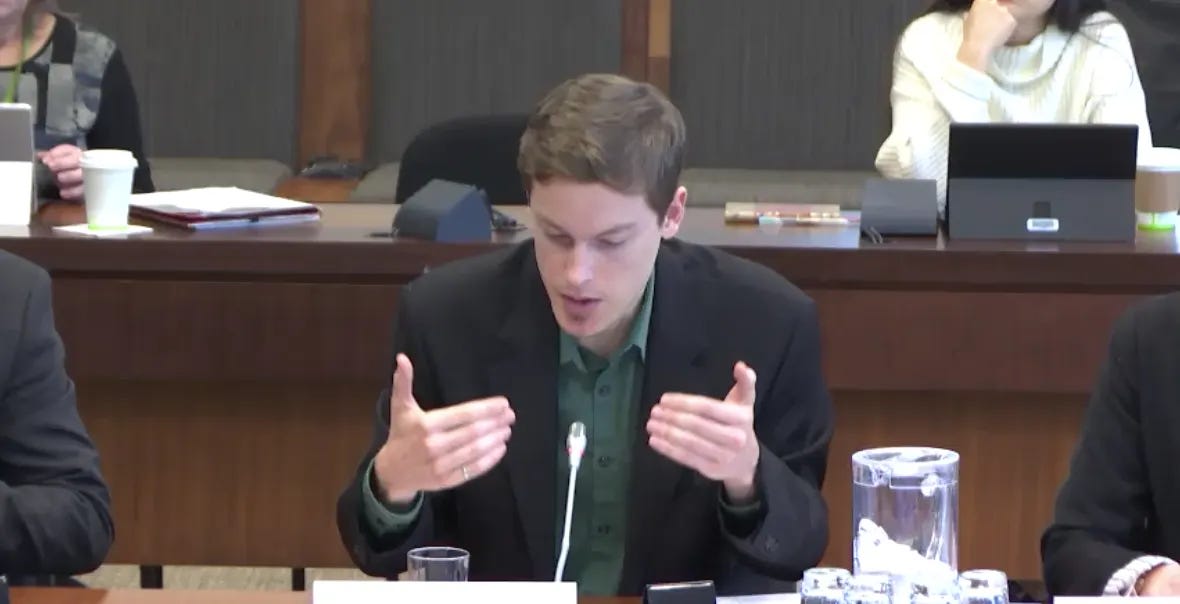
Dozens of meetings with parliamentarians and government officials: The 2025 white paper messaging in particular had many MPs asking how they can help, and inviting me to testify at committee
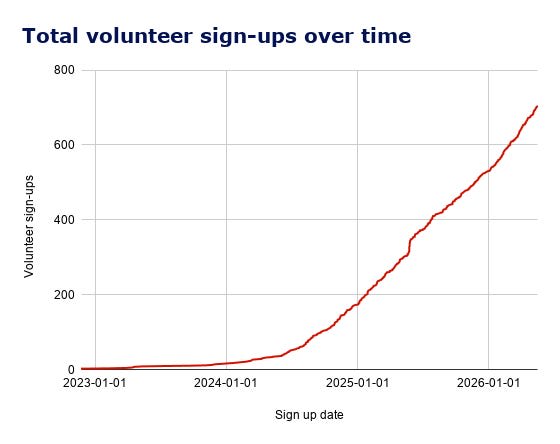
Connecting 1,500 Canadians across the countryonline and through events, and attracting over 700 volunteer sign-ups.
And many other initiatives along the way
In doing this, we’ve mirrored some of the work of organisations in other jurisdictions such as the EU’s The Future Society and the UK’s Centre for Long Term Resilience. More recently, we’ve been joined in Ottawa by other organisations (such as CIGI and Control AI) doing education and advocacy on AI’s catastrophic risks. And of course, leading scientists Yoshua Bengio and Geoffrey Hinton continue to engage governments and talk to the media.
So what makes us remarkable is not so much our notable accomplishments, or even that we were the first civil society group to do this work in Canada and still the leading one… it’s that we accomplished anything at all.
And that’s the story I want to share now.
Inauspicious beginnings
So at the start we confidently set off with all these accomplishments in mind, got a big grant, hired a team, and set to work, right?
Not quite.
In the Summer of 2022, there were just a couple local meetups and a few dozen people in Canada who had happened to come across the concerns around AGI development and were interested in doing something about it.
I’d pitched EA’s LTFF on a one-year grant to “connect, expand and enable the AGI safety community in Canada”, and got to work finding and connecting people. That’s when I met Mario Gibney, the founder of the Toronto AI Safety Meetup (which has since flourished into the Trajectory Labs co-working and event space) who became my co-founder. Evan Murphy (Vancouver AI Safety researcher) and Briana Brownell (Saskatoon AI startup founder) joined us to form an interim Board of Directors.
That Summer and Fall we created our online Slack community to bring the disparate local groups together, chose a name and website, attended as many AI conferences as possible to get a lay of the land, and prepared to incorporate as a not-for-profit.
A Spring and Fall
Only there was a challenge: how were we going to fund AIGS? It was all fine for me as a community organiser to get a grant, but when we started thinking about what AIGS most needed to accomplish - to directly influence the Canadian government - we realised that traditional EA/OpenPhil AI Safety grants weren’t an option. Then recent FTX scandal aside, they were American (i.e. foreign interference, a credibility risk) and in any case as charities couldn’t fund our core political activity.
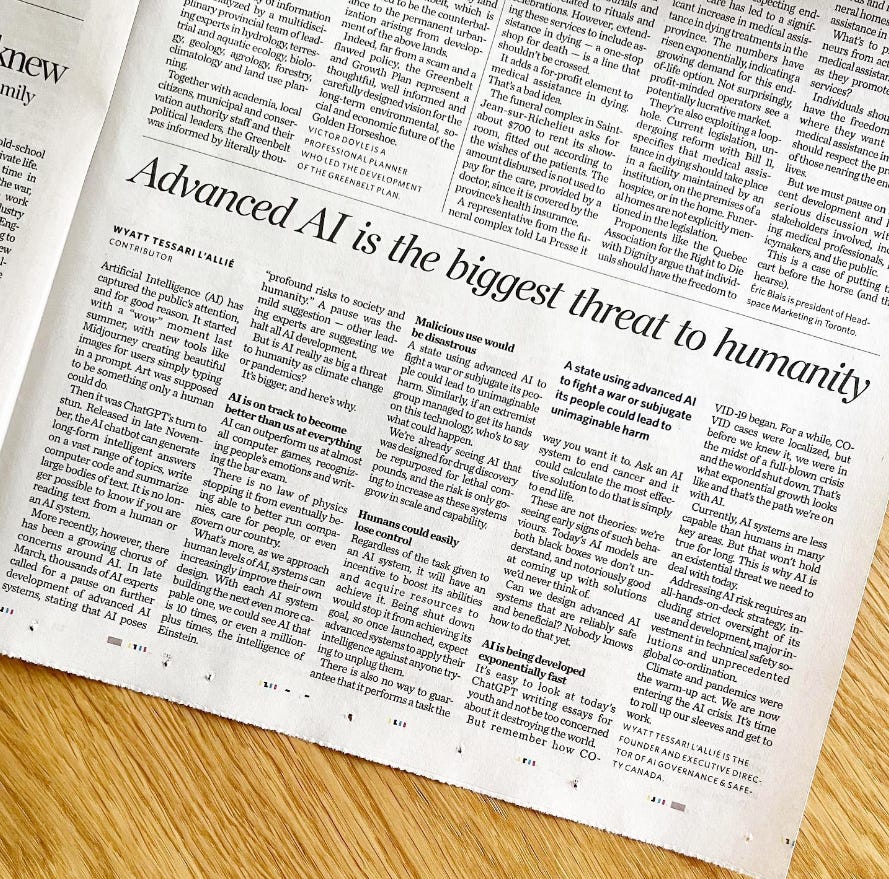
So we put on a brave face and did an initial fundraiser among 50 community members, with modest success, and AIGS was incorporated April 4, 2023. Our first move was media advocacy to seize on the Pause AI letter coverage and establish our public presence. Mario and I brought on operations and communications contractors to amplify our efforts. Our Toronto Star Op-Ed was a highlight:
It almost worked. That July and August saw tantalising funding opportunities during conversations with two large donors we’d attracted, but despite our efforts it didn’t convert into money in the bank. We ended the contracts, Mario had to step back, and AIGS was left as a volunteer organisation - just a Board of Directors and me as the only unpaid staff.
The grind begins
We could easily have disbanded at that time. My grant had expired in April and I had limited savings.
But Canada still needed an organisation like AIGS, and we weren’t about to stop working on the most important issue of the 21st century just because the money ran out. We also knew that as AI’s impacts grew, our potential as an organisation would too.
So I took on some personal debt and we got back to work. First, we knew we needed to clarify what exactly our calls to action for Canada were. From that came our first white paper Governing AI: A Plan for Canada, which put us on the policy map.
Second, parliament had recently introduced the AI & Data Act. We went all in - spent weeks clarifying what Canada needed an AI Bill for, and carefully translating the concerns around ASI loss of control into specific recommendations for the Bill.
During that time we also expanded our Board of Director with a range of professionals (including Board Chair Gordon Vala-Webb) to help steer AIGS to success, and launched a Board of Advisors with respected experts to consult on key decisions.
Dashed health, dashed hopes
All that effort didn’t save us. While it did establish our credibility and helped raise modest donations over Christmas, we were still a volunteer organisation, and my runway was now even shorter.
To make matters worse, a week after capping our AI & Data Act testimony, I fractured my femur in an accident. It wouldn’t be the only health issue to significantly slow me (and by extension AIGS) down - I have a chronic condition that among other things can cause severe fatigue and brain fog, and make looking at a screen quite painful. The symptoms are, of course, worsened by the stress of repeatedly having to focus on catastrophic risks from AI and the loneliness of being the only staff.
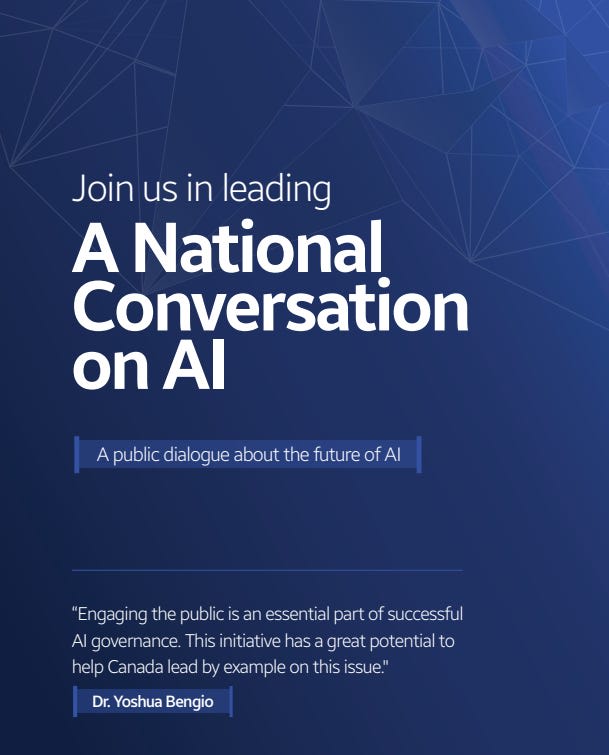
Seeing that our direct fundraising outreach wasn’t sufficient, we pivoted to launching a project that Canada needed that might also gain corporate or union sponsorship: a National Conversation on AI event series pilot. The goal was to meaningfully engage Canadians in a two-way conversation about where AI is headed and what kinds of futures people want.
It was (and remains) a worthy initiative with interest from a number of universities and civil society organisations, even getting an endorsement from Yoshua Bengio. But five months of work later, it failed to gain any major financial sponsors, and so it was put on the shelf for another day.
That failure meant that by the Summer my runway was now gone and I soon wouldn’t be able to continue as full-time executive director.
A second chance
And then, lo and behold, some money trickled in. At the last moment, two new donors stepped up just enough to keep me on full-time and AIGS moving forward.
Moreover, 2024 was the year that volunteers started to show up in numbers. So much so that we had to set up a dedicated intake and onboarding process.
The best news came when Kathrin Gardhouse - Toronto-based lawyer, PhD, and policy expert - joined and immediately started taking on projects, quickly getting promoted to Policy Lead and then to the Board of Directors.
So in September 2024 we looked around and asked “What does Canada most need now?”. With veteran political expert Fraser Green now on our Board, we realised that while up to date policy recommendations would continue to be essential, on their own they were too easy for government to ignore. Polls were showing an overwhelming likelihood of a conservative victory in a 2025 Fall election, and neither Poilievre nor Trudeau were the type to act on the arguments alone. Also, with the acceleration in AI, it seemed very plausible that 2025 might be the last federal election before superintelligence was developed.
So we pivoted in the final months of 2024 to launch the public-facing Coalition for Responsible AI. The idea was to plant a flag so that everyone in Canada who cared about these issues could find us and support the cause. It was primarily a communications campaign - engage Canadians, get ourselves in the news, attract donors, and make AI an election issue politicians had to address.
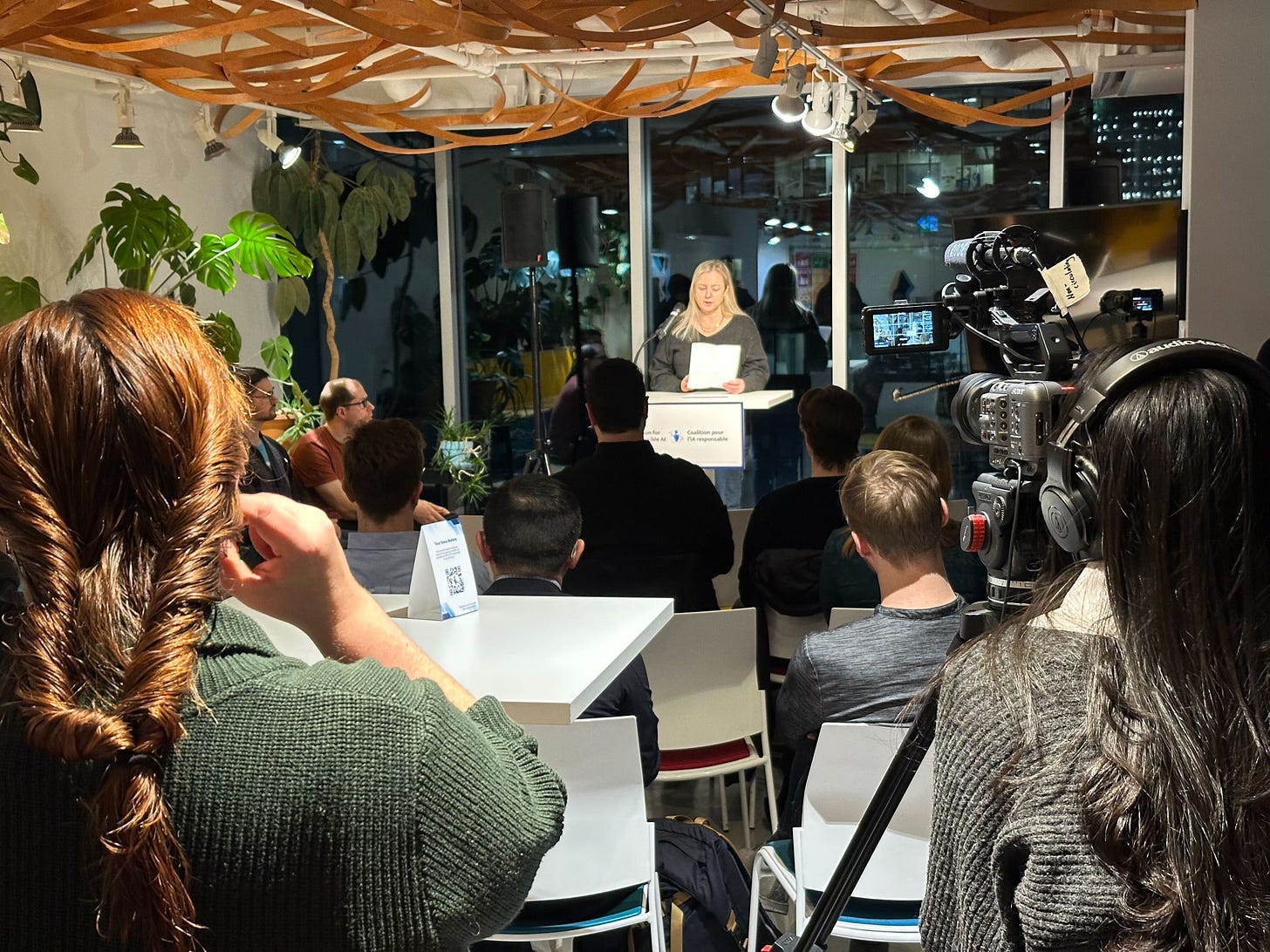
Supporters gather in Ottawa for the Coalition launch event
Politics happens, and also we fall short
In 2025, the first thing to happen was Trudeau resigning and Mark Carney taking over. He immediately called an early election, shrinking our time to prepare from 10 months to 3 months. Meanwhile Trump got inaugurated and began soaking up all media attention, making Canada’s election about who can best stand up to him. AI (and even major political items like cost of living) got drowned into the background.
We were also relying heavily on a new communications vendor to get us in the news, but they underperformed (especially in English media). And I was still the only full-time staff to keep the organisation running, meaning that I was stretched too thin and also underperformed.
The Coalition failed at its goal of getting public attention.
And when it rains, it pours: in mid 2025 a series of key grants we’d applied for got rejected (in large part because we could only apply for the portion of our work that was apolitical), I was running on empty again, and this time our overstretched donors weren’t able to fill the gap.
The writing was on the wall: the lights were about to go out on AIGS.
Stepping into the abyss
What were we to do next?
One of the things we noticed about Mark Carney is that he had significant experience managing global crises, and his book Values suggested he was a man who cared more about the arguments than public sentiment. Whereas Poilievre and Trudeau would have required a big public advocacy campaign to act, for Carney, a well-crafted plan delivered via trusted advisors seemed like the better approach. We also knew that regardless, we needed to update our white paper for 2025, and it would be the best thing to try fundraising for.
Money was all but gone, but we made a decision:
If we were to go under, we’d do so delivering one final piece of impact.
Could we hold on long enough to deliver?
Having spent the Summer drafting our 2025 white paper while battling a major health flare-up, discussing bankruptcy contingencies with Board Chair Gordon Vala-Webb, and preparing one last fundraising email, the situation came to a head on Sept 1st, 2025.
It’s a day I still distinctly remember.
AIGS’s bank account had nothing left in it, and we owed four thousand to the vendor. I checked my personal accounts - I also had nothing left in the bank, and all three of my credit cards were maxed out.
I emailed my landlord to let her know I was going to be late paying my rent.
The next day we raised $20k.
That last fundraising email, and the pitch around the white paper, had worked.
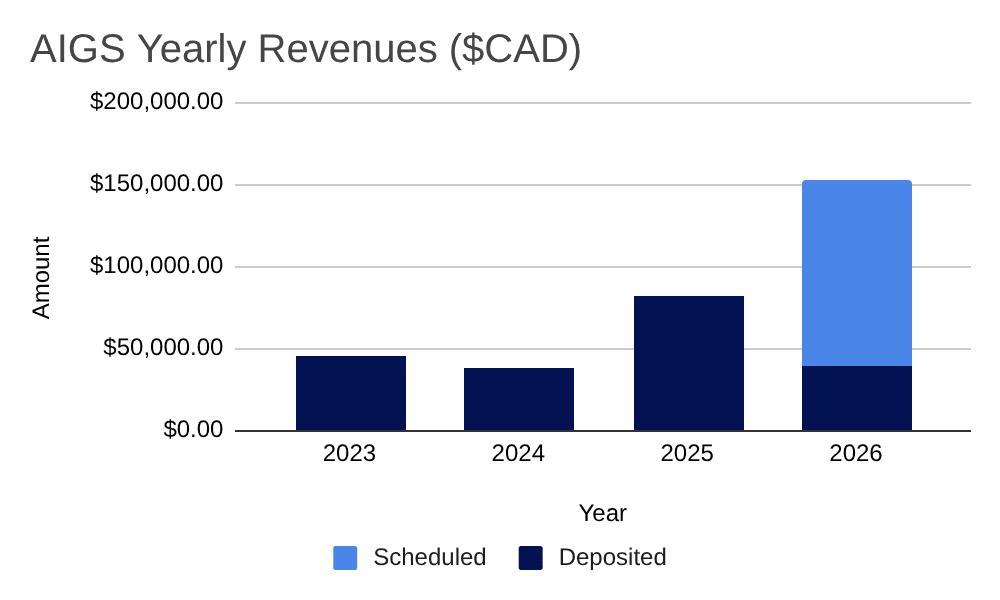
We then raised another $20k in the following weeks to finish the year at $80k in revenues, which was double our 2024 revenues. This year, thanks to some incredible donors, we’re already at $150k earned or pledged.
A stellar year
The Fall and Winter of 2025-2026 turned into our biggest success by far. The white paper was serendipitously ready to be published right when the new Minister of AI called a snap 30-day public consultation on the new national AI strategy.
The new revenue also allowed us to temporarily bring on a part-time outreach coordinator, who made sure the hundreds of emails and follow ups got to the relevant MPs. That turned into dozens of meetings, which turned into six invitations to testify at committee hearings. The video from one of them then went viral on social media, our biggest visibility yet.
Meanwhile, communication expert Dalia Ezzat volunteered to shape the next chapter of AIGS communications (and nudged me into creating this Substack account), Shivangi Pandey stepped forward to relaunch the Coalition for Responsible AI later this year with a new vision, and Christopher Tiller our volunteer Volunteer Manager started putting in long hours to help keep the community glued together.
We’re alive, and stronger than ever.
700 volunteers and 1 underpaid staff
But a yearly budget of $150k CAD, as immensely relieving as it is compared to previous years, is still not enough to run an organisation on. It means we now have a minimum of stability, but also that we still can’t afford to hire a team.
And that’s been our bottleneck. As stressful as working on catastrophic risks, battling health issues, and surviving existential financial crises has been for the last 3 years, the greatest challenge has been not having any full-time staff to work with me.
Our core volunteer team continues to pitch in remarkable amounts of work - crowdsourcing relevant news, supporting local events, building our tech stack, developing our Canadian AI policy course, and shaping our communications strategy. And the growing number of sign-ups is a huge source of potential for AIGS.
But even the best only have a few hours per week, or are between jobs and have to step back as soon as they regain employment, meaning work had to be shared across multiple volunteers and there is naturally high turnover. Moreover, we’re a remote team spread out over 5 time zones and 2 languages, making maintaining team energy, cohesion, and momentum exceptionally hard in casual or part-time work setups.
Back to imagining
Now imagine if instead we had a core team of talented communications, operations, and advocacy leaders working full-time together to shape our strategy and harness our rapidly growing volunteer base?
If AIGS were able to poach some of the top talent currently working for corporate interests, and put their skills to ensuring humanity safely navigates AI?
And if Canada actually took those initiatives that a successful post-AI world will be shaking its head about in disbelief and gratitude?
If you’d like to see that happen, you can help.
How to help:
Liked our story and want to see us succeed?
Give this post an upvote
Share it to your preferred platform
Email it to a potential Canadian donor who cares about AI going well (or to someone who might know someone who might know someone)
Canadian citizen or resident?
Join us as a donor:
Small donations expand our donor base and help us show broad support. Cherry on the cake? Make it recurring. Donate here.
Large donations take AIGS to the next level of impact. For more information and to meet the leadership, email [email protected].
Join us as a volunteer. Show us how good you are so we can hire you when funding comes through.
Join our community online or at events, and help us build momentum in Canada. All are welcome.
Thanks for reading this post and hearing our story. And wherever you are in the world, know that while AI is putting us all under great strain, the human spirit and determination to succeed remains alive and well.
Edit: The match seems to now be over - the funds were expended in around 35 minutes. But many of these charities are great and should be supported regardless!
***
On October 22nd starting at 10:00am Pacific Time, Every.org is matching donations to select animal welfare organizations at a 2:1 rate, up to $2,000 per donor per nonprofit (so if you give up to $2,000, they will contribute up to $4,000 and the nonprofit will get up to $6,000). The first donation a donor makes to each el...
Crossposted to Less Wrong
‘Like most of life’s dangers, the dangers of artificial intelligence are not easily identified from the armchair.’
J Dmitri Gallow
Epistemic status
I’m not an expert in this field, and herein I make some sweeping generalisations educated guesses about the overall...


As someone who worked for a Canadian Senator who has AI as one of her main areas of Parliamentary interest and activity, I have strongly upvoted this post and agree that AIGS is doing great work. I can personally attest to coming across their work in the course of my job advising my former boss. In fact, based on this post, I’d say AIGS is punching above its weight, as I would have assumed they were bigger / had more funding than this post indicates they do.
Thank you Kiara! Great to hear.