Comments
Thank you for this post, this is excellent work! Are you aware of ongoing efforts for any of your proposed topics? I'm asking because I'd consider starting a project on some of the above.
Thank you for this post, this is excellent work! Are you aware of ongoing efforts for any of your proposed topics? I'm asking because I'd consider starting a project on some of the above.
Thank you for your comment :)
It looks like Lennart Stern has been working on a project related to "international cooperation", "prize and market design" and "preparedness in developing countries"
I don't know about anything else, but I haven't looked much.


As economics students, we are wondering how we could best use our skills to reduce pandemic risks. We spent part of our internships at the Swiss and Stanford Existential Risk Initiatives (CHERI and SERI) thinking about this.
We now believe that:
This post explains why.
We begin by giving a brief historic overview of economic work on pandemics (1). We then give arguments for and against working on pandemic prevention and preparedness as economists, using an importance-tractability-neglectedness framework (2). After that, we give a list of open research questions where we think economists could make valuable contributions (3).
We expect this post to be most useful for economics students who are currently thinking about which cause to focus on. It can also be of interest to people who are considering starting to study economics, to economists who are could be interested in working on pandemics, and more generally to people interested in reducing global catastrophic biological risks (GCBRs).
By “pandemic prevention and preparedness”, we mean any interventions aimed at reducing the probability of pandemics (prevention) or at mitigating their impact when they happen (preparedness).
We have spent two months working on this post. We are quite confident that pandemic risks are one of the problems where economists can make the most difference. However, we are still at a very early career stage, and we have little knowledge about how pandemics work. This post reflects what we currently think. We are probably mistaken on some aspects, and we expect some of our views to change in the coming years.
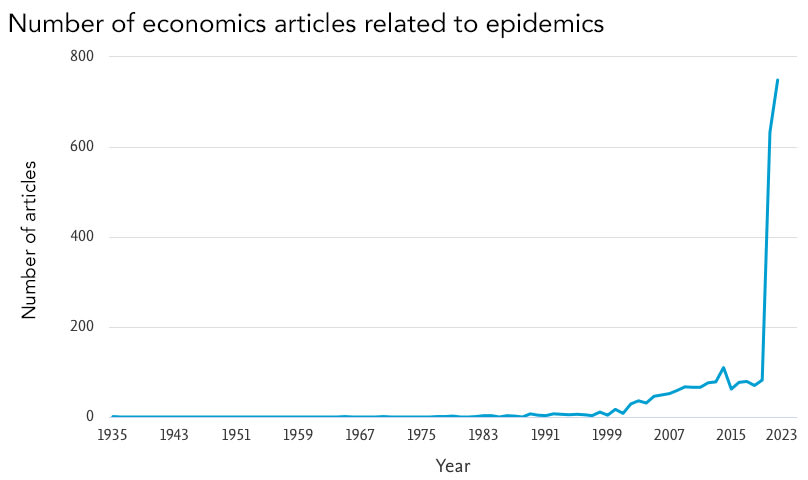
The first wavelet of interest in epidemics among economists came in the 1990s, when some of them started studying AIDS[1]. This is when economic epidemiology emerged. Economic epidemiology is a sub-field that lies at the intersection of epidemiology and economics. It tries to integrate human behavior into disease modelling[2]. Since the 1990s, epidemic-related economics have grown, presumably both because there were more and more economists, and because of events like the 2009 swine flu pandemic and the Western African ebola epidemic (2013-2016). Pandemic economics remained quite a small field until 2020. COVID-19 triggered big wave of interest from economists.
The following graph can give a good idea of what happened:
This graph represents the number of documents in the Scopus citation database that have words like "epidemic", "pandemic", or names of specific diseases in their titles or abstracts, and that are classified as being in the "economics" area[3]. Note that the last data point only includes the first 6 months of 2021. Most of the relevant economic literature is not represented on this graph, either because it is not categorised as "economics" on Scopus, or because it is not registered in the Scopus database. Nonetheless, this graph is probably a good qualitative reprensentation of how economists' interest in epidemics evolved recently.
Economics can be applied to many of the pressing problems listed by 80,000 Hours. Choosing one of these cause areas is a difficult choice. In this section, we consider the case for working on pandemic prevention and preparedness. We apply the scale-neglectedness-solvability framework developed by 80,000 Hours[4].
Global catastrophic biological risks (GCBRs) are amongst the biggest risks for humanity. Toby Ord (2020[5]) thinks there is a 1/30 chance that a pandemic will trigger a permanent collapse of human civilisation in the next 100 years. 80,000 Hours has a problem profile explaining why GCBRs are one of the most pressing problems we face.
Uncrowdedness matters because of diminishing returns: the more economists are already working on pandemic preparedness, the harder it might be to make additional progress.
The current pandemic triggered a sudden burst in economic articles and working papers about COVID-19. However, most of the economic research currently being done in this space is not very relevant for future pandemics. Among the recent economics articles from our Scopus query[3:1], about one in three seems somewhat relevant for pandemic preparedness. Almost all of them are about covid, and very few mention future pandemics in their abstract.
Moreover, the number of pandemic preparedness economic publications is very likely to go down as COVID-19 becomes a memory. Many economists are working on covid temporarily, and some of them already returned to working on their main favorite topics.
Based on these arguments, our initial guess was that there would be about 10 to 50 economists actively working on pandemic preparedness in 5 years. We now think this is a bit low. Our current best guess is that pandemic preparedness economics has a good chance of becoming a small established sub-field, with maybe around 100 active economists in 5 years. We changed our minds based on the two following arguments:
It currently seems like there is an open window for pandemic preparedness economics: a time during which it is much easier to start working on this. This window might close in the next five years. Even if it does, we think it is likely that enough economists will keep working on "pandemic preparedness economics" for it to be considered a serious subfield.
Overall, there might be :
These numbers are our current best guesses, and we are very, very uncertain about them - mostly because we spent less time thinking about these other causes.
If we doubled the number of economists working on global catastrophic biological risks, what fraction of the risk would we get rid of?
This question can be broken down into two sub-questions:
Successfully working on pandemic preparedness as an economist might be difficult for two reasons: the field is new, and many questions are interdisciplinary.
Because the field is new compared to development and environmental economics, there are much fewer introductory materials like courses and manuals. It might be more difficult to find supervisors, funding, internship or job opportunities, and to publish articles in renowned journals. However, because of covid, it might be much easier to work on pandemic preparedness now and in the years to come. The fact that more economists and policy makers are interested in this cause makes it more crowded, but also more tractable.
Because many questions are interdisciplinary, pandemic preparedness economics requires learning about other disciplines, like epidemiology, virology or synthetic biology. Interdisciplinary research seems to be generally slightly more difficult to conduct, for reasons like the difficulty of finding co-authors across fields, discipline-oriented cultures in universities, and a greater difficulty to publish in renowned journals(Davé et al., 2016[8]).
It is very difficult to evaluate the impact of research, especially future research. However, there are reasons to believe that economists working on pandemic preparedness could have a big impact.
Economists have a good track record in an other comparable cause area: global warming. Climate change and pandemic risks are two problems that are best understood by natural scientists (climatologists and epidemiologists). Both are global long term problems with big tail risks: catastrophic outcomes have a significant probability. Both require good policy solutions and international coordination. Economists have made important contributions to climate change research and policy. If economists can make a similar contribution on pandemic preparedness, we can expect them to find more and better solutions for reducing pandemic risks.
Pandemic economics is a nascent field. Longtermist economists working on pandemic economics at an early stage would help shape the field, and direct research efforts towards the most relevant questions for the very long term. Because the field is young, making impactful contributions seems easier than in older, more established fields like environmental economics.
When working on this post, we looked for open research questions about pandemic preparedness where economists could potentially make valuable contributions. These research questions are listed in the what to work on section. We think answering these questions would be a big step in reducing pandemic risks.
You could be particularly well suited for working on economics of pandemic prevention and preparedness. For example, you could already have a background in economics as well as in another discipline like epidemiology or medicine. Health economics also seems like a relevant background.
However, you don't need to already have this background to consider working on pandemic preparedness economics. You don't even need to already be interested in this cause area. It is easier than we usually think to become excited about new topics. 80,000 Hours has an in-depth article on personal fit, covering why it is important to explore different options, and how to do so.
When taking questions of coordination into account, it becomes even more important to work on a diverse range of topics. Because we are still uncertain about the potential impact of economists working on pandemics, following this path can bring more information to the EA community. You can read more about the value of gaining information here.
According to 80,000 Hours[9]:
Research in economics academia is a potentially very high impact option because you can work on priority cause areas, like global priorities research or AI policy.
Given the arguments covered in this section, we think that pandemic preparedness is another great option, and that most economics students should seriously consider it as well.
In this section, we collected broad research questions that seem promising. The main point of this section is to show that there are many questions where economists could make valuable contributions. We spent little time thinking about each individual question. They would need to be refined and perhaps framed differently before they can be used for a research project. They all currently seem worth investigating to us, but some of them might turn out not to be that relevant.
The questions are presented in no particular order. People seeking to maximise their impact might want to focus on the topics that would get little attention from economists outside of effective altruism. For example, questions under "Understanding dual-use research" might be more neglected than some of the others.
In the end, what we want is to help design and implement better policies. Working with policy makers and experts from other fields can be very useful for making this research more policy-relevant.
Here are the topics we collected:
Microeconomics, Cost-Benefit Analysis
Dual-use research is scientific research that can be misapplied to cause harm. While any research can be dual-use, some research in biology can have disastrous consequences if used to cause harm. Economists could help understand dual-use research better, by studying the costs and benefits of conducting dual-use research, the incentives to conduct and publish it, and how these incentives can be changed. These questions seem to us like the most straightforward way for economists to focus on engineered pandemics.
The following open research questions are from David Manheim's list of project ideas in biosecurity.
- How much do principal agent problems really harm research in scientific governance, or create risks?
- It seems like it’s pretty easy to get funding for X and do X*** instead. (i.e. What you really wanted to do). Is this true?
- To what extent is this a problem for biosecurity, versus useful flexibility?
- Attempt to actually quantify the benefit of past GoF [gain of function] research
- See: Reconstruction of the 1918 Influenza Virus: Unexpected Rewards from the Past https://mbio.asm.org/content/3/5/e00201-12
- Gryphon scientific just say benefits are difficult to quantify in their USG commissioned report: https://www.gryphonscientific.com/resources/gain-of-function/
- No quantitative benefits assessments mentioned in this 2017 review from Editing Biosecurity: https://mars.gmu.edu/handle/1920/11341
- Similar to above, quantifying risks and benefits of dual-use research more generally.
The two papers by Cotton-Barratt et al. (2016, 2017) seem like a good place to start thinking about these questions.
References Cotton-Barratt, Owen, Sebastian Farquhar, and Andrew Snyder-Beattie. 2016. “Beyond Risk-Benefit Analysis: Pricing Externalities for Gain-of-Function Research of Concern.” Policy Working Paper, Future of Humanity Institute, University of Oxford.
———. 2017. “Pricing Externalities to Balance Public Risks and Benefits of Research.” Health Security 15
Development Economics
Developing countries have less developed public health systems than high-income countries (Kruk, 2008). Unemployment insurance programs are less protective, and professional occupations are less compatible with remote work (Gerard et al., 2020). Because most economists work in high-income countries, economic research on pandemic preparedness is mostly focused on rich countries. This research might be difficult to apply to other contexts.
How can developing countries best prepare for future pandemics? How can they reduce the probability of future pandemics?
How do the other research questions from this post apply to developing countries specifically?
References Gerard, François, Clément Imbert, and Kate Orkin. 2020. “Social Protection Response to the COVID-19 Crisis: Options for Developing Countries.” Oxford Review of Economic Policy 36 (Supplement_1): S281–96. https://doi.org/10.1093/oxrep/graa026.
Kruk, Margaret E. 2008. “Emergency Preparedness and Public Health Systems.” American Journal of Preventive Medicine 34 (6): 529–34. https://doi.org/10.1016/j.amepre.2008.02.012.
Macroeconomics, Integrated Assessment Modelling, Health Economics, Decision Theory
Integrated assessment models (IAMs) represent several parts of the world, and link them together to see how they interact. Climate IAMs are widely used to estimate how the climate system and the global economy react to different public policies. Many economists have recently developed macroeconomic models that integrate covid transmission dynamics (McAdams, 2021). They used these models to make recommendations regarding lockdowns, contact tracing and vaccine policies. This type of models could help make better decisions during future pandemics (Berger et al., 2021) - especially if they were ready to be used before the next outbreak.
This field of research is interdisciplinary, and working with disease modellers seems very important. Environmental economists never try to make their own climate models if they have not studied climate science. Pandemic economists should not ignore the expertise of epidemiologists (Murray, 2020).
How useful are epidemic-economic integrated models? How can they be made most decision-relevant for future disease outbreaks?
Gollier (2020) lists several limitations to his integrated model: uncertainty is restricted to the reproduction rate, there is no risk-aversion, and the health impacts of the disease are improperly accounted for. How to make better integrated models?
References Berger, Loïc, Nicolas Berger, Valentina Bosetti, Itzhak Gilboa, Lars Peter Hansen, Christopher Jarvis, Massimo Marinacci, and Richard D. Smith. 2021. “Rational Policymaking during a Pandemic.” Proceedings of the National Academy of Sciences 118 (4).
Gollier, Christian. 2020. “Pandemic Economics: Optimal Dynamic Confinement under Uncertainty and Learning.” The Geneva Risk and Insurance Review 45 (2): 80–93.
McAdams, David. 2021. “The Blossoming of Economic Epidemiology.” Annual Review of Economics 13 (1): annurev-economics-082120-122900.
Murray, Eleanor J. 2020. “Epidemiology’s Time of Need: COVID-19 Calls for Epidemic-Related Economics.” Journal of Economic Perspectives 34 (4): 105–20.
Cost-Benefit Analysis
Pandemics can cause enormous amounts of damage to society. Beside the direct impact on those who catch the disease, pandemics can also affect mental health, political stability, employment and income, international relations and trade. They could trigger the collapse of industries, governments, or even of the whole human civilisation. It seems important to have cost estimates that integrate all these different costs. Putting a number on them can help policy-makers realise how big the impact would be. The (expected) cost of future pandemics can be a powerful argument in favor of doing more to prevent them.
Several studies have estimated the global costs of future pandemics. Fan et al. (2018) and Martin and Pyndick (2021) are examples of estimates that integrate the value of lives lost because of pandemics. However, they still do not integrate all the costs of pandemics. In particular, they do not count the value of the potential collapse of human civilisation. It seems valuable to further improve these estimates. See Millett and Snyder-Beattie (2017) for a cost estimate that accounts for the lives of future generations.
During a 2018 workshop, Thomas Inglesby argued that more studies should estimate costs from "prolonged societal instability, prolonged interruption of international trade, and collapses of industries and governments". He suggested it would be valuable to estimate costs in scenarios with very high case fatality rates, high transmissibility, different transmission dynamics than influenza, or deliberately initiated events (National Academies of Sciences, Engineering and Medicine, 2018).
References Fan, Victoria Y, Dean T Jamison, and Lawrence H Summers. 2018. “Pandemic Risk: How Large Are the Expected Losses?” Bulletin of the World Health Organization 96 (2): 129–34. https://doi.org/10.2471/BLT.17.199588.
Martin, Ian W R, and Robert S Pindyck. 2021. “Welfare Costs of Catastrophes: Lost Consumption and Lost Lives.” The Economic Journal 131 (634): 946–69. https://doi.org/10.1093/ej/ueaa099.
Millett, Piers, and Andrew Snyder-Beattie. 2017. “Existential Risk and Cost-Effective Biosecurity.” Health Security 15 (4): 373–83. https://doi.org/10.1089/hs.2017.0028.
National Academies of Sciences, Engineering and Medicine. 2018. “The Economics and Modeling of Emerging Infectious Diseases and Biological Risks.” In Understanding the Economics of Microbial Threats: Proceedings of a Workshop. National Academies Press (US). https://www.ncbi.nlm.nih.gov/books/NBK534894/.
Health Economics, Behavioral Economics, Microeconomics, Public Goods, Game Theory
The acceptance and adherence of the population to public health measures seems to be a key factor in responding to an epidemic outbreak. During the COVID-19 pandemic, restricting physical contacts, wearing masks and getting vaccinated are behaviors that limit the spread of the disease. How can these good health behaviors be most effectively encouraged?
There are already many studies tackling this question, so the most valuable thing to do next is probably to find or make good reviews of this literature, and see how it can be used to prepare for future pandemics. Dubé et al. (2015) did a review of reviews about incentives for vaccination; this might be a good place to start. Studying what worked best during the covid-19 pandemic also seems valuable.
Reference Dubé, Eve, Dominique Gagnon, and Noni E. MacDonald. 2015. “Strategies Intended to Address Vaccine Hesitancy: Review of Published Reviews.” Vaccine 33 (34): 4191–4203. https://doi.org/10.1016/j.vaccine.2015.04.041.
International Economics, Economics of Networks
Epidemics become pandemics when they are spread through economic flows: people and goods circulating between countries and continents. Murray (2020) writes:
For example, the Lombardy region of Italy includes one of the major world suppliers of nasopharyngeal swabs, Copan Diagnostics. In retrospect, it seems reasonable to expect that an outbreak of respiratory disease anywhere in the world might be accompanied by increased trade between Lombardy and the outbreak hotspots […]. Thus, it seems plausible that the Lombardy region of Italy could have been predicted as a location likely to be hit early and hard in any respiratory pandemic.
If we can predict which parts of the world will be hit early, we can better target surveillance and response ressources. Economists have tools to model international trade. Can these tools be used to follow or predict transmission dynamics?
We are aware of one project that does this: the GLEAM project. Two of the people working there hold a PhD in economics (Maria Litvinova and Matteo Chinazzi).
Reference Murray, Eleanor J. 2020. “Epidemiology’s Time of Need: COVID-19 Calls for Epidemic-Related Economics.” Journal of Economic Perspectives 34 (4): 105–20. https://doi.org/10.1257/jep.34.4.105.
Portfolio Management
For a pandemic to be an existential event, it has to kill almost everyone. Reducing the chances that a pandemic contaminates everyone is thus a way to decrease the chances of pandemics leading to extinction.
In that perspective :
The K / r-strategy dilemma is also relevant for nuclear winter or nanotechnology risks.
Reference
Newberry, Thomas. 2020. « Mitigating X-Risk Through Modularity ». EA Forum. https://forum.effectivealtruism.org/posts/nTZ6bnm8HFjjJWBmt/mitigating-x-risk-through-modularity.
Cost-Benefit Analysis, Financial Economics
There are several possible actions to mitigate GCBRs. Figuring out which actions have the biggest potential and how to actually implement them accounting for policy constraints (e.g social acceptability) thus have an important potential.
Doing CBAs of relevant and neglected interventions:
What is the optimal portfolio for preparedness investments ? This project could draw upon past CBAs (Millett et al., 2017) and make a guess on the functional forms of the returns to find the optimal portfolio. Especially to mitigate huge catastrophies and existential risks, what are the most efficient actions to take given a limited budget ?
References James, Smith. 2021. “Non-Pharmaceutical Interventions in Pandemic Preparedness and Response.” EA Forum. https://forum.effectivealtruism.org/posts/ydcF5CX7AkpNwMyGh/non-pharmaceutical-interventions-in-pandemic-preparedness.
Millett, Piers, et Andrew Snyder-Beattie. 2017. « Existential Risk and Cost-Effective Biosecurity ». Health Security 15 (4): 373‑83. https://doi.org/10.1089/hs.2017.0028.
Esvelt, Kevin. 2020. « Mitigating catastrophic biorisks | Kevin Esvelt | EAGxAsia-Pacific 2020 ». EAGx Asia-Pacific. https://www.youtube.com/watch?v=tttGtfYFsdI.
Cost-benefit analysis, Financial economics, Econometrics
Insurance mechanisms seem to be a promising approach to reduce the expected damages from pandemics (Berry et al., 2018) due to two main properties. The first one is that it provides early funding for response which is highly valuable due to the exponential growth of emerging diseases. The second one is that the money received by insurance mechanisms has a very low opportunity cost if it's pre-affected in the sense it can't be used for anything else than what it was aimed at. Thus, policymakers are more likely to make a strong early response if there's an insurance mechanism than if there is none.
References
Schwarcz, Steven. 2020. « Catastrophe Bonds, Pandemics, and Risk Securitization ». The Harvard Law School Forum on Corporate Governance (blog). 4 novembre 2020. https://corpgov.law.harvard.edu/2020/11/04/catastrophe-bonds-pandemics-and-risk-securitization/.
Berry, Kevin, Toph Allen, Richard D. Horan, Jason F. Shogren, David Finnoff, et Peter Daszak. 2018. « The Economic Case for a Pandemic Fund ». EcoHealth 15 (2): 244‑58. https://doi.org/10.1007/s10393-018-1338-1.
« A Good Idea Executed Badly: Why the World Bank Should Not Renew the Pandemic Emergency Facility Insurance Window ». s. d. Center For Global Development. Consulté le 3 août 2021. https://www.cgdev.org/blog/good-idea-executed-badly-why-world-bank-should-not-renew-pandemic-emergency-facility-insurance.
Industrial Organisation, Supply Chain Management, Agricultural Economics
One of the key bottlenecks for a better response to Covid-19 was the difficulty to quickly scale-up vaccine supply chains. Given that mRNA vaccines seem to be plug-and-play (i.e you can make vaccines for many diseases just changing the RNA sequence but the process of production stays the same), imagining a general process on how we could be able to scale it up really quickly seems particularly promising.
Can we build a model that enables to capture the optimal oversizing of vaccine supplies ? Such a model could include timeline considerations (i.e how long is it to scale up the supply chain to meet the global needs) and heterogeneity of stocks for each component. Adopting a general framework on this topic could have co-benefits that are mentioned below.
One of the problems we encounter with vaccine supply chain is that our need of vaccine production in pandemic time is at least an order of magnitude bigger than in normal time, and oversizing 10 times a supply chain might be very expensive.
Are there cost-effective ways to quickly scale up (e.g in 3 months which is the goal of CEPI) vaccine production ?
Basing our reasoning upon the components of mRNA vaccines (Lowe, 2021) (and the bottlenecks of greater supply chains in pandemic time), what should be our strategy :
One of the main co-benefits of the adoption of general frameworks on these topic is that other EA organizations such as ALLFED (i.e an organization that aims at feeding the world in case of agricultural disaster) have very similar questions around supply chains.
Reference Lowe, Derek. 2021. « Myths of Vaccine Manufacturing | In the Pipeline ». ScienceMag Blog https://blogs.sciencemag.org/pipeline/archives/2021/02/02/myths-of-vaccine-manufacturing
Scaling up rapidly vaccine production has a great social value (Castillo et al., 2021). For highly uncertain outcomes such as vaccine development, private investment is well suited [10] but might not internalize the social value of vaccines and thus underinvest due to risk adverseness and low prices of vaccine. Thus, giving additional incentives to ensure a quick development is definitely worth it. These incentives might be both reputational and financial.
What kind of reputation incentives can we imagine to further incentivize vaccine development ? Are there good reasons to think that a Medal from WHO or something similar could have a significant impact on the development of vaccines ?
There are two mechanisms that can be expected to be efficient to incentivize a faster vaccine development :
The fact that a strategy might be better than the other might depends on the degree to which players are risk adverse.
What we would like to know is whether there's a clearly better design for any realistic risk adverseness degree of entrepreneurs. If not, can we determine the optimal mechanism ? Such a research question should account for the fact that in our case, the degree of risk adverseness would probably be lower than for most similar problems. It is due to the fact that once a pandemic has begun, we can't expect new entrepreneurs, who are probably the most risk adverse players in comparable situations, to enter the vaccine industry and create a vaccine from scratch. Only companies that are already established can run the race and thus, the only thing that we try to incentivize is that they put more effort and more investment into the vaccine development.
References Snyder, Christopher M., Kendall Hoyt, Dimitrios Gouglas, Thomas Johnston, et James Robinson. 2020. « Designing Pull Funding For A COVID-19 Vaccine ». Health Affairs 39 (9): 1633‑42. https://doi.org/10.1377/hlthaff.2020.00646.
Castillo, Juan Camilo, Amrita Ahuja, Susan Athey, Arthur Baker, Eric Budish, Tasneem Chipty, Rachel Glennerster, et al. 2021. « Market Design to Accelerate COVID-19 Vaccine Supply ». Science 371 (6534): 1107‑9. https://doi.org/10.1126/science.abg0889.
Political Economy, Game Theory, Mechanism Design, Behavioural Economics
As reported by the Panel for Pandemic Preparedness and Response (2021), the main bottleneck in the case of Covid-19 was human decision-making. How can public institutions react faster and better?
Tung (2021) stresses the importance of fast policy responses. How can institutions react faster to outbreaks? There are at least two relevant factors: dilution of responsibility and status quo bias.
Could we find criteria that are clear enough to shift the status quo from “normally we don’t act and unless there are sufficient reasons to” to “normally, under these criteria, we must act, unless there are sufficient reasons not to”?
How to minimize the cost of making decisions that favour strong responses ?
Would reducing the number of levels of human-decision be a good way to improve the efficiency of early pandemic response ? Is there a way to find the optimal institution in terms of coordination costs / efficiency ?
What are the best ways to increase the likelihood that governments have appropriate responses against risk they’re not prepared for or not highly aware of ? Are there general characteristics that make some governments more successful against such risks ? A few examples of parameters that could affect this : the degree of transparence, the level of public confidence into the government, the influence of experts on decisions, the degree of centralization of the decision during the pandemic, the relations of a country with its neighbours etc.
High quality institutional decisions are also useful for other risks than pandemics. Figuring out how policymakers could efficiently manage sudden threats or risk they’re not aware of could be very useful.
References Berger, Loïc, Nicolas Berger, Valentina Bosetti, Itzhak Gilboa, Lars Peter Hansen, Christopher Jarvis, Massimo Marinacci, and Richard D. Smith. 2021. “Rational Policymaking during a Pandemic.” Proceedings of the National Academy of Sciences 118 (4): e2012704118. https://doi.org/10.1073/pnas.2012704118.
The Independent Panel for Pandemic Preparedness and Response. 2021. “COVID-19: Make It the Last Pandemic”.
Tung, Le Thanh. 2021. “Success in Combating a Pandemic: Role of Fast Policy Responses.” World Development Perspectives 21 (March): 100285. https://doi.org/10.1016/j.wdp.2020.100285.
Game Theory, Industrial Organization
GCBRs mitigation requires a big amount of international cooperation, especially to avoid big catastrophes. Indeed, for most risks the least safe country disproportionally increases the risk globally.
References
Sholz, Jason. 2011. « Unravelling Bueno de Mesquita's Group Decision Model», Proceedings of the 3rd International Conference on Agents and Artificial Intelligence, 18‑30. https://doi.org/10.5220/0003121500180030.
Williams, Heidi L. 2017. « How Do Patents Affect Research Investments? » Annual Review of Economics 9 (1): 441‑69. https://doi.org/10.1146/annurev-economics-110216-100959.
Optimal Taxation, Animal Welfare
A zoonosis is an infectious disease that emerged in animals before jumping to humans. AIDS, ebola, and COVID-19 are notorious zoonotic diseases. Intensive animal farming and deforestation increase the risks of new zoonotic pandemics[11]. Espinosa et al. (2020) investigate the link between meat production and emerging infectious disease. They suggest using a pigouvian tax to reduce the externalities of animal farming on human health security. What are the best ways to discourage activities that increase the risk of zoonoses?
Because this question is only focused on non-engineered pandemics, we think it is less relevant for reducing pandemic risks. However, working on this could have benefits for other causes, like animal welfare and safeguarding biodiversity.
Reference
Espinosa, Romain, Damian Tago, and Nicolas Treich. 2020. “Infectious Diseases and Meat Production.” Environmental and Resource Economics 76 (4): 1019–44. https://doi.org/10.1007/s10640-020-00484-3.
We wrote this post during the Summer Research Programs of the Stanford and Swiss Existential Risk Initiatives (SERI and CHERI). Rémi (CHERI) wrote sections 1 and 2, and about half of section 3. Siméon (SERI) wrote the rest of section 3.
We are grateful to the organisers of CHERI and SERI for their support. We'd also like to thank Aaron Gertler, Tessa Alexanian, Loïc Berger and Julian Jamison for discussions that helped inform this post, as well as [redacted as requested], Pauline Culioli and Carolin Basilowski for their helpful feedback and comments. Special thanks to our mentors, Florian Habermacher and David Manheim, who helped us navigate this project. Views and mistakes are our own.
For example, Philipson and Possner (1993) were among the first economists to study AIDS.
Philipson, Tomas J., and Richard A. Posner. 1993. Private Choices and Public Health: The AIDS Epidemic in an Economic Perspective. Cambridge, Mass: Harvard University Press. ↩︎
Wikipedia has a page about economic epidemiology if you want to learn more about this sub-discipline. ↩︎
The full search string is pretty long:
( TITLE-ABS-KEY ( "Pandemic*" OR "Epidemic*" OR health OR outbreak ) AND TITLE-ABS-KEY ( "Corona virus" OR "Coronavirus" OR "SARS" OR {MERS} OR "flu" OR "severe acute respiratory syndrome" OR "Middle East Respiratory Syndrome" OR "Influenza" OR {AIDS} OR {VIH} OR plague OR smallpox OR ebola OR {lassa fever} OR {dengue} OR {zika} OR h1n1 OR h7n9 OR "rift valley fever" OR malaria ) ) OR TITLE-ABS-KEY ( "pandemic preparedness" OR "epidemic preparedness" OR "biorisk" OR "biosecurity" OR "biosafety" OR "pandemic response" OR "epidemic response" OR "future pandemic*" ) AND SUBJAREA ( econ ) AND ( EXCLUDE ( EXACTKEYWORD , "GMOs" ) )
It can be accessed here on Scopus. It is based on many arbritrary choices made by trial and error, with the aim of including as many relevant articles as possible, while excluding as many irrelevant papers as possible. ↩︎ ↩︎
When 80,000 Hours uses this framework, they apply it to a whole cause area. Here, the cause area (pandemic risk reduction) is restricted to a specific way to work on it (economics). It still works: ↩︎
Ord, Toby. 2020. The Precipice: Existential Risk and the Future of Humanity. Bloomsbury Publishing. ↩︎
Three recent books:
Another one that is slightly less relevant is Economics in One Virus, by Ryan Bourne (2021). ↩︎
Five new courses:
Davé, Anoushka, Michael Hopkins, Joshua Hutton, Adam Krčál, Peter Kolarz, Ben Martin, Kalle Nielsen, et al. 2016. “Landscape Review of Interdisciplinary Research in the UK,” 184. ↩︎
This quote is from the economics PhD career review by Roman Duda. ↩︎
Given that private equity bears the risk, the allocation of the resources should be nearly optimal because funds that invest are incentivized to be well informed and to select the most promising projects on a return on investment standpoint given their information. They should thus select the vaccines that are the cheapest to massively scale up and that satisfy the requirements of national health agencies. ↩︎
According to the wikipedia article about zoonoses (more sources there). ↩︎



Thanks for this post! I love a good research agenda. Some other relevant bits of work: