Comments
Follow the protein: how ProVeg would use marginal funding


2
TL;DR
The majority of food choices are shaped by what people can realistically afford and access. That menu of options is itself shaped by markets and public policy. ProVeg International’s food systems work uses these two levers: markets and public policy, to build the food-choice infrastructure that makes plant-rich options accessible, affordable, and easy to choose.
Opportunities to scale impact with more funding in 2027:
- Alternative Protein / Biotech Policy in Europe ($500k-1M). We support public research and development (R&D) funding to invest in alternative protein and food biotech research. This can give high leverage, with an estimated $5-7 of public funding generated per $1 spent. There is a clear timeline: the EU research budget and votes for the Biotech Act occur in 2027.
- Corporate Protein Transition in Europe ($325-975k). This is the most proven model of those in this post. We work with large retailers to change the ratio of plant to animal products they sell. We've taken this from one market to five in eighteen months.
- Sustainable plant-rich pathways in low- and middle-income countries (LMICs) ($150-300k). Early-stage. We are working in Nigeria, South Africa, India and Brazil to demonstrate viable alternatives to animal protein to meet growing demand.
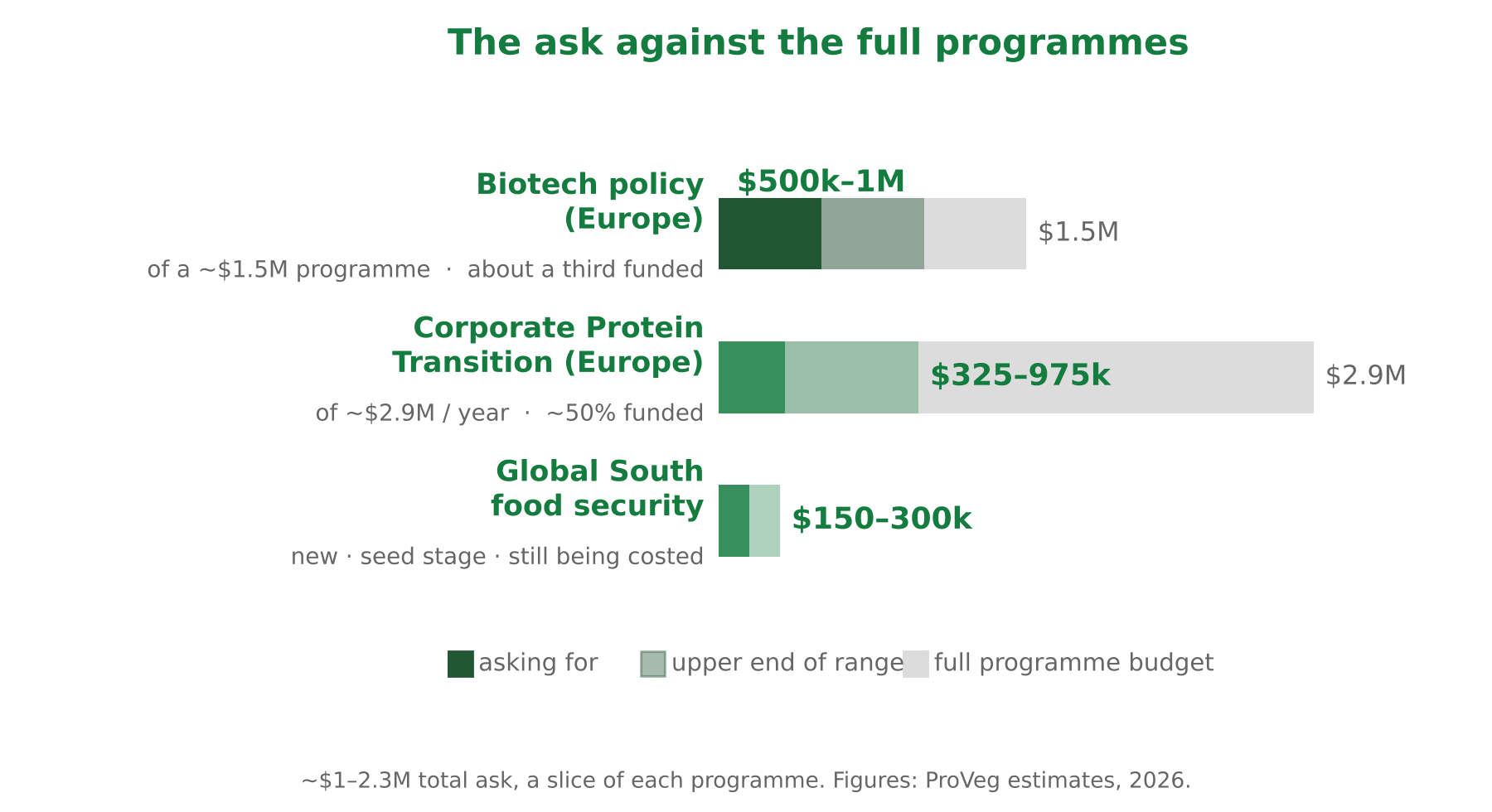
Total: ~$1-2.3M. This represents a portion of the total funding for each programme (current funding covers about a third for biotech, 50% for CPT). If you can only invest in one of these opportunities, we recommend investing in biotech first. It has the tightest timeline and, on our current estimates, the highest leverage.
You can support these programmes directly or email me at elizabeth.alvarez@proveg.org for more details.
Where ProVeg works on protein transition
Every day, billions of food choices are made. These decisions are much more influenced by the choice infrastructure of the defaults and available options people encounter than by individual preferences. Availability, affordability and positioning of foods can strongly shape these choices (Olafsson, 2026). Improving the placement, price and promotion of plant-based foods within shops results in increased sales of plant-based foods (2023 natural experiment in supermarkets). Similarly, when offering more vegetarian options in workplace cafeterias in a randomised trial, there was a 41% increase in vegetarian selections without negatively impacting total revenue (Becker, Garnett, Pechey et al., 2026). The same drivers apply to cultivated/fermented proteins; they are driven by taste, price and familiarity (Onwezen et al., 2021).
ProVeg aims to shift the global protein supply from animal to plant. We work with governments to change food policy and public funding for R&D, with retailers and caterers to put more plant-based proteins on sale, and with researchers and startups developing next-gen protein alternatives so better options exist in the first place. As these structures within the food system change to include more plant-based proteins and move away from animal ones, millions of individual food choices will change with them.
We see three high-impact opportunities for scaling, where marginal additional funding could help us achieve more than our current resources allow: alternative-protein and biotech policy across Europe, Corporate Protein Transition, and protein work in the Global South. All three are covered in this post in more detail, including what more funding would allow us to do through the first half of 2027. All three are at critical inflection moments, where consistent support can turn early progress into lasting wins and let us build on it.
Parts of this work are fortunate to receive EA-aligned backing. To name a few: the Netherlands Protein Tracker and our alternative protein work in China have received support from Coefficient Giving, and our work in China receives support from Giving Green, too. Nevertheless, we could absorb more funding for the projects mentioned in this post.
1. Alternative-protein and biotech policy (Europe)
Helping governments invest in alternative-protein innovation is one of the higher-leverage opportunities for marginal funding right now. Making alternative proteins competitive with conventional meat and dairy requires substantial R&D investment. However, the sector remains relatively underfunded, and public funding has the potential to unblock critical challenges, mainly:
- Competitiveness: to make products competitive with animal-based ones in price and consumer experience (taste, consistency and mouthfeel).
- Regulation: since novel food products (such as cell-based meat) are not currently covered by approval mechanisms within the EU, it will take longer and be more expensive to bring such products to market in Europe compared to countries like the US, Singapore or Israel.
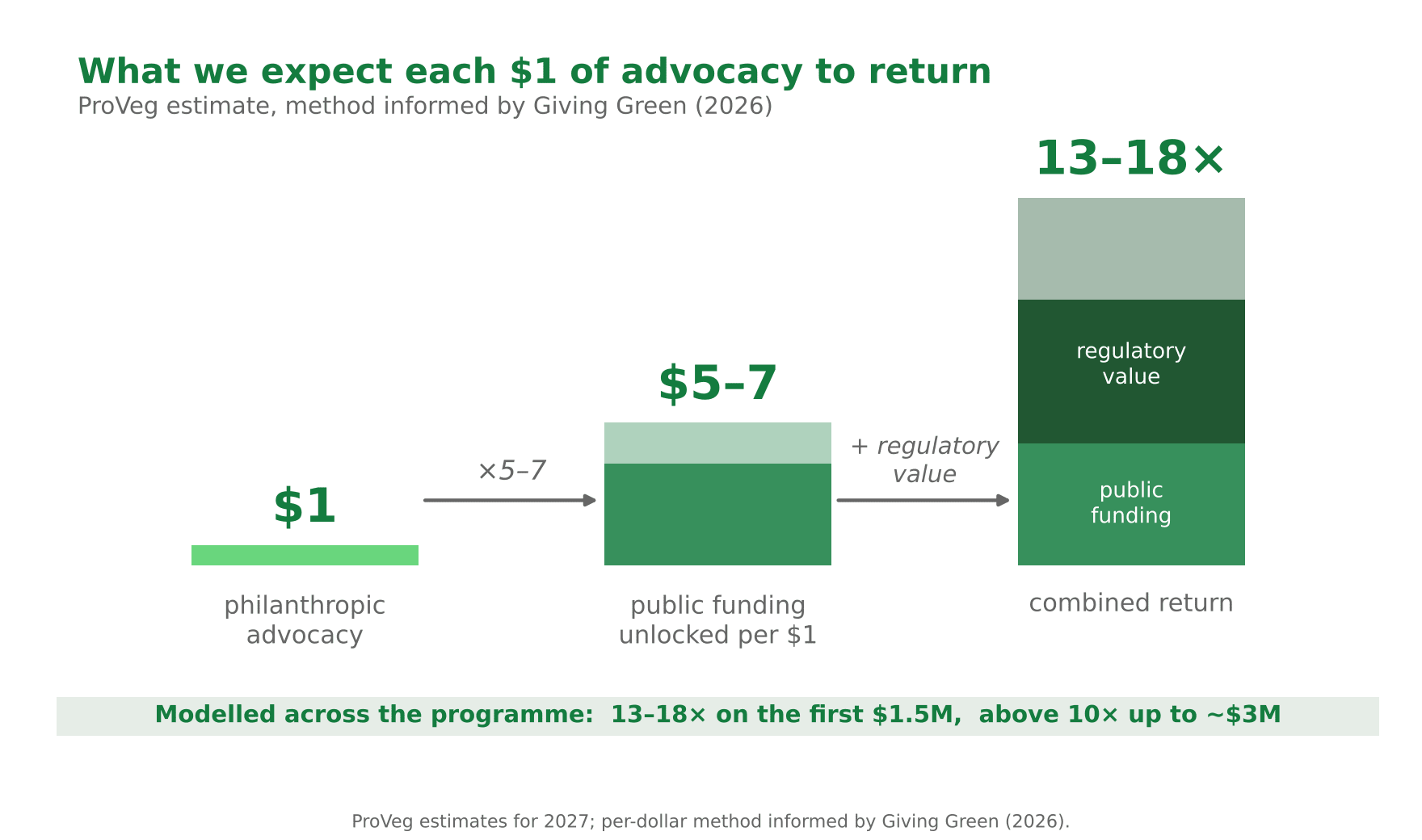
There is a compelling multiplier effect. Earlier this year, this assessment from Giving Green estimated that every $1 spent on advocacy could unlock $5 in public R&D funding. This public funding could consequently attract an additional $3.60 in private follow-on investment for every government dollar. Which, overall, represents a 18x multiplier on philanthropic capital combined (this higher-end figure is mainly due to private money being invested, and so should be interpreted as approximate upper values).
Europe presents great opportunities for food biotechnology right now. The EU has a strong scientific base but needs to do more to translate research into commercial products and manufacturing capacity. Decisions on its next seven-year research budget (2028–2034) and two new Biotech Acts will help determine whether Europe becomes a competitive centre for food biotechnology. We are working at EU and Member State level to secure public R&D investment, build political support and create workable regulatory frameworks.
What we’ve already done:
- In Germany, we worked with coalition partners and our advocacy helped unlock €38M in federal funding for alternative proteins in the 2024 budget.
- In China, we co-authored a Blue Paper mapping the technical bottlenecks to scaling alternative protein with the Chinese Institute of Food Science and Technology.
- This year we ran the 2026 expert webinar series with Jiangnan University, which drew over 10,000 researchers.
Marginal funding would allow us to do more
Biotech policy advocacy, as we fully envision it, will cost us a minimum of $1.5M in the next 12 months, working in Brussels and EU Member States. We need ~$100k for each Member State included in the project, and we estimate we need a minimum of 10 Member States engaged in 2027 for the project to deliver; with 14, we would maximise the return of the project.
With our current expected funding, we can cover around one third of the programme. Each additional Member State increases the national public research funding and the likelihood of a positive Member State vote on cultivated meat applications in November 2027.
- We are looking for between $500k-1M, where each ~$100k allows us to add another Member State to the programme.
- It moves public money many times its own size. In 2027, the first $1.5M of funding into our biotech policy programme is expected to return $5-7 in public funding per $1 spent, and 13-18× its cost in public funding and regulatory value.
2. Corporate Protein Transition (Europe)
Engaging with a few major retailers can influence the food choices available to millions of consumers. Several countries in Europe have markets dominated by a handful of supermarket chains. In Germany, the top 4 retailers account for >80% of the market (Edeka, Rewe, Schwarz, Aldi; Savills, 2024). In the Netherlands, >80% is accounted for by the top 5 retailers (58% by the top 2 retailers) (USDA, 2025). On average, across Europe, top grocers account for ~60% of national markets (Van Dam et al., 2021). Therefore, changes in the product mix, pricing and promotion within a few companies can lead to large changes in the consumption patterns within an entire nation.
We work with them to set and publish targets for plant-to-animal protein in their sales, raising the standard across the market. By lifting commitments and delivering on them this way, we shift buying behaviour at the level of the market, not one shopper at a time. We do this by:
- Collecting and monitoring each company’s ratio of plant- to animal-based protein, using a standard system (Protein Tracker).
- Publishing the standardised results, so companies can be compared and claims contested.
- Pushing companies to set and raise public commitments toward a 60:40 plant-to-animal ratio.
- Supporting them to deliver, by changing the product mix (basket), range, placement, pricing and promotion.
How It’s Working So Far:
- In the Netherlands, 95% of the market has set higher plant-based ratio targets. Two organic chains have met theirs, and we keep working to support the traditional ones to reach theirs.
- German chains like REWE, Aldi Süd, EDEKA, Lidl, and Kaufland now disclose their splits; Carrefour in Belgium and Frisco in Poland were first movers. We've gone from one market to five in eighteen months, with Portugal and Czechia next.
- Lidl brought its own-brand plant-based range to price parity, with support of our Price Study. The company reported an increase of 30% in sales for this category.
- We co-founded Plant-Rich Europe (with WWF, Madre Brava and WRI; 40+ NGOs) and built the Protein Shift Hub, a platform that tracks 72 of the largest food companies across six countries.
Our impact figures showed that in the Netherlands in 2024, the overall retail market shift influenced by our CPT programme avoided 1.2 to 1.3 million animal lives (15.03 to 16.80 lives per USD), and 83.17 to 84.52 million unscaled Suffering Adjusted Days (SADs) (1,074 to 1,091 unscaled SADs per USD).
Under ProVeg’s 40% more conservative attribution scenario, the programme avoided 465,596 to 520,642 animal lives (6.01 to 6.72 lives per USD), and 33.27 to 33.81 million unscaled SADs (429 to 436 unscaled SADs per USD).
Marginal funding would allow us to do more
Our work with European supermarkets costs around $2.9M per year. Our current funding covers about 50% of our ambition for the next 12 months, and doesn't cover growth to new markets.
What do we need?: $325k to $975k, to secure continuity and expansion into two more countries.
- To keep the programme running at pace in the upcoming months, we need between $325k - $975k. This would allow us to protect the ground we've gained since 2025.
Continuity matters. Moving from the first contact to establishing a protein ratio measurement with a retailer can take up to a year, and longer to set a public target. If we pause those relationships, the progress could slip fast. - An additional ~$100k would help take the CPT model to Portugal and Czechia.
3. Food security in the Global South (Nigeria, South Africa, India and Brazil)
Over the next decade, low- and middle-income countries (LMICs) are expected to drive nearly all growth in farmed animal and fish consumption, while rising incomes and urbanisation shift diets toward more animal-source foods. Whereas the two European opportunities above seek to reduce existing overconsumption of animal-source foods, in these countries we are working to expand the range of credible ways to meet rising demand—so that intensive animal agriculture is not treated as the inevitable default. Our national offices in Nigeria, South Africa, India and Brazil are exploring interventions to support sustainable plant-rich pathways to meet that demand.
Each of these countries has different approaches that reflect their priorities and context. Food security often provides a common, practical entry point. This work will connect protein diversification with issues that governments already prioritise, including: nutrition, agricultural livelihoods, climate resilience, and domestic food production.
We want to turn our existing foundations in these local offices into concrete programmes; additional funding will help us:
- Set up an Africa hub, starting with pilots in Nigeria and South Africa.
- Implement pilots in India to work on seaweed, fortified plant-based proteins, and other products.
- Strengthen our Brazil track, building on the plant-based regenerative farming pilots we already run in the country.
- Implement Policy work with ministries of agriculture, environment and health to get plant-rich options into their national food and climate plans.
What marginal funding would do
- Our Food security interventions are new. Seed funding to launch these will create the foundation to pitch for larger amounts of funding. Our current single-country pilots will cost around $40-90k per year; a co-designed, multi-year scale-up is closer to $300k.
What do we need?: Seed funding (~$150–300k, still being costed).
- Provides the initial funding to launch our new interventions across the Africa hub (Nigeria and South Africa), India, and Brazil, building on existing country teams, relationships and programme foundations.
- Supports locally-driven solutions for food security, agricultural livelihoods and protein diversification. Through these approaches, we aim to position plant-based alternatives as a priority strategy of national food-system development when major investment and policy decisions are made.
- This is an early-stage opportunity and still developing the detailed budget. The programme launches in 2027, so seed funding now will help us establish the programme and turn existing opportunities into concrete work.
Putting it together
The total funding required would be roughly ~$1-2.3M. This is only a fraction of the total required: we currently have funding for a third of the $1.5M Biotech programme, and 50% of the $2.9M CPT programme.
If you can only back one, here's how we'd weigh them:
- $500k-1M needed for Biotech: Is the most time-sensitive because the EU decisions it depends on have fixed dates, and it's where each dollar could go the furthest.
- $325-975k for Corporate Protein Transition: Is the most established and proven from this list; the model is already in place, and there is scope for scale-up.
- $150 - 300k seed funding for LMIC food security: Is the earliest-stage, but also the most neglected.
The figures given here are our estimations based on current budgets. There are some uncertainties in these values. The biotech value is an estimate depending on votes in the EU in 2027. The value of CPTs is an estimate from the top down, so we include a conservative value for attribution (40%) as well as the market-level estimate.
If you are interested in supporting any of these programmes, we are very happy to provide more specific details and the cost-effectiveness models available. Our CPT impact models build on AIM's encouraging estimates of the protein shift, and we have done some modelling of impacts from biotech. We don't yet have numbers for the Global South; this is something that seed funding will be used for.
How to support
If any of these programmes resonate with you and you want to support them, the simplest way is to donate directly, adding the details on your preferred designation in the form.
We have a few different ways to give, including workplace giving and some tax-deductible routes in several countries, depending on your location. If you are thinking about a larger gift or would like more detailed information, email me at elizabeth.alvarez@proveg.org.
I'll be in the comments section in the upcoming days; feel free to ask for more details!
_______
Notes on authorship: This post contains outputs from programmes, data, and models created by members across teams and offices of ProVeg International. I wrote this post, and any mistakes are my own.
All text is human-written. I lightly used an LLM to proofread this post and create charts from our data. The analysis, data, and conclusions are ProVeg's own.