Disclosure: I am an Entrepreneur in Residence at Kickstarting for Good and I work for ProVeg International. Both organisations are making some of the bets I argue for here, and readers should weigh that. However, the arguments are my own, and I have tried to flag the places where my vantage point is most likely to be biasing them.
In short: New philanthropic capital is arriving in animal advocacy at a scale the movement's existing playbook was not built for. This is a piece for people who fund the movement, and for those who think about it and have their own view of what should be funded — what I am after is a conversation: push back, amend, tell me what you would fund instead. I have simply dared to name what I would fund if I had the money, or the power to direct it. I hope others are daring to do the same, because we are entering a phase in which abundance should let us be more experimental, and bolder in our pragmatism.
I grouped my ten bets into three moves:
1. What to fund directly: the policy layer underneath food systems (Bet 1), the alt-protein transition (Bet 2), and narrative change (Bet 10).
2. Who does that work and where, and for which animals: talent and infrastructure (Bet 3), the Global South (Bet 7), and neglected species (Bet 9).
3. How we evaluate and structure the funding: blended impact (Bet 4), intervention pluralism (Bet 5), patient capital (Bet 6), and absorption capacity (Bet 8).
Acknowledgments: I'm grateful to Pablo Moleman, Carol Destro and Elizabeth Álvares for their thoughtful feedback on this piece and for pressure-testing my arguments. Any remaining errors or weak spots are my own.
As most of you already know, a significant wave of new philanthropic capital is entering the animal advocacy space, and it has a specific source. Anthropic's seven co-founders have pledged to give away 80% of their wealth, and the company has instituted the most aggressive employee donation-matching programme in tech history — a 3:1 match for early staff who move private shares into a donor-advised fund (Nan Ransohoff, "The Third Wave of American Philanthropy"). When Anthropic's valuation reached $380 billion earlier this year, the company gave employees the option to cash in on their equity, and a confidential draft S-1 filed with the SEC suggests a full liquidity event (an IPO or a share sale) may not be far off (Jack Lewars, "What is the Funding Anthropalypse?"). In her recent Substack piece, Ransohoff estimates AI wealth could add somewhere between $37 and $100 billion a year in intended philanthropic spend in the near future.
It's worth asking why so much of this is landing specifically on farmed animals, rather than being spread evenly across every cause a wealthy donor might pick. Part of the answer is that the people and institutions involved overlap. Holden Karnofsky, who co-founded GiveWell and Open Philanthropy (now Coefficient Giving), now works at Anthropic; at least one co-founder has publicly identified as an effective altruist; and Anthropic staff are well represented at EA conferences. Because animal welfare has long been one of EA's core cause areas, alongside global health and existential risk, it was always going to be near the front of the queue as this wealth started moving. As we learned from his recent piece, Lewis Bollard, who has spent years funding this space, expects much of the next generation of major animal welfare donors to come directly from AI labs.
It is also a decisive moment for funders to ask where they want this money to go, and that question carries real responsibility. Capital this concentrated, and this closely tied to a single source, is a risk to manage as much as an opportunity to spend. I believe that whatever else this wave funds, building a more diversified and resilient funding base for animal advocacy is part of spending it well. The instinct so far has been to mostly ask how we absorb it inside our existing playbook and existing animal welfare organisations. I believe the more appropriate question, and the more ambitious one (one that's realistic given the scale of capital now arriving) is what a much bigger playbook and movement ecosystem could look like.
These are ten bets that I think could make the movement more impactful for animals. Before getting to them, I want to reflect on why systemic work is funded in such a limited way by EA. I start there because the ten bets come from a systems view of the problem, and they all run through that same crux. If we solve it, the bets become more realistic to pursue.
First of all, why hasn't EA funding already gone to systemic work?
If shifting the production system itself and its underlying social support (cheaper alternative proteins, wider institutional and social adoption, a different default on the plate) is as promising as I argue here, a funder's first question is fair: why is it not already the obvious pick in the EA movement? In my view it comes down to one thing:
A measurement problem, not a merit problem.
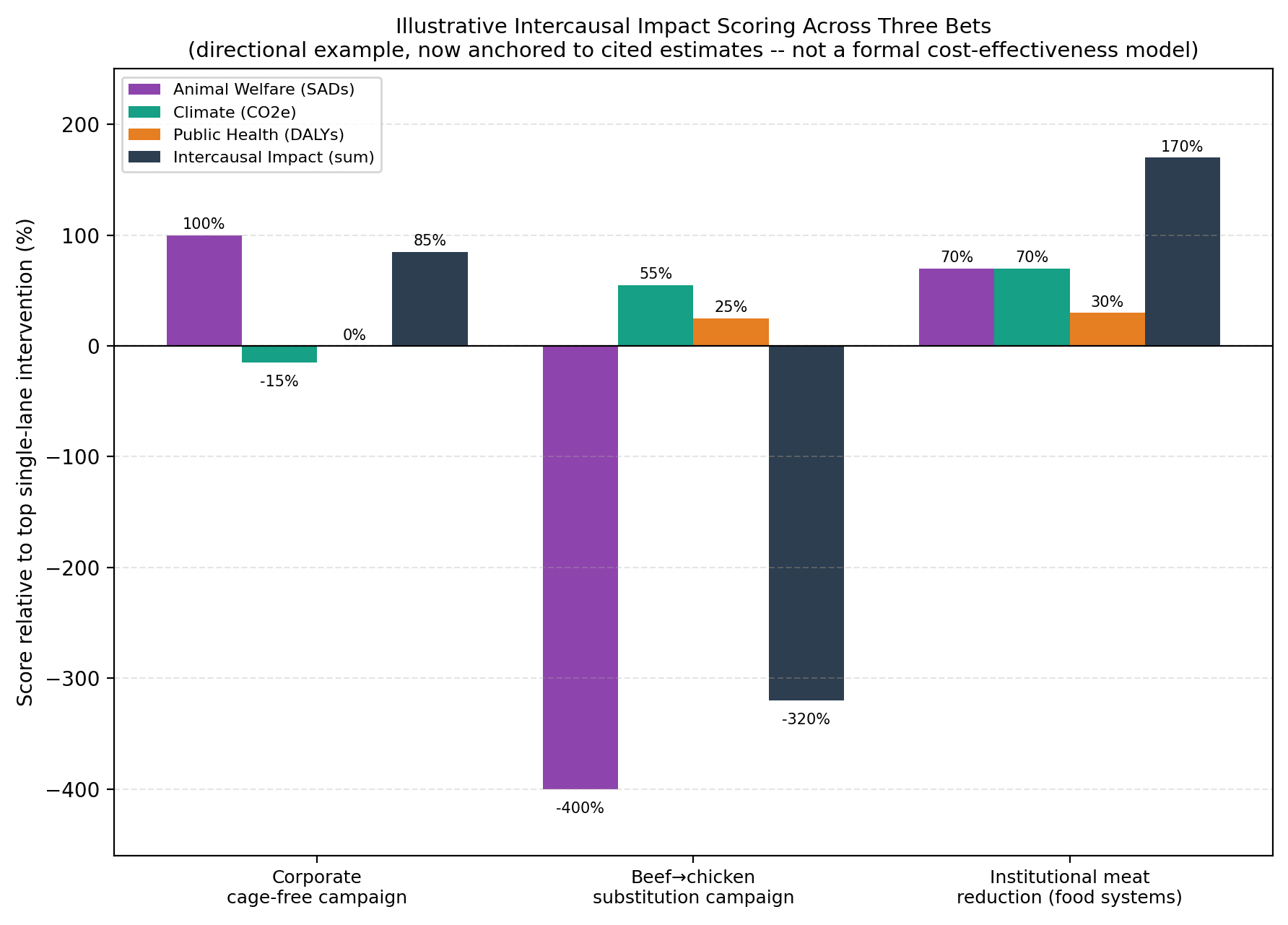
The research bodies supporting the animal welfare movement deliberately score interventions in the native unit of a single cause: animal welfare in Suffering-Adjusted Days (SADs), global health in Disability-Adjusted Life Years (DALYs), climate in tonnes of CO2-equivalent averted. That discipline is defensible within a lane, since it measures each intervention against its own stated objectives, but it penalises interventions that create real value across more than one area, which describes how most systems work actually works, especially food systems one.
Take a school-plates initiative that shifts institutional meals toward plant-based defaults. On any single scale it may look middling. But its counterfactual case may be stronger than any one metric shows, because a fair accounting would convert those effects into a common currency rather than penalising the intervention for succeeding on more than one front. Conversion, not addition, is the operation that matters here, and it is easy to get wrong: suffering-adjusted days, tonnes of CO2-equivalent, and disability-adjusted life years cannot be summed, because the units do not combine. Funding decisions should account for correlated benefits a single-lane cost-effectiveness analysis can't see.
It is true that the movement already has some examples of initiatives trying to grapple with the need to measure interventions across different areas. For example, the incubator Charity Entrepreneurship's own scale-up research on alternative proteins already reports exactly this kind of dual case for a single intervention, modelling both the tonnes of CO2-equivalent averted and the animals spared side by side (Charity Entrepreneurship, "Securing Scale-up Funding for Alternative Proteins"). Rethink Priorities' Cross-Cause work points to the same instinct from a different angle: it puts global health, animal welfare, and existential risk on one common welfare scale so they can be weighed against each other rather than judged only within their own lane (Rethink Priorities, "Cross-Cause Cost-Effectiveness Model"). RP has already turned this from a research question into a live funding mechanism: its Cross-Cause Fund allocates real money on that basis, rather than defaulting to whichever cause has the cleanest single-lane metric. Climate mitigation is still under evaluation for inclusion in that fund, pending confirmation that existing climate funds meet RP's data and quality bar. A newer, more experimental attempt at the same problem comes from Impact Lab, which published its inaugural ranked index of giving opportunities this year, explicitly placing animal welfare interventions alongside global health ones on a shared scoring framework.
Once research bodies and some philanthropists accept that complex problems demand evaluation methods that go beyond a single metric, systemic work will read differently: not as a weaker bet on animals, but as a strong bet on animals that also moves public health and climate.
These bets aren't ten independent picks from a menu; they cluster into three moves, as I mentioned above. Two are about what to fund directly: the policy layer underneath food systems (Bet 1), the alt-protein transition it's meant to unlock (Bet 2) and the narrative change needed for society to follow through on these changes (Bet 10). Three are about who does that work, where, and for which animals: the talent pipeline (Bet 3), the neglected geography (Bet 7), and the neglected species (Bet 9). Four are about how we evaluate and structure the funding itself: blended impact (Bet 4), intervention pluralism (Bet 5), patient capital (Bet 6), and absorption capacity (Bet 8).
The Ten Bets
1. Policy work to end factory farming
We're all aligned across the movement on the need to end factory farming, and this should remain one of our central areas of focus, since that’s unfortunately where the (human caused) suffering is greatest for animals. Corporate campaigns have been the movement's best win of the last decade: a small number of target companies, clear asks, and commitments we can point to that alleviate suffering in factory farms. That's exactly why the movement funded them so heavily, and the case for continuing to fund them is strong. With more funding flowing to the movement, we should start thinking about what should be funded alongside corporate work, even work that makes the pressure corporate campaigns put on companies stronger still.
The most natural complement to corporate campaigns is policy. Corporate commitments are voluntary, which means nothing holds a company to one once it becomes inconvenient; regulation is what turns a win against one company into a floor every company has to meet. Up until now, though, policy work has always been the harder sell, since legislative timelines run long, outcomes are diffuse, and it's genuinely hard to point to a bill and say "our dollar did that." That is the counterfactual problem, and funders probe it harder than almost anything else, rightly so. The Denmark example, which I explain below, is an existence proof that the work can land. What it does not give us is a clean method for assigning credit among the organisations that made it land. That should be fine from a social movements perspective, since what matters is not who did what, but what we achieved together, and how we did it, so that we can replicate it.
The honest position is that policy attribution stays hard, and that the constructive response is to fund it in a way that makes learning possible: multi-year grants with intermediate indicators agreed in advance (which go beyond the activities of one, two, or three organisations), such as coalition membership, bills tabled, committee testimony and budget lines opened, assessed as a portfolio rather than grant by grant, with process tracing commissioned afterwards from people who were not running the campaign. A wave of money large enough to hire real policy talent, keep multi-year campaigns funded past their first setback, and build the coalitions that move legislation will let us finally see whether political work is a worse bet than more immediately visible interventions, or simply a neglected one.
Past social movements offer a precedent for this. In the Civil Rights Movement, for example, established "inside game" work was a precondition for its most ambitious wins, which supports investing more strategically in that inside game in this moment of relative abundance. The CRM was driven by an ecosystem of organisations working across different fronts. For example, the NAACP Legal Defense and Educational Fund (LDF) provided legal representation, filed briefs, and defended activists arrested during protests, boycotts, and sit-ins throughout the movement's disruptive phase. The Southern Christian Leadership Conference (SCLC) engaged in policy advocacy, particularly around voting rights — actually, the Selma campaign was explicitly designed to pressure Congress toward what became the Voting Rights Act of 1965. Decades earlier, well before that disruptive phase, the NAACP had already been carrying out quiet, laborious litigation work. Regardless of where we are in the cycle of social movements as social movement theorist Bill Moyer taught us (Bill Moyer, “Doing Democracy: The MAP Model for Organizing Social Movements”), the NAACP was doing its policy work well before MLK became well known.
This example shows that we do need to build an ecosystem of organisations driving change from the political inside, not only through corporate engagement. Therefore, in the case of our movement, the highest-leverage version of that inside game isn't just corporate asks, but the policy layer underneath food systems: redirected agricultural subsidies, procurement standards, farm transition support, and industry regulation that shifts what an entire food economy produces, not just what one company sells.
As a movement strategist and president of The Navigation Fund, David Coman-Hidy argues persuasively, in his recent and very thoughtful Substack article on the pro-life movement (David Coman-Hidy, “What Did the Pro-Life Movement Get Right?”), another social movement with many lessons for ours, "what the animal movement needs is a policy agenda that could enable more city and state victories that move the needle for animals, one focused on winning while developing our activists and capturing grassroots energy for the cause." He then asks the key question, one I share: "What are the fights that are winnable at the city or state level, that build legislative relationships and train advocates, and that create real momentum toward something bigger?"
As I mentioned above, Denmark is, in my opinion, the clearest recent working example. In 2023 its government published the world's first national action plan for plant-based foods, backed by a dedicated Plant-Based Food Grant that has since grown to roughly €170 million (Rethink Priorities, "Denmark's Agricultural Transition Policy"). That plan followed years of coalition-building by NGOs across the ideological spectrum: the Vegetarian Society of Denmark, the pro-industry group Plantebranchen, Greenpeace Denmark, and the farmer-aligned think tank Frej co-authored a report, "From Feed to Food," making the explicit case for a National Action Plan. Meanwhile, the Network for Plant Proteins (now with 270 members across the value chain) built the relationships between farmers, industry, and government that let the ask land without triggering the backlash a top-down mandate would have. This example signals not only the success of policy work in changing systems, but also how it requires different organisations to work in synergy , which means strengthening an ecosystem, not just one or two highly effective organisations as I argued somewhere else in a more fun way (Bárbara Buril, "Social Movements as Ecosystems and the Vital Role of Different Theories of Change"). A wave of new capital large enough to fund policy work at scale needs to fund that kind of coordination deliberately.
So policy work does the slow labour of resetting the rules a food system runs on (what gets subsidised, what a procurement contract requires, what a regulator will approve), but new rules only matter if there's something ready to fill the space they open up. That would be my next bet.
2. Alt-protein transition as a growing centre of gravity
If Bet 1 changes the rules a food system runs on, this bet is about changing what's actually on the shelf once those rules shift by supporting more direct interventions in the alt-protein transition. Where Bet 1 funds inside game initiatives, this bet builds the field of alternatives. If we want to change the system, we also need to invest in creating the world we are aiming for, which means building real alternatives to the status quo. The Ayni Institute identifies this as one of five approaches to change, all of which we need in order to build a multi-strategic ecosystem of change. I explore this framework in more depth in my Substack, as I suggested above.
The bigger reason to lean in now is the size of the possible upside. If the underlying protein market genuinely shifts, it doesn't just avert suffering directly, but changes the default option on every plate for every future consumer. It's also a bet that can open up real change in culture more broadly, which is the core of any social change a movement like ours ultimately wants to achieve: we do want to reduce suffering now, but of course our goal is to eliminate it in the future. If transformation lands in culture, much of the rest gets relatively easier, since we will have social support to ask for policy change, more power to ask companies to commit, and so on.
As Lewis Bollard argued in his widely cited recent Substack post, now is the moment to revive alternative proteins by speeding up AI-driven product innovation and pushing back against regulatory headwinds, a work that could reverse factory farming's current default path of indefinite growth (Lewis Bollard, "The AI Windfall"). This isn't a hypothetical bet, since it's already the shape of the work being modestly funded today, and it's ready to scale in markets such as China, where there's a real opportunity to shift cultural habits through products rather than moral argument in a market where public and political discourse works differently than in liberal democracies.
Because many of these technologies are novel foods (precision fermentation, cultivated ingredients, molecular farming), regulatory approval has often been the bottleneck between a lab breakthrough and a product on the shelf. Defending that regulatory space is one step toward the broad acceptance of alt-protein this movement is working for. None of this — the policy work in Bet 1 or the product work here — moves without people who know how to run it. That shortage is the next bet.
3. A venture-style bet on talent and infrastructure (especially in the Global South)
Bets 1 and 2 both assume a supply of skilled people that doesn't yet exist at this scale. For example, policy staff, farm-transition specialists, campaign leaders, researchers, product scientists, and the AI-driven and culturally-smart marketers who can build social demand for the new products to be launched. As we all know, money will be arriving faster than the people who know how to spend it well. Fellowships, incubators, and university programmes are now a direct fix for this lack of talent in the movement.
As we learned in her recent post in the EA Forum, Zoë Sigle, Senior Program Officer at the EA Animal Welfare Fund, splits a possible shared strategy into three buckets: scaling what already works (50–60%), testing new interventions (30–40%), and growing movement infrastructure and people power (10–20%) (Zoë Sigle, "The $120 Million Question: How Will It Help Animals"). Following this funding strategy, that last bucket becomes the smallest, and it's also the one where a handful of the right people, ten years out, end up founding or running the organisations that absorb everything else on this list. By underfunding growing movement infrastructure and people power this way, we not only cap what the other 80–90% can actually achieve, but also fail to tap into the only power we have as a movement: not economic, not political, but the power of people and their support for animal welfare. Project Phoenix Substack recently published a very insightful piece on the importance of funding people power (“What Should the AI Windfall Build?”) in the farmed animal movement.
Five years ago, founding an animal advocacy organisation essentially meant one route. Today there are at least nine dedicated incubators and fellowships across the movement, from AIM's flagship program to regional efforts like Animal Advocacy Africa and Welfare Matters in Southeast Asia (Sofia Balderson, "So You Want to Start Something for Animals: A Map of the Incubators"), as well as Kickstarting for Good, where I work. This expansion is a signal worth taking seriously: it shows a real appetite for the movement to grow. Yet not all of these programs are well funded, and much more could be done with more resources. Moreover, even with this growing number of incubators and fellowships, few of them address the talent bottleneck at its root, and language is a major barrier. The world is big, the problems we face are complex, and many talented, entrepreneurial, and brilliant people do not speak English. That is why I believe we need to expand capacity-building initiatives in the Global South.
Also, the same fellowship and incubator pipeline that builds food-policy capacity is simultaneously staffing animal welfare organisations and alt-protein-adjacent policy work — and vice versa — because in practice these aren't separate talent markets. People going through one incubator might launch their own organisation aligned with the incubator, but might also leave it to join an existing organisation leading a different theory of change. In other words, people going through fellowships and incubators end up carrying talent across the movement's different theories of change, so fund the pipeline once, and it strengthens every part of this list at the same time.
However, funding more people and more organisations doesn't resolve a harder problem underneath it: how do we know which of the resulting interventions are actually worth funding, especially when their value doesn't fit inside a single metric? The next three bets turn from building capacity to fixing how we measure what that capacity produces.
4. Blended impact beyond suffering-per-dollar
This is the practical form of the measurement problem raised at the start of the piece. As already noted, some of the strongest interventions available to us do not reduce cleanly to a single suffering-per-dollar number, because their value is split across animals, climate and public health at once (sometimes across other areas of society as well). An intervention can look excellent on the one metric we're grading it against while quietly borrowing against a cause area nobody in the room is tracking.
Campaigns that shift consumption from beef toward chicken are the clean example: judged purely on emissions, they're a good result — less land and feed per calorie, so a real climate win. Judged on animal suffering, it becomes much worse, because chickens are smaller and it takes many more of them to replace the same tonnage of beef (Sebastian Joy, "The Importance of Intercausal Impacts"). While a corporate campaign has a discrete unit of success (a commitment, a company, a date), structural work doesn't produce that unit. Its effects arrive diffusely, through many actors at once, and often only become visible years after the spending that caused them. This matters for donors who identify not only as caring about animals, but also about climate, public health, and long-run risk — with animal welfare as one serious concern among several.
As the philanthropy advisor Jack Lewars notes, the traditional effective altruist causes will attract enormous support, but many of these new donors are also likely to build out a broader list over time: justice, the arts, democracy protection, reproductive rights (Jack Lewars, "What is the Funding Anthropalypse?"). For donor circles focused on causes beyond animal welfare (and especially beyond EA), an intervention that visibly moves animal welfare, public health, and the environment together is a much easier “yes” than one asking a donor to weigh suffering-per-dollar against causes they weren't otherwise planning to fund. Taking this into account, my question is: shouldn’t we also be thinking about a more varied (but not less effective) philanthropic portfolio, for those who value interventions that touch more than one aspect of society?
But even for donors who care little about those other causes and are focused on animal welfare alone, it is worth naming that welfare reforms change the conditions under which an animal is farmed, but they do not change how many animals are farmed. Per-animal reform has a ceiling that demand reduction does not: welfare reform recovers a fraction of one animal's suffering, while a life never farmed recovers the whole of it. On the animal metric alone, production volume is the variable that moves the total, and food systems work is the most direct lever we have on it.
I strongly agree with the tech leader and philanthropy expert Nan Ransohoff, who argues that the tools that defined the last era of giving weren't built for questions about civilizational flourishing, and that funders working through this new, abundant terrain will need to lean on taste and judgment as much as on spreadsheets (Nan Ransohoff, "The Third Wave of American Philanthropy"). This doesn’t mean we shouldn’t measure the impact of interventions (as I argue below), but that we need to lean on factors beyond numbers to really grapple with the impact of things — including the feeling of how one intervention is changing ‘the climate’ of the conversation, something not always measurable in the way we are used to, but extremely important when, for example, a piece of animal-cruelty news breaks and shifts public outrage.
The practical upshot: we shouldn't force every animal-related initiative into a suffering-per-dollar frame just to make it legible to this money. Some of it is honestly structural, movement-building work; and for a real slice of this donor pool, that's not a weaker pitch. If a single metric can't fairly capture an intervention like this, the answer is to fund a genuinely diverse portfolio of theories of change, and get better at comparing across them. That's the next bet.
5. The intervention pluralism moment
We should celebrate that some funds in the movement are taking this point seriously.
The EA Animal Welfare Fund is explicit that it's trying to maximise the total diversity of approaches across the whole ecosystem. As it says in its own 3-Year Grantmaking Strategy post on the EA Forum: “"AWF aims for maximizing 'total' diversity of approaches addressing animal suffering rather than 'AWF's' diversity, which means that AWF will specialise in particular segments as long as there are good grantmakers who prioritize other areas we find important." Its strategy only works if other funders and organisations hold ground it doesn't cover: producer engagement, government advocacy, technology, movement-building — each reinforcing the others rather than competing for the same dollars. It seems that AWF tracks this, and specialisation is a sensible approach for a fund of its size. The open question is what happens as much larger sums arrive, since specialisation assumes someone else covers the rest, and the bigger the funder, the more that assumption needs checking rather than presuming.
This intervention pluralism bet rests on the idea that social change requires action across several "wheels of change," the five approaches described by the Ayni Institute: personal transformation, building alternatives, the inside game, structural organizing, and mass protest. No single wheel can turn a movement on its own, so they need to turn together.
The same point is made in an article on transition finance, which argues that single interventions are like flowers: they don't always grow, and when they fail, the problem is often not the bulb but the garden. The soil may be poor, the pH unbalanced, the sun too strong, the wind too harsh. As the authors put it: "A good transition financier therefore does not only look at individual investments. It also considers the wider garden. Beyond assessing risk, return, and impact at the project or company level, transition finance increasingly requires an understanding of ecosystems: policy direction, infrastructure readiness, value-chain coordination, market demand, and the sequencing of public and private capital" (Lucas Simons and Andrea Viviers, "A Good Transition Financier Is Also a Good Gardener").
It’s important to be clear that pluralism is not a licence to stop measuring. Every successful social movement has been multi-strategic (Mark and Paul Engler, This Is an Uprising), but within each theory of change some interventions are simply better than others. We therefore need to measure interventions independently of the theory of change they pursue — a hard challenge, but one that groups within the movement are working on, as with the Culture Indicators Project led by Sharpen Strategy, which measures cultural change in the United States driven by animal advocacy, just to name one example of an initiative focused on measuring systemic, cultural change.
So I believe this is a genuine intervention pluralism moment: a chance to fund that diversity deliberately, now, so the ground is laid for the next round of high-impact work to actually have somewhere to land. Funding that diversity deliberately only pays off if funders are also willing to wait for it. Pluralism and patient capital are two sides of the same commitment.
6. The time for patient capital
The current wave of abundance should allow us to make long-term bets without needing a quick return. In this context, patient capital means funding structural work on the understanding that it compounds over a decade rather than a grant cycle. Of course, in terms of impact, this may look unimpressive on this year's ledger, but within a decade it could be transformative, even shifting the Overton window (the range of ideas the public and policymakers consider acceptable and worth debating).
In this context, patience is not the same as a blank cheque. What makes structural work fundable isn't a promise of eventual results, but whether a grantee can say in advance what should be true at year three if the theory is working. That means an explicit theory of change, grounded in a credible model of how systems shift; intermediate indicators agreed at the outset; and review cycles honest enough to confirm a slow bet is on track or to end one that has stopped moving.
Systemic interventions are the clearest test case for patient capital, because supply chains, manufacturing capacity, institutional adoption, and consumer habits, to name a few, do not shift within a single grant cycle. But once they shift, they don't shift back, and neither does the policy infrastructure underneath them. Denmark's plant-based action plan took years of NGO coalition-building before it became government policy, and now funds itself through a standing grant renewed by parliament rather than a one-off campaign win.
Redirecting agricultural subsidies, supporting farmers through the transition away from livestock, building the regulatory and grant infrastructure for new forms of food, and shifting how people perceive food are exactly the kind of multi-year, non-linear wins patient capital is suited to fund. The payoff shows up as a changed default, not a quarterly result.
Denmark had the wealth, institutions, and time horizon to let this kind of change compound over years. The parts of the world that raise most of the world's farmed animals have none of those advantages yet, which is exactly why patient capital matters even more where the next bet is pointed.
7. Global South neglectedness
Most farmed animals alive today are raised and slaughtered in the Global South. More than 75% of the world's farmed animals live in Asia alone — including 90% of farmed fish and 45% of land animals (Coefficient Giving, "Farm Animal Welfare in Asia"). Mercy For Animals puts a sharper number on the imbalance: at any given moment, 80% of farmed animals live in Latin America and Southeast Asia (including India and China), yet these regions receive only about 10% of the movement's total farm animal budget — while the US and EU, home to just 6% of farmed animals, absorb roughly 85% of it (Leah Garcés, "Identifying Opportunities for Farmed Animals," EA Forum). This imbalance between where most farmed animals are and where funding flows clearly points to a neglectedness case that needs to be solved even within the EA paradigm.
That imbalance holds in the funding data too. Farmed Animal Funders' 2021 figures show $91 million going to North America and $70 million to Europe, compared with $15 million for Asia, $10 million for Latin America, and roughly $2.5 million for the whole of Africa (Animal Advocacy Africa, "Mapping the Charitable Funding Landscape for Animal Welfare in Africa"). Rethink Priorities has modelled what a more optimal allocation would look like: for example, roughly 17% of total effective animal advocacy resources going to Africa alone (9.1% Sub-Saharan, 8.1% North Africa and the Middle East) — several times the actual share it receives today. It is also where trained advocates and functioning organisations are thinnest. Africa holds an estimated 3.2–3.4 billion land-based farmed animals, yet as of 2022 only 83 organisations across the continent had ever received dedicated farmed-animal funding (Animal Advocacy Africa, "Mapping the Charitable Funding Landscape for Animal Welfare in Africa"). This is, again, a textbook neglectedness case.
This isn't only a case for funding where the animals are, but also a case for funding in sequence. The Global South is where absorptive capacity is thinnest today, due mainly to a lack of investment in the movement's infrastructure of organisations and talent. Funders who expect scale before they've paid for capacity will conclude, wrongly, that the region cannot absorb money. We have to build the conditions for these regions to absorb this money too.
8. Absorption capacity and scalability are now key
As already argued above, cost-effectiveness should stay our first filter, but it's not the only one that matters anymore. A genuinely cost-effective intervention can still have a low ceiling — capped by geography, logistics, or simply by how many experienced people exist to run it well, regardless of how much money shows up behind it. In practice, that's a room-for-more-funding (RFMF) constraint as much as a cost-effectiveness one.
Absorption capacity and scalability are now almost as important as cost-effectiveness. A cost-effectiveness ratio only tells you how well a dollar performs once it lands somewhere; it says nothing about whether an organisation can actually put tens or hundreds of millions of dollars to work without its systems, staff, or pipeline buckling under the volume. Jack Lewars applies this distinction deliberately in his own work funding mid-stage global health, where the question he manages toward isn't only "is this intervention efficient" but "can this organisation absorb serious money and still deliver" (Jack Lewars, "What is the Funding Anthropalypse?").
That shift, in the face of this new era of abundance, matters because some of the projects capable of absorbing this scale of funding won't clear the cost-effectiveness bar that a smaller-money era set for them — a bar calibrated to a world where the safest use of a scarce dollar was funding only the very top of the effectiveness curve. As the money supply grows, that bar should be expected to fall: once the most cost-effective organisations hit their ceiling for useful funding, the realistic alternative to a slightly-less-effective but highly scalable project isn't a better option, since it would mean unspent money instead. Something similar may already be underway in global health giving, as growing budgets push funding past the handful of gold-standard interventions and toward larger, more absorptive ones.
Food systems work may be the best-suited bet on this list for absorbing that kind of money, because it typically involves complex interventions that operate on multiple fronts and touch diverse metrics. The instinct so far has been to ask existing highly effective interventions to absorb more: bigger campaigns, larger policy teams, more grants to the same organisations. That has concrete limits, because it is less a funding-size problem than a shape problem — for example, a campaign built to win one commitment from one company doesn't necessarily get more efficient because you triple its budget.
Some of the RFMF we've been underestimating may not sit inside a single welfare intervention, for example, but in how food systems are organised as a whole. Those tend to be sized for economies and big social infrastructures, which is part of why they can absorb a check an order of magnitude larger than a corporate ask.
9. Neglected species
Another bet I'd take is redirecting funding toward neglected species — fish, shrimp, and farmed invertebrates. They make up the overwhelming majority of animals in the food system by any count, yet receive only a small fraction of the money and attention.
Rethink Priorities estimates that roughly 440 billion farmed shrimp are killed each year, against 51–167 billion farmed fish and 70.8 billion chickens; at any given moment, some 230 billion shrimp are alive on farms — more than all farmed vertebrates and insects combined (Rethink Priorities, "Shrimp: The Animals Most Commonly Used and Killed for Food Production"). The funding has not followed those numbers: only about 11% of global farmed animal welfare philanthropy goes to aquatic animals at all (Stray Dog Institute, cited in Senterra Funders, "Beneath the Surface: Funding to Improve the Lives of 540 Billion Animals").
That neglect has begun to shift. The moral weight research of the past few years narrowed the uncertainty considerably, and the money has started to move with it: ACE now lists both the Shrimp Welfare Project and the Aquatic Life Institute among its recommended charities (Animal Charity Evaluators, "2025 Charity Recommendations"), and the EA Animal Welfare Fund has backed work in the same space. The portfolio is beginning to follow, from a long way back.
But a thorough approach to these animals cannot stop at welfare techniques. It also has to take on public perception, and not only for its own sake: adoption of the techniques depends on it. Expanding people's moral circle far enough to include a shrimp is a hard problem in its own right, and it needs funding alongside the work already underway on stunning and slaughter methods, stocking densities, water quality, and feed composition.
Rockwell and Tom Billington, a co-founder of Fish Welfare Initiative, make a version of this argument about the movement's growing enthusiasm for welfare technology, and about the need to work on other fronts as well — not least to make welfare tech itself more acceptable. Right now we are overinvesting in short-term deployment and underinvesting in the slower work that makes the intervention real.
Hype can crowd out long-game strategies. Ultimately, the pro-animal movement needs to build a broad strategy for reducing animals' vulnerability, building institutional power, and shrinking exploitative industries. To achieve this, we need a diverse ecosystem. We need some people making near-term welfare gains and others working on long-term structural change. […] However, welfare tech becomes attractive precisely because it does not challenge the system very much.
(Rockwell and Tom Billington, "Beware Silver Bullets: Are We Making Welfare Tech Into the Next Bubble?")
So I'd argue for more work on neglected species that goes beyond welfare tech to include other strategies for them – including narrative work. And that leads to the last point of this piece.
10. Narrative change
Lastly, and tied to everything above, I think the movement needs to fund narrative work.
Corporate campaigns work because reputational pressure bites, and reputational pressure exists only to the degree that the public already cares. Policy wins depend on political feasibility, which is a function of public sentiment. Denmark's action plan (Bet 1), for example, was possible because a coalition had spent years making plant-based eating legible and unthreatening. Institutional meat reduction lands where procurement officers believe their diners will accept the change. Every intervention currently topping our cost-effectiveness rankings is drawing down a stock of public moral concern that somebody else built, and almost none of our funding goes toward building it. The measured cost-effectiveness of a corporate campaign is partly a function of narrative spending nobody is doing, and those campaigns would be more effective if narrative work were running alongside them.
On the ITN framework this bet scores high on importance, extremely high on neglectedness, and badly on tractability (or more precisely on measurability, which we have mistakenly learned to treat as the same thing). But we have no evidence that narrative work fails — if anything the opposite, judging by the social movements that have invested heavily in it. We have an absence of evidence within our own movement, because we have barely funded this work at all: not at scale, and not in the smaller, sustained form either — campaigns built for specific audiences and kept running long enough to shift how those audiences think.
The obvious objection comes from our own movement's research. Rethink Priorities found weak effects from a theory-informed documentary (Mathur, Peacock et al.), and that result is well known here. But that study, and the persuasion literature it sits in, measures whether one piece of media shifts one viewer's stated behaviour over a short window. What I am proposing is not one, two or three cultural products. Sustained cultural presence changes what a society treats as normal over a decade or more (the difference between asking whether a single advertisement made you buy something and asking what fifty years of advertising did to how we eat). These are different objects, they need different evidence bases, and collapsing them is a large part of why this area has stayed unfunded. It is also why the measurement work in Bet 5, like the Culture Indicators Project, matters so much: it is building the instruments that would let us evaluate this bet on its own terms.
The historical examples are the reference point here. In Art Works, Ken Grossinger documents how movements have consistently built a cultural arm, each in a language of its own — the freedom songs the Civil Rights movement drew from gospel, the murals that carried the immigrant rights movement into public space, the music festivals that funded and amplified environmentalism. The point is that the base rate of durable social change achieved without a cultural arm looks very low. I am not aware of a single example (if you know of one, please share it in the comments), yet we are currently running the experiment of trying to build social change without investing in narrative (or at least in very poorly). That matters especially for a movement like ours, whose cause is so embedded in the irrationality of taste, where nothing moves people like a story that speaks to their emotions.
If there is a single thread running through all ten bets, it is that complex problems will not yield to single-metric solutions, and that a moment of abundance is precisely when a movement should stop asking how to do more of what it already knows how to measure, and start building a bolder playbook for social change.
References
- Nan Ransohoff, "The Third Wave of American Philanthropy"
- Jack Lewars, "What is the Funding Anthropalypse?"
- Charity Entrepreneurship, "Securing Scale-up Funding for Alternative Proteins"
- Rethink Priorities, "Cross-Cause Cost-Effectiveness Model: Introduction and Overview"
- Rethink Priorities, "Cross-Cause Fund Methodology"
- Impact Lab, "Impact Index"
- Bill Moyer, "Doing Democracy: The MAP Model for Organizing Social Movements"
- David Coman-Hidy, "What Did the Pro-Life Movement Get Right?"
- Rethink Priorities, "Denmark's Agricultural Transition Policy"
- Report "From Feed to Food", published by Green Transition Denmark, Denmark's Nature Conservation Association, Greenpeace, Danish Vegetarian Association, Dyrenes Beskyttelse and the Plant Branc with 18 proposals to reduce greenhouse gas emissions from Danish agriculture.
- Bárbara Buril, "Social Movements as Ecosystems and the Vital Role of Different Theories of Change"
- Lewis Bollard, "The AI Windfall"
- Zoë Sigle, "The $120 Million Question: How Will It Help Animals," EA Forum
- Project Phoenix UK, "What Should the AI Windfall Build?"
- Sofia Balderson, "So You Want to Start Something for Animals: A Map of the Incubators"
- Sebastian Joy, "The Importance of Intercausal Impacts," EA Forum
- EA Animal Welfare Fund, "3-Year Grantmaking Strategy," EA Forum
- Coefficient Giving, "Farm Animal Welfare in Asia"
- Leah Garcés, "Identifying Opportunities for Farmed Animals"
- Animal Advocacy Africa, "Mapping the Charitable Funding Landscape for Animal Welfare in Africa"
- Rethink Priorities, "Shrimp: The Animals Most Commonly Used and Killed for Food Production"
- Stray Dog Institute, cited in Senterra Funders, "Beneath the Surface: Funding to Improve the Lives of 540 Billion Animals"
- Faunalytics, "The Moral Weight Project Explained, Part 1"
- Rockwell and Tom Billington, "Beware Silver Bullets: Are We Making Welfare Tech Into the Next Bubble?"
- Maya Mathur, Jacob Peacock, et al., Rethink Priorities, "Effectiveness of a Theory-Informed Documentary to Reduce Consumption of Meat and Animal Products"
- Ken Grossinger, Art Works
- Lucas Simons and Andrea Viviers, "A Good Transition Financier Is Also a Good Gardener"