Comments
More from the author
Curated and popular this week
Note: This post was crossposted from the Coefficient Giving Farm Animal Welfare Research Newsletter by the Forum team, with the author's permission. The author may not see or respond to comments on this post.
Subtitle: On vegan advocacy, effective altruism, and FIFA
I turn 40 today. Here are some hot takes.
On factory farming
1. Our biggest challenge is salience. If factory farming led the evening news, it wouldn’t last lo...
This month effective altruism has gotten lots of attention, including a cover story in The Economist. It feels pretty surreal to be on the receiving end of it. But I feel grateful these ideas have caught on, and even more grateful for the drive, earnestness, and compassion of so many people who took strange but well-argued ideas seriously and then actually acted on them....
64
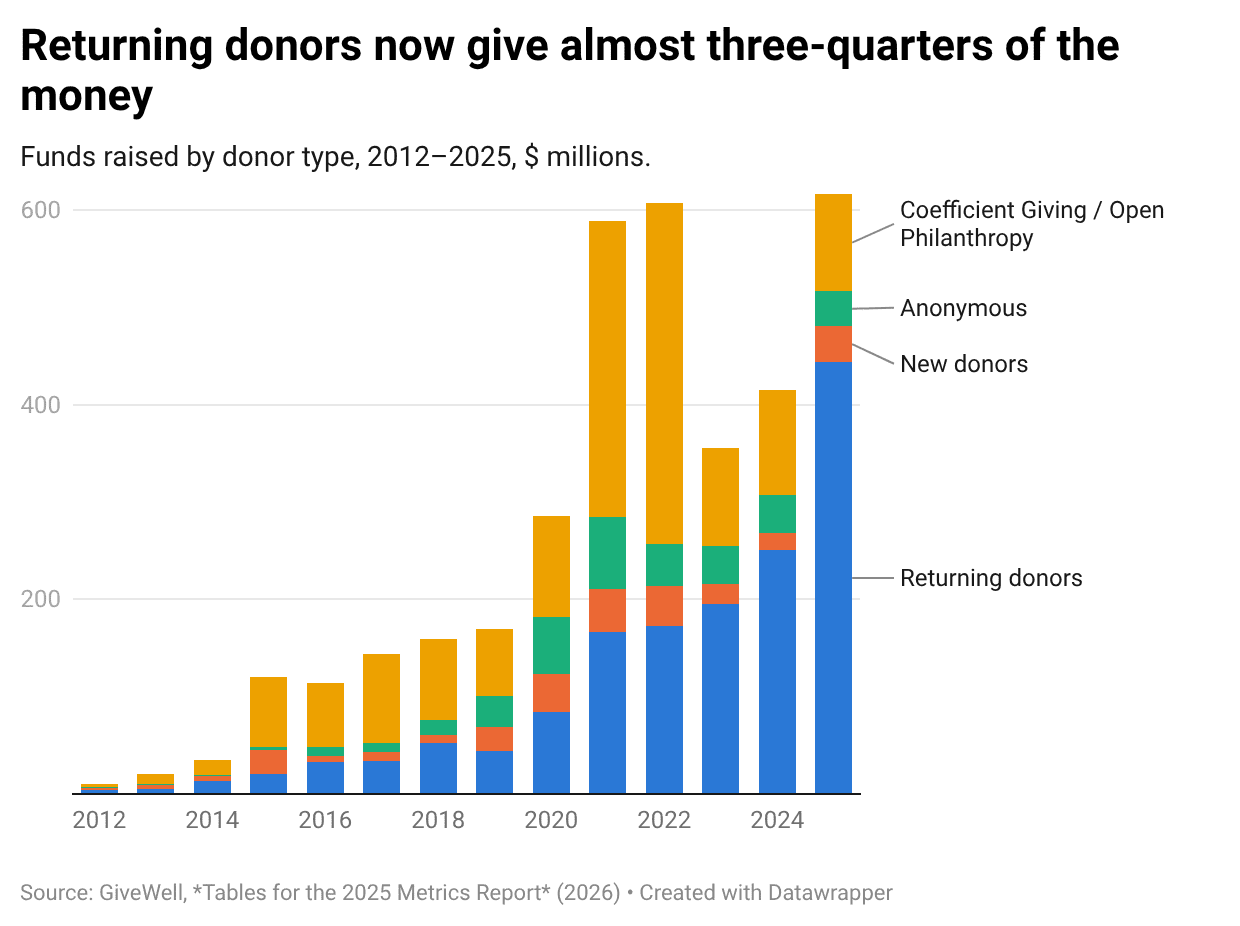
Previously: GiveWell raised less than its 10th percentile forecast in 2023 · GiveWell fundraising up 17% in 2024
GiveWell has published its...
Recent opportunities to take action
I increasingly realize just how emotionally inaccessible the concept of ethical offsetting is to most people. With regard to climate, the figure I remember from William MacAskill is that he estimates one dollar donated to Clean Air Taskforce to save 1 ton of CO2. If you take this seriously, then you basically don't need to bother with any efforts to have less waste in your personal life. (With the possible exception being your image, but only if you're a public figure.)
I think most climate people are very suspicious of charities like this, rather than or in addition to not believing in ethical offsetting. See this Wendover Productions video on problematic, non-counterfactual, and outright fraudulent climate offsets. I myself am not confident that CATF offsets are good and would need to do a bunch of investigation, and most people are not willing to do this starting from, say, an 80% prior that CATF offsets are bad.
This article just made HN. It's a report saying that 39 of 50 top offsetting programs are likely junk, 8 "look problematic", and 3 lack sufficient information, with none being found good.
re: CATF, you can look at FP's cost-effectiveness analysis of CATF's work (past, future), along with their non-cost effectiveness-based reasoning (see Why do we trust this organisation?) and their general methodology for evaluating relative impact in high-uncertainty contexts like climate (where they argue that "bottom-up cost-effectiveness analyses as well as bottom-up plausibility checks... are fundamentally insufficient for claims of high impact"), and judge for yourself. I personally think that the notion of "CATF offsets" doesn't make much sense once I drilled down to that level; if I donate to them it won't be for ethical offsetting reasons.
re: the vast majority of offsetting-oriented climate charities, I'm skeptical myself.