Comments

(Epistemic Status: Personal experience, supplemented with good, though slightly flawed, data)
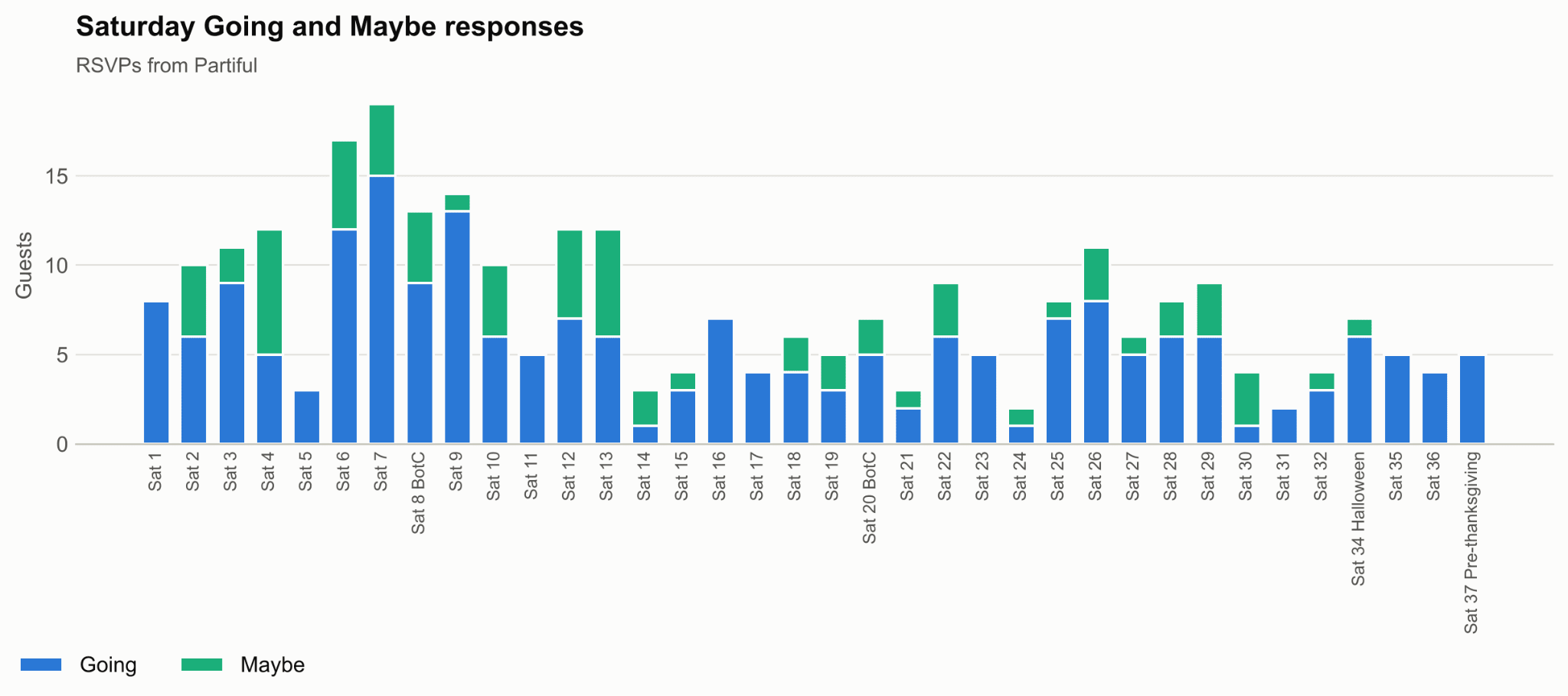
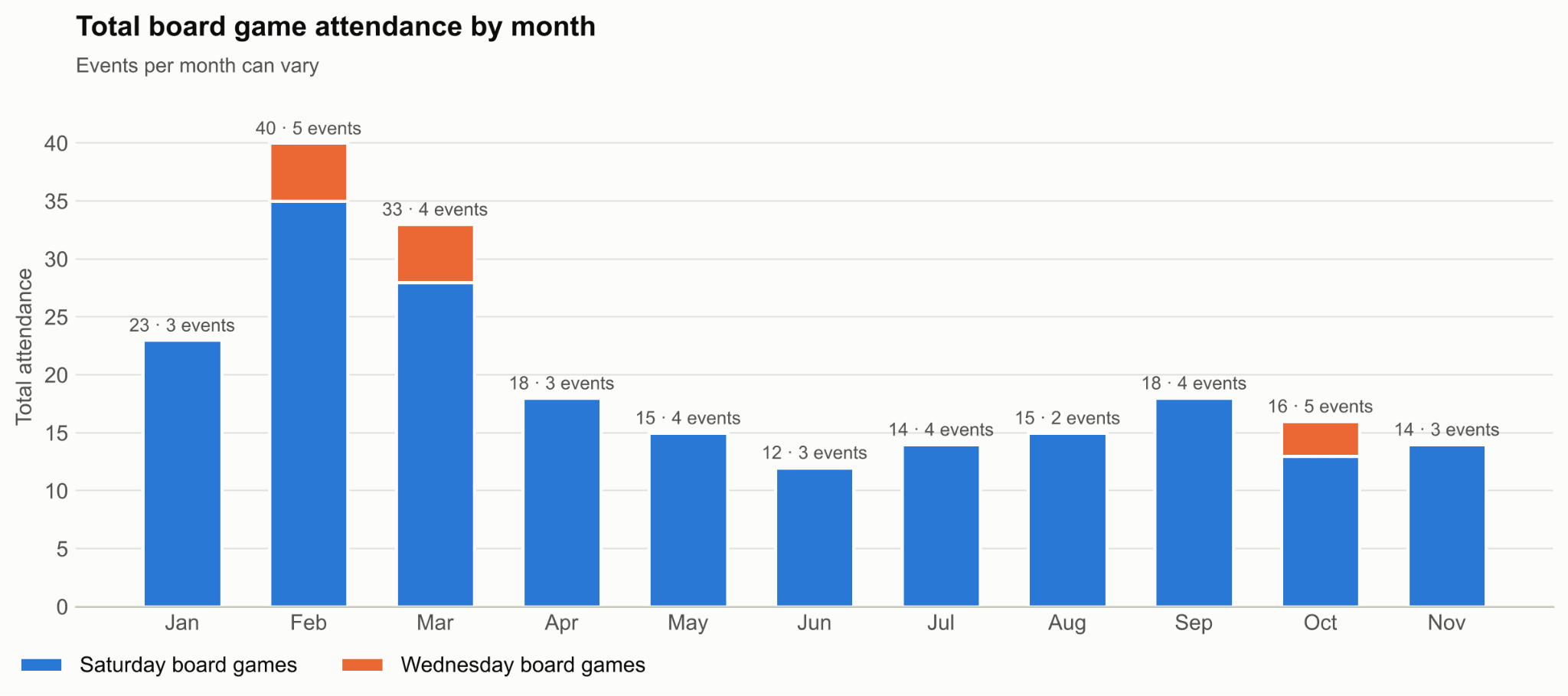
At the start of 2025, I moved across the country to a city (Boston) I knew little about and that was filled entirely with people I didn’t know. Nearly two years later, I’m now happier, more satisfied, and have a better social life than ever before, and it is basically all downstream of deciding, at the start of 2026, that I was going to start hosting board games. After successfully hosting an initial board game night and querying attendees on continued interest, I committed myself to hosting every week until people lost interest or I was otherwise prevented from continuing. More than 9 months later, I am very happy to say that I am still hosting (approximately) every week (I’ve hosted ~37 out of the 45 weeks).
In terms of specific life-improvements, I think that hosting board games has been directly and obviously causal in meeting my amazing girlfriend, turning several casual acquaintances into best friends, and generally increasing my average happiness by ~0.5-1 points (on a 10-point scale). I also just know a lot more people in the area, feel like I’m part of a community, and get to attend a lot more engaging and novel events with people I find interesting.
Given my now fairly substantial experience hosting, I figured it was worthwhile for me to write up some of my reflections on hosting, so here they are (in proper list form):
- Hosting makes attending events simple and easy. Before I started hosting, I regularly had the experience of thinking it would be good to go out and attend a specific event, but ultimately backing out since it was easy to just skip. It also substantially reduces transport time for obvious reasons.
- Effective Altruist, LessWrong, and Astral Codex Ten community members are substantially more interesting and enjoyable to spend time with than ~any other people I have met (though I am filtering on various axes, including “enjoys the events I host”). I think it would be hard to overstate the value of shared cognitive styles and shared culture among these communities for making strong connections.
- It can be difficult to predict who will be a regular attendee. I can think of at least three very regular attendees who I assumed would not show up again after their first event.
- Keeping attendance open and explicitly welcoming first-time attendees creates a nice flow of new people, which keeps events more interesting and helps prevent devolution into stale in-jokes. It is also valuable since there is some attrition on existing attendees that has to be made up for.
- Hosting in a home is often much better than a public place, especially for board games. In particular, the general noise levels are much lower and the seating, etc. are more comfortable/manipulable. I don’t play music when hosting and I think this is preferable since it lets people hear each other more easily. That said, I expect there is a trade-off here with welcoming new people since individuals are likely more hesitant to attend a non-public-venue event if they don’t already know other attendees. This has been addressed in my case by the fact that the Boston community very often has other (public-venue) events. It is also just actually the case that there are a surprising number of people who are willing to show up at my board game events without knowing anyone prior (I think this is great!).
- New people appearing/attending is generally fairly difficult to predict since they are often people who are only recently in town or only recently heard about the events. Relatedly, it is often difficult to predict how people hear about events.
- You generally get fewer attendees the later you announce an event (on the timescale of a week). This is mitigated by the fact that I host approximately every week so people anticipate and plan around it even when I forget to send out invites/event postings until late in the week.
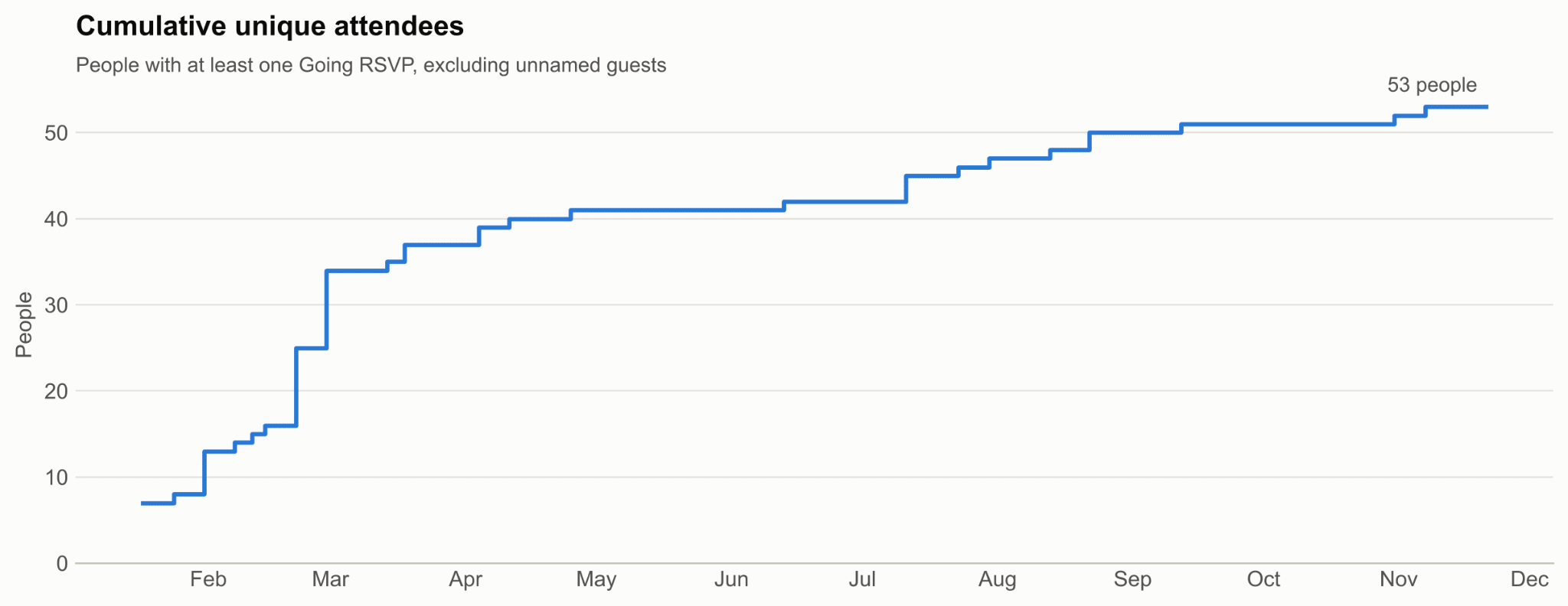
- Many people will come once and seem to have a good time and then never appear again. My RSVP data shows that approximately 29 of the 53 unique attendees (55%) only came once (not including anonymous/unnamed attendees).
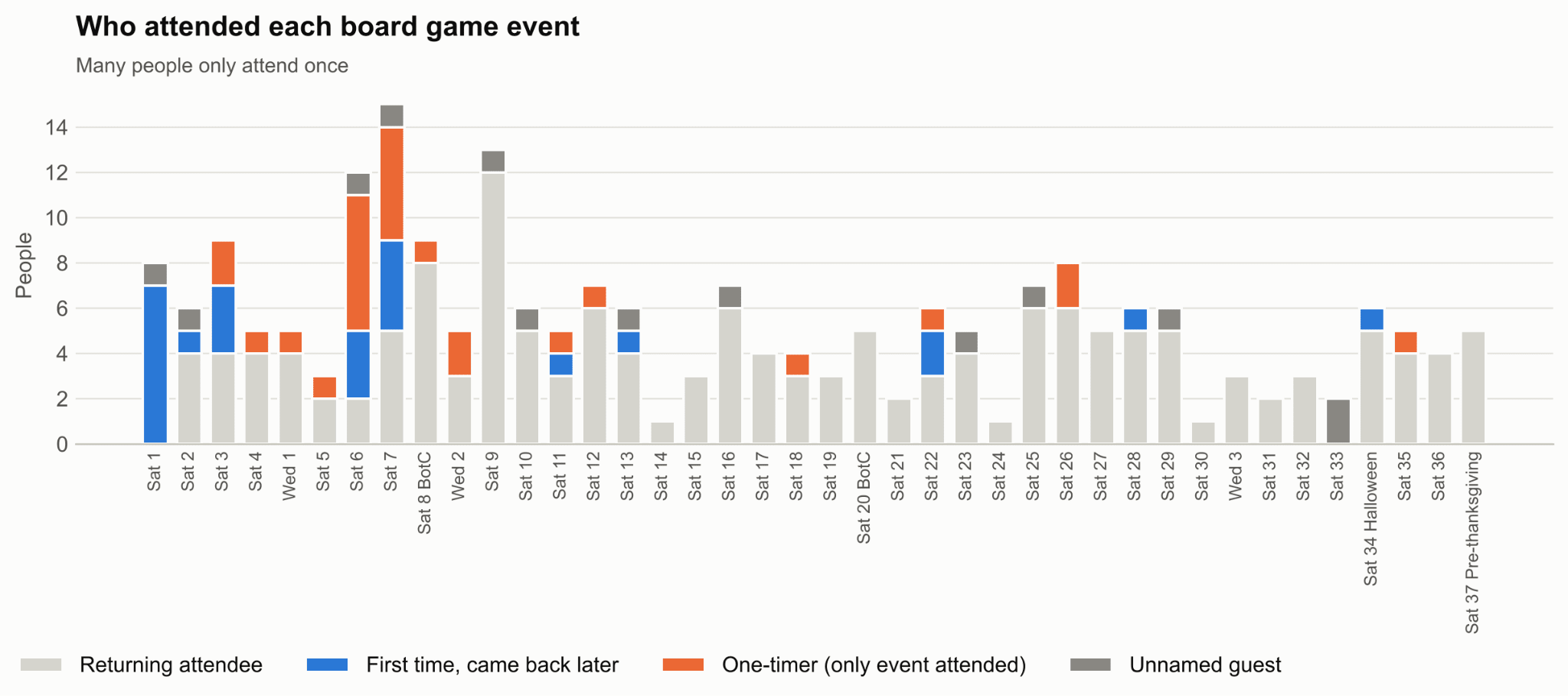
- Regular attendees make up most of the total attendance over time. Specifically, 7 regular attendees (those with 10+ events) make up 55% of all measured attendance (among named ‘Going’ RSVPs). My measured attendance for board games has an average/median around 5 or 6. Given that I have a couple regular attendees who don’t RSVP, I think this is probably closer to 6 or 7.
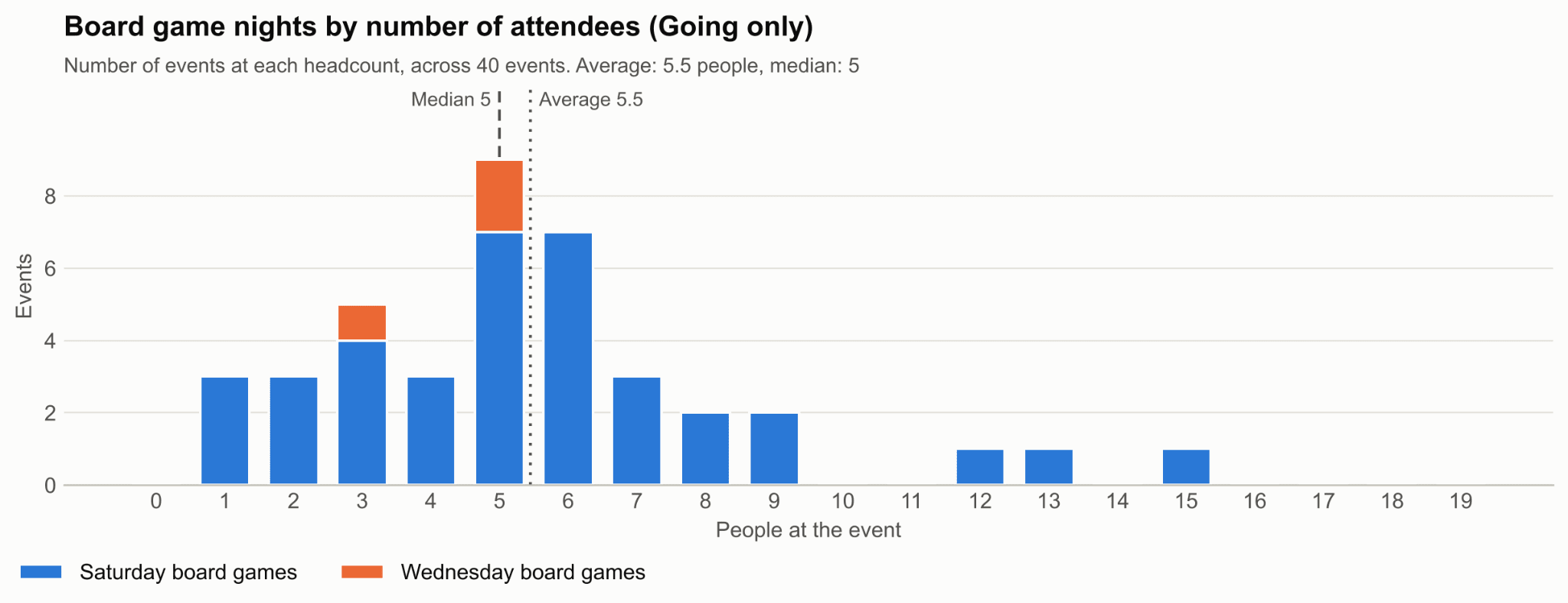
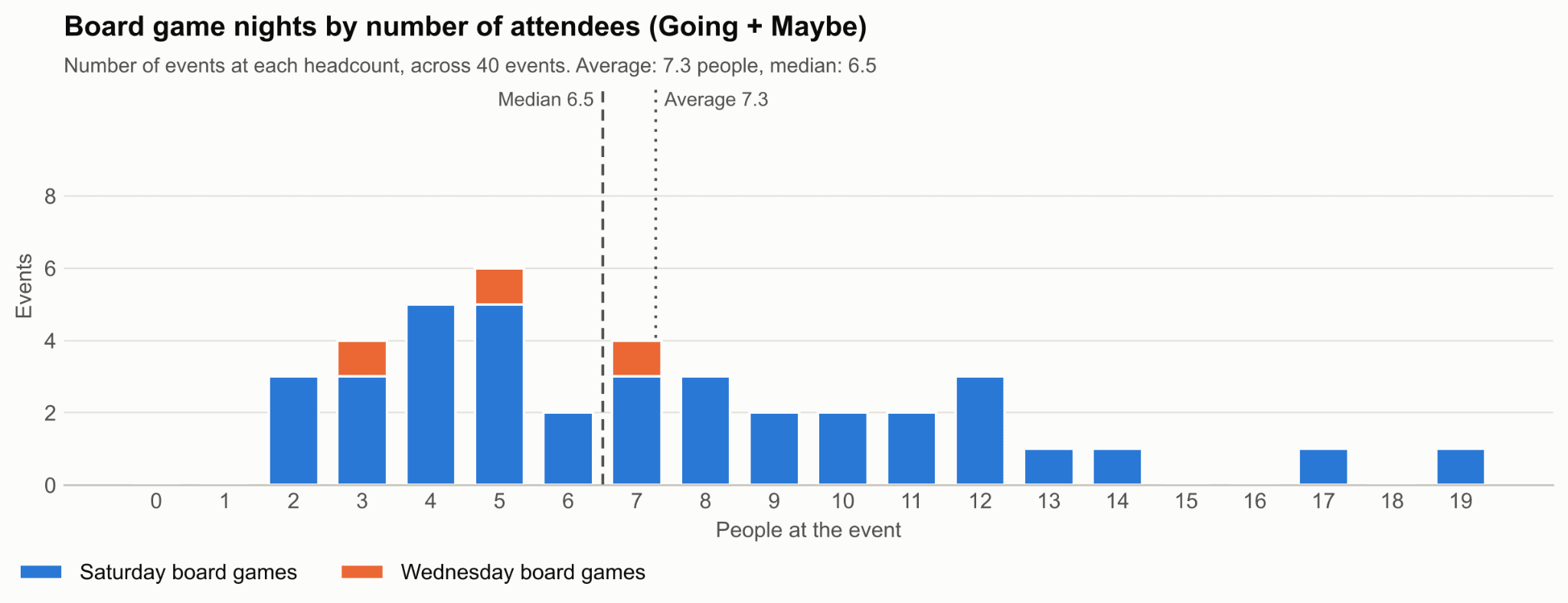
- People in the community enjoy mechanically dense games, but most still actively enjoy silly and/or relatively simple games, especially when they are more social.
- It is valuable to have “starter” board games to play at the beginning of the night that can easily accommodate additional players as they arrive. Great examples of this include Poetry for Neanderthals and Fae Kin, but generally anything that is fast and can support a wide range of players is probably good here.
- Maintaining novelty is very important when hosting on a regular basis. Simple methods for achieving novelty mainly include new/different board games and new/different people. In order to maintain novelty for regulars, it is best to have some rare or entirely different events (e.g. reading groups, kayaking, singalongs, hikes) that push people out of the social grooves that they have been etching.
- Hosting is helpful for keeping up a social life if you (hypothetically) end up breaking your ankle backpacking in Vermont (this is an important rite of passage for Boston community organizers).
- There are occasionally disruptive people that I have had to eject in some fashion (3 so far, plus 1 that I would have uninvited if he showed up again). There’s a lot that could be said about this kind of thing, but my main takeaways would be (1) this has been a relatively minor part of my experience (I really don’t think about it much) and (2) this can be very simple and just consist of messaging them when they RSVP and requesting that they don’t attend (I don’t generally provide specific reasons since I’m not interested in litigating my justifications).
- If you do something every week for several months, then some habits you maintain for e.g. 4 months will not remain at e.g. 5 months. Two examples for me were cleaning (I cleaned right beforehand every week for the first few months, now I don’t really clean for board games specifically) and not eating leftover oreos (I kept oreos as snacks for the first several months, but swapped them out after I started occasionally craving and eating them on other days).
- For snacks, I generally provide pretzels, seltzers, baby carrots, hummus, and (previously) oreos. The pretzels, seltzers, and oreos all keep very well, so I have generally stocked them for a few weeks at a time. I recommend having a stack of disposable paper bowls; they are just very good for snacks. Cost for snacks, etc. has not been an issue for me, but I usually include a little (non-mandatory) ‘Venmo me here if you want to help me keep this going’ note on my event descriptions and have been pleasantly surprised by people doing exactly this.
- When I initially started hosting, a mistake I made was assuming that dinner was a required feature, so (inspired by Ben Orenstein’s Fractal dinners) I used Uber Eats’ ‘Group Order’ feature to get everyone’s dinner delivered (it has a nice feature that lets people pay for themselves). The experience of doing this was manageable, but occasionally frustrating, and after discussing with regulars, I dropped it, which simplified things significantly on my end. It is definitely a reasonable option, so I would recommend it if it seems applicable (though I would suggest also trying out DoorDash’s group order option as well).
- Another minor mistake I made was buying napkins. Napkins are useless. Everyone knows they are useless. If you have napkins and paper towels, people will always use the paper towels because, unlike napkins, they can turn a ‘mess’ into ‘not a mess’ instead of turning a ‘mess’ into ‘a mess, plus a destroyed napkin.’ This means you will never be rid of your napkins and they will haunt you forever with their uselessness.
Anyway, I should mention that I am definitely not the only person in the local community running events (my current events are probably around 35% of the events being run monthly), so a substantial part of my positive experience has included other people hosting interesting events. That said, I think that I can claim credit for creating a space with exactly the kind of consistent social interaction that encourages people to invest in getting to know each other and hosting their own (less regular) events.
Overall, my conclusion from this whole experience is that it is possible to achieve things like “creating community” in sustainable ways through appropriate applications of time, effort, and favorable circumstances. Other than that, I think I’ll just close by saying that the Boston EA/LW/ACX conspiracy community is always open to new members, so reach out if you’re in the area and I’ll pass along the community info (discord, mailing list, etc.).


I’ve been to one of these! Thanks for enriching the Boston community Owen!