Summary
- It is uncertain how many people there in the EA community and what proportion of these the EA Survey manages to sample
- We compare EA Survey numbers to other data sources and estimate that we sampled around 40% of highly engaged EAs, and fewer less engaged EAs
- Based on this, we estimate there are around 2315 highly engaged EAs and 6500 (90% CI: 4700-10,000) active EAs in the community overall.
How many people there are in the EA community remains largely unknown. The two most recent EA Surveys received about 2500-2600 EA-identifying respondents, but we don’t know what proportion of the total EA community this represents. There are also multiple different criteria we could use to define the EA community.
David Nash has estimated that there are around 500-2000 people who “either attend multiple EA events each year or contribute to online discussion, and some proportion of people who work at an EA-related organisation.”
David Denkenberger, conversely, noted that local groups have around 2124 regular attendees (defined as 25% of events or an event every two months) based on estimates by local group organisers in the 2019 Local Groups Survey, which is higher than the upper bound of David Nash’s estimate.
Denkenberger also noted that there are 4400 Giving What We Can members in total and 843 self-identified GWWC members in the 2018 EA Survey (19% of the total membership) and so, if one were to assume this represented the response rate for the EA Survey as a whole, this would suggest that there were around 13,000 EAs.
That said, we suspect that Giving What We Can membership is not a good basis for making this kind of inference about what portion of the EA Survey we sampled. It seems likely that many people who have taken the Giving What We Can pledge are not engaged in, and perhaps do not identify with, the EA community. Luckily, we have access to a number of different proxies that we think serve better.
 Click here for footnotes:
These results converge fairly closely on around 40%, provisionally suggesting we sampled around 40% of the real populations in these cases.
However, we need to take into account the fact that all of these groups would be fairly high engagement on average, probably around levels 4-5 on the self-reported engagement scale below.
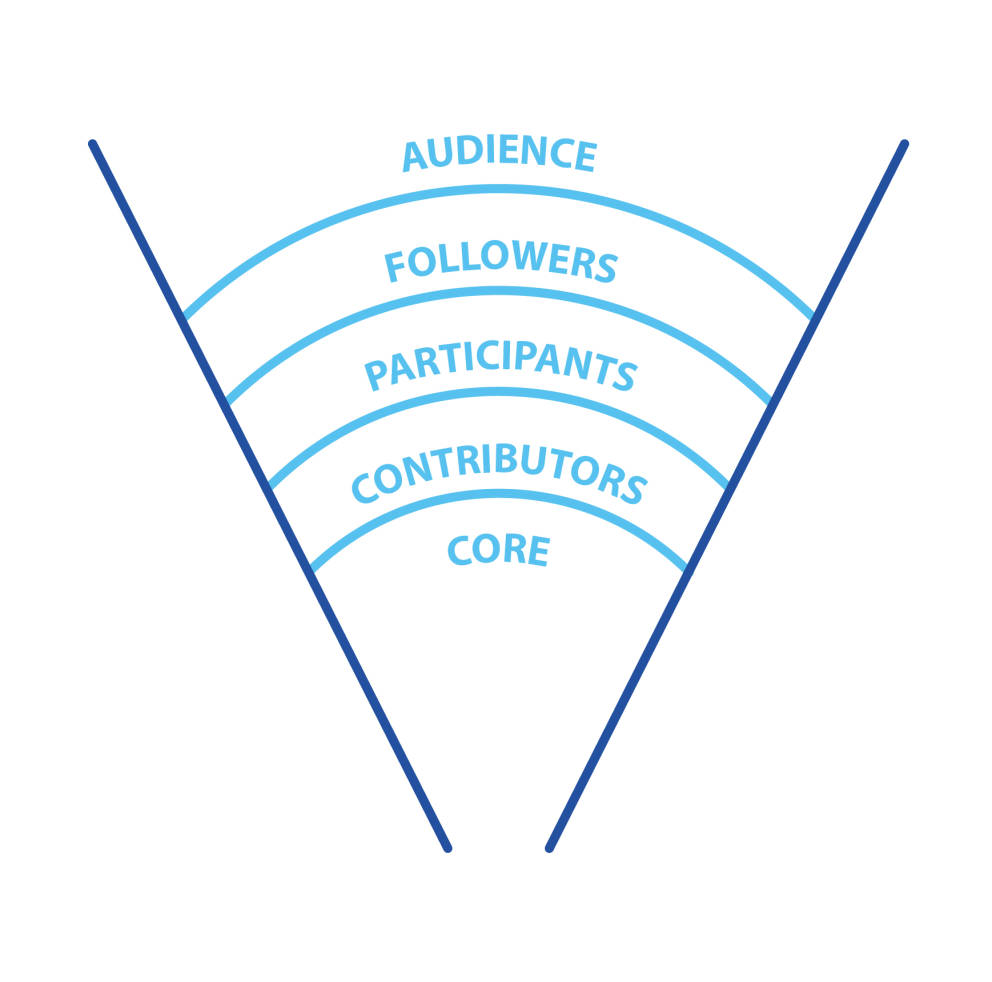
- 1) [Audience] No engagement: I’ve heard of effective altruism, but do not engage with effective altruism content or ideas at all
- 2) [Followers] Mild engagement: I’ve engaged with a few articles, videos, podcasts, discussions, events on effective altruism (e.g. reading Doing Good Better or spending ~5 hours on the website of 80,000 Hours)
- 3) [Participants] Moderate engagement: I’ve engaged with multiple articles, videos, podcasts, discussions, or events on effective altruism (e.g. subscribing to the 80,000 Hours podcast or attending regular events at a local group). I sometimes consider the principles of effective altruism when I make decisions about my career or charitable donations.
- 4) [Contributors] Considerable engagement: I’ve engaged extensively with effective altruism content (e.g. attending an EA Global conference, applying for career coaching, or organizing an EA meetup). I often consider the principles of effective altruism when I make decisions about my career or charitable donations.
- 5) [Core] High engagement: I am heavily involved in the effective altruism community, perhaps helping to lead an EA group or working at an EA-aligned organization. I make heavy use of the principles of effective altruism when I make decisions about my career or charitable donations.
On the whole, we would expect to sample higher proportions of more engaged EAs, at around the 4-5 level, due to higher engagement causing higher motivation and them also being more likely to encounter the EA Survey more often. Conversely, we would expect people matching the description of levels 1-2 to be less likely to encounter the survey and to have less reason to take it.
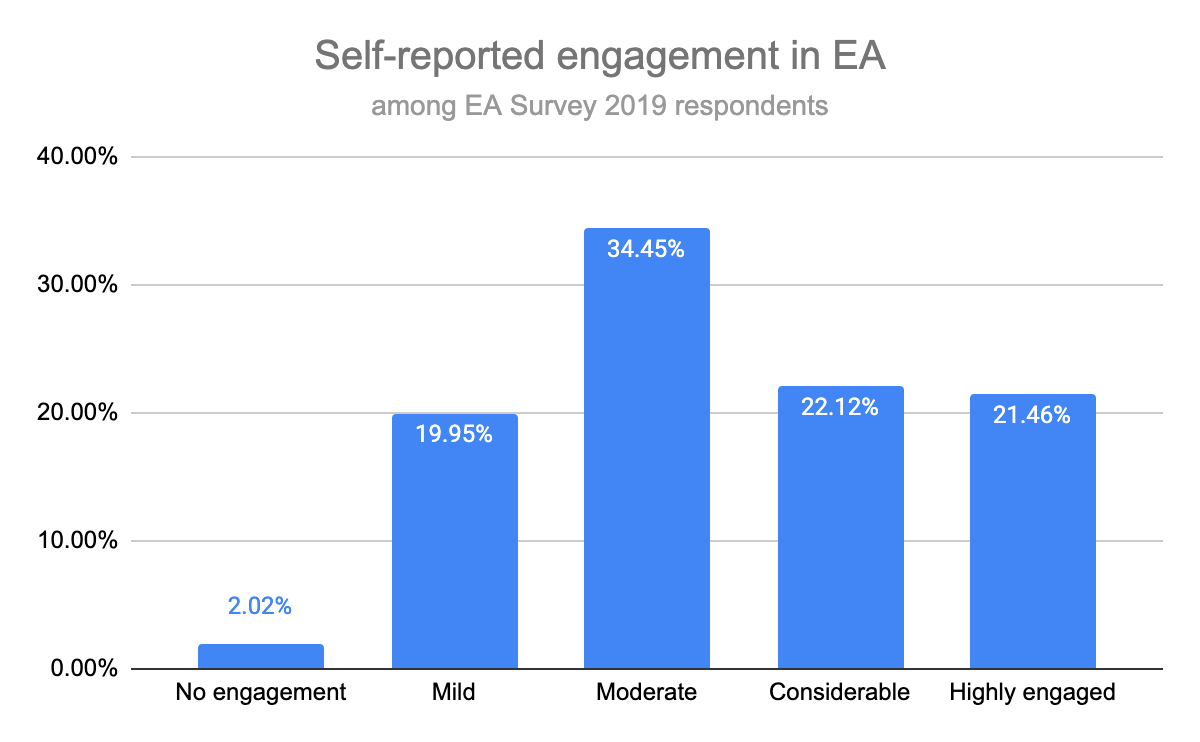
Looking at the EA Survey results, this is what we see, with slightly more at level 3 than 4 or 5, but fewer at level 1 or 2.
In general, we would expect there to be more people who are peripherally engaged with EA or who have merely encountered the idea, as suggested by the funnel (or concentric circles) models.
So this suggests, as we would expect, that the EA Survey samples relatively more people from the moderately engaged ‘participants’ group and upwards, than from less engaged groups.
Nevertheless, for estimating the size of the EA community we are probably mostly interested in respondents who identify at least with level 3. To reiterate: this corresponds to someone who has “engaged with multiple articles, videos, podcasts, discussions, or events on effective altruism” and who “sometimes consider the principles of effective altruism” when they “make decisions about... career or charitable donations”, which seems a plausible minimal characterisation of involvement in the EA community. Someone selecting level 2, conversely, has engaged with a few articles/podcasts etc., but may not even necessarily “sometimes consider the principles of effective altruism” when making decisions. Of course, being part of the “EA community” in this sense is not a criterion for being effective or acting in an EA manner- for example, one could donate to effective charity, without being involved in the EA community at all- but it still seems valuable to estimate how many people are involved in the EA community specifically in this narrower sense.
Since the proxies we used to estimate our sampling rate predominantly apply to level 4-5 EAs, we can estimate the size of this higher engagement population. There were 926 level 4-5 EAs in our sample, so if we sampled around 40% of this population, we would expect there to be 2315 in this population in total. Of these, 1140 would be estimated to be in the highest level of engagement (level 5).
We don’t know exactly what proportion of level 3 EAs the EA Survey sampled, though as noted, we would expect it to be somewhat lower than the portion of level 4-5 EAs. If we sampled 30% of level 3 EAs (a slightly lower rate than for more engaged EAs), then we would estimate that there are 2443 level 3 EAs of this kind and 4758 EAs (level 3-5) overall. Conversely, if we sampled many fewer level 3 EAs than 4-5s (let’s say only 10% or 4 times fewer than 4-5 EAs) then we would estimate there to be 7330 such EAs, and almost 10,000 (9,645) EAs overall.
Looking at our slightly more detailed guesstimate model, we see that the estimated 90% CI for the total EA community (in the level 3-5 sense defined above), is between 4,500 and 10,000, with a mean around 6,500.
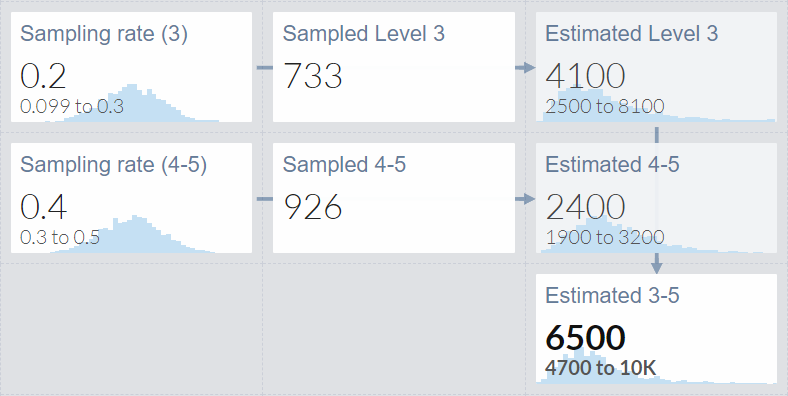
This suggests that there are roughly 2000-3000 highly engaged EAs in total- quite a lot, in some ways, but still very small in others. For example, this would only be a fraction of the student population of most universities.
Likewise the estimated size of the EA community more broadly, worldwide, is only 5000-10,000 or about the size of a small town or university. Indeed, the global EA community, even according to the larger estimates, only has about as many members as the weekly attendance of a mid-ranking mega-church. These kinds of numbers seem worth bearing in mind when thinking about the reach and scope of the EA community.
Credits

The annual EA Survey is a project of Rethink Charity with analysis and commentary from researchers at http://rethinkpriorities.org/. This essay was written by David Moss. Thanks to Aaron Gertler, Peter Hurford, Jason Schukraft and Neil Dullaghan for comments.
We would also like to express our appreciation to the Centre for Effective Altruism and the EA Meta Fund for supporting our work. Thanks also to everyone who took and shared the survey.
If you like our work, please consider subscribing to our newsletter. You can see all our work to date here.
Other articles in the EA Survey 2019 Series can be found here


Thank you for writing this up!