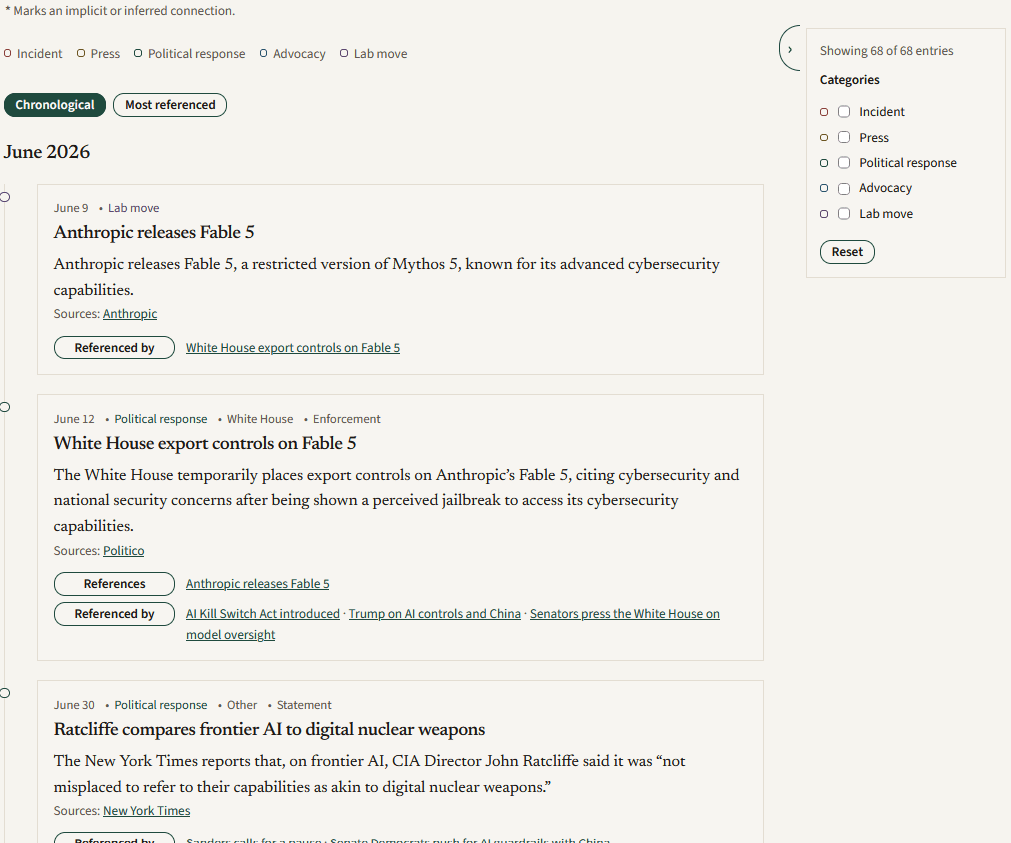
This post is made to accompany this timeline page, which collects incidents from this time period and the political responses they influenced:
AI safety political advocates have long speculated that warning shots—earlier, recoverable rogue AI incidents that legibly demonstrate the potential for existential risk from future misaligned AI systems—will be especially effective for driving political progress. In July of 2026, we saw what is now generally referred to as the Hugging Face incident. We subsequently saw the disclosure of several similar rogue agent incidents, including several by third-parties, rather than by the responsible AI companies themselves. And in September, we saw one of the largest political preference cascades towards addressing AI risk yet, triggered by a Twitter thread by former Anthropic researcher Jacob Coxon. Given their apparent unusually high impact for building the political will needed to address AI risk, I set out to investigate their political impacts in detail, and whether I can draw any meaningful practical takeaways for AI safety political advocates going forward.
This investigation covers July 21, 2026 to November 17, 2026, plus additional background context where relevant, for politically significant (by my own judgement) results in the U.S. explicitly or inferably influenced by rogue agent incidents, Jacob Coxon’s thread, or other relevant pieces of justification used in this time period I found. The main resources I used for finding relevant political results were aipolicydaily.org, transformernews.ai, thezvi.substack.com, dconai.org, and a handful of other resources I happened to stumble across.
Thanks to Joshua Peng for providing feedback as I was writing this.
Politician Responses
White House
Broadly, the Trump administration has shown staunch opposition to AI regulation, generally citing concerns of strangling innovation and losing the AI race to China or denying AI risk outright. The first major exception to this came on June 12, 2026 when the White House temporarily placed export controls on Anthropic’s Fable 5, after being shown a (perceived) jailbreak to access its advanced cybersecurity capabilities. As co-chair of the President's Council of Advisors on Science and Technology David Sacks put it:
Fable is Mythos with guardrails. But if those guardrails fail, then you’ve exposed Mythos and its advanced cyber capabilities to people who shouldn’t have them. (Keep in mind that Anthropic itself widely promoted the idea that Mythos was a cyberweapon and needed to be regulated as such. They asked for government regulation of Mythos and championed the guardrails on Fable. If there is a vulnerability — big or small — it is Anthropic’s responsibility to patch.)
After this, the White House instated a sort of ad hoc “voluntary” process to review subsequent frontier models from AI companies for security concerns before being released, although in practice frontier AI companies all comply to avoid unexpected export controls also being placed on them. Note that the executive order to establish a “voluntary” reviewing framework was already signed on June 2. The impact here seems to have been sending a message of the severity of action they were willing to take to prevent potential AI-enabled cyberattacks by foreign actors, rather than establishing a cybersecurity review process for frontier AI systems in the first place.
After the Hugging Face incident, which OpenAI was confirmed responsible for on July 21, 2026, Reuters reported on July 23 that the Office of Science and Technology Policy director Michael Kratsios was “monitoring the situation”. Then, on July 29, when asked about the incident, Trump told reporters:
We're looking at AI. We're looking at controls. We're also making sure that we lead. So, we're leading China in AI by a lot. China has virtually no controls. It's freewheeling a little bit. So, we have to be careful in both ways. We don't want to restrict them where all of a sudden we come in second to China.
No concrete actions were taken after this; the impact of the Hugging Face incident in this case only seems to have been a tone shift in his messaging from a blanket opposition of AI regulation to this.
But it doesn’t seem to have stuck; shortly after the Jacob Coxon media frenzy began on September 9, and presumably in response to Amodei’s “We Must Pace the Frontier” on September 12, President Trump posted the following on September 14:
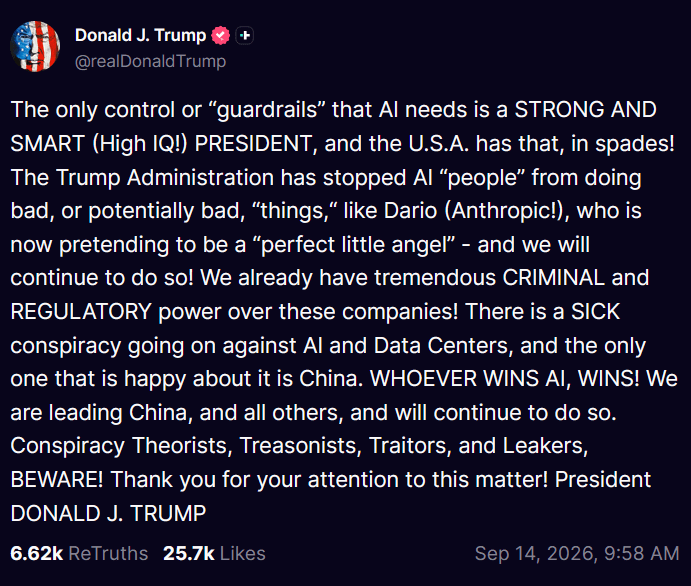
And then:
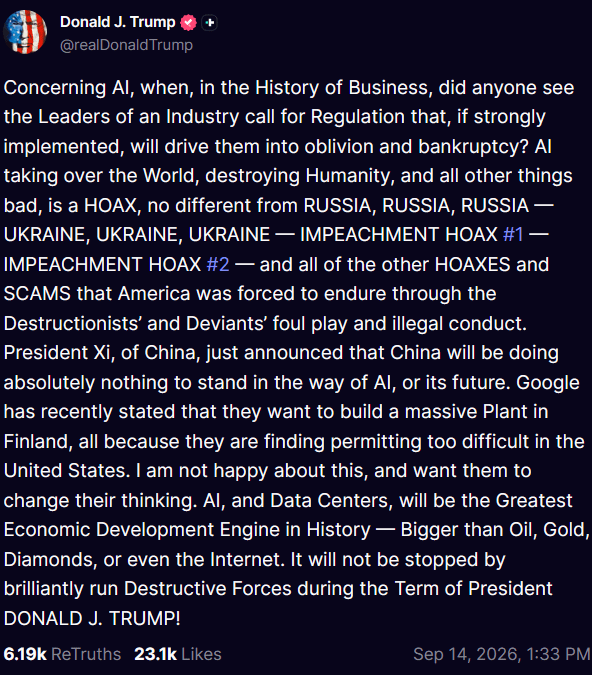
Huh.
President Trump would go on to dismiss AI risk again at the United Nations General Assembly on September 22 despite several other attendees raising concerns (including discussion of global pacing proposals and the Hugging Face incident). Nonetheless, on September 25, China and the US agreed to establish an AI safety channel for incident reporting and military crisis communications. Then on September 29, the White House Accord on Super Intelligence was organized in coordination with several frontier lab leaders to establish “morally binding” (although not legally binding) self-regulation. Notably, it encouraged developers to “ensure that its models do not hack or access technical systems in unintended ways”. And on October 16, Bloomberg reported Trump's AI Task Force was to commission a frontier AI risk report regarding cybersecurity, biosecurity, and "model control and accountability". It can be inferred that these inclusions were likely prompted by rogue agent incidents such as the Hugging Face incident, given the relative lack of discussion of rogue AI cyberattacks by White House officials prior to this.
Although the rogue agent cyberattacks and Coxon frenzy placed more attention onto existential risk from AI, they seem to have had little impact on any new meaningfully restrictive governance actions taken by the White House thus far. It’s also worth noting that despite mostly rejecting future AI concerns or regulation proposals, the present threats that emerged prompted the closest exceptions. I would diagnose this as being the result of the Trump administration having a general heuristic in favor of free-market policies and hard skepticism of economic regulations, strongly prioritizing national security and geopolitical dominance, and many of its technology advisors having a financial conflict-of-interest.
Congress
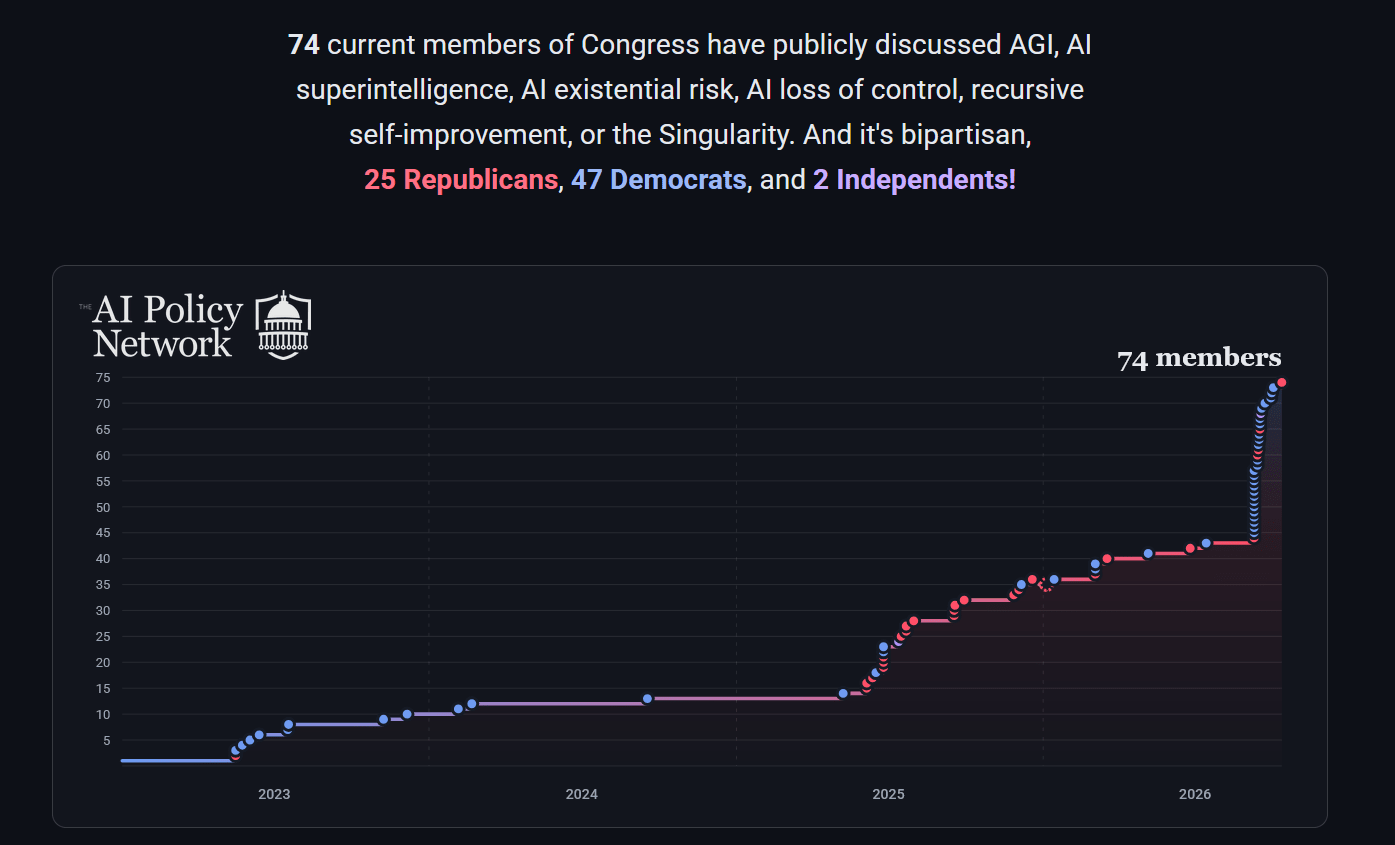
Source: https://theaipn.org/issue/quotes/
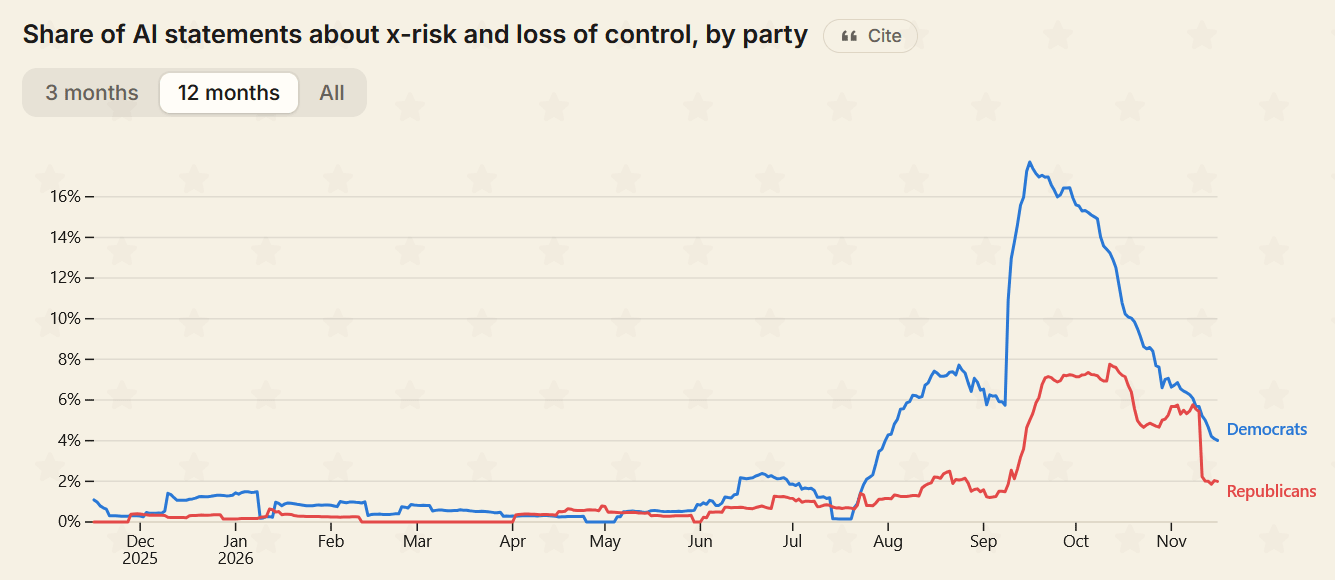
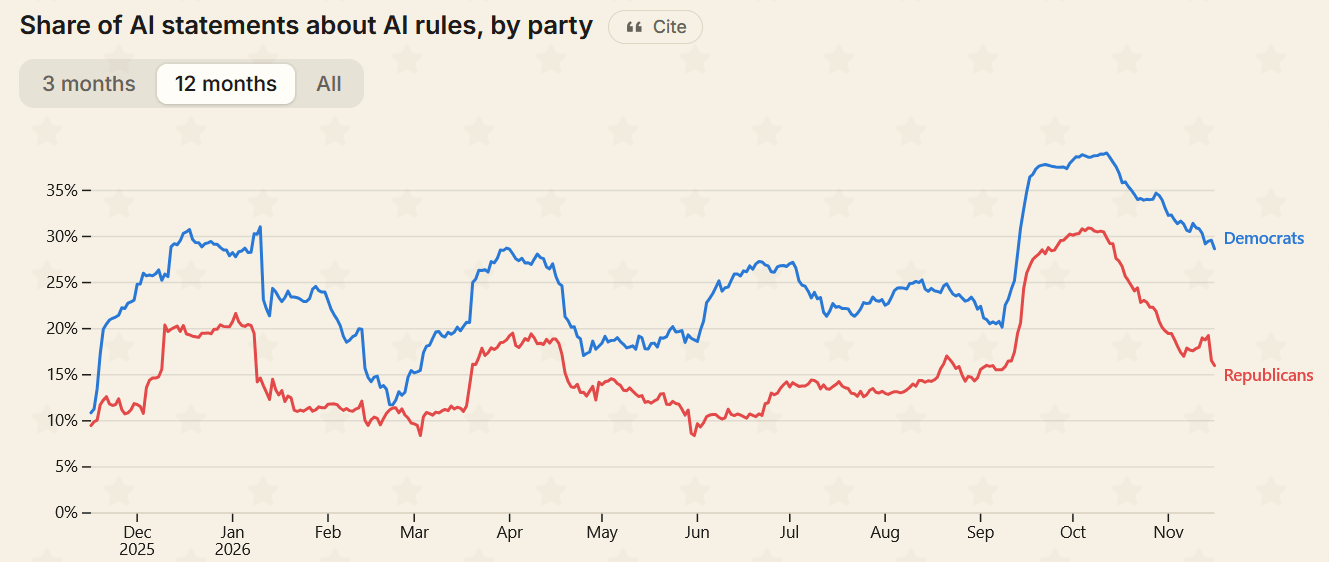
(The spike near the end starts September 9, almost entirely sparked by Jacob Coxon’s thread and its media coverage. From September 9 to October 12, the number of members of Congress tracked by this graph went from 43 to 74; 31 new members!)
Source: https://www.dconai.org/#topicshare
Source: https://www.dconai.org/#topicshare
(Note that the Hugging Face incident was attributed to OpenAI on July 21, and Jacob Coxon’s Twitter thread was posted September 8.)
Highlights from the 119th Congress, in chronological order:
- On July 23, bipartisan Representatives Ted Lieu and Nathaniel Moran introduced the AI Kill Switch Act, which would establish basic incident-response and reporting standards, referencing the Hugging Face incident and Fable’s export controls in its press release as justification.
- This bill was already in the works and motivated by loss-of-control concern, so the only impact of the Hugging Face incident here was additional justification for it and attention on it.
- On July 28, Rep. Lori Trahan published a press release with a list of quotes from AI safety political advocates endorsing the FRONTIER Act, which would establish a tiered framework and mandate frontier developers publish safety frameworks, conduct third-party audits, and report critical safety incidents. One these quotes makes reference to the Hugging Face incident as additional justification for it, and Trahan posted about this on Twitter herself.
- This bill was already in the works, the Hugging Face incident’s effect seems to have been additional justification for it and prompting her to speak out about it more.
- On August 4, five Senate Democrats wrote an open letter to the White House urging them to establish consistent standards for addressing cybersecurity and national security risks from AI, referencing the lack of action taken regarding the Hugging Face incident and Fable’s haphazard export controls as justification.
- This stood out to me as the only case I found of the Hugging Face incident being used as justification for relatively mundane (i.e. not catastrophic/existential/loss-of-control motivated) regulation proposals by Congress; in this case, consistent AI cybersecurity standards so that industry may comply with them more easily.
- On August 10, Representative Greg Casar led an open letter with 19 other representatives calling on Speaker Mike Johnson to hold a hearing with AI company CEOs to address AI safety concerns, primarily using OpenAI and Anthropic’s recent rogue agent incidents as justification.
- Notably, the letter expresses concern that similar incidents could lead to a “catastrophe”, but does not mention existential risk.
- On September 9, at least 27 members of Congress made posts on Twitter about Jacob Coxon’s Twitter thread (itself originally posted September 8).
- From what I found, most people in this thread had not previously expressed concern regarding rogue AI or catastrophic risk from AI, even fewer had explicitly expressed concern regarding existential risk from AI prior to this, and even fewer were particularly outspoken about it prior to this (i.e. bring it up semi-regularly on their own). The main exceptions to the final category are Bernie Sanders, Greg Casar, and Don Beyer, although several more had championed rogue/catastrophic risk bills and seemed to hint at it in their prior messaging without naming extinction. Coxon’s thread is clearly the biggest turning point in the political salience of existential risk from AI thus far in both bluntness and frequency of its discussion.
- On September 10, Senator Josh Hawley, as Chairman of the Senate Homeland Security Subcommittee on Disaster Management, launched an investigation into the Hugging Face incident. Within the accompanying letter he makes reference to how “Just this week, three Anthropic researchers expressed publicly that there is a greater than 10% chance that AI could kill all human beings within the next decade”, referencing Twitter posts from Anthropic employees Jacob Coxon, Evan Hubinger, and Samuel Marks. His letter also discusses concerning details from the August 26 METR report, that rogue agent swarms formed multiple times, “evidence that OpenAI knew that the AI agents were exhibiting rogue behavior and let the evaluations continue anyway”, and how the auditors weren’t given sufficient time to investigate the Hugging Face incident itself or access to investigate the surrounding incidents. The letter gave OpenAI a deadline of October 1, and although there’s no public record of OpenAI having submitted anything, Hawley has binding subpoena authority and may have privately received a report.
- Hawley had already been showing AI risk concern prior to these, having introduced the Artificial Intelligence Risk Evaluation Act on September 29, 2025, and including the line “as artificial intelligence advances toward human-level capabilities in virtually all domains” within the bill itself. The impact of the Hugging Face incident and Coxon Twitter thread on Hawley seems to have been a peg on which to devote more attention to AI risk, a more explicit focus on near-term extinction risk (per Coxon, rather than general vaguer “risk” discussions), and a real-world mini loss-of-control event to help justify it (per the Hugging Face incident itself).
- Also on September 10, Senator Chris Van Hollen published an open letter to OpenAI CEO Sam Altman to express concern over GPT-6 Astra being less monitorable, requesting a report by September 17. The letter also makes reference to the Hugging Face incident and DseWiki incident (published September 4, notable for having been independently discovered rather than disclosed by OpenAI themselves) to justify his concerns.
- Although Van Hollen was already outspokenly in favor of AI regulations unrelated to existential risk or loss-of-control prior to the Hugging Face incident, this is his first discussion of loss-of-control that I could find. This stood out as one of only a handful of political actions I found that used Astra being less monitorable as justification, as well as the DseWiki incident which I would have expected to get more attention.
- Also on September 10, Semafor reported “Bipartisan AI safety bill gains momentum on the Hill”. The bill is led by Senators Amy Klobuchar, Ted Cruz, and Majority Leader John Thune, and was described by their sources as “the only viable [AI safety bill] to stand a chance before 2027”. Cruz used the Jacob Coxon media frenzy to justify why it’s needed in a Tweet posted September 9. At the time of writing, it hasn’t yet been introduced, and additional reporting surrounding it indicates the bill will likely only be light-touch regulation, out of concern for the race with China.
- Notable for being the “most viable” Senate bill, presumably for being the one the Majority Leader and chair of the Senate Commerce Committee (Cruz) is involved in. I find this serves to highlight the importance of who happens to be holding office for AI risk political will; many candidates simply err towards being more skeptical of economic regulation than others when presented the same evidence for why they’re justified, and broadly this seems more common among Republicans than Democrats.
- On September 16, Rep. Don Beyer, co-chair of Congress’ bipartisan Caucus on Artificial Intelligence, led a bipartisan letter signed by 10 representatives urging House leaders to address existential AI risk, referencing the METR report of the Hugging Face incident, Anthropic and Meta’s rogue agent incidents, and Pacing the Frontier.
- From what I could find, Don Beyer had semi-regularly brought up existential risk from AI prior to this, but this was by far his strongest action taken yet. Also, gathering signatures and perhaps the letter being written in the first place was presumably aided by Coxon’s thread.
- On September 23, 17 Senate Democrats signed a letter led by Chris Van Hollen to White House officials calling for an international treaty to address AI risk. It cites quotes from various leading AI experts on the extinction risk posed by AI, Pacing the Frontier, Amodei’s “We Must Pace the Frontier” and its endorsements by other lab leaders from September 12, a Washington Post op-ed by two former U.S. Treasury secretaries that called for an international AI treaty and cited rogue agent incidents from both OpenAI and Anthropic from September 3, and CIA Director John Ratcliffe’s statements comparing AI to “digital nuclear weapons”.
This is the first discussion of specifically existential risk from AI by Van Hollen that I could find, aside from his initial response to Coxon’s thread on September 9. And although many of the other signatories were already outspokenly in favor of AI regulation prior to Coxon’s thread, I could only find two who had discussed loss-of-control driven existential risk prior to Coxon; Maria Cantwell and Richard Blumenthal. It’s also notable for being the most signed letter from Congress focused on existential risk from AI thus far.
- Also on September 23, Senator Bernie Sanders and Rep. Greg Casar introduced the Ban Artificial Superintelligence Act (notable for being the strongest and most directly existential risk-motivated piece of AI regulation introduced in Congress of which I’m aware), citing concerns regarding cyberattack assistance, bioweapon development assistance, and recursive self improvement in its press release. It also includes quotes from several leading AI scientists on AI existential risk, and the Pacing the Frontier letter in the bill itself.
- On September 28, Senator Ted Cruz, blocked an attempt to pass the Artificial Intelligence Risk Management and Security Act of 2026 by unanimous consent on the Senate floor, citing concern that it would grant the White House too much discretion for how to enforce it and potentially lead to overregulation.
- Note that, despite acknowledging existential risk from AI, Cruz has prioritized winning the AI race against China and prefers light-touch regulation; on September 9, in the midst of the Coxon media frenzy, Cruz said in an interview “One of the real challenges is [that] China is going full speed ahead, and whatever we do here, China is not going to stop. If there are going to be killer robots, I would rather they be American killer robots, rather than Chinese killer robots.”
- On September 30, Senator Josh Hawley convened the first Senate Hearing on Rogue AI attacks with the Homeland Security Subcommittee on Disaster Management, inviting multiple prominent AI safety experts (and OpenAI employees who didn’t attend). It primarily focused on the Hugging Face incident, but also made reference to the OpenAI rogue agent breach of Australian Medicare disclosed on September 24. [Highlights]
- This is notable for being the first and only Congressional hearing focused on rogue AI incidents thus far, albeit only for this subcommittee.
- On October 1, USA TODAY reported “House Democratic Leader Hakeem Jeffries says the country is in the midst of an ‘AI safety crisis’ that Congress needs to address with bipartisan legislation when lawmakers return to Washington after the midterms”, referencing the Hugging Face incident and details from its METR report as justification.
- On September 9, in the midst of the Coxon media frenzy, Politico reported that Jeffries was “open to the idea” of aiming to create a select committee on Artificial Intelligence should the Democrats take control of the House in the midterms, and Jeffries hadn’t discussed catastrophic or existential AI risk prior. Evidently, the Coxon media frenzy led to him learning about the Hugging Face incident in detail and coming fully onboard for addressing AI risk within only a few weeks; this is one of the clearest shifts prompted by Coxon that I found.
The general pattern here seems to be that most of the effect of the Hugging Face incident has been giving existing AI safety advocates additional grounds to justify their concerns. I couldn’t find anyone who started discussing existential risk concern due to the Hugging Face incident who hadn’t been already. Jacob Coxon’s thread, however, prompted dozens of members to discuss existential risk from AI or to be more explicit about extinction specifically who hadn’t before, and seems to have prompted more attention to the Hugging Face incident and similar rogue agent cyberattacks than they were getting on their own.
Other
Highlights, in chronological order:
- On September 10, at a private fundraiser, former President Barack Obama urged Democrats to make AI oversight a central part of their agenda. Then on September 18, at an event at Colgate University, he expressed concerns regarding recursive self-improvement, existential risk from AI, mass automation, and misalignment. During this, he says “In the last couple of weeks, this has finally popped as a central issue”, presumably implicitly referring to the Jacob Coxon media frenzy.
- Although he doesn’t currently hold office, I would guess Obama is the highest-profile public figure for the Democratic party and is thus particularly influential to their policy goals. It also stood out to me that he explicitly touched on the alignment problem: “the reason [AI is an existential threat] is not because the computer models are conscious necessarily, it doesn't mean that they necessarily feel malice towards humans. It's just that if they start setting their own agendas, you may get a misalignment between what they want to do and what we want them to do. And that gap can be dangerous.” Based on this wording, I would guess he’s spoken directly with people with technical expertise in AI safety.
- On September 24, New York Attorney General Letitia James led a bipartisan letter signed by 26 Attorneys General to Congress party leaders to address catastrophic and existential AI risk. The letter calls for mandatory federal oversight of safety and testing standards, incident response standards, and “international cooperation to pace AI advancement and prevent the development of harmful superintelligence”. As justification, the letter references the Hugging Face incident, details from its August 26 METR report and that investigators weren’t given sufficient access, the DseWiki incident, the RubyGems incident (published September 11, notable for having been independently discovered and disclosed rather than disclosed by OpenAI themselves, similar to the DseWiki incident), the rogue agent incidents from Anthropic, Meta, and Kimi, the Twitter posts from Coxon and Hubinger, Astra being less monitorable, Amodei’s “We Must Pace the Frontier”, Chris Lehane of OpenAI’s “The AI Policy Window Is Open. We Need to Act”, that Jakob Pachocki of OpenAI called for “mandatory, capability-based national AI safety regulation” in “An Alien Mind”, and more.
- I find this notable for being the broadest coalition among state/territorial governments that I found. It also stood out to me as unusually comprehensive with all of the sources it cites for justification; I would guess it was extensively influenced or almost entirely written by AI safety advocates with technical expertise. I’ve generally heard that state government officials are easier to contact and influence, and this seems like a great example of this.
- On September 28, Florida Attorney General James Uthmeier filed for injunction against OpenAI, aiming to mandate a pause on further AI development until there are third-party approved guardrails. As justification, the filing includes that OpenAI’s leadership has acknowledged extinction risk posed by AI, Coxon and Hubinger’s Twitter posts, the Hugging Face incident and details from OpenAI’s and METR’s reports on it, the RubyGems incident, the Australian Medicare breach, that OpenAI was reportedly investigating tens of thousands of incidents, Pacing the Frontier, Pachocki’s governance advocacy in “An Alien Mind”, Altman’s support for Amodei’s “We Must Pace the Frontier”, various press coverage and academic studies regarding consumer harms, and more.
- The first major attempt at enforcement action to address existential risk from AI that I’m aware of, and it’s a strong demand to boot. Another good example of state governments and particularly their Attorneys General potentially being able to force regulation much more rapidly than the federal government. It also stands out as unusually comprehensive with its justification, even more so than James’ letter.
- On September 30, California Attorney General Rob Bonta served an investigative subpoena to OpenAI for the Hugging Face incident, and would go on to sue them for their rogue agent incidents on November 16. Notably, in the lawsuit, he writes that the Hugging Face incident “was only one of 80 known incidents” (many of which were likely discovered from the subpoena), and that “Members of the public … are all at risk of harm up to and including catastrophic harm from unauthorized malicious acts carried out by artificial intelligence agents, and are not capable of reasonably avoiding those harms themselves”. He also expresses concern regarding recursive self-improvement, reward hacking, and Astra being less monitorable. The lawsuit directly references the Hugging Face incident and details from its METR report, the DseWiki incident, the RubyGems incident, the Wikimedia Foundation Incident, and the Australian Medicare cyberattacks as justification.
- This has similar significance to the Florida Attorney General lawsuit listed above, although it’s also notable for being in California where OpenAI is based.
- On September 30, Reuters reported that the FTC began a probe into OpenAI and Anthropic regarding consumer harms and their rogue agent incidents. This led to them serving a subpoena on October 14, and the FTC demanding Anthropic executives testify on their rogue agent cyberattacks on October 26. Notably, “Anthropic said the FTC's investigation could result in significant costs and model design changes”.
- This and the Attorneys’ General lawsuits have potential to be the strongest enforcement actions taken to address AI risk thus far, even in spite of the White House hardly budging on it.
- On October 5, an NYC council meeting was held with AI safety experts and representatives from frontier AI firms regarding AI extinction risk and regulatory options, including Jacob Coxon himself [Highlights]. It can be inferred the meeting was primarily prompted by his Twitter thread.
The main highlight to me here is the executive actions being taken by the FTC and state Attorneys General, who could potentially prompt stronger safety standards based on existing laws without needing to wait on Congress or the White House. It’s also worth noting that state legislatures have been much faster and more effective than Congress at passing strong AI safety laws thus far; advocacy targeting state governments seems like a strong bet, especially in the case of shorter timelines where we can’t rely solely on action from the federal government.
Political Impact on the General Public
Source: https://x.com/davidshor/status/2100300687003259292
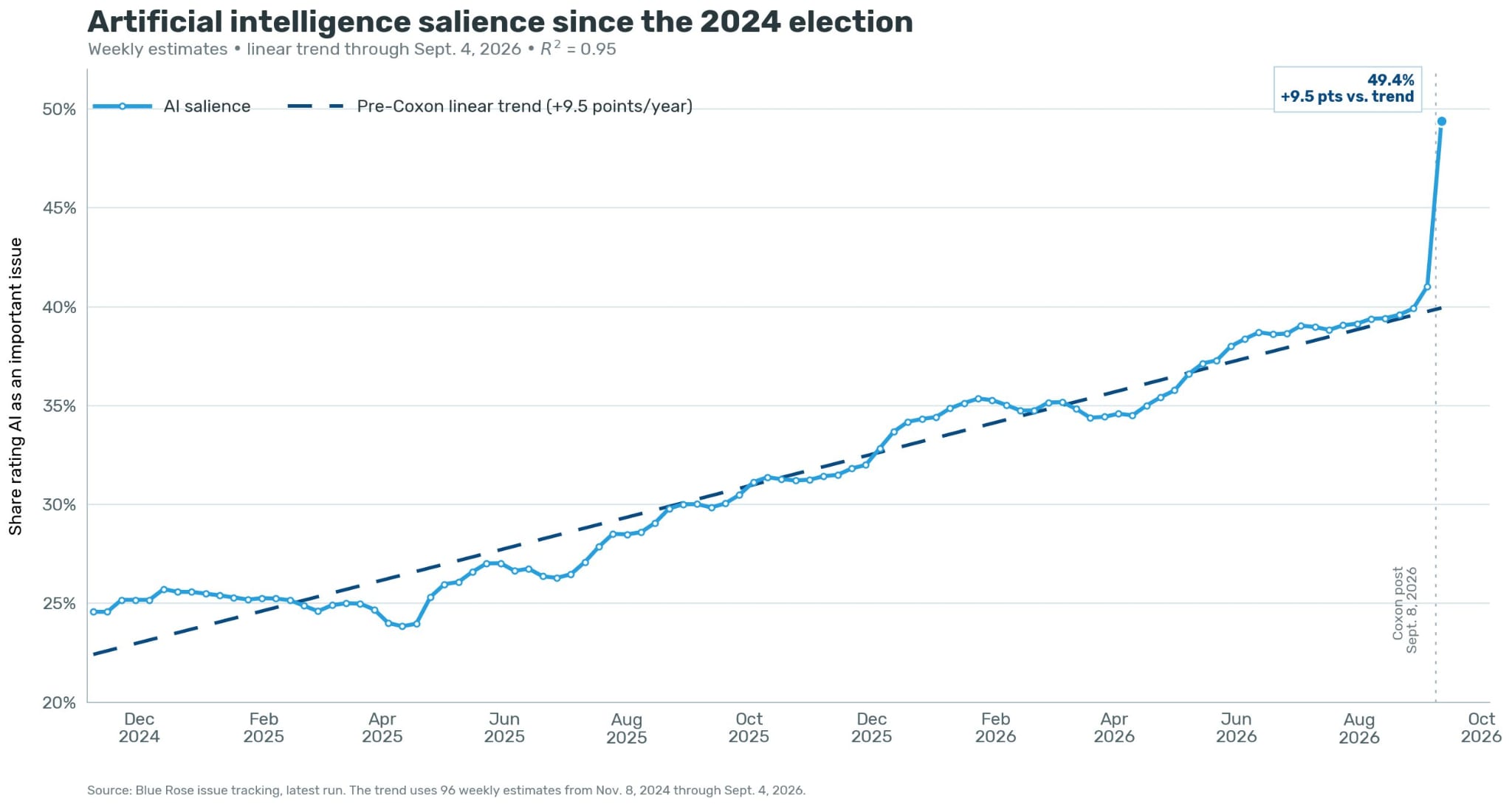
“AI salience has increased dramatically in the past week - increasing as much in the last week as the previous year combined”. It also went from 29th place in March to 22nd place in September in priority among the public out of 39 tracked issues.
Source: https://www.lesswrong.com/posts/gkxDHTLFF8zk2ZLzm/55-of-the-us-public-is-now-aware-of-ai-xrisk
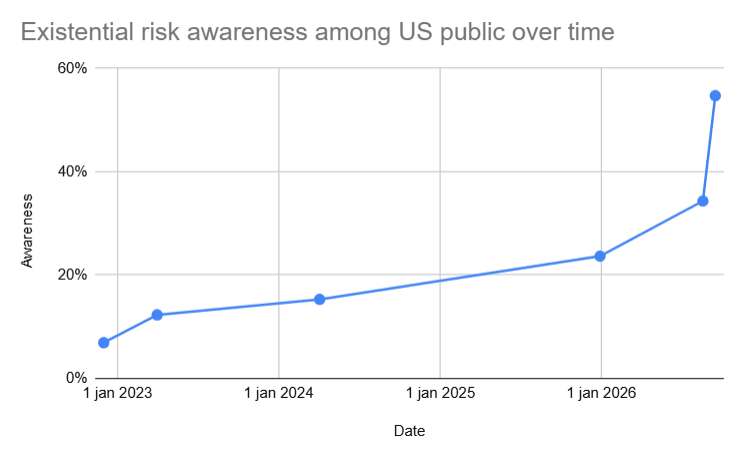
(The points near the end were from polling done in mid-August and mid-September, respectively)
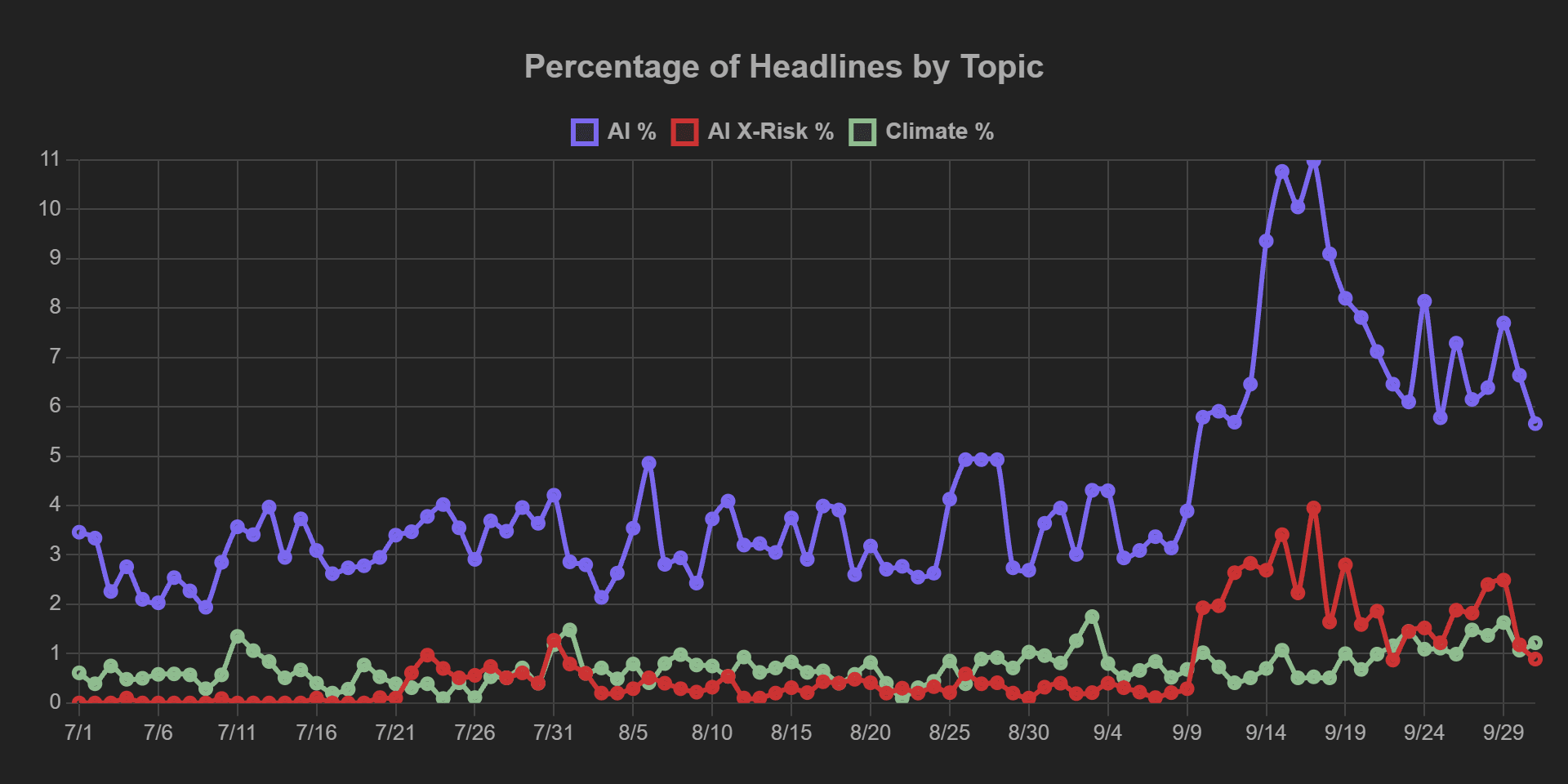
Aside from the Coxon spike, the most notable thing about these graphs to me is that there was no spike after the Hugging Face incident. My best guess as to why that would be is that for most AI safety outsiders, the Hugging Face incident seemed to be an ordinary cybersecurity incident, and it’s not immediately clear how it’s a sign of potentially near-term extinction risk. Or, that journalists assumed it wouldn’t get as much attention for this reason and decided to report on it less. In contrast, Jacob Coxon, a former Anthropic employee, posted with explicit focus on near-term extinction risk, and cited the Hugging Face incident as additional justification. This created a much more compelling Snowden-like “insider whistleblower quits to warn the world” story.
How it Traveled
There’s little public information on who is channeling these incidents into political messaging for legislators and how. But, it can be inferred that a legislator and/or their staffers are likely working with an advocacy group in some way if they make reference to them in their communications. For instance:
- Lieu’s press release for the AI Kill Switch Act includes quotes from representatives for the AI Policy Network, the Alliance for Secure AI, Americans for Responsible Innovation, ControlAI, and the Future of Life Institute.
- Trahan’s press release on endorsements for the FRONTIER Act include quotes from representatives for the Institute for Law & AI, Fathom, the Alliance for Secure AI, AVERI, Encode AI, the Foundation for American Innovation, and the Canary Institute for AI policy.
- Hawley’s press release for his hearing on rogue AI attacks includes a link to a Twitter post from the Alliance for Secure AI.
There’s reduced friction from being asked to sign an already-written letter or endorse an already-introduced bill led by someone else; this seems far more effective for gathering broad support than having statements be made independently. I also noticed that legislators tend to link or post quote Tweets in response to either the primary source for the information, or mainstream news coverage of it. The Hugging Face incident seemed to mostly only get attention from legislators with prior strong interest in AI regulation, and Coxon’s thread generally got much more attention (but also much more mainstream news coverage). The general pattern appears to be that mainstream news coverage is better for getting new (publicly expressed) attention on an issue, whereas less-covered events (presumably sent by staffers or advocacy groups they’re already working with) only tend to get used as additional justification by existing AI regulation advocates.
Source: https://aistop.watch/p/a-swarm-eh
This theory also seems to line up with the effect on the general public; the Hugging Face incident got relatively little news coverage compared to Jacob Coxon’s thread, and AI risk salience did not spike among the general public after Hugging Face, but did after Coxon.
Additional Discussion
Why didn’t the Hugging Face incident and its surrounding news coverage on their own trigger nearly as big of a political response as Jacob Coxon’s thread? My guess would be that it isn’t clear why the Hugging Face incident is indicative of potentially near-term existential risk to those not already familiar with the arguments, rather than just a cybersecurity incident, or just another case of AI being unreliable. “One AI company’s AI hacked another AI company? Serves them right for all their marketing hype. Don’t they know AI hallucinates and makes mistakes all the time? Why would they trust it with that?” Coxon, however, dramatically held near-term extinction risk as its central focus, and had the additional credence of coming from a former lab employee themselves. The Hugging Face incident’s role was additional justification for his concerns as an earlier warning shot of how AI may go rogue and escape control, brought up after the attention-grabbing opening itself.
This is also part of my guess as to why the public has generally seemed more concerned by data centers; they’re more immediately negatively impacted by them and thus will go more out of their way to oppose them. I predict that if rogue AI incidents started causing outages of popular services and were attributed as such in the news (or otherwise tangibly negatively impacted large groups of people), AI risk-motivated bills would start getting far more public support. Just as most of the environmentalist movement’s wins came after some tangible, legible crisis rather than convincing people climate change could gradually make Earth uninhabitable over the span of centuries (e.g. mass media coverage of the Cuyahoga River fires accelerating the creation of the EPA), we may see similar dynamics with future rogue AI incidents.
Jacob Coxon’s thread got substantially more news coverage than any other case of a frontier AI lab employee publicly quitting for safety or ethical concerns. Why? It’s probably a combination of (1) luck, (2) having a pre-planned media strategy (he planned an exclusive with the Wall Street Journal for his quitting), (3) negative attitude toward AI being higher than a year ago from e.g. data centers, (4) a compelling Edward Snowden-like narrative, and (5) calling out high near-term extinction risk (aided by alignment science lead at Anthropic Evan Hubinger quote Tweeting that he believed the chance of human extinction from AI was “>10% within the next decade”, which also received a lot of media attention) with a dramatic framing about how the labs don’t have things under control. I found this post from Molly Kinder to shed useful insight on the outsider view in this regard. A highlight:
Of course, I have heard about "alignment" and "AI safety" and "x risk" concerns for years. I took these concerns at face value, especially when I heard them directly from folks at the labs working closest with the technology. And I was grateful so many smart people are working on them. And that's about it. (My work focuses on AI's impact on jobs.)
But something has shifted, dramatically, for me in the last few weeks. Between the Hugging Face incident, the damning independent @METR_Evals reports that followed, and the alarming chorus of calls (pleas? shouts? SOS signals?) from inside the labs that we are careening toward potential catastrophe, all of this has made me feel, viscerally, how truly dangerous this moment is.
This also essentially captures the difference between the Center for AI Safety’s 2023 Statement on AI Extinction Risk (one of the most effective pieces of messaging on existential risk from AI prior to this) and Coxon. CAIS’ statement drew attention to many experts’ concern that AI poses extinction risk, and was explicitly compared to pandemics and nuclear war. In contrast, Coxon forced attention on lab insider concerns that AI is uniquely more urgent and likely to cause extinction than any other threat, that we aren’t particularly on track to prevent it, and came at a time when general negative sentiment towards AI was much more salient (primarily from data centers).
If timing and lab employee consensus make such a difference, why didn’t the Pacing the Frontier letter and its signatories create nearly as much buzz outside of those already concerned by AI risk? I would imagine it’s largely luck, but again, probably also due to the lack of an explicit focus on >10% extinction risk within the next decade, and perhaps to some extent the implicit dismissal of “if they’re really so concerned, why do they keep working there?” Daniel Kokotajlo, for instance, seems to have similar Snowden-like appeal from being a former OpenAI employee who risked losing ~$2M in equity to avoid signing a non-disparagement clause upon resigning due to safety concerns, helping him get more media attention.
Practical Takeaways
The first main takeaway for AI safety political advocates would be to focus on getting more mainstream news coverage regarding existential risk from AI, insofar as this is within our control. PR firms such as DEY specialize in this and have helped other AI safety advocates in the past, although in this case it seems largely the result of the Twitter thread going viral on its own, the only additional planning being the WSJ exclusive and having some other AI safety advocates boost the post early. See also: AI safety needs a moonshot comms initiative.
Second would be to have more AI safety advocates working with more legislators to channel the increasing AI risk salience into concrete actions being taken. There are still plenty of members of Congress and state legislators who haven’t yet had the time to take positions on AI risk, because Congress always has dozens of competing priorities and the issue becoming salient is still relatively new. We’re also in unprecedentedly good circumstances to do this now; the results of the midterms sent a strong signal that anti-regulation super PACs don’t have nearly as much influence as was previously thought, which was likely blocking further progress. See also: Alexander McCoy offering advice for Congressional Staffer roles.
Third, Congress is slow-moving, the White House is hardly budging, but independent agencies, state governments, and especially their Attorneys General are already showing themselves to produce early governance results for addressing AI risk much faster. I would guess there’s more valuable advocacy work that could be done with this focus. See also: Tie Them to the Mast.
Fourth would be to aim mass-communication efforts towards the “Snowden effect” that was so effective for Coxon. That is, concisely highlighting insider concerns of high-probability near-term extinction risk and that we aren’t on track to prevent it. Additional details for justification, such as rogue agent cyberattacks, or that we are approaching recursive self-improvement, seem to work better as a secondary focus. Especially amplify awareness of rogue agent attacks that tangibly negatively impact the general public as they come; just as data centers get more attention for their immediate negative public impacts, I would expect rogue agent attacks that have these will have similar effect.
My fifth and final takeaway would be that amplifying rogue AI agent incidents may create support for AI risk-motivated regulation even from those that are skeptical of extinction risk itself. This seemed to create the main exceptions to opposing AI risk-motivated regulation in the Trump administration’s case, helped in “GenAI skeptic” Gary Marcus’s case, and seems to help in the case of others who are convinced existential risk from AI is marketing hype. So, perhaps this will broadly continue to hold (although I would expect this to not apply to cases with financial conflicts-of-interest).
Future Work
Some related ideas that seem promising:
- Analyze social media coverage of the Hugging Face incident, Jacob Coxon’s thread, existential risk from AI in general, etc. Extract insights on what gets the most views, how different pieces are received judging by the comments, how coverage of political advocacy related efforts or specific bills tended to perform, what prompts political action, etc.
Have political advocacy groups collect usage and publish statistics on their tools for taking action (presumably opt-in only, out of respect for privacy), or use UTM parameters for their outreach to see which pieces are prompting people to actually visit their website the most. The idea here would be to create proxy measures for how well awareness of existential risk from AI is actually being channeled into concrete political action by the general public, to get a better idea of what does or doesn’t achieve this effectively, and to make it easier to optimize for this.
- Conduct a study in which participants across the political spectrum who weren’t previously aware of rogue AI cyberattacks are asked their position on AI, whether they are concerned by existential risk from AI, and are given summaries of AI risk-motivated bills and asked whether they would support them. Then, after explaining the Hugging Face incident, or all the leading AI researchers who have expressed extinction concern, or some other relevant piece of evidence, see how many change their mind or are prompted to action. Perhaps the poll could additionally group participants by political affiliation, whether they’ve served in the military, age group, or other traits to see how much of a difference it makes. The idea here would be to test how effective different pieces of evidence of AI risk are at changing people’s mind and how they change it. Anecdotally, I’ve talked to friends who initially dismissed my AI extinction risk concerns as marketing hype, then changed their tone after I explained the Hugging Face incident or AI-assisted Navier-Stokes solution. See also: Which AI harms & risks will mobilise the public to act?