This was interesting and had me thinking for a while. This made me consider mixed options as a very relevant consideration for clueless agents. I have some more specific thoughts below. I consider 1. and 5. to be somewhat serious objections to your argument but 2.-4. not so much.
1.
It seems hard to deny that mixed options are possible, and it directly follows from maximality that when they dominate some options, those should be impermissible. I however don’t think I agree with the actual substantive claim being made regarding those:
(*) Even if we don’t have one of the mixed options that would dominate the nowhere-optimal option in mind, we should still consider it impermissible. (In fact, the argument against P1 requires that we don’t have these mixtures in mind because otherwise P1 would just agree.)
Assume menu and in where is the option that looks for mixed options to expand the menu to and then choose again from Let be a nowhere-optimal option. If we don’t expect to find a mixed option that dominates , it does not seem impermissible to me either. If we do expect to find one, then that should be reflected in dominating which would rule impermissible. That is to say that I don’t think the nowhere-optimal option is impermissible by virtue of being nowhere-optimal but by the dominating option actually being available. (Or to put it another way: the convexification of the menu used to rule nowhere-optimal options impermissible needs to be earned instead of just stipulated)
2.
To my understanding, your argument of choosing somewhere-uniquely-optimal options is about them being securely permissible (by (a) being undominated and (b) being secure from being nowhere optimal and therefore being ruled out by (*)) and not about other options being impermissible in relation to them. That is to say that you are not arguing for E-admissibility over maximality but merely showing that somewhere-uniquely-optimal options are safe. I read the text as being about how to avoid doing things you shouldn’t rather than giving guidance what you should do.
3.
There is something decision theoretically fishy about mixed (by lottery) options:
As Jesse Clifton pointed out, going along with these involves a dynamic inconsistency. Keeping the preference to carry them out always needs some form of commitment to the plan. Incomparability itself needs it sometimes but needing it always seems noticeably worse.
Randomizing what we might do seems to strictly lose us information (our choices being part of the world). Having willingness to pay to mix options then violates the “no negative VOI” -intuition.
These might not be such a large issue since mixed (by lottery) options are never somewhere-uniquely-optimal so don’t need to be chosen anyway, assuming of course that the mixed options are also in the menu. (This is slightly strange on its own too.) The preference for these does still exist. (I noticed this thanks to Michael St. Jule’s comment)
4.
Nowhere-optimality becomes less common, and somewhere-uniquely-optimality becomes more common the more variation the representor has. That is to say that the decision rule gives us less determinate action guidance, the more clueless we are. This makes sense but still feels a bit awkward for a decision rule made to help with cluelessness to do. This combined with what Clifton noted about it likely being very difficult to find somewhere-uniquely-optimal options, makes the decision rule seem not very action guiding (in that there are many options we could choose) but also quite difficult to follow (in that they are hard to find). I think Jim Buhler’s comment is related to this too.
5.
Even granting (*) and the decision rule following it, I think the conclusion of ending up almost where we started is too strong even with the softening by “almost”. The behavior is similar, but the idea is extremely different. I read where we started (i) as maximizing EV relative to the (subjective) probability distribution and where we end up (ii) as maximizing EV relative to some permissible (subjective) probability distribution. The preciser doing (i) has a sense in which they are required to choose an option because it is the best or one of the equally best options and they are required to use the same p for every decision. The impreciser doing (ii) is merely doing it because they have to choose something and avoid choosing impermissible options. The impreciser can use one probability function for a decision and another one for the next. Doing (i) allows thinking that you have chosen the best option by your reasons and doing (ii) allows thinking that you didn’t choose against your reasons.
I think it's reasonable to say that nowhere-optimal actions can be permissible if we don't have the dominating action in mind, but let me try push back a bit. Imagine that you're in a decision situation, thinking about what's permissible. You know that you have two options, A and B, and that neither of A and B dominates the other. However, you also remember thinking about this same decision situation in the past, where you recognized that you also have a third option C. You remember that C dominates B and that it doesn't dominate A. Unfortunately, you just can't remember what option C is. In this sort of case, I have the intuition that it'd be impermissible to choose B. If that's right, then actions can be rendered impermissible by virtue of being dominated by options that we don't have in mind.
On 3:
One thing to note here is that, although I use mixed actions to rule out nowhere-optimal actions, I don't advocate choosing mixed actions. The decision rule says you should choose somewhere-uniquely-optimal actions, and (as you say) it's impossible for a mixed action to be somewhere-uniquely-optimal. I think that helps a bit with the decision-theoretic-fishiness / dynamic inconsistency / paying to avoid information problems. See also my reply to Jesse's third point.
On 4:
Yes, it's true that more actions tend to become somewhere-uniquely-optimal when there are more probability functions in our representor. I still think that the decision rule makes lots of actions impermissible though. In particular, I think the 'flanking variants' test will rule out lots of actions. See also my reply to Jim Buhler on finding somewhere-uniquely-optimal actions.
On 5:
That's true. The preciser maximizes EV with respect to the probability function. The impreciser just has to maximize EV with respect to some probability function. But, as you say, those can be very different, so maybe it was an overstatement to say that we're almost back where we began.
The memory example is interesting. I now think my rejection of (*) (from my previous comment) was too strong but I haven’t figured out what to make of this more precisely. I feel like there is something valuable to be said about different ways that options can exist or be available and how relevant they are to maximality or other decision rules. I’ve always thought of menus as very unambiguous objects, so this is difficult to wrap my head around. I have more specific thoughts about the example below.
I share your intuition for B being impermissible. Having witnessed B being dominated makes it very hard to say that it would be permissible. I am, however, skeptical of my intuition because it needs to make assumptions that I’m not convinced of.
The situation has two conditions: (1) I’m sure that if I remembered what C was, it would be a valid option at the current situation and that it dominates B. Being sure in this way without knowing what C is requires the situation to be the same in every way that could affect these. (2) I’m unable to generate the same options as the other time. I think this can happen in three ways: (i) the inputs to that generation are different, (ii) the generation process is different or (iii) the generation process is just nondeterministic (or possible to run incompletely). Both (i) and (ii) make fully trusting the similarity of the situation implausible so (iii) must be true to satisfy the conditions. As far as I can tell, for the intuition of deferring to a different run of the process to make sense, these assumptions need to be made:
A common reference menu (not necessarily objective/true) must exist, and the process must sample it.
Knowledge of dominance relations on the reference menu is authoritative over relations on samples of it.
I notice that if I consciously deny these, I don’t get the intuitive verdict.
Another example to test the second assumption in isolation: An undeniably trustworthy oracle tells me that an option exists that would dominate B but not A[1]. My intuitive verdict again is that it would be pretty incredible to take B. I feel this intuition is somewhat weaker than in the memory example but still clear.
I read “an option exists” as it being in my menu (because that is at least intuitively what being an option means) and then give it similar privileges as real options. Thinking about it more critically, I have a hard time accepting objects that I cannot choose to play in my decision rule for my objects of choice. In terms of the assumptions, I take the oracle to have access to relations on the reference menu but I’m still unsure if I’m willing to let those be authoritative.
Or similarly: It is a logical implication of my information. This is the case with mixed options over nowhere-optimal options vs somewhere-uniquely-optimal options.
I’m one of the judges of the competition. My comments shouldn't be taken as a full review of a post. And, unfortunately, I won’t have capacity to comment on every post or engage with all replies. Thanks so much to everyone who entered!
I think this is a neat and thought-provoking argument that ought to give proponents of cluelessness pause.
My thoughts on this haven’t fully settled, but some reactions:
Suppose that, per the post’s argument, the most choiceworthy actions according to (the most plausible version of) imprecise consequentialism are the somewhere-uniquely-optimal ones. There is still a question of how this view should enter into intertheoretic aggregation. I think it would be odd for imprecise consequentialism to dominate the intertheoretic aggregation, given big disagreement between different elements of the representor about the value of somewhere-uniquely-optimal actions.
Example:
A is great according to common-sense morality, and is nowhere-optimal.
B and C are meh according to common-sense morality, and are uniquely optimal according to p_B and p_C, respectively. Also, B is terrible according to p_C and C is terrible according to p_B.
It seems to me that A should at least be permissible, when aggregating over these two theories.
I’m not sure yet that we can distinguish somewhere-uniquely-optimal and nowhere-uniquely-optimal actions. The space of policies available to us in real life is extremely high-dimensional and it’s not yet clear to me that you couldn’t run a similar argument to your MAWF example to cast doubt on the somewhere-optimality of any policy.
I tend to think that one should never be required to strictly c-prefer a mixture of A and B to C whenever neither A nor B is c-preferred to C. (For one thing, this involves a kind of dynamic inconsistency: I know that, once the coin lands, no matter how it lands, I will no longer have a c-preference between the continuation plan and C.) I tend to think that it’s an unfortunate feature of the dominance rule that this happens, and I would love it if there was some repair to the dominance rule that didn't have this property. Sadly I don’t have one to give, and I suspect any such theory would have its own significant costs.
But, if there were a way to avoid the conclusion that a nowhere-optimal action is always c-dispreferred to some mixture, then there is only the weaker argument that we ought not choose nowhere-optimal actions. And I’m not yet convinced that nowhere-optimality is a problem.
Thanks! Yeah, good question. The view I've sketched will say that A is c-impermissible, but we can still say that A is all-things-considered permissible after taking moral uncertainty into account. As an analogy, declining to push someone in front of a trolley to save 5 people is c-impermissible, but can be all-things-considered permissible after taking moral uncertainty into account.
On your second point, I think the thing I wrote in reply to Jim Buhler applies:
Basically I think the 'flanking variants' test will rule out a lot of actions but not all of them. In general, if our set of available actions is finite, then for each probability function there must be some action that has highest EV (and the same holds for infinite action sets modulo some small complications).
In practice, I think the easiest ones to identify will be extreme actions, like donating all your money to charity. Then we have some reason to think that the action is higher EV than its flanking variants, e.g. it's higher EV than giving less money, and it's impossible to give any more.
Of course, if we start individuating actions finely enough, then the flanking variants test might start ruling out even extreme actions. For example, it might be implausible that ideal reflection on your current evidence could lead you to judge that donating all your money at time X is higher EV than both (i) donating all your money one millisecond earlier and (ii) donating all your money one millisecond later. That would suggest donating all your money at time X is nowhere-optimal, in which case it's dominated by some mixed action, in which case it's c-impermissible.
But note that acting c-impermissibly in this way seems like an inevitable product of our cognitive limitations. So acting c-impermissibly in this way seems at least more forgiveable than choosing actions that are nowhere-optimal (and hence dominated) even on a coarse-grained individuation of our action space.
On your third point, I agree it seems kinda implausible to think you're required to strictly c-prefer the AB mixture to C even though neither A nor B is strictly c-preferred to C, but as you say denying it will have costs. We can read off one cost from my argument: you'll have to deny Dissent, Unanimity, or Justification.
> We can read off one cost from my argument: you'll have to deny Dissent, Unanimity, or Justification.
I haven’t thought about this much at all, but: One idea is that you could avoid the kinds of reflection principle violations involved in preferring mixtures by “rectangularising” the representor (cf. this). I.e., enlarge the representor such that your current expectations match your expectations of your future expectations.
This would violate Unanimity (relative to your original representor), but I’m not sure that’s so bad on its own. I think I’m more worried that it has other bad properties, e.g., maybe we can’t do this without creating “too much” imprecision.
Yeah, that seems like a pretty good way to go. I think creating too much imprecision might be a concern, and that there's also a concern about motivation. As I understand it, rectangularising in this case means adding probability functions to your representor on which, e.g., Pr(X | Heads)<0.01. But that seems incompatible with characterizing your representor as the set of probability functions you could settle on after ideal reflection on your current evidence, because (we can stipulate that X is such that) ideal reflection won't lead you to believe that X and Heads are so tightly anti-correlated. And given that, it seems maybe hard to justify including probability functions on which Pr(X | Heads)<0.01 in your representor (and thereby letting those probability functions affect what's permissible/impermissible for you).
Right, you might want to say that the distributions added to the representor should not have an epistemic interpretation, but should be thought of as a choice-theoretic representation. That is, we have a choice-theoretic reflection principle (something like, if I know that I’ll in future judge A and B to be permissible, I should judge them to both be permissible now), which along with other constraints forces choice behaviour that is representable by the larger representor.
one should never be required to strictly c-prefer a mixture of A and B to C whenever neither A nor B is c-preferred to C
There are candidate counterexamples to this claim. For example, imagine A is giving a benefit to Amy, and B and C each designate the same action of giving a benefit to Bobby. Then if you're impartial, you won't strictly c-prefer either of A or B to C, but you might strictly c-prefer the 50:50 mixture AB to C on the basis that it's fairer to randomize who gets the benefit.
Also, imprecise consequentialism (plus Dissent, Unanimity, and Justification) has an even more counterintuitive implication than 'you can be required to strictly c-prefer a mixture of AB to C even though neither A nor B is c-preferred to C.' It implies:
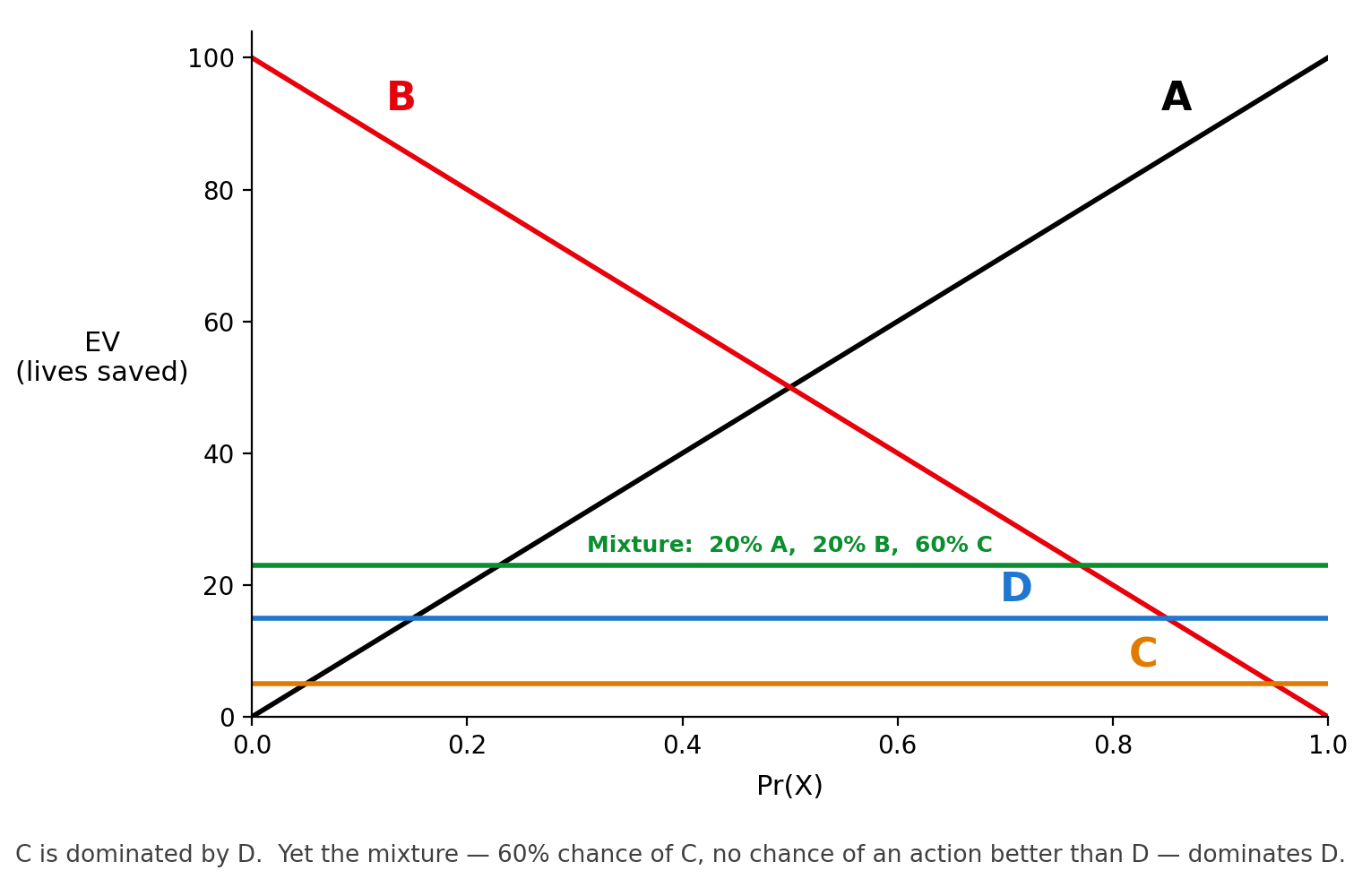
You can be required to strictly c-prefer a mixture of A, B, and C to D, even though (i) neither A nor B is c-preferred to D, (ii) C is c-dispreferred to D, and (iii) the mixture has an arbitrarily high probability of resulting in C.
Here's an example to illustrate:
I made the mixture have a 60% chance of C just to avoid the diagram being all bunched up. But the steeper you make the diagonals A and B, the higher you can push the probability of C and yet still have the mixture dominate D.
How do you recommend choosing between somewhere-uniquely-optimal actions if there are multiple? I'm imagining the worst case where we still have several left that we're clueless between.[1]
And are all convex combinations of (lotteries over) somewhere-uniquely-optimal actions also somewhere-uniquely-optimal? (Let’s suppose our set of actions is closed under convex combinations, so somewhere-unique-optimality is defined with respect to that set.)
EDIT: The answer is no. 60-For-Sure, 100-If-True and 100-If-False are all somewhere-uniquely-optimal (under convex combinations), but 60-For-Sure dominates the convex combination of picking one of 100-If-True or 100-If-False at random, with 50% probability each.
I suppose the actual worst case is where inaction is ~always somewhere uniquely-optimal, and especially when building a portfolio to give across organizations, but that will depend on the particulars involved.
Thanks! I guess given a choice between somewhere-uniquely-optimal actions, you should first check if any of them are ruled out by non-consequentialist considerations (like deontological constraints). If you still have multiple options at that stage, then the view I've sketched here will say that they're each permissible and that you can choose between them how you like. In practice, I'd try to choose the action that's somewhere-uniquely-optimal on my forced-to-say-a-number probability function, for moral uncertainty sorts of reasons.
donating $4.99 to MAWF and donating $5.01 to MAWF are also available actions, so your reflection would have to lead you to assign higher EV to donating $5 than to either of these. It’s hard to see how reflection could do that. Coming to believe that donating $5 is the highest-EV action available to you would seem to require forming beliefs about the likely consequences of donating $5 specifically.
Don't we have the exact same problem with any amount given to any org, such that all possible donations are Nowhere-Optimal according to your argument? What makes MAWF special?
Thanks! I wrote a reply to this but I now see it failed to send and I can't seem to recover the text.
Basically I think the 'flanking variants' test will rule out a lot of actions but not all of them. In general, if our set of available actions is finite, then for each probability function there must be some action that has highest EV (and the same holds for infinite action sets modulo some small complications).
In practice, I think the easiest ones to identify will be extreme actions, like donating all your money to charity. Then we have some reason to think that the action is higher EV than its flanking variants, e.g. it's higher EV than giving less money, and it's impossible to give any more.
Of course, if we start individuating actions finely enough, then the flanking variants test might start ruling out even extreme actions. For example, it might be implausible that ideal reflection on your current evidence could lead you to judge that donating all your money at time X is higher EV than both (i) donating all your money one millisecond earlier and (ii) donating all your money one millisecond later. That would suggest donating all your money at time X is nowhere-optimal, in which case it's dominated by some mixed action, in which case it's c-impermissible.
But note that acting c-impermissibly in this way seems like an inevitable product of our cognitive limitations, so it seems at least more forgiveable than choosing actions that are nowhere-optimal (and hence dominated) even on a coarse-grained individuation of our action space.
If I’m reading you correctly, it seems that the 'flanking variants' test for nowhere-optimality doesn’t rule out the action as described since it invokes a strict inequality where only a weak one is argued for (this is separate from @JesseClifton/@Jim Buhler's worry that it rules out too much).
The meaning of nowhere-optimal was:
An action is nowhere-optimal if and only if it doesn’t have the highest EV of all available actions on any probability function in your representor.
That is, nowhere-optimal ⟺ never weakly best ⟺ always strictly worse than some other action.
The general ‘flanking variants’ test (for nowhere-optimality) was:
We ask whether ideal reflection could lead us to judge an action higher EV than all of its flanking variants. If the answer is no, the action is nowhere-optimal.
In the running example, let's grant that nothing ideal reflection could settle on puts $5.00 strictly above both $4.99 and $5.01, say because a cent makes no difference (subjectively, on pure reflection). Then we've identified an action that couldn't have a higher EV than its flanking variants after ideal reflection. But can we conclude from this that the action is nowhere-optimal? No, because ‘nowhere-optimal’ = ‘always strictly worse than some other action’, and $5.00 was never argued to be strictly worse than $4.99 or $5.01.[1]
Should the test perhaps be this?
We ask whether ideal reflection could lead us to judge that an action is no worse in EV than all of its flanking variants. If the answer is no, the action is nowhere-optimal.
Though on that version, the $5.00 donation isn't ruled out.
Just to clarify the example and concept: if we added the option c-For-Sure, which gives c with 100% probability, to the set of options in your example, it would be somewhere optimal iff c is at least 50, right?
Take Pr(X)=50%. Then 50-For-Sure, 100-If-True and 100-If-False all have EV 50.
And further, any lottery/gamble between any three of them (50-For-Sure, 100-If-True and 100-If-False) has EV 50, if the draw of the option is statistically independent from X's probability distribution.
Impressions from the 21st Annual U.S. Cluster Headache Patient Conference, organized by Clusterbusters.
On the morning of the last day of the conference, E. was hanging out with other “clusterheads” outside the conference hotel when he started having a cluster headache attack. Before he could go back to his hotel room, J. offered E. his DMT v...
TL;DR:
The movement has an evidence problem. To solve it, for each intervention we need to know:
* What types of evidence that intervention needs
* What types of evidence different sources can give us
In this post, we outline a framework for evidencing an intervention through five stages:
...
This competition entry has been selected for publication by the Forum team.
1. Introduction
Here’s Anthony DiGiovanni’s unawareness argument, quoted from his summary post (footnotes omitted):
Let’s say that we c-prefer A over B if the reason we prefer A is an impartial altruistic comparison of the actions’ possible consequences.
P1. Normative premise: To justify c-preferring A over B, it’s not enough to say (e.g.) that A seems heuristically good. Rather, we need to argue that A has higher “expected value” broadly speaking, meaning: In some sense we “expect” that, if we were idealized agents who could aggregate all of A’s and B’s possible consequences into literal EVs, then we’d say A has higher EV. (We ourselves don’t need literal EVs to justify c-preferences, hence the scare quotes.) Otherwise, it’s unacceptably arbitrary to c-prefer A.
P2. Conceptual premise: If our understanding of A’s and B’s possible consequences is sufficiently coarse-grained, then we don’t have an argument for “expecting” our idealized self’s EV for A to be higher, lower, or equal to B’s. So A’s and B’s “EVs” are incomparable. In particular:
a. Against precise EVs: We shouldn’t represent actions’ degrees of c-preferability with literal precise expected values.
b. Against “best guesses”: Even if we don’t use literal precise EVs, we shouldn’t always force ourselves to compare A’s and B’s “EVs”.
P3. Empirical premise: Due to unawareness (at least), our understanding of any pair of actions’ possible consequences is indeed very coarse-grained — enough that the conclusion of (P2) follows (i.e., these actions’ “EVs” are incomparable). In particular, the actions’ “EVs” are too severely imprecise to compare them, regardless of whether we (a) formally model these “EVs” or (b) appeal to informal/heuristic arguments.
Conclusion: We aren’t justified in c-preferring any action over any other.
I’m going to argue against P1: the normative premise. I think you can be justified in c-preferring an action A over another action B without “expecting” your idealized self to assign higher EV to A than B. In particular, I think this can happen in situations where you have a third available action C, in addition to A and B.
I’m also going to argue against the inference. Even if P1, P2, and P3 are true, the conclusion doesn’t follow. In fact, I think the conclusion is false: we are justified in c-preferring some actions over others. The key is to recognize the possibility of mixed actions, like flipping a coin and performing different actions depending on whether it lands heads or tails.
2. When can you “expect” your idealized self to assign higher EV to A than B?
P1 says that, to justify c-preferring A over B, we need to “expect” that our idealized self would assign higher EV to A than B. What does DiGiovanni mean by “expect”? It can’t be mathematical expectation or greater-than-50% credence. DiGiovanni thinks (and I agree) that we’re too clueless for that. If we can’t assign meaningful EVs to actions, we also can’t assign meaningful credences to hypotheses about the EVs that our idealized selves would assign to those actions. Any credences we did assign would be unacceptably arbitrary.[1]
So what does DiGiovanni mean by “expect”? I don’t need a full answer. For now, I just need the following principle, which I think DiGiovanni would endorse:
Dissent
If some probability function in your representor[2] assigns higher EV to B than A, then you can’t “expect” your idealized self to assign higher EV to A than B.[3]
Dissent is hard to deny. Ideal reflection on your evidence could lead you to settle on any probability function in your representor. So if your representor contains some function on which B has higher EV than A, your idealized self might settle on it. In that case, you can’t “expect” your idealized self to assign higher EV to A than B.
3. A challenge to P1
With Dissent in our pocket, here’s a case to challenge P1. It’s a case in which some probability functions in your representor rank B above A (and hence, by Dissent, you can’t “expect” your idealized self to assign higher EV to A than B), and yet it seems plausible that you’re justified in c-preferring A to B.
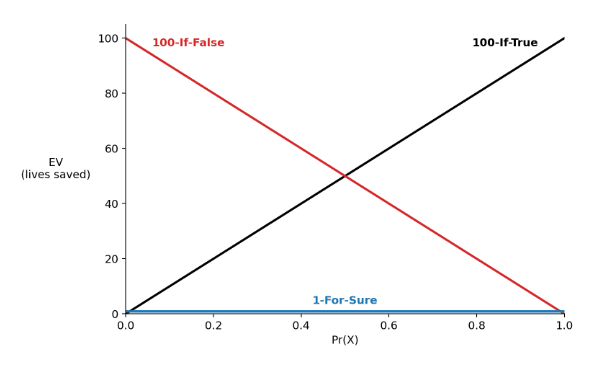
Take a proposition X about which you’re truly clueless: so clueless that your representor contains at least one probability function on which Pr(X) < 0.01 and one probability function on which Pr(X) > 0.99.[4] And suppose you have three options:
100-If-True: Save 100 lives if X is true.
100-If-False: Save 100 lives if X is false.
1-For-Sure: Save 1 life for sure.
Here’s a diagram to represent these options, with Pr(X) on the x-axis and EV on the y-axis:
Given this setup, you can’t “expect” your idealized self to assign higher EV to 100-If-True than 1-For-Sure. After all, your idealized self could settle on a probability function on which Pr(X) < 0.01. That would mean 1-For-Sure saves more lives in expectation. Similarly, you can’t “expect” your idealized self to assign higher EV to 100-If-False than 1-For-Sure, because your idealized self could settle on a probability function on which Pr(X) > 0.99.
So according to P1, you’re not justified in c-preferring either of 100-If-True or 100-If-False to 1-For-Sure. But this seems implausible. As the diagram indicates, there is no probability function in your representor on which 1-For-Sure has the highest EV of your available actions. 1-For-Sure is, as I’ll say, nowhere-optimal:
Nowhere-Optimal
An action is nowhere-optimal if and only if it doesn’t have the highest EV of all available actions on any probability function in your representor.
And on top of that, there are probability functions in your representor on which 1-For-Sure has much lower EV than 100-If-True and 100-If-False. On probability functions on which 100-If-True has lower EV than 1-For-Sure, 100-If-False has much higher EV. And on probability functions on which 100-If-False has lower EV than 1-For-Sure, 100-If-True has much higher EV. Given these facts, it seems intuitive that you’re justified in c-preferring at least one of 100-If-True and 100-If-False to 1-For-Sure. If that intuition is true, P1 is false.
Here’s an extra argument for the intuition. Imagine that the only things that distinguish your options are their consequences, so that c-preferences are the only bases on which to determine what you’re morally permitted to do. (So none of the options violates any deontological constraint, exercises a personal prerogative, or anything like that.) Even given this stipulation, it seems morally wrong to choose 1-For-Sure. If that’s right, you must be justified in c-preferring 100-If-True or 100-If-False to 1-For-Sure, since c-preferences are the only things that could make it wrong to choose 1-For-Sure. That again implies P1 is false.
4. A challenge to the inference
Suppose you’re not convinced and you want to hold on to P1. I also have a challenge for the inference: P1, P2, and P3 can all be true (at least depending on how you read them) and yet the conclusion can be false. In fact, I’ll argue that the conclusion is false.
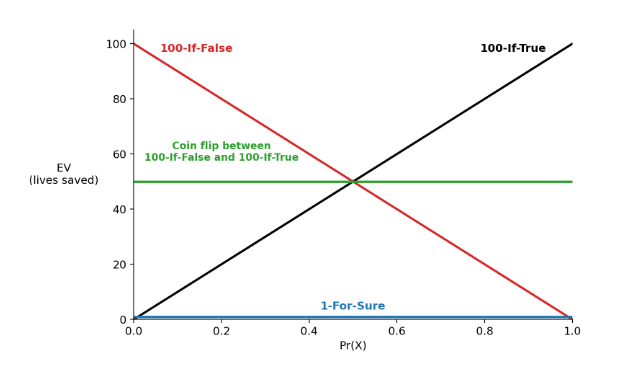
Consider again our case above, but now suppose you have access to a fair coin. That gives you another option: flip the coin, and then choose 100-If-True on heads and 100-If-False on tails. This option averages the EVs of 100-If-True and 100-If-False. The result is that, on every probability function in your representor, the coin flip has an EV of 50 lives saved. Let’s add that to our diagram:
As you can see, the coin flip has higher EV than 1-For-Sure on every probability function in your representor. When that’s the case, we’ll say that the coin flip dominates 1-For-Sure:
Dominance
An action A dominates an action B if and only if A has higher EV than B on every probability function in your representor.
We then appeal to the following principle:
Unanimity
If A dominates B, then you can “expect” your idealized self to assign higher EV to A than B.
I think DiGiovanni would endorse Unanimity.[5] And it seems hard to deny. Your representor is supposed to represent your entire belief state, so (in some sense) every part of your belief state is telling you that A has higher EV than B. It’s then unclear why you couldn’t “expect” your idealized self to assign higher EV to A than B.
There’s one more assumption I’ll need for my argument. P1 only states a necessary condition on justified c-preference, but I’ll assume the sufficiency direction as well. Let’s call it:
Justification
If you can “expect” your idealized self to assign higher EV to A than B, then you’re justified in c-preferring A to B.[6]
Now we have everything we need. The coin flip dominates 1-For-Sure, so by Unanimity you can “expect” your idealized self to assign higher EV to the coin flip than 1-For-Sure. Then by Justification, you’re justified in c-preferring the coin flip to 1-For-Sure.
This fact about the coin flip generalizes, giving us the following result:
Result
If some action N is nowhere-optimal, then N is dominated by some mixed action.[7][8]
And if N is dominated by some mixed action, Unanimity and Justification together imply that you’re justified in c-preferring the mixed action to N.
This result sets up a challenge to DiGiovanni’s conclusion: that we aren’t justified in c-preferring any action over any other. Specifically, it lowers the bar. No longer do we need to find some pair of actions A and B such that A dominates B. Instead, we just need to find some nowhere-optimal action N: some action that doesn’t have the highest EV of all available actions on any probability function in your representor. Then, by the Result, we can trust that there’s some mixed action that dominates N.
Plausibly, there are such nowhere-optimal actions. For example, I claim that donating $5 to the Make-A-Wish Foundation (MAWF) is nowhere-optimal. For this not to be the case (i.e. for the MAWF donation to be somewhere-optimal), it’s not enough to just imagine a story in which donating $5 to MAWF happens to turn out best. Instead, it would have to be that ideal reflection on your current evidence could lead you to settle on a probability function on which donating $5 to MAWF has the highest EV of all your available actions.
And this seems very implausible to me. To see why, note first that ideal reflection is something you do from the armchair. You don’t get to go out and gather new evidence. You only get to reflect on the evidence you already have. And note second that donating $4.99 to MAWF and donating $5.01 to MAWF are also available actions, so your reflection would have to lead you to assign higher EV to donating $5 than to either of these. It’s hard to see how reflection could do that. Coming to believe that donating $5 is the highest-EV action available to you would seem to require forming beliefs about the likely consequences of donating $5 specifically. For example, you might have to form a belief that there’s some threshold effect that kicks in at $5, such that $4.99 would fail to trigger it and $5.01 would be overkill. It seems unlikely that pure reflection on your current evidence could lead you to believe in such an effect. If that’s right, donating $5 to MAWF is nowhere-optimal, so it’s dominated by some mixed action, so we’re justified in c-preferring the mixed action. That means DiGiovanni’s conclusion is false: we are justified in c-preferring some actions over others. Specifically, for every nowhere-optimal action N, we’re justified in c-preferring some mixed action to N.
5. The relevant mixed actions might be hard to find
Here’s a potential concern. You might know that you’re justified in c-preferring some mixed action over donating $5 to MAWF, and yet not know which mixed action you’re justified in c-preferring. Depending on the extent of your cluelessness, it could be quite complicated, spreading probability mass over a huge number of different actions. This mixed action would still be available to you in some sense. It would be physically possible for you to perform it, and you could happen to perform it by chance if you correctly guessed the probability distribution. But you couldn’t reliably choose to perform it.
Does that rescue the spirit of DiGiovanni’s conclusion? I don’t think so. To see why, it’ll be useful to have some terminology:
Somewhere-Uniquely-Optimal
An action S is somewhere-uniquely-optimal if and only if S alone has the highest EV of all available actions on some probability function in your representor.
With that in hand, we can state a result that’s a reverse of the above:
Reverse Result
If some action S is somewhere-uniquely-optimal, then you’re not justified in c-preferring any other action (mixed or not) to S.
The proof is quick and it just needs Dissent. Take a probability function on which S is uniquely optimal. Every other pure (i.e. non-mixed) action has a strictly lower EV there, and so does every mixed action: a mixed action’s EV is the average of its components’ EVs, and some of its components have lower EV than S on the relevant probability function. So for every rival action R to S, there’s a probability function in your representor on which S has higher EV than R. Then by Dissent, there’s no rival R such that you can “expect” your idealized self to assign higher EV to R than S. And then by P1, there’s no rival that you’re justified in c-preferring to S.
So, whatever situation you find yourself in, you can be sure that:
For every nowhere-optimal action N, you’re justified in c-preferring some other action to N (even though you might not know which action).
For every somewhere-uniquely-optimal action S, you’re not justified in c-preferring any other action to S.
These facts make me think that it’s morally wrong to choose nowhere-optimal actions, and morally right to choose somewhere-uniquely-optimal actions.[9] That would mean it’s right to act like a person who c-prefers somewhere-uniquely-optimal actions to nowhere-optimal actions. That makes me think that DiGiovanni’s conclusion is false in spirit, as well as in the letter.
6. Does our rule guide clueless agents?
So our candidate moral rule in the face of cluelessness is:
Choose a Somewhere-Uniquely-Optimal Action
1. It’s morally impermissible to choose a nowhere-optimal action.
2. It’s morally permissible to choose a somewhere-uniquely-optimal action.
This rule isn’t complete, because it doesn’t tell us about the moral status of actions that are somewhere-jointly-optimal-but-nowhere-uniquely-optimal. But it’s complete enough to be getting on with.
Is this a decision rule that clueless agents can follow? Can clueless agents identify nowhere-optimal actions? Can they identify somewhere-uniquely-optimal actions? I think the answer to each of these questions is yes. To determine whether an action is nowhere-optimal, you ask: could ideal reflection on my current evidence lead me to regard this action as the highest-EV action available to me? That question seems answerable. We already answered it for the $5 MAWF donation in the previous section. And we used a test to do it: could ideal reflection lead me to regard this action as higher EV than donating $4.99 and $5.01? This sort of ‘flanking variants’ test can be applied generally. We ask whether ideal reflection could lead us to judge an action higher EV than all of its flanking variants. If the answer is no, the action is nowhere-optimal.
We can also feasibly identify somewhere-uniquely-optimal actions. Presumably, we have introspective access to at least one of the probability functions in our representors. For example, we have introspective access to our forced-to-say-a-number probability function. We can then calculate EVs on that function. If multiple actions are tied for EV on that function, we can calculate their EVs on very-slightly-different probability functions (e.g. changing the probability on some proposition from 80% to 79.999%) until we have a unique winner. That gives us a somewhere-uniquely-optimal action.
Of course, there are practical problems with this procedure (like listing out all of our available actions and calculating their EVs), but these are not cluelessness problems. They’d blight us even if we weren’t clueless (with just one probability function in our representor) and we can handle them in standard ways: focusing on a subset of our available actions and calculating their EVs in broad strokes. We then subject our candidate somewhere-uniquely-optimal action to the ‘flanking variants’ test. That might lead us to shift the action along some dimensions (e.g. donating more or less), but we’ll still hit a maximum somewhere. In general, if our set of available actions is finite, then for each probability function there must be some action with highest EV.[10] This action will be at the place where, on our forced-to-say-a-number probability function, shifting along any dimension will have greater expected costs than benefits.
7. Conclusion
I’ve presented two challenges to the unawareness argument. The first is a challenge to P1. In the case of 100-If-True, 100-If-False, and 1-For-Sure, you can’t “expect” your idealized self to assign higher EV to either bet than to 1-For-Sure. But 1-For-Sure is nowhere-optimal, and it seems wrong to choose it over each bet. So plausibly, you’re justified in c-preferring at least one of the bets to 1-For-Sure. If that’s right, P1 is false.
The second is a challenge to the inference. Suppose P1 is true. The coin flip between 100-If-True and 100-If-False dominates 1-For-Sure, so by Unanimity, you can “expect” your idealized self to assign it higher EV. Then by Justification, you’re justified in c-preferring the coin flip to 1-For-Sure. And the point generalizes: every nowhere-optimal action is dominated by some mixed action, and we’re justified in c-preferring the mixed action. And plausibly, lots of the actions available to us are nowhere-optimal. For example, donating $5 to the Make-A-Wish Foundation is nowhere-optimal because ideal reflection on your evidence couldn’t single it out over its flanking variants, like donating $4.99 and $5.01. So DiGiovanni’s conclusion is false: we’re justified in c-preferring some actions to others.
These two challenges led us to a decision rule for clueless agents: choose a somewhere-uniquely-optimal action. We can be confident that these actions are not justifiably c-dispreferred to any other action. And plausibly we can identify somewhere-uniquely-optimal actions. One way would be to calculate EVs on our forced-to-say-a-number probability functions.
So principles like Dissent, Unanimity, and Justification have taken us almost back to where we began. Clueless agents should pick some probability function and maximize EV with respect to it.
Here are the quotations from DiGiovanni (and coauthors) that make me think he’d endorse this:
“Where do the precise higher-order weights come from? How do you non-arbitrarily pin them down?” (source).
“Insofar as our representor exhaustively describes our epistemic state, it’s not clear what these higher-order weights are supposed to mean. Each distribution in the representor models a different way of weighing up the relevant considerations, and, by hypothesis, we think it’s indeterminate which way is best. So why is the aggregated representor, derived from putting determinate weights on each distribution, a better description of what we ought to believe? By aggregating, instead of adding information for free, it seems we lose information about our inability to non-arbitrarily pin down weights.” (source)
Here are quotations from DiGiovanni that make me think he’d endorse Dissent:
“Strategy s1 is better than s2 if and only if s1 has higher [EV] under every p in P.” (source)
“Given two strategies, if neither strategy is net-better than the other under all these ways of making precise evaluations, then we’re not justified in comparing these strategies.” (source)
“On the supervaluationist approach, it seems to straightforwardly follow that one option is determinately at least as good as another if and only if that is the case relative to all measures in P.” (source)
“we prefer action A over B if and only if A has higher expected utility under every distribution in the set.” (source)
This is just for convenience. The argument also works for propositions with narrower probability ranges. We just have to scale up the size of the sure payoff accordingly.
Here are the quotations from DiGiovanni that make me think he’d endorse Unanimity:
“Strategy s1 is better than s2 if and only if s1 has higher [EV] under every p in P.” (source).
“On the supervaluationist approach, it seems to straightforwardly follow that one option is determinately at least as good as another if and only if that is the case relative to all measures in P.” (source).
“we prefer action A over B if and only if A has higher expected utility under every distribution in the set.” (source)
Here are the quotations from DiGiovanni that (together with Dissent) make me think he’d endorse Justification:
“all possible ways of making a strategy’s UEV precise have the same sign… So the strategy’s net impact is comparable with 0, i.e., we can say it’s net-positive.” (source)
“Strategy s1 is better than s2 if and only if s1 has higher [EV] under every p in P.” (source).
“On the supervaluationist approach, it seems to straightforwardly follow that one option is determinately at least as good as another if and only if that is the case relative to all measures in P.” (source).
“we prefer action A over B if and only if A has higher expected utility under every distribution in the set.” (source)
A mixed action is a commitment to perform different actions conditional on different outcomes of a lottery. ‘Choose 100-If-True on heads and 100-If-False on tails’ is an example of a mixed action.
This result appears as Lemma 3 in Pearce (1984). It holds given finitely many pure actions (or a compact set of them) and a closed, convex representor. See also Troffaes (2007):
“This leaves E-admissibility [i.e. being highest EV on some probability function in your representor] and maximality [i.e. not being lower EV than any other action on every probability function in your representor]... they coincide if the set of gain gambles is convex (for instance, if we consider randomised decisions).”
Raiffa (1961) makes the point that randomization can turn ambiguity into risk:
"Suppose you withdraw a ball from the urn with unknown composition but do not look at its color. Now toss a fair (unbiased) coin and call 'red' if heads, 'black' if tails. The 'objective' probability of getting a match is now .5…"
Michael St. Jules makes a point along these lines in this post. He shows that a portfolio of interventions can be better than doing nothing on every worldview even when no single intervention is.
At least in situations that don’t involve any deontological constraints, personal prerogatives, or anything like that, so that c-preferences are the only bases on which to determine what you’re morally permitted to do.
If multiple actions are tied for highest EV on some probability function, we can use other probability functions as tiebreakers. If multiple actions are tied for highest EV on every probability function, then we can know that each is not justifiably c-dispreferred to any other available action, and so we can regard each action as morally permissible.



This was interesting and had me thinking for a while. This made me consider mixed options as a very relevant consideration for clueless agents. I have some more specific thoughts below. I consider 1. and 5. to be somewhat serious objections to your argument but 2.-4. not so much.
1.
It seems hard to deny that mixed options are possible, and it directly follows from maximality that when they dominate some options, those should be impermissible. I however don’t think I agree with the actual substantive claim being made regarding those:
(*) Even if we don’t have one of the mixed options that would dominate the nowhere-optimal option in mind, we should still consider it impermissible. (In fact, the argument against P1 requires that we don’t have these mixtures in mind because otherwise P1 would just agree.)
Assume menu
2.
To my understanding, your argument of choosing somewhere-uniquely-optimal options is about them being securely permissible (by (a) being undominated and (b) being secure from being nowhere optimal and therefore being ruled out by (*)) and not about other options being impermissible in relation to them. That is to say that you are not arguing for E-admissibility over maximality but merely showing that somewhere-uniquely-optimal options are safe. I read the text as being about how to avoid doing things you shouldn’t rather than giving guidance what you should do.
3.
There is something decision theoretically fishy about mixed (by lottery) options:
4.
Nowhere-optimality becomes less common, and somewhere-uniquely-optimality becomes more common the more variation the representor has. That is to say that the decision rule gives us less determinate action guidance, the more clueless we are. This makes sense but still feels a bit awkward for a decision rule made to help with cluelessness to do. This combined with what Clifton noted about it likely being very difficult to find somewhere-uniquely-optimal options, makes the decision rule seem not very action guiding (in that there are many options we could choose) but also quite difficult to follow (in that they are hard to find). I think Jim Buhler’s comment is related to this too.
5.
Even granting (*) and the decision rule following it, I think the conclusion of ending up almost where we started is too strong even with the softening by “almost”. The behavior is similar, but the idea is extremely different. I read where we started (i) as maximizing EV relative to the (subjective) probability distribution and where we end up (ii) as maximizing EV relative to some permissible (subjective) probability distribution. The preciser doing (i) has a sense in which they are required to choose an option because it is the best or one of the equally best options and they are required to use the same p for every decision. The impreciser doing (ii) is merely doing it because they have to choose something and avoid choosing impermissible options. The impreciser can use one probability function for a decision and another one for the next. Doing (i) allows thinking that you have chosen the best option by your reasons and doing (ii) allows thinking that you didn’t choose against your reasons.
Thanks! Great points.
On 1:
I think it's reasonable to say that nowhere-optimal actions can be permissible if we don't have the dominating action in mind, but let me try push back a bit. Imagine that you're in a decision situation, thinking about what's permissible. You know that you have two options, A and B, and that neither of A and B dominates the other. However, you also remember thinking about this same decision situation in the past, where you recognized that you also have a third option C. You remember that C dominates B and that it doesn't dominate A. Unfortunately, you just can't remember what option C is. In this sort of case, I have the intuition that it'd be impermissible to choose B. If that's right, then actions can be rendered impermissible by virtue of being dominated by options that we don't have in mind.
On 3:
One thing to note here is that, although I use mixed actions to rule out nowhere-optimal actions, I don't advocate choosing mixed actions. The decision rule says you should choose somewhere-uniquely-optimal actions, and (as you say) it's impossible for a mixed action to be somewhere-uniquely-optimal. I think that helps a bit with the decision-theoretic-fishiness / dynamic inconsistency / paying to avoid information problems. See also my reply to Jesse's third point.
On 4:
Yes, it's true that more actions tend to become somewhere-uniquely-optimal when there are more probability functions in our representor. I still think that the decision rule makes lots of actions impermissible though. In particular, I think the 'flanking variants' test will rule out lots of actions. See also my reply to Jim Buhler on finding somewhere-uniquely-optimal actions.
On 5:
That's true. The preciser maximizes EV with respect to the probability function. The impreciser just has to maximize EV with respect to some probability function. But, as you say, those can be very different, so maybe it was an overstatement to say that we're almost back where we began.
Thanks for the reply!
The memory example is interesting. I now think my rejection of (*) (from my previous comment) was too strong but I haven’t figured out what to make of this more precisely. I feel like there is something valuable to be said about different ways that options can exist or be available and how relevant they are to maximality or other decision rules. I’ve always thought of menus as very unambiguous objects, so this is difficult to wrap my head around. I have more specific thoughts about the example below.
I share your intuition for B being impermissible. Having witnessed B being dominated makes it very hard to say that it would be permissible. I am, however, skeptical of my intuition because it needs to make assumptions that I’m not convinced of.
The situation has two conditions: (1) I’m sure that if I remembered what C was, it would be a valid option at the current situation and that it dominates B. Being sure in this way without knowing what C is requires the situation to be the same in every way that could affect these. (2) I’m unable to generate the same options as the other time. I think this can happen in three ways: (i) the inputs to that generation are different, (ii) the generation process is different or (iii) the generation process is just nondeterministic (or possible to run incompletely). Both (i) and (ii) make fully trusting the similarity of the situation implausible so (iii) must be true to satisfy the conditions. As far as I can tell, for the intuition of deferring to a different run of the process to make sense, these assumptions need to be made:
I notice that if I consciously deny these, I don’t get the intuitive verdict.
Another example to test the second assumption in isolation: An undeniably trustworthy oracle tells me that an option exists that would dominate B but not A[1]. My intuitive verdict again is that it would be pretty incredible to take B. I feel this intuition is somewhat weaker than in the memory example but still clear.
I read “an option exists” as it being in my menu (because that is at least intuitively what being an option means) and then give it similar privileges as real options. Thinking about it more critically, I have a hard time accepting objects that I cannot choose to play in my decision rule for my objects of choice. In terms of the assumptions, I take the oracle to have access to relations on the reference menu but I’m still unsure if I’m willing to let those be authoritative.
Or similarly: It is a logical implication of my information. This is the case with mixed options over nowhere-optimal options vs somewhere-uniquely-optimal options.