Comments
Donors should push animal welfare and global health charities to have more robust scaling plans


I helped hundreds of unemployed people with their job search as COO of School of Hard Knocks.
We had a training module called "the difference between a dream and a plan".
A dream is saying you want to run a bar in Spain some day. A plan is learning Spanish, understanding the licensing laws, saving up a deposit and scouting locations. Many attendees had the former and almost none had the latter.
I'm sometimes reminded of this by global health 'scaling plans'. Ultra Philanthropy's Mid-Stage Global Health Fund, which I manage, aims to bring a cost-effective health intervention to scale by 2029, so I assess a lot of them.
As an UHNW advisor, I also see a fair number of growth pitches from animal charities.
We usually talk about scale as a question of ambition and money. These organisations have plenty of ambition, and I expect the Funding Anthropalypse will soon give them enough money.
What's missing is a proper plan to scale - one with professional management and leadership in it. In short, I think we need more Managing Directors and Chiefs of Staff.
Scaling models often sell funders a dream. A typical one looks like this:
This sets off alarm bells.
First, the GiveWell Top Charities are incredibly hard to beat. Any model predicting you'll beat them by two orders of magnitude is probably overstating your effectiveness or understating your real costs (in my experience, usually both).
Second, I've seen many, many organisations whose plan reads '... infinity', almost always 5+ years out. I am always suspicious of a plan where cost-effectiveness dramatically increases at a point far enough in the future that no one will check.
When those deadlines arrive, very few have hit their goal. Usually, this is because consistent delivery, team coordination and accurate monitoring all get harder as you expand, and so you need to add more bodies (and therefore more costs). There are very few roles that allow one person to oversee far more goods or services without being overburdened.
I think the scaling optimism copies the tech model, where a single repeatable product can serve hundreds, then thousands, then millions of people. However, most sectors don't work like this. A software product can serve its millionth user with the same codebase, but you can't serve a million people without more nurses.
Third, these models assume the co-founders can manage a much bigger staff, usually while doing their own work and most of the fundraising and strategy. The founders become the bottleneck, lacking either the time or the talent to do everything expected of them.
If you're a donor, treat any plan that reaches huge scale without expanding its back-office staff with great scepticism. A scaling plan without new senior hires in it is a dream with a budget attached.
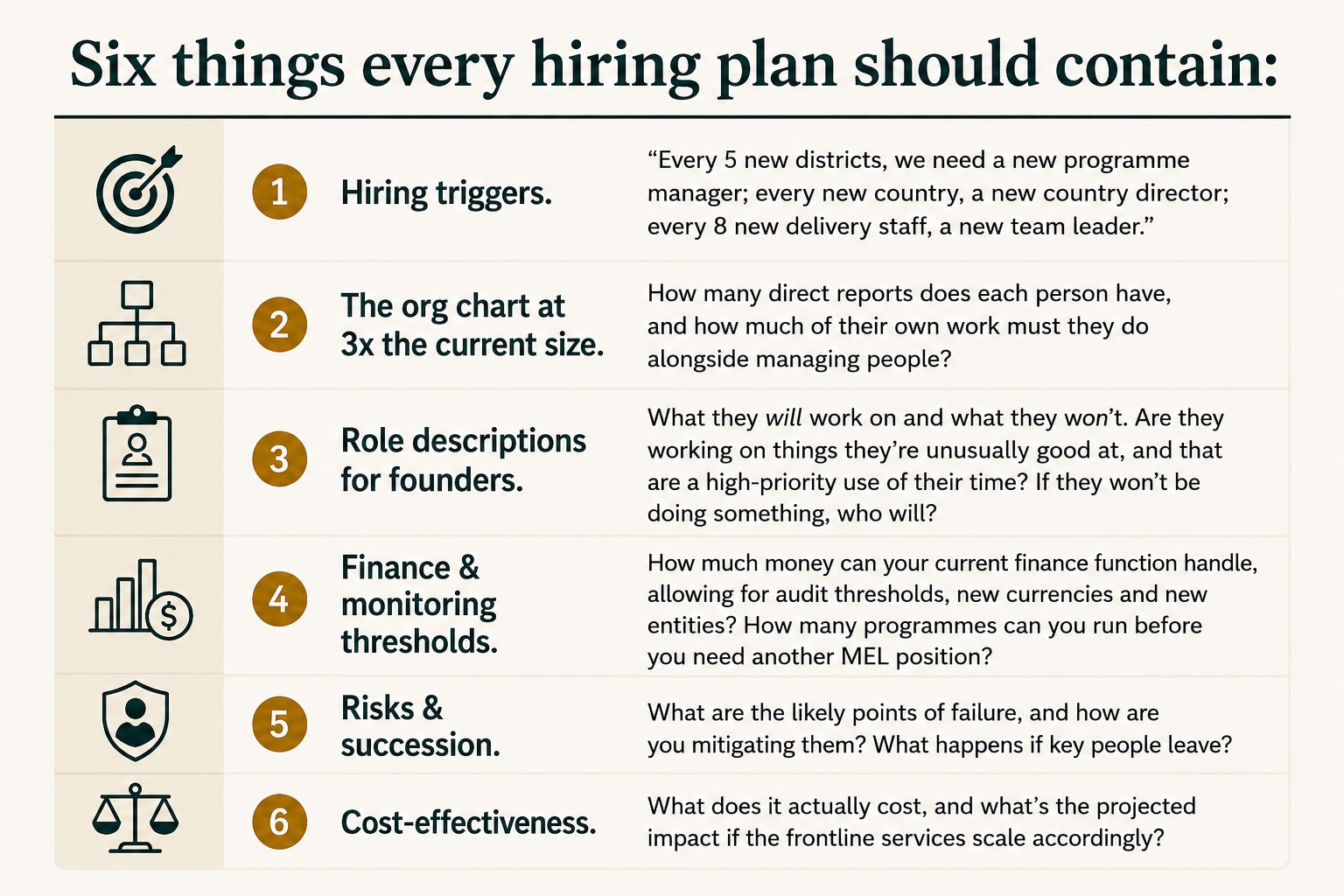
Instead, we want to see reasonable hiring triggers, a clear idea of the founders' roles and a thought-through future org chart.
In the wider charity sector, the biggest blocker is usually the optics of overheads. The average donor hates overheads and wants them arbitrarily capped.
This is less of a problem in EA, where we have embraced unrestricted grantmaking for a long time. However, the pressure on cost-effectiveness at small scale remains, and this tends to discourage adequate back-office hiring.
Founders have several jobs no one else can do - defining the vision and strategy, and securing the money and people to make it happen.
But the cost-effectiveness world pushes us to keep overheads as low as possible. So co-founders, often smart generalists, end up ‘teaching themselves’ the next thing that needs doing: bookkeeping, MEL, designing their randomised controlled trial (RCT).
This is usually a false economy. You can do the basics, but the second you need to add a million contraceptive doses to your accounting inventory, you're frantically asking Claude and hoping its advice is kosher.
Autodidact founders scaling back-office functions is usually a mistake. It costs their time, produces errors and takes them away from work that only a founder can do.
Interestingly, I do not see this problem in the existential risk projects I review for clients. These organisations tend to have robust back-office functions.
I think this is because of two factors. First, although I am sure many longtermist projects wish they had more funding, it has been relatively easier to get a large cheque out of longtermist funders. Organisations have often been able to get seven-figure funding (even nine-figure funding) very soon after being founded.
Second, the astronomical stakes of 'and then we save all future humans from extinction' means that there is far less pressure on short-term cost-effectiveness than in other fields. It's inconceivable that hiring a senior MD would seriously affect your expected value if you prevent humanity's extinction.
If, as I expect, we are about to enter a world of more abundant funding in neartermist cause areas, this directly loosens constraint one, and we should strive to loosen constraint two.
Accordingly, I think a new rule of thumb for animal welfare and global health interventions should be: if it's a profession and not your core skillset, buy the expertise, from a consultant, a firm or a new hire.
This shows up most often in finance, operations, HR, MEL - but also, the most neglected of all, people management.
Running organisations and teams is a profession. I’ve built staff teams twice, at School of Hard Knocks and One for the World, so I can say from experience: managing people well is incredibly difficult. It was consistently the hardest and most time-consuming part of my work.
A randomised trial in Indian textile firms also found that adopting structured management practices raised productivity by 17% in the first year. These were for-profit manufacturers, so adjust accordingly, but also see Nick Allardice, CEO of GiveDirectly’s, writing for sector-relevant material.
The title varies - Managing Director, Chief of Staff, COO, Executive Director, CEO, even Founders’ Associate - but the impact is the same: it pays to hire someone to make the organisation function.
Managing Directors run the project, directing people and systems, so the founder can concentrate on strategy, fundraising and externally representing the organisation.
Chiefs of Staff focus on delivery, keeping people on the right priorities and on schedule. They specialise in seeing a plan through from conception to completion.
Most founders aren't actually selected for their capacity to run a team or direct people's work. They excel at articulating a vision and convincing staff and money to back it.
So why don't more founders hire these roles?
One reason is status. Founders want to stay at the top of the org chart. When I see a founder with 10 direct reports, it's often because they want to remain 'above' all the directors and heads of functions.
That doesn't mean they should direct everyone's work personally. Managing Directors and Chiefs of Staff let founders keep their status without spending most of their time on line management. Hiring an MD is a 'silent promotion' - it frees founders to do the strategy, vision and fundraising that only they can do.
I've been that hire twice. School of Hard Knocks' founder took me on as their first employee; One for the World's volunteer founders hired me as the first full-time Executive Director while they stayed on the board, and we grew revenue 7x in 4 years. Both times, the founders kept the vision and the status, and the organisations grew because someone was paid to run them.
As a founder, ask yourself: "How will this project run when I only personally know one third of the staff?" It might seem fanciful, but it's entirely plausible that every grantee of our Mid-Stage Fund gets to $10m revenue in the next 3 years. At that point, the founders will have hired only a fraction of the team and will probably see the whole organisation together once or twice a year. This is a significant organisational change.
A second reason is fear of bureaucracy. Tech readers will hear this as 'manager mode', the thing 'founder mode' warns against. But that failure belongs to product companies; delivery charities fail the other way, with the vision intact but the service late or substandard.
However, I think the most common cause of underhiring is the desire to keep costs low to improve short-term cost-effectiveness. This is something that we can address as a community, likely improving medium-term impact.
I think so, yes, for three reasons.
One, cost-effectiveness bars are falling as more money comes online. Accordingly, the threshold for being 'fundable' is easier to reach.
Two, donors will adapt to this new reality. My hope is that this post accelerates that transition, but it will likely happen organically as the new reality becomes clearer (e.g. because donors see GiveWell making unprecedented grants to Top Charities, signalling the changing times).
Three, most importantly of all, because I actually think that it is more impactful to staff up properly.
Most cost-effective organisations only make sense at scale and their unit economics may not even work while small. The goal is to grow until they can compete with the most cost-effective charities in the world.
When I look at the valley of death in global health, I see very few charities that die there because they hired a handful of senior staff. I see large numbers that stalled because of burnt-out employees, inadequate risk management, lack of quality control or poor coordination - in short, just about all the reasons Nick lists here.
Scale can solve your overhead rate, but a low overhead rate can’t take you to scale. Imagine a senior Managing Director at US$200,000 per year. At $1m revenue, that’s 20% of the budget. At $10m, it’s 2%, and no one minds any more.
I'm not saying you can explode your budget next month. But, pretty soon, I expect a robust scaling plan will do more for your fundraising and delivery than a super lean model and outstanding cost-effectiveness.
And, even if you don't have the budget or scale to hire a senior executor right now, you can still set triggers for when you should. Triggers protect against both failure modes: hiring too early and overloading the budget, or overstretching the current team and hiring only when something breaks.
For donors: scrutinise your grantees' plans to scale (or hire an advisor - talk to us for a free recommendation). Ask for the org chart in 3 years' time and what the founders aim to be doing. Look out for anyone managing more than 8 direct reports (ideally no more than 5).
Be deeply sceptical of any organisation that says it can scale dramatically with a minimalist leadership and back-office team. (Be especially sceptical of anyone claiming their cost-effectiveness will go from 'competitive' to 'orders of magnitude better than New Incentives'.)
Most importantly, make it explicit that you'll pay for overhead - and that you're less likely to fund organisations that don't plan for it.
For founders: turn your scaling dream into a serious plan. Set hiring triggers in advance and map your operations, finance, HR and MEL needs as you grow. Budget a line for an MD, a Chief of Staff or both before you need it. Then get someone who's scaled something to red-team the plan.
For talented people: I hope many more of these roles are hired in the next year. If you're organised, ruthless at delivering and can manage people, put yourself forward. A great first step is joining High Impact Professionals' talent directory, so organisations can find you. (They also have an Impact Accelerator Program starting soon.) I think a lot of $1m organisations are about to become $10m organisations, and you can help them do it.
A quick non-exhaustive list:
The Funding Anthropalypse can buy programmes at ten times the scale. The cheapest thing it should buy is the people who turn those dreams into plans.
Jack Lewars is the founder of Ultra Philanthropy, an independent advisory that helps major donors give for maximum impact, and is the fund manager of its Mid-Stage Global Health Fund. He advises donors giving up to nine figures a year, and is Chair of Trustees at High Impact Athletes. Talk to him about your giving.

Thank you for this! In my experience, scalability is the difference between success and failure. Unfotunately it is rare to find organizations, particularly in the healthcare space, who can actually scale and maintain impact.