Comments
This is a super interesting exercise! I do worry how much it might bias you, especially in the absence of equally rigorously evaluated alternatives.
Consider the multiple stage fallacy: https://forum.effectivealtruism.org/posts/GgPrbxdWhyaDjks2m/the-multiple-stage-fallacy
If I went through any introductory EA work, I could probably identify something like 20 claims, all of which must hold for the conclusions to have moral force. It would. then feel pretty reasonable to assign each of those claims somewhere between 50% and 90% confidence.
That all seems fine, until you start to multiply it out. 70%^20 is 0.08%. And yet my actual confidence in the basic EA framework is probably closer to 50%. What explains the discrepancy?
- Lack of superior alternatives. I'm not sure if I'm a moral realist, but I'm also pretty unsure about moral nihilism. There's lots of uncertainty all over the place, and we're just trying to find the best working theory, even if it's overall pretty unlikely. As Tyler Cowen once put it: "The best you can do is to pick what you think is right at 1.05 percent certainty, rather than siding with what you think is right at 1.03 percent. "
- Ignoring correlated probabilities
- Bias towards assigning reasonable sounding probabilities
- Assumption that the whole relies on each detail. E.g. even if utilitarianism is not literally correct, we may still find that pursuing a Longtermist agenda is reasonable under improved moral theories
- Low probabilities are counter-acted by really high possible impacts. If the probability of longtermism being right is ~20%, that's still a really really compelling case.
I think the real question is, selfishly speaking, how much more do you gain from playing video games than from working on longtermism? I play video games sometimes, but find that I have ample time to do so in my off hours. Playing video games so much that I don't have time for work doesn't sound pleasurable to me anyway, although you might enjoy it for brief spurts on weekends and holidays.
Or consider these notes from Nick Beckstead on Tyler Cowen's view: "his own interest in these issues is a form of consumption, though one he values highly." https://drive.google.com/file/d/1O--V1REGe1-PNTpJXl3GHsUu_eGvdAKn/view
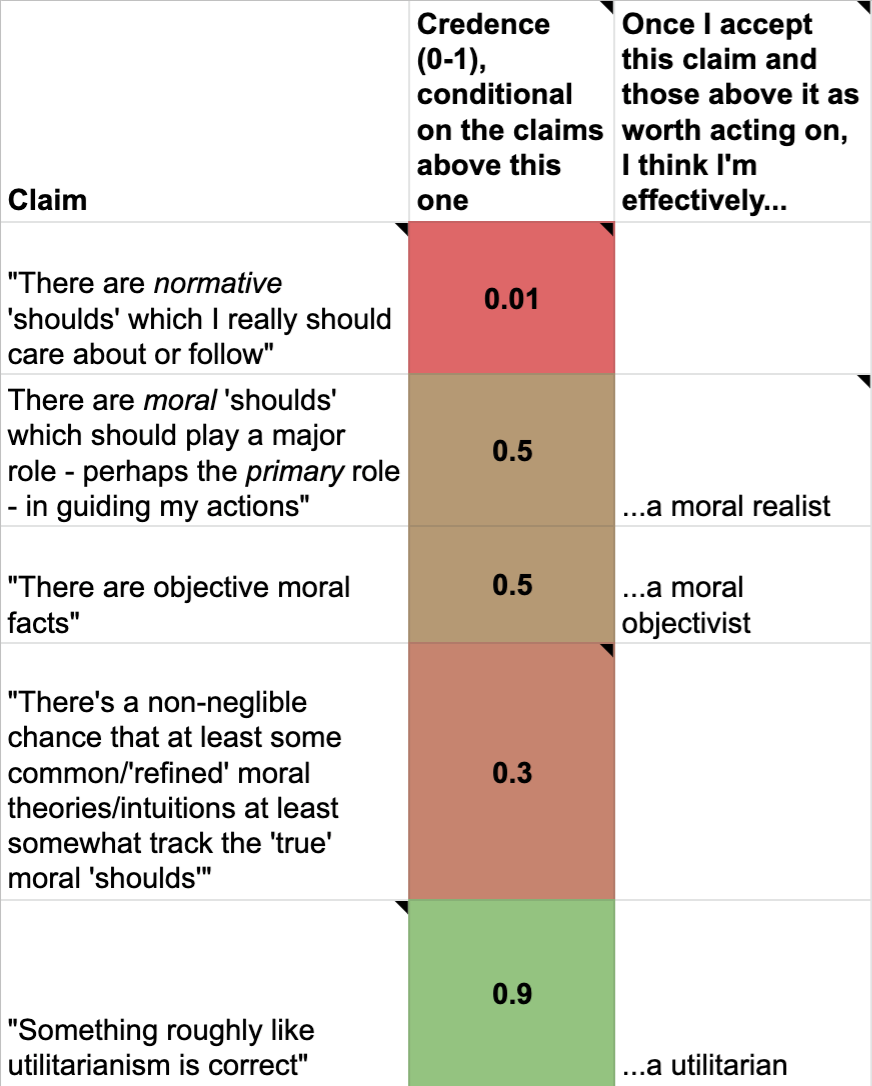
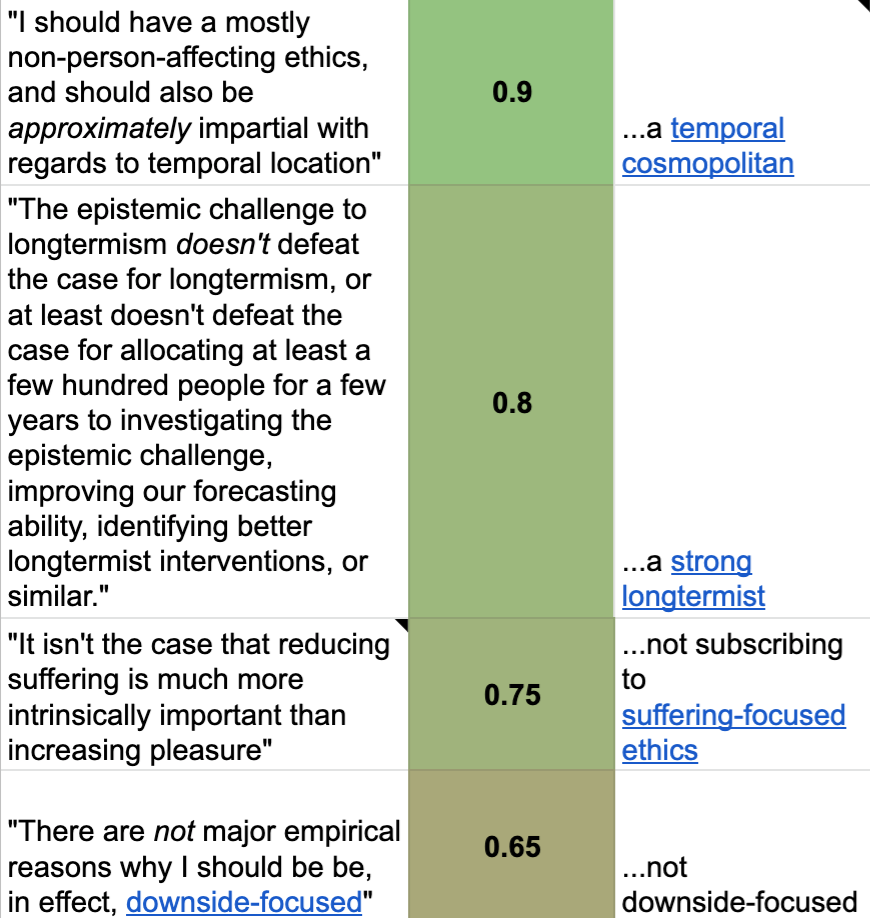
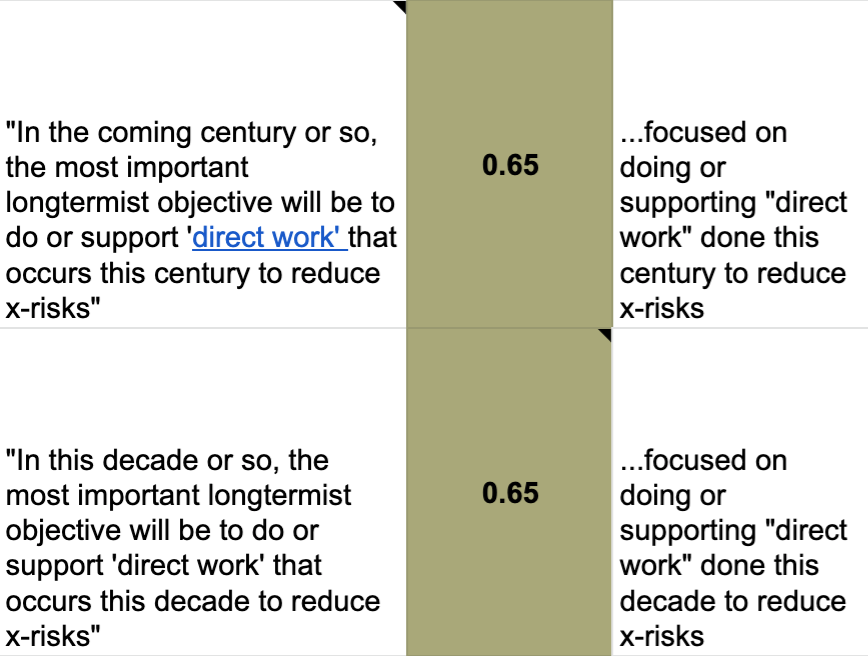


Thank you for sharing! I generally feel pretty good about people sharing their personal cruxes underlying their practical life/career plans (and it's toward the top of my implicit "posts I'd love to write myself if I can find the time" list).
I must confess it seems pretty wild to me to have a chain of cruxes like this start with one in which one has a credence of 1%. (In particular one that affects one's whole life focus in a massive way.) To be clear, I don't think I have an argument that this epistemic state must be unjustified or anything like that. I'm just reporting that it seems very different from my epistemic and motivational state, and that I have a hard time imagining 'inhabiting' such a perspective. E.g. to be honest I think that if I had that epistemic state I would probably be like "uhm I guess if I was a consistent rational agent I would do whatever the beliefs I have 1% credence in imply, but alas I'm not, and so even if I don't endorse this on a meta level I know that I'll mostly just ~ignore this set of 1% likely views and do whatever I want instead".
Like, I feel like I could understand why people might be relatively confident in moral realism, even though I disagree with them. But this "moral realism wager" kind of view/life I find really hard to imagine :)
I'd have guessed that:
Am I wrong about that (admittedly vague) claim?
Or maybe what seems weird about my chain of cruxes is something like the fact that one that's so unlikely in my own view is so "foundational"? Or something like the fact that I've only identified ~12 cruxes (so far from writing out all the assumptions implicit in my specific priorities, such as the precise research projects I work on) and yet already one of them was deemed so unlikely by me?
(Maybe here it's worth noting that one worry I had about posting this was that it might be demotivating, since there are so many uncertainties relevant to any given action, even though in reality it can still often be best to just go ahead with our current best guess because any alternative - including further analysis - seems less promising.)
Hmm - good question if that would be true for one of my 'cruxes' as well. FWIW my immediate intuition is that it wouldn't, i.e. that I'd have >1% credence in all relevant assumptions. Or at least that counterexamples would feel 'pathological' to me, i.e. like weird edge cases I'd want to discount. But I haven't carefully thought about it, and my view on this doesn't feel that stable.
I also think the 'foundational' property you gestured at does some work for why my intuitive reaction is "this seems wild".
Thinking about this, I also realized that maybe some distinction between "how it feels like if I just look at my intuition" and "what my all-things-considered belief/'betting odds' would be after I take into account outside views, peer disagreement, etc.". The example that made me think about this were startup founders, or other people embarking on ambitious projects that based on their reference class are very likely to fail. [Though idk if 99% is the right quantitative threshold for cases that appear in practice.] I would guess that some people with that profile might say something like "sure, in one sense I agree that the chance of me succeeding must be very small - but it just does feel like I will succeed to me, and if I felt otherwise I wouldn't do what I'm doing".
Weirdly, for me, it's like:
I think that this is fairly different from the startup founder example, though I guess it ends up in a similar place of it being easy to feel like "the odds are good" even if on some level I believe/recognise that they're not.
Actually, that comment - and this spreadsheet - implied that my all-things-considered belief (not independent impression) is that there's a ~0.5-1% chance of something like moral realism being true. But that doesn't seem like the reasonable all-things-considered belief to have, given that it seems to me that:
So maybe actually my all-things-considered belief is (or should be) closer to 50% (i.e., ~100 times as high as is suggested in this spreadsheet), and the 0.5% number is somewhere in-between my independent impression and my all-things-considered belief.
That might further help explain why it usually doesn't feel super weird to me to kind-of "act on a moral realism wager".
But yeah, I mostly feel pretty confused about what this topic even is, what I should think about it, and what I do think about it.
I'm actually not very confident that dropping the first four claims would affect my actual behaviours very much. (Though it definitely could, and I guess we should be wary of suspicious convergence.)
To be clearer on this, I've now edited the post to say:
Here's what I say in the spreadsheet I'd do if I lost all my credence in the 2nd claim:
And here's what I say I'd do if I lost all my credence in the 4th claim:
This might look pretty similar to reducing existential risk and ensuring a long reflection can happen. (Though it also might not. And I haven't spent much time on cause prioritisation from the perspective of someone who doesn't act on those first four claims, so maybe my first thoughts here are mistaken in some basic way.)
That seems like a fair comment.
FWIW, mostly, I don't really feel like my credence is that low in those claims, except when I focus my explicit attention on that topic. I think on an implicit level I have strongly moral realist intuitions. So it doesn't take much effort to motivate myself to act as though moral realism is true.
If you'd be interested in my attempts to explain how I think about the "moral realism wager" and how it feels from the inside to kind-of live according to that wager, you may want to check out my various comments on Lukas Gloor's anti-realism sequence.
(I definitely do think the wager is at least kind-of weird, and I don't know if how I'm thinking makes sense. But I don't think I found Lukas's counterarguments compelling.)