Comments
Thanks for sharing this, Luke, this is a great overview of what WAI's been up to! I love Fig 1 especially.
Thanks for sharing this, Luke, this is a great overview of what WAI's been up to! I love Fig 1 especially.
Hi Luke. Thanks for the great post.
I wonder whether you have any thoughts on how to integrate considerations related to welfare comparisons across species into WAWS. I think this is needed to assess whether effects on non-target animals can be neglected. I link some related posts in the 1st paragraph here.
Thanks, Vasco! In the long-term, I absolutely agree that accounting for impacts on all sentient animals is important. That is what we're trying to work towards, but we need to approach it gradually for strategic and practical reasons. WAWS needs to advance a lot on several dimensions before we will be able to meaningfully account for soil invertebrates, for example, in welfare impact assessments.
Allowing research and even limited interventions to go ahead without answering all of these questions should allow us to learn more, attract more interest to WAWS, and help normalize the ethics of considering all the animals who we aren't clueless about. In the meantime, we'll be working to reduce cluelessness about the most numerous and otherwise overlooked animals.
Thanks for the clarifications. They made sense to me. At the same time, I believe the most cost-effective ways of building capacity to help any given group of animals will generally be optimised with such animals in mind.

This post will summarize the trajectory of Wild Animal Initiative’s field-building for wild animal welfare science so far, along with patterns and indicators we want to see more of going forward. Beginning with an initial phase focused on establishing credibility and awareness of the field, through a second phase that has placed more emphasis on the distinctiveness and broad priorities of the field, we are now moving into a third phase designed to consolidate effort and encourage more projects to build on each other, enabling the field to make faster progress towards answers to key questions and potential interventions. This post also covers where our research funding has gone over the past few years and some of the field-building milestones we’re seeing.
Wild Animal Initiative (WAI) launched in early 2019 with the objective of establishing a mainstream scientific field dedicated to the practical study of wild animal welfare (hereafter referred to as “wild animal welfare science” or WAWS). We chose to approach the problem of wild animal suffering through scientific field-building because there were (and remain) many critical questions requiring empirical research before we could know that any wild animal welfare intervention or policy is having a net-positive impact. The study of wild animal welfare requires concepts, methods and skills from both ecology and animal welfare science, but at the time, there were very few scientists studying the welfare of free-living wild animals and there was little crossover between these fields in terms of projects, conferences, or academic programs. Although it would be possible to hire scientists from one of these fields and cross-train them to do research outside of academia (as indeed we do at Wild Animal Initiative on our research team), academic institutions provide a number of efficiencies, such as access to specialized laboratory equipment, field sites, agreements with publishers, and a culture of peer review. By funding academic research, we could take advantage of expertise and infrastructure all over the world, which would also allow us to reach more animals. By helping to coordinate WAWS into a recognized academic field, we could multiply the impact of the research we fund by making its importance clearer to other scientists and decision-makers, and by potentially attracting mainstream funding from universities and agencies to support more WAWS projects.
Our first challenge was establishing awareness and legitimacy of WAWS as a useful, scientifically compelling and tractable area of research. This would attract scientists from adjacent fields to integrate WAWS concepts and methods into their current research, providing experience that would reveal to them and us their level of enthusiasm and aptitude for long-term engagement with the field.
In those first few years, we emphasized areas of overlap with the adjacent fields of ecology, conservation and captive animal welfare science. We asked researchers in these fields to give WAWS a try. For ecologists that meant trying to interpret physiology and behavior in terms of welfare or measuring putative welfare indicators alongside their population and habitat-scale metrics, while for captive animal welfare scientists that meant developing welfare indicators for species with large wild populations or devising new methods to make captive-based welfare assessment methods feasible to apply in the wild. The support of Coefficient Giving, beginning in 2021, allowed us to launch a grants program and enable many more ecologists and captive animal welfare scientists the opportunity to try their hand at wild animal welfare research. This supercharged our field-building work. Beyond the handful of projects we could actually afford to fund, the prospect of receiving a grant incentivized hundreds more researchers to submit proposals engaging with the concepts and methods we wrote about and collaboratively advised them on.
As we started to see repeat grantees and increasingly relevant projects being proposed, we shifted emphasis away from encouraging researchers to ‘try’ WAWS by simply integrating it with their existing research programs, and increasingly emphasized the challenging priority areas and concerns that make the field distinct and will be necessary to inform responsible wild animal welfare interventions. See for example the text of our 2023 call for Seed Grant (<$30k) proposals or our most recent (2025) call for proposals.
As someone who has been with Wild Animal Initiative since the beginning (coming from a PhD in molecular ecology and working part-time on academic outreach at Animal Ethics), if you told me back then that this would be the state of wild animal welfare science in 2026, I would be thrilled. Especially in the past year, we have begun to see important external signals of field-building milestones being reached, including:
Our theory of change has always been centered on academic field-building, as we think that is the only way to get research done at scale with the credibility that will be required to bring positive policy attention to wild animal welfare (on that note, we’re excited to work with the new policy-focused CWAW!). However, academic field-building is only a means to an end, and ultimately we will only be able to improve wild animal welfare if the field produces quality research on impactful welfare issues.
Developing the science necessary to inform responsible wild animal welfare interventions that can meaningfully impact most animals is a huge, long-term endeavor, and most of that impact will be felt only after a sustainable, mission-aligned academic field is established. To that end, we have seen meaningful progress through our grants and internal research towards identifying priorities for further, more concentrated research to focus on. Broadly, we categorize these in terms of identifying factors impacting wild animal welfare, developing tools for assessing wild animal welfare at scale (necessary for monitoring & evaluating interventions), and scoping wild animal welfare interventions. I summarize some highlights from each category here, and you can see the broad sweep of WAI’s external grantmaking allocation in Figure 1 below.
Does diet mediate effects of sublethal parasitic infections on host welfare?: This project is primarily studying the impact of intestinal nematode parasites on wild mouse welfare and how that effect interacts with other risk factors. However, because it takes an experimental approach by deworming some of the mice in expectation of seeing a positive welfare impact, it could also be considered a trial of a wild animal welfare intervention.
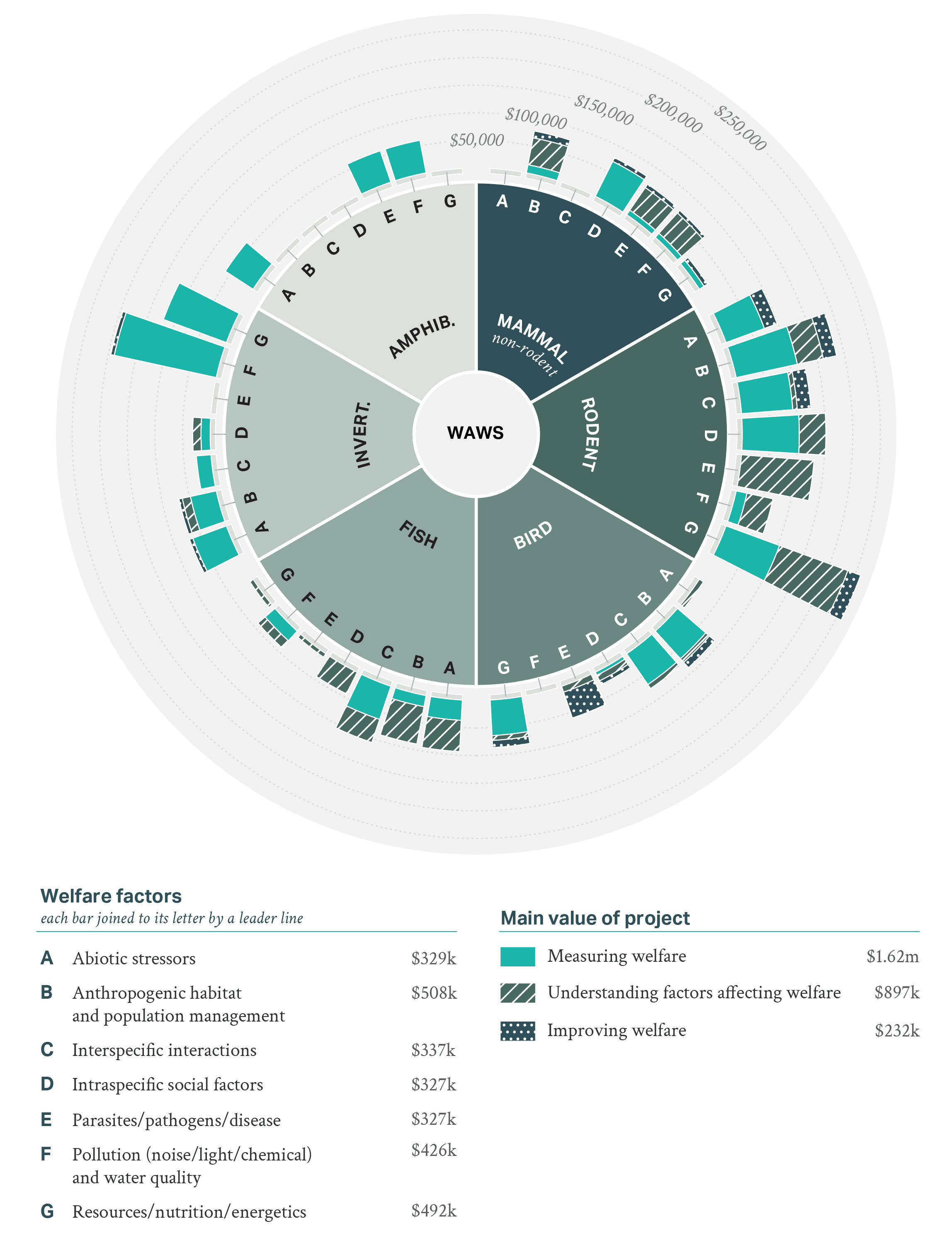
Figure 1: How WAI’s grantmaking has broken out across taxa (note that rodents are distinguished as a priority group from non-rodent mammals), project types, and welfare factor categories since our 2023 calls for proposals (which is when our metrics became more consistent). It reflects the consequences of some meaningful prioritization decisions on our part: 1) lots of funding to rodent projects; 2) significant funding to invertebrate projects and almost all of it to projects whose primary purpose is "measuring welfare" (because that remains the primary barrier to understanding and improving invertebrate welfare, even more than with other taxa); 3) generally diversified funding across taxa and welfare factors. These reflect our strategy of building and maintaining a broad field that is working towards a better world for all animals, while nudging its priorities towards the most numerous animals and the most important and tractable causes of suffering. Note that for projects that considered welfare factors from multiple categories, the budget was divided equally across those categories.
We are happy with the foundation of wild animal welfare research we’ve seeded over the past few years, and excited to see those projects’ results. However, as I alluded to earlier, most of our early grantmaking took a big-tent, experimental approach, emphasizing giving a shot to scientists who were new to the field (which was almost everyone at the beginning) and initiating projects on diverse species using diverse methods. There is necessarily a trade-off, and that brings me to the topic of what we haven’t optimized for up to this point but need to see more of going forward. We haven’t seen enough projects building on each other. I mentioned one standout example above, which is the project using machine learning to evaluate attention bias in wild fish. However, this is one of a handful of exceptions.
The long timescale of academic research is probably a huge factor. From the point when we fund a project, it usually takes months to start; sometimes because the principal investigator must recruit a PhD student or postdoc, or permits must be obtained. Then, the pace of many projects is limited by field seasons. Once the data is collected, the pace of analysis and writing is largely in the hands of the researchers, but it is challenging, often requiring coordination of a whole team of researchers who may have other projects or teaching responsibilities. Then, there’s the academic publishing process, which is genuinely inefficient (to put it mildly). The net result of this is that most of the projects WAI has funded have not published their results yet, and the ones that have are mostly from the earliest funding rounds, when we funded projects on the widest variety of themes and methods. Funding wide early was a strategic choice, since our first priority was introducing new people to the field and demonstrating its scope and relevance across many disciplines. However, all this means that there has been little opportunity for new grant applicants to build on or even learn about previous WAI-funded research unless they already collaborate with the relevant grantees. Moreover, each year we’ve received a larger share of projects focusing on abundant/neglected taxa and more important causes of suffering, and we’ve generally prioritized those over continuing to fund less impactful research directions. We’re really pleased to be seeing that shift and think we’ve taken the right approach so far, but we are approaching a pivot point. Ultimately, it is crucial for projects to build on each other and develop into deep research programs because actually improving wild animal welfare is such a complex, multi-step challenge.
If our initial priority of establishing mainstream acceptance of WAWS was phase 1 of WAI’s strategy (~2019-2023), and phase 2 involved emphasizing the distinctiveness of the field by leaning more into our priority themes while still focusing on growing the field (~2023-26), we are now entering a third phase. To accelerate progress improving wild animal welfare by building on this initial foundation of research initiatives, and to encourage long-term commitment to WAWS by reinvesting in the researchers who have demonstrated enthusiasm and aptitude for WAWS, the next phase of WAI’s strategy will emphasize the development of research programs over individual projects, and developing institutions through networks of researchers.
We have lots of plans and changes in store to address those objectives. I won’t share anything here that we aren’t prepared to share with the scientists in our network, but I can describe some of the most important changes that will be coming to our grants program when our next call for proposals launches this fall. Currently, we offer three main types of research grants that are primarily distinguished by their budget limits and competitiveness. We are now introducing all-new grant types, with much more specific purposes. These grant types will be offered simultaneously, but are designed to lead from one type to the next for any given research program or study system:
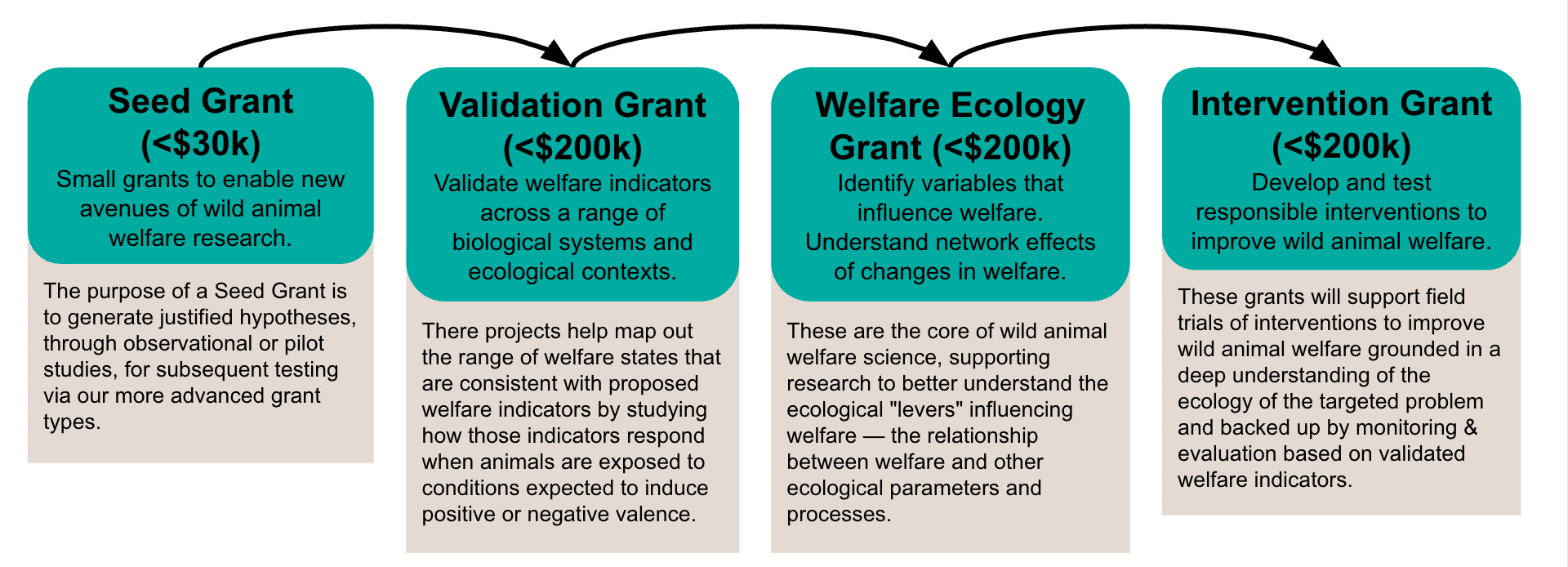
Figure 2: The progression path through WAI grant types. A grant applicant seeking to break ground on a new research program would first apply for a Seed Grant if their focal species and the welfare challenges they face are poorly understood. If the basic biology of the species is reasonably well understood, but it has not been studied in welfare terms in the wild, they may apply directly for a Validation Grant. If the applicant is already an experienced wild animal welfare scientist (based on publication record) and there are validated indicators for the proposed focal species (or close relatives), they may apply directly for a Welfare Ecology Grant. We expect that it will take multiple Welfare Ecology Grant projects (by the same or different teams) for most research programs to mature to the point where they can proceed to an Intervention Grant.
We will also be experimenting with ways to hasten the handover of new knowledge between projects, such as requiring grantees to commit to a timeline for publication (or at least pre-print sharing) and facilitating more small-scale meet-ups for researchers working on related problems (like this one organized by WAI grantees working on applying cognitive bias tests to wild animals). Investing in WAWS institutions, particularly research centers, could also help accelerate research feedback loops, since co-located wild animal welfare scientists should be relatively up-to-date with each other’s findings.
WAI’s first 7 years of field-building for wild animal welfare science has laid the foundations of a recognized and growing field (albeit one still almost fully dependent on WAI for funding). We have prioritized establishing awareness and legitimacy for the field, publishing research that articulates key concepts of the field, and awarding research grants that showcase the scope and priorities of the field while giving scientists from adjacent fields an opportunity to incorporate wild animal welfare into their personal research programs. A trade-off of this approach is that research has been less concentrated towards any single breakthrough or intervention. However, we are already seeing this pay off in terms of a broad base of interest and support for wild animal welfare science. Our grants have seeded many compelling avenues for further development, and we think the field has reached a stage where WAI-funded research effort can become more consolidated into projects that build on one another. This is a tactical evolution to help ensure the coordination-related benefits of an academic field are actually realized in terms of research towards the most pressing and action-relevant questions.

I find this a poor account of progress for an organisation that has received such substantial funding over seven years.
This post acknowledges that most funded projects have not yet published results, projects have rarely built on one another, and WAI does not currently have the evidence and measurement tools needed to test any WAW intervention. So, WAI cannot yet point to any animals whose welfare has improved as a result of its work.
I get that direct impact was never the immediate objective. But ‘field-building takes time’ surely has a limit. After seven years and many millions of dollars, I would have expected at least some changes in wildlife-management practice or interventions ready to go.
Phase 3 appears designed to correct weaknesses in the previous approach. WAI is only now introducing a way for seed ideas to become actual interventions. Perhaps the eventual benefits will justify the investment. For now, the case for WAI’s cost-effectiveness appears to depend almost entirely on highly speculative future impact.
Millions and millions in funding every year, no animals helped yet, and no clear plan for reducing animal suffering in some kind of quantifiable way. Instead, the promise is that future work will ‘help [to] ensure [that] the coordination-related benefits of an academic field are actually realized in terms of research towards the most pressing and action-relevant questions.’
What am I missing. How does this meet EA’s bar for cost effectiveness?
(I don’t work at WAI anymore)
Not addressing your question, but asking to try to better understand your perspective: don’t the points you’ve made here roughly apply to cultivated meat as well (which many agree is a legitimate EA cause area, and also you seem to personally endorse it)?
I know saying “my cause area is wasting money but hey yours is too” is not an effective argument; that’s not what I’m trying to do. But I think if I understood why “millions spent, no animals helped yet” doesn’t apply, in your view, to cultivated meat I’d better understand the root of our disagreement.
That's... a good point! Well, with cultivated meat, you can see the path to the upside clearly. WAI may have an enormous theoretical upside too, but at present the achievable welfare gain from any research programme is much harder to quantify.
The rough equivalent would be if cultivated meat didn't already exist, and we were still in the stage of 'we're spending millions building the field of researchers to perhaps develop some component of an ingredient that might be added to other speculative ingredients that might lead to the intervention of a cultivated meat product which might, at some point, displace slaughter meat'. Then I wouldn't be too hot on cultivated meat either, but that's not where we are. The product exists. It has already cleared regulatory processes in several countries and reached consumers, and we can measure progress on things like cost, scale, production efficiency and commercialisation. And there are major non-animal-welfare reasons pushing in the same direction - climate, food security, AMR, and so on.
So I think my objection isn’t inherently 'millions spent, no animals helped yet.' You're quite right that this could also be said of cultivated meat. It’s millions spent, while after seven years things still seem very far upstream from a specified, testable intervention and measurable animal impact. Even more bafflingly, WAI is often recommended as among the most cost-effective ways to help animals. How?
IIRC, EA began seriously funding cultivated meat in 2016-17, when it was still very woo woo - but the intervention at least existed. I can’t imagine EA putting millions into cultivated meat before there was a concrete intervention to get behind, funding researchers to explore questions in the hope that something actionable might eventually emerge at some unspecified point.
Okay cool, that’s helpful. It seems like the root disagreement is not whether research is ever worth funding, but how clear the research —> impact path should be, and perhaps how short.
My guess from this/reading your other comments is that ~ 2 major things underpin a difference between you and I in terms of excitement about WAW/WAI. Both connect to the fact that cost-effectiveness is always a comparative claim. So on the one hand, I probably rate WAWS as more cost-effective to promote than you do, but importantly, I also rate other things as less cost-effective than you do (making the bar easier to clear).
Towards the latter point: I care a lot about indirect and unintended effects of interventions on all sentient beings. This means that, without a good understanding of ecology and WAW, the cost-effectiveness of the vast majority of potential animal welfare interventions is basically not knowable. For a variety of reasons connected to (what I view as) the failure of the taste/price/convenience model, I don’t have that much confidence that merely inventing cultivated meat will be enough to change diets. But even if it was, I don’t have any idea exactly how those diets will change (small animal replacement problems), or how the resulting land use changes will affect wild animal welfare. I’m pretty consequentialist in my ethics, so I’m not comfortable helping some farmed animals at the expense of billions to quadrillions of wild animals. As someone who hates factory farming this is a hard place for me to sit, and I’m probably not ethically pure on it — I still am vegan and support farmed animal advocacy financially. But in response to the uncertainty about how shrimp stunning, cultivated meat, vegan advocacy, etc. affects wild animals, the only thing I can see to do is research it, and my calculations of cost effectiveness of those other activities is correspondingly really really wide, making research a cost-effectiveness-competitive thing to do.
My guess is that you don’t share this view at all and may even think it’s sort of dumb! That’s fine, but arguing about whether WAI in particular is cost-effective won’t help us make progress on this disagreement (which I think is also the source of disagreement between you and the vast majority of other people who are excited about WAWS). Instead, if you wanted to change my mind that WAI was a good giving opportunity, you’d need to show me that I should not care about the effects of land use change resulting from factory farming elimination or cultivated meat production on wild animal welfare (among a variety of other things).
The second source of disagreement is how much the sort of field-building work WAI does leads into interventions, and how soon. Using cultivated meat as a benchmark: yes, we already have cultivated meat, but we have no way to produce it cost effectively at scale. I’m not a cultivated meat expert, but barring some kind of revolutionary development I would assume that we’re more than 5 years away from scaled cultivated meat deployment? If that’s right, there are definitely interventions in WAW that could realistically be available on that timeline. We already have a variety of contraceptive products that work in the lab for rodents. I’m in the middle of designing a targeted research program that (I hope) will get us to the point of a cost-effective, scalable deployment within 5-8 years. Similarly, I’ve designed a research agenda that I believe, within ~ 3-5 years of research, maybe less, could answer to a degree of confidence I’d be willing to act on whether bird-window collision prevention is net positive to promote. Another angle I’m pursuing is wildlife vaccination — it might not pan out, but if it does, I would expect to be ready to recommend an intervention within no more than 10 years. Whether that’s good enough probably depends on how quickly you think other interventions will start benefiting animals; you might think cultivated meat replacement will be here in much less time than I do.
Connecting this back to WAI: although I’m not doing this work at WAI, none of it would be possible without WAI. My work there and the field-building work they’ve done give me the tools I need to do this more intervention-focused research, and the research WAI does/supports is the substrate by which these ideas have been generated. If the work I’m doing now continues to make progress, I’ll need scientists who get the basic ideas to carry it out. And once I rule in/rule out the ideas I already have, I’ll need there to have been more research in the meantime to support more ideas and ways to help animals.
None of this is that dissimilar to what GFI does for cultivated meat. If I understand correctly, the product didn’t really exist before EAs got into it, and a huge amount of EA and animal advocacy money went towards not just object level research but building university groups so there would be a talent pipeline, lobbying to make more money available, etc. And WAI is working on a harder problem at an earlier stage, so things are a little slower/less tractable, but the scale is commensurately higher.
I don’t really expect you or others with values focused on shorter timelines/direct effects only to be convinced — I think it’s fine for EAs to differ on what they mean by “cost-effective.” Some people want “strong evidence for immediate-ish impact” and others want to take a bunch of high risk, high reward bets and expect that at least a couple pan out. Both are legitimate investment strategies, and WAI is likely to be most appealing to people who (1) are very worried about indirect effects or (2) prefer the latter cost-effectiveness definition.
I wouldn’t say that I require short timelines or immediate effects. If that were the case, I wouldn't support cultivated meat. I understand the argument for funding very speculative work where I can see the causal chain from research to an intervention with enormous potential impact. My concern with WAI is that they are still trying to discover both what the relevant welfare problems are and what interventions might eventually follow from understanding them. This seems to me an absurdly vague proposition for the level of funding involved.
You seem to find value in producing knowledge in an enormous, neglected domain because unknown future interventions could be extraordinarily valuable. Whereas I want more evidence that the knowledge-production process - or any other strategy - is actually converging on interventions. Until then, the theoretical upside is too abstract for me to treat it as competitive with cultivated meat, because the latter is at least clear and in existence.
And it existed before EA got involved. I think it was around 2013 that the first cultivated meat burger was tried - it was an extremely crude, mega expensive proof of concept - but nevertheless a tangible starting point. Meanwhile WAI is seven years in with no concrete interventions on the table.
A quick question I have for you; at what point would you decide that WAI isn’t worth funding anymore?
Hi Siobhan, I think the key question is how morally valuable an objective you consider improving wild animal welfare to be, and why. “Why” because if someone only cares about reducing the most obvious negative human impacts on wild animals, then field-building is probably not worth the effort. However, if they want to prevent animals dying from botulism in heatwaves, regulate wild animal populations via fertility rather than mortality, or do anything for wild fish and invertebrates, then the cost of building a scientific field is likely unavoidable. To your suggestion that WAI’s field-building is limitless, I will just link back to my reply from last December: https://forum.effectivealtruism.org/posts/kizAAxyNkDtwShEJ2/wild-animal-initiative-when-does-research-become-impact?commentId=WHsgMhniyfKJNtrmM.
I think my post addresses a lot of your specific criticisms here. It not only acknowledges, but explains why "most funded projects have not yet published results" (all but the earliest-funded projects are ongoing) and why "projects have rarely built on one another" (we chose to fund projects on a wide variety of taxa, welfare issues and assessment methods early on to prioritize learning and establishing the field). If you disagree with those explanations or the choices involved, I'd be happy to consider alternatives.
Similarly, re: "Phase 3 appears designed to correct weaknesses in the previous approach." - that is true, but in the sense that every approach has its weaknesses and its strengths. Our theory of change has always involved multiple phases, and it makes sense that our tactics would change with those phases. If we had launched in 2019 with the kind of posture we’re adopting in ‘phase 3’, we might have more short-term, small-scale interventions to show for it, but we would have been less successful at building a respected field, and we would not have connected with most of the people who are now spearheading WAWS academic institutions and beginning to bring some mainstream funding to WAWS. We would not have received that invitation to curate a special issue of ICB seven years ago, or even three years ago (when the earliest of the grants featured in Figure 1 were awarded). This is the sort of signal and opportunity that has caused our tactics and emphases to evolve through the phases outlined in this post.
I think I’m getting lost in the intermediate outcomes. I understand there are signs that you’re succeeding at building the field. But I keep coming back to a basic question: what is the causal pathway from this work to animals actually being better off? I’m struggling to identify it beyond 'a stronger field may eventually discover interventions', and I find that difficult to evaluate against alternative uses of the funding.
I’m also not sure the examples you give make the case for building an entirely new academic field as strongly as you say. Avian botulism, wildlife contraception, fish welfare etc appear to already be established areas of research to varying degrees; what seems novel is applying a welfare-oriented lens. That makes me wonder why the right response is to build a new field at substantial cost, rather than fund targeted intervention development using knowledge that already exists in adjacent disciplines.
So no, the key question for me isn't how important I happen to think WAW is in general. It's 'how have animals benefitted so far, and if not at all yet, then on what sort of timeline can we expect concrete outcomes, and at what further cost?'
Apologies if this is naive, but how much funding has wild animal welfare as a cause area received in total? And how does that compare with other sort of pre-intervention causes? Just curious to understand your point about millions given in funding every year better.
Separately, is it possible that progress here (if not bottlenecked by the hardness of the problem), is bottlenecked by talent? My understanding is that less than <30(?) people work on this full time and there are major sub-areas where people are sorely needed. Of course, that doesn't undermine your main point, but it might be useful to figure out why the cause area seems stuck.