Comments
Thankful for you taking my LW post seriously and thinking through its implications! I'm glad that it was intellectually productive for you.
Thankful for you taking my LW post seriously and thinking through its implications! I'm glad that it was intellectually productive for you.
Thanks! I appreciate this. Not a criticism of your post, but a note across this topic: It seems to me that there is not enough sketching of the funding timeline(s) and forecasting of how it may actually occur in real time. How much money will come after the six-month period of an IPO? How confident do we feel about that? Why might more money actually come over a longer time period, etc.
I think the strongest part of the argument is the emphasis on robustness rather than requiring grantmakers to predict AGI correctly. Even if the timelines are substantially longer, identifying projects that remain valuable across both worlds seems like a sensible portfolio strategy. I also like the suggestion that non-AI grantmakers should build enough AI literacy to recognize important inflection points without necessarily abandoning their existing causes. The difficult part is probably avoiding both complacency and overreaction when the evidence is still highly uncertain.
Epistemic status: Wrote this pretty fast, probably ~70% confident some version of the thesis claim is true, would welcome being proven demonstrably wrong.
Context: I’m a grantmaker focused on alt-protein and am fairly well-connected/moderately in the loop of what animal welfare grantmakers are doing.
This post was significantly inspired by “You (Yes You) Should Have A Feb 2020 Checklist For AI Policy,” which is more geared for the existing AI safety crowd but directionally a good push in general.
Thesis: I think EA non-GCR grantmakers should probably be doing more to prepare for AGI/TAI than we are, and might be on track to get caught with our pants around our legs within the next few years. We are not acting as if we’ve priced it in.
TAI Soon
Short timelines to AGI/TAI seem very plausible (like, at least 50% chance of arrival in the next 1-6 years). Points of evidence include:
The Good
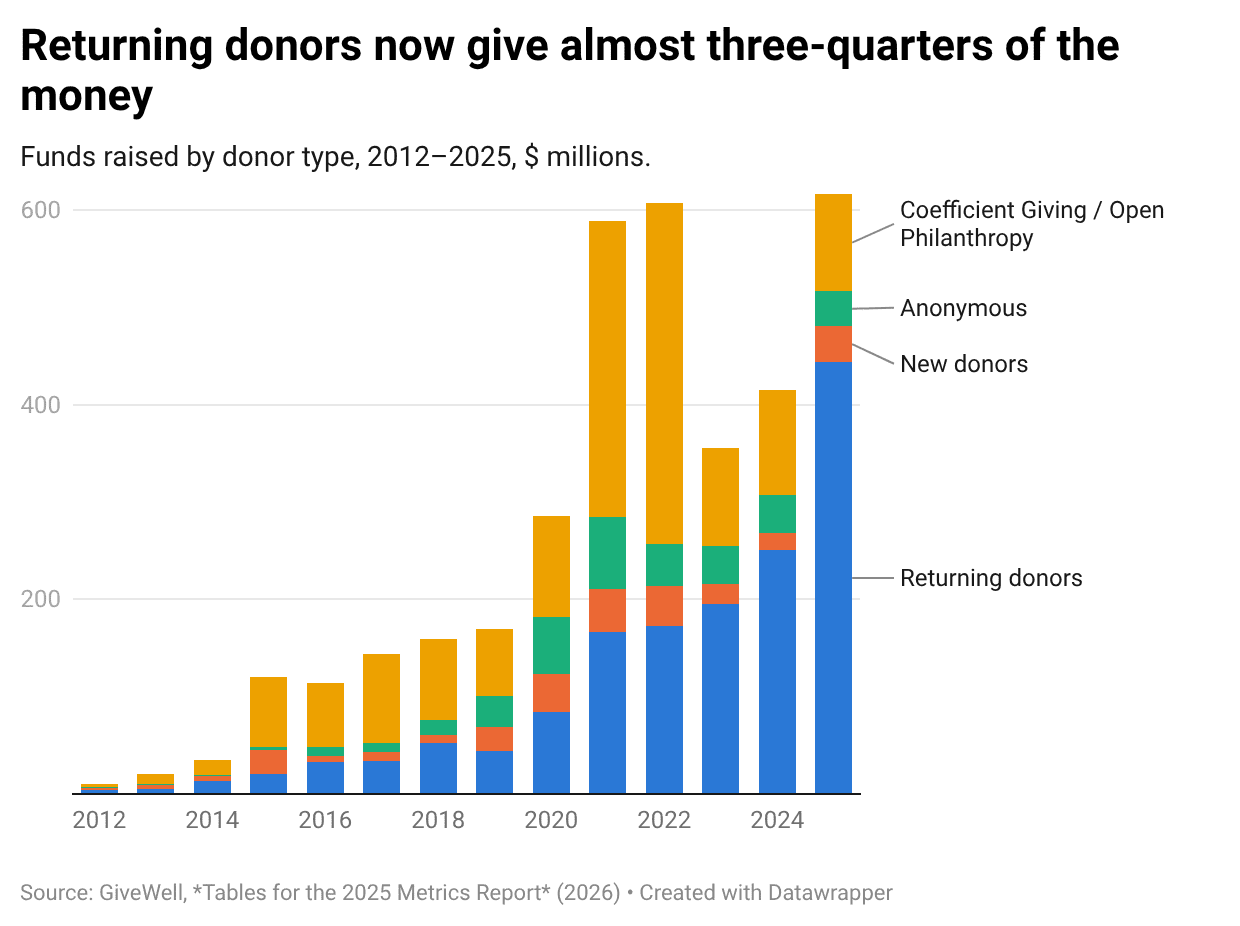
My rough qualitative sense is that the thing we’re doing best at is preparing/hoping for a very crazy amount of funding to come online for all EA cause areas post-Anthropic IPO.
The Less Good
The things we are doing worse at is everything that is not encompassed by “ooh shiny what if we all have tons of money in a year.” There’s probably some point here about people’s epistemics, like obviously this type of discourse gets more people excited and has more memetic spread as a result. I think there’s probably also some general cognitive dissonance and motivated reasoning among non-AI people to stay in denial/not wanting to really believe that things could get completely crazy and scary.
What are we not doing that we should be? The one sentence version is: we are still mostly not pricing in the possibility that AGI will radically change the underlying facts of our non-GCR cause areas and updating our strategy accordingly.
Basically this is an expected value argument. If you seriously think there’s a meaningful chance (25-60%) of TAI within the next five years, there’s almost certainly some very high EV things you can do now to lay the groundwork better for those worlds.
The idea that we can forecast events that totally shift the ground under us (for good or bad) has mundane precedent for it. Global health and climate philanthropy collectively across 2023-2024 did not accurately price in the ~50% chance of a Trump 2024 victory and what Trump 2.0 would mean. As a result, these communities mostly (with some exceptions) got caught with their pants around their ankles when USAID and most of the IRA got deleted (though I do mostly buy FP’s glass half full take about the IRA).
What To Do
Here are some very rough but concrete suggestions for non-AI grantmakers based on all of this (note, all of these assume you’re not planning to pivot to working on AI safety in the next 6-12 months):

This all seems right and locally reasonable, but it also just seems very weird and confusing to me to update massively towards short AI timelines but not reconsider whether you should be a grantmaker in a different space (i.e., in a space more related to making transformative AI go well).
Agreed! I’ve been thinking about this a lot for myself the last few months and I think others should be considering it too. I wrote this piece more as, “conditional on you not planning to switch, you should at least do the following."
I think it’s unlikely that lots of GHW or animal grantmakers switch to working on AI, mainly because grantmakers have a comparative advantage in their existing field and are arguably worse positioned to be an AI grantmaker compared to hiring someone with years of experience out of an existing AI non-profit, plus various personal identity & organizational reasons.
At the same time, I think there's probably loads of alpha on the table for GHW/animals that we’re on track to leave on the table in the status quo.
Also very aware that maybe on some level, this is all still a form of being in denial even if it's a Pareto improvement, idk.
Even if you can't be an AI grantmaker, it seems quite plausible you could do something else that would be more helpful for AI than being a grantmaker in another area (which could be actively counterproductive for AI since you might be distracting funders from funding AI safety to funding other causes that aren't very important if timelines to ASI are short).