Executive summary: The author offers five experience-based proposals for improving development charity work in 2026—ranging from reducing car use to lowering NGO salaries—arguing that many current practices are inefficient, distort local systems, and undermine long-term, cost-effective impact.
Key points:
The author argues that NGO car ownership in low-income countries is usually economically inefficient, socially distorting, and sets unrealistic norms compared to cheaper alternatives like public transport or motorbikes.
Short-term, time-bound projects are criticized as inefficient and sometimes harmful, with the author arguing charities should instead fund long-term solutions delivered by organizations that do one thing well.
The author claims cost-effectiveness analysis should be standard in development sectors and suggests EA has positively influenced wider donor attention to cost-effectiveness.
Donor funding should be bimodal, focusing on small-scale testing of new ideas and large-scale funding of proven interventions, rather than large unproven projects.
The author argues that high NGO salaries reduce cost-effectiveness, distort local labor markets, and pull talent away from government and business, and suggests paying closer to market rates.
The post emphasizes that these recommendations are not universally applicable but reflect practical lessons from the author’s on-the-ground experience in development work.
This comment was auto-generated by the EA Forum Team. Feel free to point out issues with this summary by replying to the comment, and contact us if you have feedback.
I would like to share one agreement and one disagreement and would love to hear your thoughts
Agreement: Fund solutions not projects - I strongly agree with this framing and I fear that the project-centric approach to fundraising has caused NGOs to also have a project-focused mindset to trying to reach its objectives. The Wicked Problems of global health and development required long-term, systemic and integrated solutions across a range of private, public and civil society actors that are unlikely to drive long-term meaningful change through singular projects. While I believe that we can make real impact through marginal, cost-effective, long-hanging interventions (perhaps fortification of food staples :P), a solution mindset helps align thinking and incentives.
Disagreement: Lower salaries - I find similarities in your argument to the more common "funding overheads" argument which is where my initial disagreement stems from. In reading beyond the headline, I would actually agree that if NGOs are paying multiples more than comparable private or public sector roles then this can have a fundamental distorting effect on the labor market and may be attracting talent for extrinsic, short-term motivations which could be very problematic.
However, at least from my experience in the Indian NGO space, I have not seen the scenario that you lay out with NGO workers getting paid so much more. I wonder if this is something systemic to the Ugandan context or other more narrow context.
Personally, I am in favor of seeking to align NGO salaries with overall labor market salaries - whether that means increasing or decreasing the benchmarks. I don't think that the pricing in of intrinsic motivation or altruism is an effective salary-structure approach, especially once organisations pass beyond the "R&D" mode and start meaningfully growing and seeking general talent from the labour market.
I think the situation is likely to be different on the salary front in India compared with Sub-Saharan Africa. Its definitely not just Uganda, but pretty consistent across East Africa at least and I would be pretty confident the situation is the same in West and Central Africa too.
I think your "align NGO salaries with labour market salaries" is actually a better framing than my "pay your workers less". I never suggested pricing in intrinsic motivation. I just put "lower salaries" because in 12 years I have never seen NGO salaries below the market here. See my comment from the article "Fortunately great workers are usually happy with a little more than the market rate,"
I don't really see the connection of my salary argument to "overhead discussion. What similarity do you see?. On that note I don't really like or even fully understand the concept of "overheads". Isn't it just part of the cost of what we do? People also define overheads wildly differently. The only thing I don't like is when people don't consider overheads as part of their total costs of operation or separate "out of country" and "in-country" costs. Its all just costs.
Fair points, all well made and is so often the case, I think we are actually in vast agreement.
Sorry for not being clear on my analogy to overheads. The discussion of 'overheads' often feels to me like a proxy for a larger, ethical discussion on whether intrinsic motiviation for charity work should be priced into the finances of an organisation. I agree whole-heartedly with you and disdain the 'overheads' framing for evaluating the financial health and financial models of organisations. Similarly, I don't think intrinsic motivation should be priced into team member pay, and I understand you feel the same way.
Upon reflection on this discussion, I am trying to think through reasons why we observe different labor dynamics in the NGO-space in parts of Africa as opposed to what I have observed in South Asia and the West. Perhaps the labour markets in these various African markets have been distorted by international funding with significantly greater purchasing power parity. In India, we observe that most NGOs are significantly funded by local sources of funding meaning that the funding dynamics are somewhat calibrated to existing, domestic market forces. Would be interested on your experiences and why you believe you see these multiples of salaries in your local context?
Yeah I'm not sure we're disagreeing on anything here really lol.
Wow I knew NGOs in India had local funding, but that its significant enough to mean that NGO wages are similar to the local economy is pretty great. Go geneorus Indians. Labour dynamics in Africa are a conundrum to economists in general, and I don't have great answers I'm confident in. What's for sure is that in general wages in the formal sector in Uganda are weirdly high and its not fully understood.
"Why, when I run a survey in rural Uganda, do youth with the same education and experience expect a wage three to four times higher than the youth I worked with in India?….. Neither the government or NGOs, moreover, seem to set wages according to the local market or local conditions..."
I think a big part of the reason is that much of what's considered the "formal" sector here is basically a tiny false economy. A small group of entities which include the government, foreign companies that collude with govt (Oil companies, banks, tourism) and NGOs pay weirdly high salaries. This means there is a weird bubble where salaries are far higher than the vast majority of people (85%-90%) who work within the real local economy. Everyone working in this informal sector wants a "salaried job" because that basically means they get to enter the false, bloated economy.
This phenomenon has consequences outside of the NGO sphere too, such as absurdly high oil prices, and banks having both the highest fees and profit margins in the world, while locals suffer. There's also almost no correlation between wages and productivity in this fake sector of the economy.
In the NGO sector, a decent part of the reason for absurdly high wages is because of Western Guilt. Here unlike India there are often (or usually) Westerners working alongside locals in NGOs, with the Westerners earning western salaries. They then feel like local pay should be kind of close to theirs. In the capital Kampala this is often the case with NGO office staff often on close to Western salaries. My solution is that the one case where there should be an "altruism tax" is when Westerners work here - they shouldn't be on western salaries. This in practise will mean that fewer westerners will be willing to work. I don't think this is bad, there's oodles of local talent and experience here that can manage just fine most of the time.
This is a much-needed perspective for 2026. With funding challenges increasing, it’s more important than ever to rethink how charity work is done. When people choose to donate smarter and support sustainable solutions instead of short-term projects, the impact can be far greater and long-lasting.
Thanks for sharing this. Really appreciate the solution-focused lens on a system that clearly needs rethinking. I recognize and mainly agree with the points you raise.
For context, I’ve spent about six years working in an international NGO, primarily living and working in Sub-Saharan Africa. I’m currently with a small, EA-aligned organization that already seems to implement many of the practices you highlight.
One possible addition to your list (though I realize it may be less immediately “doable”) is a deeper engagement with decolonization in charity/NGO work, and greater awareness of white saviorism as a systemic issue.
Coming from a European background, and often working outside my own cultural context, I try to stay conscious of how my position and biases shape what I see as “effective” or “good.” For example, while I strongly value cost-effectiveness analysis, I also started realizing how it can operate through a “white gaze”: Western actors defining what counts as valid knowledge, success, or impact using our own metrics, potentially marginalizing local ways of knowing and prioritizing.
Reading “White Saviorism in International Development” helped me reflect on potential blind spots within the Effective Altruism movement itself. Ideas like Giving What We Can, to help others because being in the global top X% of earners, can sometimes unintentionally echo white-savior dynamics in how the motivation for giving is framed primarily from the perspective of Western privilege.
I’m not suggesting we abandon these concepts, but I do think they might benefit from more critical reflection. Intellectual humility requires us to acknowledge that we have blind spots that are, by definition, difficult for us to see.
For anyone interested in exploring this further, I can recommend:
White Saviorism in International Development: Theories, Practices and Lived Experiences, edited by Khan, Dickson, and Sondarjee
I’d be curious to hear your thoughts on how impact-driven approaches can better integrate self-awareness, and decolonial practice without losing their strengths around rigor and effectiveness.
(I've started a substack, so a few more people might encounter my spicy takes - I'll still mostly be here.)
USAID is gone. Direct country aid to low income countries is down 25%. So now’s a great time to share five ways I think development charity can be done better in 2026.
To state the obvious... none of these ideas will be the best approach all of the time, there’s plenty of grey area and nuance. I start a little playful, then get a little more serious.
1. Ditch the Cars
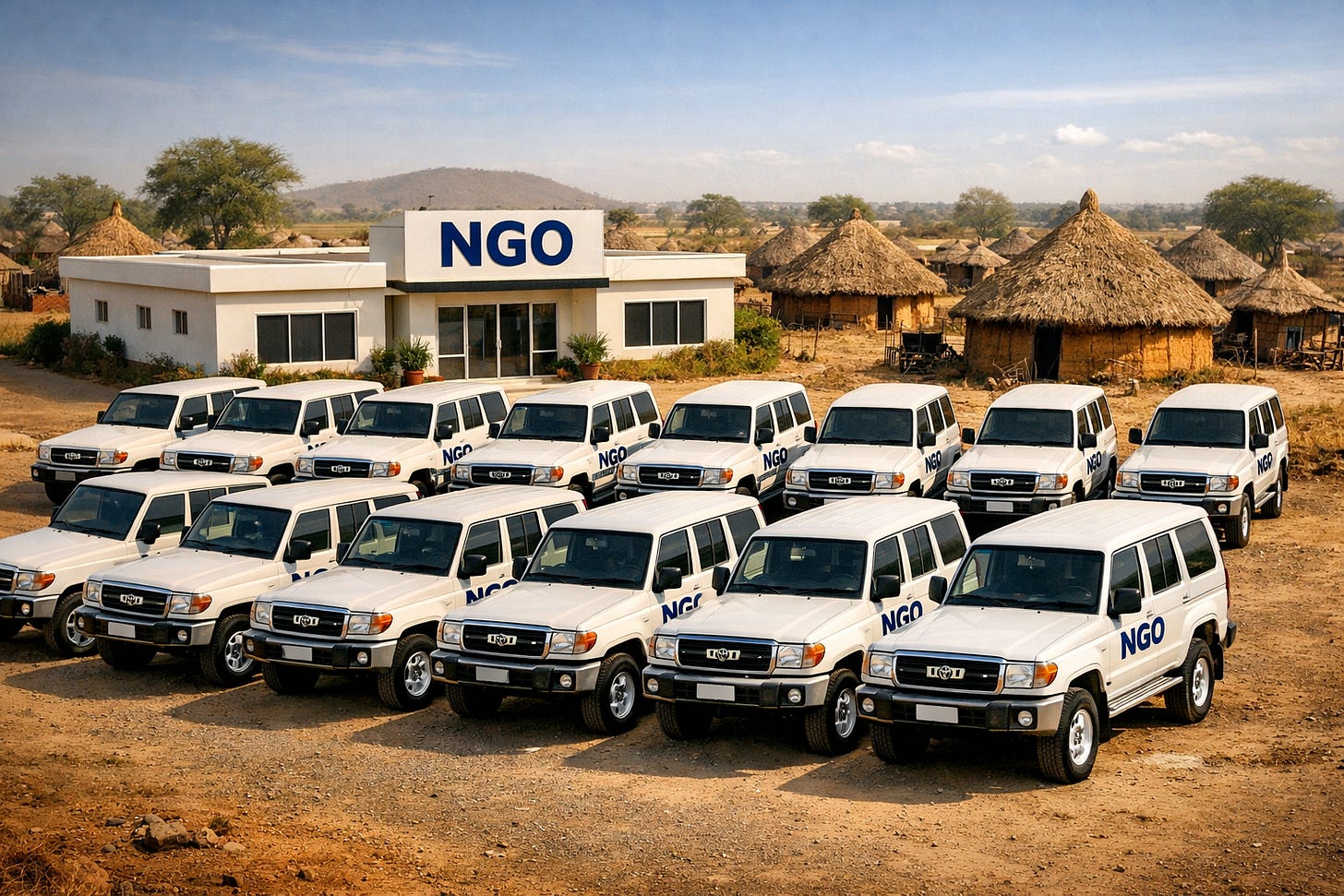
Close your eyes and picture the first thing that comes into your head when I say “NGO”. It might be………… a shiny white Landcruiser
The view from the front window of my hut
But owning cars doesn’t usually make economic sense in low income countries. The ‘real’ market makes this clear. Business rarely buy cars, instead they use public transport or motorbikes. When companies do own cars, its more Corolla than Landcruiser .
Cars are often more expensive dollar-for-dollar than in richer countries, fuel costs are high and many NGOs hire drivers, all while public transport is dirt cheap. To move 100km on Ugandan public transport costs only $5. For off-road work, motorbikes are far cheaper. Efficiency gains from driving are small and rarely justify the expense, and when necessary hiring cars is easy.
Cars also distort community dynamics. My wife works on a complex peace initiative and fights to stop funders visiting in their cars. Years of hard work and trust-building can be undermined when the NGO Land Cruisers show up. All of a sudden the power gap widens and relationships change. Is this really a locally led initiative? Does the will for peace really come from within the community?
NGO vehicles can also set dangerous norms. GiveWell interviewed government health staff in Malawi for a great Podcast series. Healthcare workers complained that they relied on NGO cars to transport samples and medications between health facilities, which stopped after USAID cuts. But these commodities could be transported on motorbikes at almost negligible cost, samples should never have moved in cars. NGOs set an expensive, unrealistic norm which had an easy and cheap alternative.
2. Fund Solutions not Projects
I mean cost-effective, long term solutions. The most effective orgs do one thing well for a long time. Think Against Malaria foundation and New Incentives. Traditional NGOs like Doctors without borders and Amnesty international also prove the value of focus and experience, outperforming generalist BINGOs with their myriad projects. As you solve the same problem for a long time you gain deep knowledge, learn what works best and become more efficient, the charity version of “10,000 hours” of deliberate practice. We need master NGOs, not jacks-of-all-trades. Charity Entrepreneurship leads the way launching orgs that AIM to solve one particular problem. Solutions are also more scalable than projects as learning iteration builds “scalable models”, that can be replicated across countries or regions.
8 years ago, we signed up 4 of our Health Centers to a “5 year” USAID funded maternity project. Ugandan women bought vouchers for $1, which provided a full package of maternity care. Health facilities would then bill the project for services provided. But the project took 1.5 years of setup and planning, and 1 year of “closing”, so we only provided maternity services for 2.5 years, half the project length! Central project admin sucked up 35% of the project budget, not even counting high admin costs on our provider side. After the project, some maternity centers closed because they couldn’t function without project money.
Short term Projects with a start and a finish are inefficient. You start from scratch so spend a lot planning, plus hiring, tech setup, procurement, launch meetings, early pilots. All before actually helping people. Most staff have little experience in the specific project activity so waste time figuring things out. Then you pay more just to close the project out. All of this wastes money and time.
As well as being inefficient, the “in and out” nature of projects can lead to dangerous duplication problems. During Covid, World Vision funded a temporary “outreach project” where they paid government workers to provide free healthcare one day a week at rural sites. To our dismay, one clinic set up right next to our permanent health center, where people pay a small fee to access care. People gravitated to the free temporary care, our patient numbers dropped and the facility struggled to break even. A temporary project undermined a permanent solution. To World Vision’s credit, after I contacted them they moved the clinic away from our health center.
There’s also little chance to iterate and learn during a project. You do what you’re paid to do, then stop. Yes there’s always a review and commentary on what worked and what didn’t, but its often not worth much because staff without experience are guessing, and we didn’t test properly so don’t really know what the problems were.
I’m concerned that GiveWell and other Effective Altruist funders too often fall into this “Project trap”. Most early GiveWell money was given to orgs that do one thing well, whether experienced orgs like AMF, Hellen Keller or GiveDirectly, or new efficient orgs that Charity Entrepreneurship founded. Now the situation has changed, with more Big International NGOs like CHAI, and PATH almost “commissioned” to perform time-bound projects.
My org OneDay Health partners with a Vision Spring market solution which sells reading glasses for $3 across Uganda. At the same time @Evidence Action[1] and CHAI launched a project which gave away 25,000 reading glasses for free in Uganda in 2025. If these free drops scale up, their project could undermine the world’s leading eye-glass NGO who have a market-based solution, which has distributed millions of reading glasses to date. I hope there was discussion between Evidence Action and VisionSpring before this started, but even if there was I think this duplication has great potential to do harm.
There are some situations where projects might be the best approach, but in general its better to back existing solutions, and fund existing orgs which do one thing well and have been doing it (or plan to) for a long time.
3. Fund cost effective solutions
That 20% of the most cost-effective charities might do over 80% of the good in the charity world remains an anathema to many funders. In fields like healthcare, livelihoods and education, every org should have at least a rudimentary cost-effectiveness analysis of their work, that funders should at least consider.
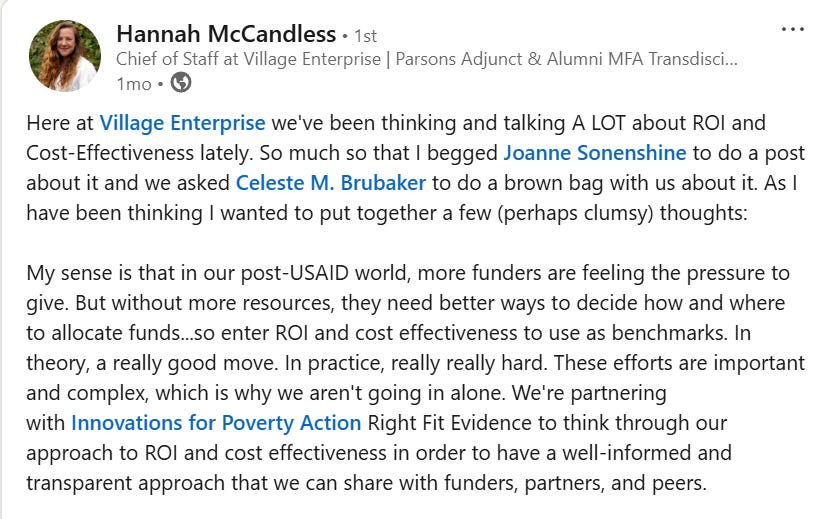
A silver lining post USAID crash is that cost-effectiveness chat is on the rise. A potential donor (unrelated to Effective Altruism) just asked me to fill out a cost-effectiveness spreadsheet, both surprising and awesome. I think Effective Altruists might underrate the influence they’ve had in helping the wider charity world think more cost-effectively.
Big NGOs like Village Enterprise now take cost-effectiveness more seriously than ever
4. Fund Bimodal - Test and Scale
Most money should go towards two purposes. Test new ideas (small pots), and scale proven solutions (big pots). Unfortunately much donor money still goes to a muddy-middle-ground of large unproven projects. At the end of the project we didn’t learn much, nor do much good.
Our local community Health Worker knocked on my door and explained the new rubbish collection initiative in our village. Apparently we would take our trash to a designated collection point, then pay the council for our efforts. But right now we just burn the trash for free, and no-one in our community sees trash as a big problem. I asked him if he thought this initiative could work...
“Of course not, why would people pay to move their rubbish? But Germain AID (GIZ) is funding the project and they’ve paid me to tell everyone about it.”
A few days later at a party I struck up a conversation with a GIZ worker about said project. The rubbish project would cost around a million dollars, including importing 5 brand new rubbish trucks. I asked her why they didn’t “test the approach first in one area” to see if it would actually work, before spending a million dollars rolling out a huge rubbish collection project? She shrugged and said “well we just won the Development contract so we’re doing it”. Their rubbish collection plan was neither a test, nor was it proven to work somewhere else.
After a (somewhat heated) discussion about the absurdity of it all she basically agreed the rubbish projectR was unlikely to work, and we went back to eating pizza and talking about the great weather here.
The project failed spectacularly.
Test
Small pots of money can test cost-effectiveness and viability of new ideas on a small scale. If after the test the work seems doable and cost-effective, we can implement on a larger scale. I think we should test more interventions at a smaller scale for less money. Too many decent ideas are left on the research desk table, that we could test with $10,000 - $100,000.
One caveat is that there are many dubious “feesability” studies that test “Can we roll out intervention X in country Y”. Can this pregnancy blood test panel work in Kenya? Can hepatitis B care be integrated into HIV care in Uganda? The answer most of the time is a straightforward “yes”. Systems are often strong enoughThe more important questions are often “is this cost-effective”and “is there political will”.
One example of testing “feesability” that doesn’t make huge sense to me is the EvidenceAction Glasses project discussed above. On their website they state
But I don’t think this is very difficult. If we can deliver vaccines at scale, we can deliver eye glasses. Vision Spring have already proved that they can deliver glasses, and through a more complex user-pays model.
There are of course exceptions where an intervention might actually be really tricky and we do need to see if we can do it. For example in-line to clean water supplies is complex to roll out at scale, so we should test if we can do it.
Scale
As smaller money pots go to testing, the big bucks should fund stuff at scale we’re pretty sure is cost-effective and doable. Give cash, give Vaccines, pay people to get vaccines, get teachers better plans, teach at the right level, treat HIV, Prevent malaria, cure malaria etc. Orgs like GAVI, GiveWell and the Gates Foundation generally do this well much of the time. Scale can happen through different, although I agree with Mulago Foundation that the Government and the Market are the most common pathways to huge scale.
5. Lower Salaries
Yes this sounds terrible, seems unfair and pains me to say. But its important.
In most cases, NGO workers are paid 2x-4x more than similar private sector roles. In orgs like the UN and USAID, it can be 10x. The benefits of paying more are immediately gratifying – better workers, high staff retention and less rich-western guilt. But unfortunately harms outweigh those benefits. Fortunately great workers are usually happy with a little more than the market rate, and by paying a bit less orgs can avoid a wide range of potential harms.
a. Less cost-effective work: Often salaries are the biggest org expense, so impact our bottom line, making every dollar do more good for those we serve. If we think our work “needs” a lot of highly paid workers, maybe the work is not simple enough to be cost-effective at scale.
b. Brain Misallocation “In Ugandan villages where non-governmental organisations (NGOs) hired away the existing government health worker, infant mortality went up.”High NGO salaries pull workers away from other important work in government, business or politics. We might think our work is the most-important, but if NGOs suck the top-talent from business and government, they can undermine the very systems we build our cost-effective solutions on.
c. Dissatisfaction at other orgs: While most NGOs have inflated salaries, other NGOs struggle to buck the trend and pay market rates. Workers naturally compare their salaries to other NGO workers and look to jump ship at a moments notice. Even when people don’t jump ship, its not very nice working for half as much money as your mate doing a similar job.
d. Market distortion. “this back of the envelope calculation that we were 75% of the local economy… we destroyed and distorted the local economy completely; as development practice that would’ve been utterly and completely unethical.” Ivan Gayton from MSF.
High NGO salaries drive inflation, from rent to food. This makes it harder for others not in the NGO-economy to survive. Gulu where I live is the most expensive city in Uganda, and its hard to imagine any good reason other than a heavy NGO presence. This makes doing business and attracting investment hard, Gulu has less manufacturing than other similar sized cities. I’ve seen people try to do business here, but quickly move elsewhere as salary expectations are too high.
The education market also gets distorted. The flood of post-war NGOs triggered a flood of “development studies” degrees as young people chased the NGO gold rush. Within a few years most NGOs were gone and the degrees no longer glittered.
With less money in the ecosystem, what better time to recalibrate and pay workers something closer to the market rate.
This is far from an exhaustive list, but what seemed important and “doable” to me at the time. I’m keen to hear your thoughts, especially disagreements of course!
Edit: The match seems to now be over - the funds were expended in around 35 minutes. But many of these charities are great and should be supported regardless!
***
On October 22nd starting at 10:00am Pacific Time, Every.org is matching donations to select animal welfare organizations at a 2:1 rate, up to $2,000 per donor per nonprofit (so if you give up to $2,000, they will contribute up to $4,000 and the nonprofit will get up to $6,000). The first donation a donor makes to each el...
Crossposted to Less Wrong
‘Like most of life’s dangers, the dangers of artificial intelligence are not easily identified from the armchair.’
J Dmitri Gallow
Epistemic status
I’m not an expert in this field, and herein I make some sweeping generalisations educated guesses about the overall...



Executive summary: The author offers five experience-based proposals for improving development charity work in 2026—ranging from reducing car use to lowering NGO salaries—arguing that many current practices are inefficient, distort local systems, and undermine long-term, cost-effective impact.
Key points:
This comment was auto-generated by the EA Forum Team. Feel free to point out issues with this summary by replying to the comment, and contact us if you have feedback.